



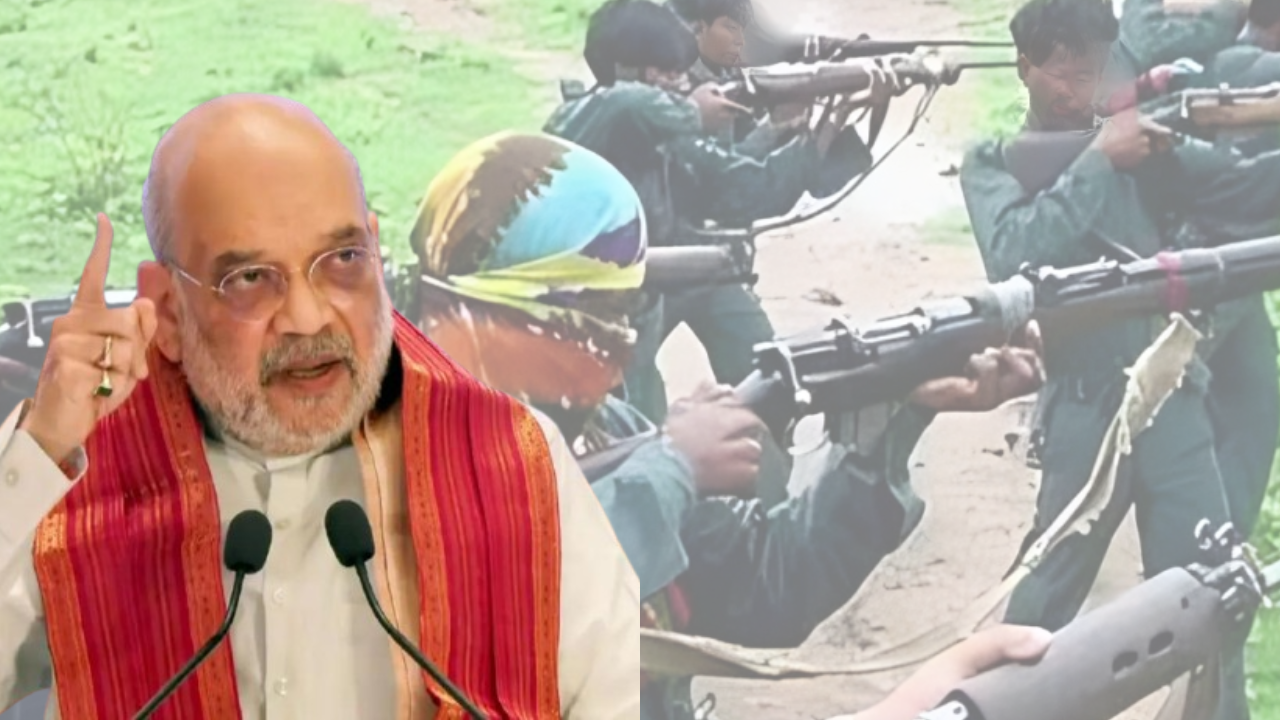
As the sun sets over the dense canopy of Chhattisgarh’s forests today, it marks more than the end of a day, it signals the final countdown of a historical deadline. Union Home Minister Amit Shah’s target of March 31, 2026, was never a date on paper, rather it was a security benchmark, and a message to both the Naxals and the nation. That deadline expires today, and with it this question rings louder than ever: Is India closer to ending Naxalism now than at any time in decades?Shah’s deadline is not just about counting encounters, but it is a sign that the end game may finally be near.Speaking in the Lok Sabha on Monday, the Home Minister said India’s anti-Naxal campaign has reached its final stages, claiming that Naxalism has been almost wiped out in Bastar, the region once seen as a bastion of “red terror”. He said that roads, schools, ration shops, health centers and welfare distribution are now visible in the area. The claim marks a dramatic change for an area that once symbolized the peak of Naxalite influence. But how did Bastar and much of Central India become part of the Red Corridor in the first place?
.
Construction of the Red Corridor – How did it all start?
The Red Corridor did not come on the map of India overnight. Its story begins in 1967 in Naxalbari, West Bengal, where a peasant revolt gave rise to what India would later know as Naxalism.However, what started as a local rebellion did not remain local for long.Gradually, the movement spread to some of the most remote, underdeveloped and tribal dominated areas of India. Over the years, it spread to Chhattisgarh, Jharkhand, Odisha, Maharashtra, Madhya Pradesh, Andhra Pradesh, Telangana and parts of Kerala and Karnataka. Piece by piece, this extended belt of unrest became known as the “Red Corridor”.But it was never just a movement of slogans and rebellion. This soon turned into a violent armed challenge to the Indian state. Naxalite groups created parallel systems of control in remote areas, attacked security forces, blew up roads and public infrastructure, extorted money and in many cases recruited civilians, even children, into their networks.Reference Link: https://www.pib.gov.in/PressReleasePage.aspx?PRID=2120771®=3&lang=2At its peak, Naxalite violence affected 126 districts and reached deep forest areas where state presence was weak.However, this is no longer the case.
.
narrowing the red corridor
More districts exit the corridor The Naxalite moment which once spanned states now looks very small. According to government data, the number of districts affected by Left Wing Extremism has steadily fallen from 126 to 90 in April 2018, then to 70 in July 2021, and to only 38 by April 2024. Moreover, even within those 38 districts, the number of worst-affected districts has reduced from 12 to 6, which is now limited to Bijapur, Kanker, Narayanpur and Sukma in Chhattisgarh, West Singhbhum in Jharkhand and West Bengal. Gadchiroli in Maharashtra. The message is hard to ignore: the once-grand Red Corridor is no longer the corridor it used to be.If we look a little closer, the picture becomes even clearer. Of the 38 affected districts, the number of “districts of concern”, areas that still require intensive resources beyond the most affected areas, also decreased from 9 to 6. These are Alluri Sitarama Raju in Andhra Pradesh, Balaghat in Madhya Pradesh, Kalahandi, Kandhamal and Malkangiri in Odisha, and Bhadradri-Kothagudem in Telangana. The category of other districts affected by Left Wing Extremism has also reduced, from 17 to 6. These include Dantewada, Gariaband and Mohla-Manpur-Ambagarh posts in Chhattisgarh, Latehar in Jharkhand, Nuapada in Odisha and Mulugu in Telangana. In short, the insurgency has not only been reduced in scale, it has also been pushed into a narrower, more fragmented geography. MHA data tells this more clearly: Naxalite active area has declined from 18,000 sq km in 2014 to about 4,200 sq km by 2024, and further to just a few hundred sq km by 2025. What was once a wide corridor is now limited to some dense forests.The rebellion is not only losing land but also people The figures inside the movement tell quite a story. Government data shows that over the past decade, as security operations have been supported by roads, welfare, and a strong state presence, the insurgency has steadily weakened. Between 2004–2014 and 2014–2024, violent incidents almost halved from 16,463 to 7,744. Over the same period, deaths among security personnel declined from 1,851 to 509, while civilian deaths declined from 4,766 to 1,495.
.
And this trend continued in 2025, when security forces killed 270 Naxalites, arrested 680 and 1,225 cadres surrendered. Add the large-scale surrenders in Bijapur, Chhattisgarh and Maharashtra, as well as major operations like Operation Black Forest, and the pattern becomes clear: the Maoist movement is not only losing territory, it is also losing fighters. In fact, more than 8,000 Naxalites have given up violence in the last 10 years, strengthening the government’s claim that the insurgency is no longer spreading out, but is gradually being contained to its last pockets.Reference Link: https://www.pib.gov.in/PressReleasePage.aspx?PRID=2182437®=3&lang=2https://www.pib.gov.in/PressReleasePage.aspx?PRID=2120771®=3&lang=2
March 31 – Why does this date matter?
The March 31 deadline is the government’s attempt to draw the final line under one of India’s longest-running internal security threats. Because Naxalism was never limited to just firing in the jungle. Over the years, Maoist groups have targeted security forces, roads, telecommunication towers, public infrastructure, and democratic institutions. They used violence, extortion, coercion and recruitment in tribal areas, turning many remote areas into places where the state struggled to function.And this is the main point.In areas like Bastar, the fight was not just over territory, it was also about whether roads could be built, schools opened, health services accessible and whether banking and communication could work or not. Shah argued in Parliament, “There was no Red Terror there because there was no development there, but because of the Red Terror there was no development there.” Emphasizing his point, the minister compared Naxalbari, Bastar, Saharsa and Ballia. Literacy and income levels in all four were equally low in earlier decades, he said. Yet Naxalism took root only in Naxalbari and Bastar, not in Saharsa or Ballia. His message? “There was a Red Terror not because there was no development there, but because of the Red Terror there was no development there.”And the damage, he said, was brutal. Shah pointed to Naxalites executing innocent villagers by branding them as “enemy informers”, staging sham “people’s courts” without judges, without lawyers, without due process, and trying to replace the Constitution and the justice system with fear and parallel rule. So, in simple terms, March 31 matters because it is more than a security deadline, but a point where India not only ends the armed insurgency, but ends the decades-long Naxalite hold on neglected tribal areas, and takes a step towards replacing it with governance, law and development.
Repainting the red corridor: How is the government doing it?
As India crosses an important milestone in its fight against left-wing extremism, years of planning, operations and development are beginning to yield results. The “Red Corridor”, once spanning 12 states and parts of Uttar Pradesh, has shrunk dramatically. The government’s zero-tolerance approach against Naxalism combines security operations, welfare schemes and community participation to restore lives and livelihoods in the affected areas. In Parliament, Shah highlighted the strategy of dialogue with those willing to talk while taking strict action against those attacking civilians and security forces. At the same time, advanced technology, including drones, satellites, AI analysis and social media surveillance, has strengthened coordination and helped reclaim areas long subject to fear.
zero-tolerance approach
The government has taken a firm zero-tolerance stance against Naxalism, combining security operations with development initiatives to reclaim affected areas. The strategy focuses on two key objectives: restoring the rule of law and rapidly compensating for decades of developmental neglect. Full implementation of welfare schemes ensures that benefits reach areas long deprived due to insurgency.
coordinated national strategy
The National Policy and Action Plan on Left Wing Extremism, approved in 2015, outlines a multi-pronged approach that combines security measures, development intervention and protection of local rights. Central authorities support states with armed police forces, India Reserve battalions, intelligence sharing, counter-insurgency training and inter-state coordination, thereby providing an integrated response to the left-wing threat.
strengthen security
The security infrastructure has been drastically improved. 612 fortified police stations have been created, up from 66 in 2014, along with 302 new security camps, 68 night landing helipads, 15 joint task forces and six CRPF battalions to support the state police. The National Investigation Agency and the Enforcement Directorate have targeted Naxalite finance, seizing crores of rupees and prosecuting funders. Long-term actions and targeted attacks have led to thousands of arrests, surrenders and neutralization of top cadres.
.
development as a tool
Development has become a major weapon against extremism. Schemes like Special Central Assistance, Special Infrastructure Scheme and Dharti Aaba Tribal Village Utkarsh Abhiyan focus on roads, mobile connectivity, financial inclusion and public infrastructure. Over 17,500 km of roads have been approved, 10,505 mobile towers have been planned, and over 1,000 bank branches, 937 ATMs and 5,700 post offices have been established. Skill development initiatives, including ITIs, skill development centers and 178 Eklavya Model Residential Schools, empower youth and provide alternatives to extremism.
Civic Engagement and Media Outreach
The government has strengthened trust with communities through civic action programs and media campaigns countering the Naxalite agenda. Tribal youth exchanges, radio jingles, documentaries and pamphlets ensure awareness, engagement and support for democratic governance.
The big picture: How close is India really?
The short answer is this: India appears very close to ending large-scale organized Naxalite violence and, according to Amit Shah, it has already effectively crossed that threshold.Speaking in Parliament, the Union Home Minister announced that the Naxalite leadership had been virtually wiped out. “Their politburo and central structure have been almost completely destroyed. Our target was to have a Naxal-free India by March 31. The country will be informed after the entire process is formally completed, but I can say that we have become Naxal-free,” Shah said in the House.
.
He also made it clear that the Center will continue to act firmly against armed extremism. Describing “Naxal-free India” as one of the biggest achievements of the government, Shah said those who take up arms will have to face consequences. He said, “The solution to remove injustice is spelled out in the Constitution. Taking up arms is not the answer.”Still, there is an important caveat. Even if the main Maoist structure is dismantled, small underground cells, splinter groups, extortion networks or isolated local violence may continue for some time. And if governance in tribal areas weakens, the deeper issues that once fueled insurgency, land insecurity, displacement, poor governance and distrust of the state may persist.That’s why the next step matters. Now the shift is from counter-insurgency to integration. In simple words, the battlefield may have been won, but peace still has to be secured.So yes, India is closer than ever, and as per Shah’s own claim, effectively so.


