



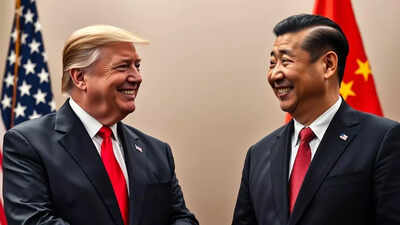
Chinese ministry said that unilateral tariffs imposed by the United States breach both international trade norms and US domestic legislation. (AI image)
After the US Supreme Court said that US President Donald Trump’s tariffs are illegal, China has urged America to remove ‘unilateral tariff measures’. Soon after the US apex court’s verdict, China said it is doing a comprehensive review of the ruling. It cautioned that continued confrontation between the two nations would be detrimental.The statement from China’s Commerce Ministry on Monday followed closely on the heels of a significant setback for President Donald Trump at the US Supreme Court, which invalidated several of the tariffs introduced as part of his broader global trade strategy, including duties targeting China.Shortly after the judgment, Trump announced a fresh 10% tariff on all imports into the United States, effective Tuesday. He subsequently raised the proposed rate to 15%, a shift that reportedly caught some officials off guard.According to a Reuters report, in its response, the Chinese ministry said that unilateral tariffs imposed by the United States breach both international trade norms and US domestic legislation, and do not serve the interests of any side. It reiterated that while collaboration between Beijing and Washington yields mutual benefits, conflict damages both.Trade policy and tariff issues are expected to feature prominently in discussions ahead of Trump’s anticipated visit to China in late March and early April, during which he is scheduled to meet President Xi Jinping.The proposed new duties are based on Section 122, a separate and previously unused legal provision that permits tariffs of up to 15% but requires congressional approval if they are to remain in force beyond 150 days. No prior US president has relied on Section 122, and invoking it could open the door to additional legal scrutiny.“China will closely monitor developments and resolutely protect its own interests,” the Commerce Ministry stated.According to the state-run Global Times, Gao Lingyun, a researcher at the Chinese Academy of Social Sciences, described the US tariff actions as “highly arbitrary,” arguing that they were being used as a “political tool.” He said tariff decisions should rest on careful evaluation rather than political considerations.The US court’s decision struck down several duties introduced by the Trump administration on major Asian exporting economies, including China, South Korea, Japan and Taiwan — the latter being the world’s largest producer of chips and a crucial link in global technology supply chains.
&w=218&resize=218,150&ssl=1 "New car purchase rates among young people drop to 10-year low in THIS country")


