



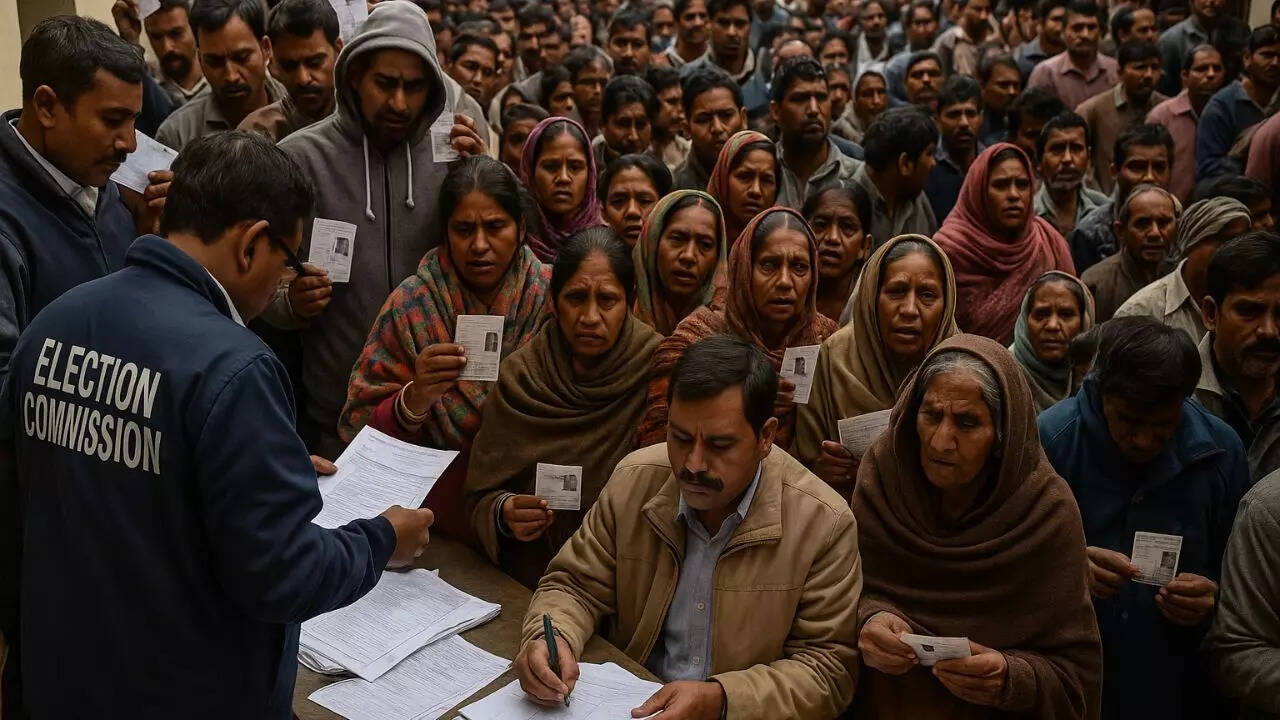
New Delhi: Across India, from big metros to small towns and remote hamlets, a quiet but important exercise is underway to refresh the country’s voter rolls. Special Intensive Revision or SIR involves booth-level officials visiting homes with updated lists, seeking confirmation and corrections as they work through one of the world’s largest electoral databases.What began as routine verification has unexpectedly attracted intense national attention, sparking debate and new curiosity about how India’s most fundamental democratic document is kept accurate.In form of Election Commission In the race to update the rolls ahead of crucial elections, political parties are sounding the alarm. They argue that SIR, rather than simply removing duplication, may change electoral equations by disproportionately affecting certain voter groups.With the Supreme Court intervening, opposition concerns growing and millions of people joining the process, the political mood is one of cautious anticipation. As soon as the exercise has started, a question has started coming to the fore. Supporting the election body’s decision to conduct this intensive exercise, Chief Election Commissioner (CEC) Gyanesh Kumar has said that “pure electoral rolls are indispensable to strengthen democracy.”Gyanesh Kumar said, “The world’s largest voter list purification process was conducted in Bihar alone, and once this drive spreads to 51 crore voters across 12 states, it will be a historic achievement for the Election Commission and the country.”However, more than a technical administrative act, it has become a political saga, with legal, constitutional and social implications that go to the heart of India’s most fundamental democratic right. Vote.
sir and constitution
SIR is based on one of the most powerful lines of the Indian Constitution. Article 324 gives the Election Commission wide powers to run the elections in the country. Not just the spectacle of voting day, but everything that makes it possible.This single provision empowers the Commission to take steps whenever it feels that there is a need to take care of the integrity of the process, including the maintenance of electoral rolls.That constitutional power is reinforced by the Representation of the People Act, 1950, which not only allows amendments to the electoral roll but also explicitly allows the Commission to go beyond the usual annual updates. The law opens the door to deeper, more detailed exercises when the situation demands, and the procedures to be followed are set out in the electoral registration rules.In other words, SIR is not an improvisation, but a legally based tool designed for those moments when routine maintenance of the roll is not sufficient.While most years see “summary revisions” focusing on new characters and basic updates, SIR is different. It combines complete door-to-door enumeration, rigorous document verification and large-scale data audit.
Sir Vikas
India’s first major enumeration campaign dates back to the early years after independence under the Representation of the People Acts of 1950 and 1951. Early “intensive” amendments produced basic electoral rolls, but as the population grew and people’s mobility increased, summary amendments became the norm.
How is SIR different from Special Revision?
While a summary amendment focuses on new characters and routine corrections, the SIR goes much deeper, including statewide door-to-door verification, detailed scrutiny of entries and large-scale data audits.For example, under summary revision, a voter who has changed his residence will have to file a form to update his address. Under SIR, the booth level officer visits that address, confirms whether the voter still lives there, checks if anyone has become newly eligible, and updates the rolls based on physical verification instead of waiting for the voter to initiate the change.
SIR vs special amendment
What is political dispute?
As the political storm over Special Intensive Revision (SIR) has intensified, the Congress is planning a major protest rally in Delhi in the first week of December against the “politically motivated” changes in voter lists.Congress leader KC Venugopal alleged that the Election Commission was working “at the behest of the BJP”, while Rahul Gandhi described the SIR as an attempt to “institutionalise vote theft”.
protest on sir
The confrontation has also shifted to the courts, with both the Trinamool Congress and the DMK moving the Supreme Court against the ongoing amendment in West Bengal and Tamil Nadu, arguing that compressed timelines and inconsistencies in the process risk disenfranchising genuine voters.Opposition parties collectively claim that the timing of the SIR, the scale of the proposed deletion and alleged procedural lapses in states like Bihar point to an attempt to skew the electoral playing field ahead of crucial elections, particularly affecting migrants, minorities and other vulnerable voter groups.
How does it matter?
There are sharp differences of opinion over the SIR of voter lists in poll-bound states, with three chief ministers of West Bengal, Tamil Nadu and Kerala attacking the process, while Assam has been left out of the process this year.In Assam, Chief Minister Himanta Biswa Sarma said the Election Commission could not conduct the SIR because “the NRC has not been notified yet.”He said the SIR requires NRC data to verify citizenship and added that “in the case of Assam, the notification is still pending.” Instead the ECI has ordered a special summary amendment, which the state “fully supports.”Sarma said the goal is to have an “error-free and foreigner-free” voter list and the SIR will be taken after the NRC notification next year.Union Home Minister Amit Shah has also said that the Bharatiya Janata Party (BJP) fully supports the special intensive vetting of the Election Commission and described it as a necessary exercise to purify the electoral rolls, PTI reported. Shah also hit out at Congress’s ‘Voter Adhikar Yatra’ in Bihar, claiming that the opposition has launched the campaign to “protect infiltrators” and alleged that the party “wants to win elections with their help”.,West Bengal Chief Minister Mamata Banerjee has been the harshest critic, calling the process dangerous and rushed. Referring to the deaths of booth-level officials, he asked, “How many more people will die? How many more people need to die for this sir?” He has described the rollout as “unplanned, chaotic and dangerous”.Mamata Banerjee has also written a strongly worded letter to CEC Gyanesh Kumar and urged him to stop the SIR.
West Bengal Chief Minister Mamata Banerjee led a rally in Kolkata to protest against the SIR exercise. (ANI photo)
Tamil Nadu Chief Minister MK Stalin called the SIR “flawed, confusing and dangerous”, warning that the forms are so complex that “even well-educated people will get their heads around them.” “If you can’t defeat us, you want to remove us,” he said, alleging political motives.Kerala Chief Minister Pinarayi Vijayan called the Election Commission’s move “a challenge to the democratic process”, criticized the use of outdated data formats and warned that it could “undermine the public mandate.”With three states objecting to the process and Assam opting out pending NRC notification, the SIR rollout has emerged as one of the most politically charged administrative exercises ahead of the 2026 election season.
What happened in Bihar sir?
Ahead of the Bihar elections, CEC Gyanesh Kumar had claimed that the first phase of Special Intensive Revision (SIR) in Bihar had been conducted “without any appeal”, indicating what the Election Commission views as a smooth and uncontested verification process.The number of voters in the state now stands at 7.42 crore, down from 7.89 crore before SIR, which is about 47 lakh less than the old voter list. However, compared to the draft roll published on August 1, in which 65 lakh names were removed on grounds such as death, migration and duplication, the final numbers actually show an increase.
Congress MP Priyanka Gandhi Vadra, Samajwadi Party MP Akhilesh Yadav, TMC MP Mahua Moitra and others at a protest by India Bloc MPs against the Election Commission’s Special Intensive Revision (SIR) of electoral rolls in Bihar during the monsoon session of Parliament, in New Delhi. (PTI photo)
A total of 21.53 lakh new voters were added after the draft publication, while 3.66 lakh names were removed, resulting in a net gain of 17.87 lakh voters between the draft and the final list. The EC said the final figures reflect improvements made during claims and objections and demonstrate the scale of the verification process undertaken under the SIR.
What does the Election Commission say?
The Election Commission has defended the special intensive vetting as a routine but necessary cleanup of the country’s electoral rolls, and stressed that the exercise aims to make the electoral lists “transparent, accurate and fully inclusive”.In a detailed press brief, the Commission said the objective of the SIR is to ensure that all eligible citizens are added and no ineligible names remain, describing it as part of a broader effort to make the rolls “error free” across states.Responding to criticism from opposition parties, Chief Election Commissioner Gyanesh Kumar told reporters that “misinformation” was being spread about the process, accusing some leaders of “firing from the shoulder of the Election Commission”.
CEC Gyanesh Kumar on SIR
The Election Commission had also clarified the discrepancies identified in Bihar, saying that the additions made after the draft rolls were under rules that allow updates up to ten days before nominations.
technology driven sir
The Election Commission is relying heavily on digital tools to execute special intensive vetting, with a mix of citizen-facing apps and backend platforms that support the large-scale door-to-door verification exercise. Voters can use the Voter Helpline app and the ECI portal to check their registration status, download or submit forms, correct entries and, in some cases, book a call with their Booth Level Officer (BLO). These tools allow electors to view pre-filled details extracted from legacy rolls and upload missing documents online, thereby reducing duplication and administrative burden during the nationwide verification drive.On the field side, officials rely on the BLO app (formerly Garuda), a mobile platform used for door-to-door verification, verifying voter residence, updating addresses and capturing photographs and GPS-tagged data. The app also lets BLOs record polling booth features and track verification progress in real time, feeding directly into the supervisory dashboard.Special Intensive Review has emerged as much more than an administrative exercise. Now it stands at the intersection of politics, perception and democratic faith.Whether the SIR ultimately strengthens the integrity of India’s electoral rolls or deepens existing doubts will depend not only on the Election Commission’s implementation, but also on how transparently the process is communicated and how responsibly political parties engage in it.


