



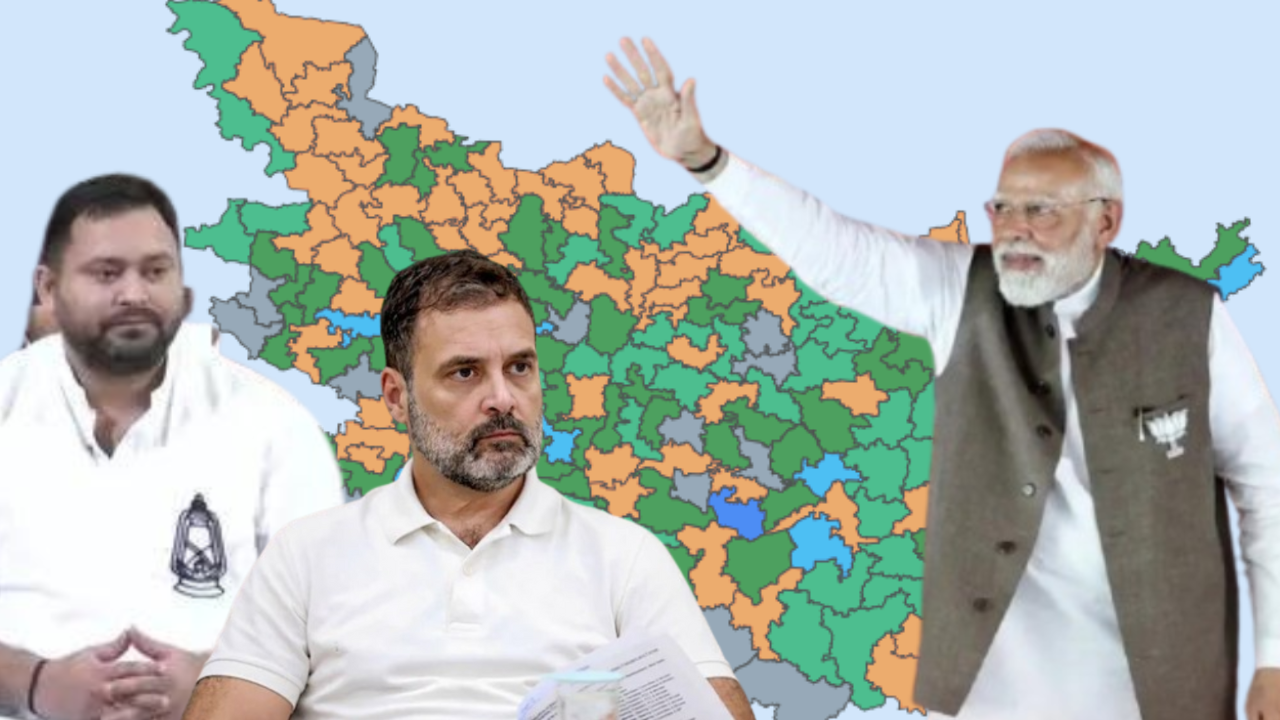
New Delhi: Why did Prime Minister Narendra Modi choose the heart of Mithilanchal – not Patna, not Magadha – to launch the NDA’s campaign for the upcoming assembly elections in Bihar? This election was filled with both emotion and strategy.The symbolism was spot on. PM Modi The legacy of socialist stalwart and former chief minister Karpoori Thakur – who was an icon among the Extremely Backward Classes (EBC) and a unifier of all castes – was invoked. He said, “Karpoori Thakur ji dedicated his life to the upliftment of the poor and the backward. His ideals guide us.” Thakur, who once contested elections from Phulparas in the Mithilanchal region, belonged to the EBC community – a major political force in the region. Interestingly, at one time there were speculations about this seat. Tejashwi YadavThe latter’s choice underlines its enduring political weight.The rallies, which have been described within the NDA as “the first step towards Patna”, are more than the launch of a campaign. He reflected the social history of Mithilanchal and its carefully crafted approach to the crucial 80 assembly seats out of the total 243 in Bihar. By combining the language of development and legacy, the BJP sought to remind voters of its delivery record while positioning itself as the natural heir to Bihar’s backward class leadership.When choosing Mithilanchal to launch his campaign in Bihar, PM Modi was not just addressing the crowd – he was invoking memory, identity and numbers all at once. The message was clear: the road to Patna, and perhaps power, starts from Mithila.
Why did PM Modi start his campaign in Mithilanchal?
The political geography of Bihar can be divided into five major regions – Tirhut, Mithilanchal, Kosi-Seemanchal, Magadh and Bhojpur – each with unique demographic structure and voting patterns. Among them, Mithilanchal stands out not only for its size but also for its electoral weight. Spread across districts like Madhubani, Darbhanga, Samastipur, Saharsa and Supaul, the region is home to a mix of Maithil Brahmins, Yadavs, Dalits, Muslims and EBCs – a combination that reflects the social diversity of the state.Read this also- Bihar Elections 2025: Castes, alliances and calculations – how the numbers add upThe 2020 assembly elections proved the political instability of the region. While the NDA marched ahead with a modest majority across the state, its performance in Mithilanchal was crucial to that victory. In the 2024 Lok Sabha elections, the BJP and its ally Janata Dal (United) won all seven parliamentary seats in the region, reaffirming their strategic centrality.Yet, this loyalty is not permanent. In 2015, when Nitish Kumar’s JD(U) joined hands with Lalu Prasad Yadav’s RJD and Congress under the grand alliance, the alliance swept Mithilanchal – JD(U) won 19 seats, RJD 14 and Congress 11 – highlighting the swing nature of the region. This cyclical pattern of switching allegiance has prompted the BJP-led NDA to shift its campaign focus back here. As analysts say, “The road to Patna passes through Mithila.,
Samastipur: EBC nerve center and the legacy of Karpoori Thakur
The selection of Samastipur as the starting point was both emotional and strategic. The birthplace of Karpoori Thakur, this district holds deep symbolic importance in the backward class politics of Bihar. It also reflects the fluid electoral flow that has defined Bihar’s last decade.Among the 10 assembly seats of Samastipur, political allegiance has been constantly swinging between the NDA and the Grand Alliance. In 2010, the BJP won both the seats it contested, while the JDU dominated the rest. When Nitish Kumar joined the Grand Alliance in 2015, BJP was wiped out here. Five years later, after JD(U) returned to the NDA, the alliance won five out of ten seats, with RJD close behind.This fluctuation reflects the volatile nature of the EBC vote. The EBC community, which comprises 112 subcastes and represents 36% of the state’s population, is fragmented despite its numerical strength. Only a few of these sub-groups, such as the Nice, the Kumhar, the Kahar and the Nonia, have enough concentration to decisively tilt the election outcome.The influence of Karpoori Thakur has been shaping this story. During his tenure in the 1970s, he pioneered the empowerment of backward classes through the Reservation Commission, which extended affirmative action to the poor and marginalized. “Karpoori Thakur gave a sense of dignity to the poor and the backward,” PM Modi said in Samastipur, presenting the NDA as Thakur’s ideological successor. BJP hopes that this emotional appeal will help in uniting the scattered EBC votes under its banner.
Begusarai : Ideological crossroads of North Bihar
From Samastipur, PM Modi traveled to Begusarai, a district often called the “Leningrad of Bihar” for its leftist past and ideological churn. Over time, Begusarai has seen a shift from Communist dominance to RJD strongholds and now the growing presence of the BJP.In 2010, the BJP-JD(U) alliance maintained its dominance in Begusarai, winning six out of seven seats. In 2015, the resurgence of the Grand Alliance reversed those gains. By 2020, the two alliances divided the honours, each winning two seats, reflecting the increasing fragmentation of the district.For the NDA, Begusarai represents a litmus test of whether its twin appeals of caste inclusivity and development outreach can bridge the ideological divide. With urbanisation, industrial aspirations and first-time young voters reshaping the demographic profile of Begusarai, the BJP hopes to leverage PM Modi’s “double-engine” growth narrative to establish control.
Beyond caste: development as a political currency
PM Modi’s Bihar campaign is not based on mere caste arithmetic, but on the symbolism of development linked to the cultural identity of Mithila region. Over the past few years, the BJP has invested heavily in public projects across North Bihar to reinforce this narrative.In 2024, Union Home Minister Amit Shah laid the foundation stone of Mata Janaki Temple in Punauradham (Sitamarhi), which is considered to be the birthplace of Sita. Spread over 67 acres, the Rs 883 crore project is envisioned as a major spiritual and tourism centre. Shah also flagged off the New Delhi-Sitamarhi Amrit Bharat Express, improving rail connectivity in the region.Read this also- Delhi, Jharkhand… and now Bihar: BJP trying to corner Grand Alliance on ‘infiltrators’ – will the strategy work?Earlier this year, PM Modi inaugurated projects worth over Rs 2,000 crore, including the civil enclave at Darbhanga airport (costing Rs 912 crore) and AIIMS Darbhanga, the state’s second AIIMS, built on 187 acres at an estimated cost of Rs 1,264 crore.The Union Budget 2025 further expanded this reach with the announcement of the Makhana Board, which aims to promote globally recognized Mithila Makhana. The initiative targets districts like Darbhanga, Madhubani, Saharsa, Supaul and Sitamarhi, blending economic potential with cultural pride.Together, these projects underline the BJP’s attempt to weave developmental nationalism into the regional fabric and convert cultural pride into political loyalty.
Opposition’s counterattack: Regional campaign of Grand Alliance
The grand alliance comprising RJD, JD(U), Congress and Left parties has launched a vigorous counter-campaign in North Bihar. Its “Voters Adhikar Yatra” covered large parts of Mithilanchal and Kosi-Seemanchal, with leaders targeting both PM Modi and Chief Minister Nitish Kumar over unemployment, migration and farm distress.However, the yatra ran into controversy during its Darbhanga leg, where alleged derogatory comments against the Prime Minister were sharply condemned by the NDA. BJP leaders accused the opposition of “insulting the cultural ethos of Bihar”, triggering a political confrontation.Meanwhile, RJD leader Rabri Devi revived the demand for a separate Mithilanchal state, a sentiment sometimes expressed by local cultural groups as well. Although the idea is much less popular among mainstream parties, it keeps alive the emotional narrative of Maithil identity – which both alliances are trying to harness in their own ways.2023 Caste Survey: Understanding the mathematics behind Bihar’s caste matrix and 36% EBC factorPatna: Bihar government’s 2023 caste-based census provides important context to PM Modi’s EBC outreach. The survey revealed that Extremely Backward Class (EBC) is the largest social group in Bihar at 36% of its 13.07 crore population. Combined with 27% Other Backward Classes (OBCs), these two categories constitute about 63% of the state’s people, underscoring why caste arithmetic motivates every major alliance.Muslims number 17.7%, while the so-called “upper castes”, traditionally a BJP stronghold, are 10.6%, divided into Brahmins (3.7%), Rajputs (3.4%), Bhumihars (2.9%), and Kayasthas (0.6%).
The NDA’s caste network is built around small caste consolidations: Dusadh/Paswan (5.3%) through the factions of Pashupati Kumar Paras and Chirag Paswan; Kushwah/Koeri (4.2%) through Upendra Kushwah and state BJP chief Samrat Chaudhary; and Musahar (3%) through Jitan Ram Manjhi’s Hindustani Awam Morcha (Secular).As for the grand alliance, Chief Minister Nitish Kumar’s JD(U) is dependent on EBC loyalty, while the RJD is dependent on Yadavs (14.3%) and Muslims (17.7%), who together form a strong social alliance.Interestingly, the survey revealed that Kurmi, Nitish Kumar’s caste group, constitutes just 2.9% of Bihar’s population. Yet, JD(U)’s influence extends beyond caste through Nitish’s personal credibility among backward communities.The survey, conducted in two phases and released by senior officials led by Development Commissioner Vivek Kumar Singh, was officially called “caste-based census” instead of “caste census” to avoid legal complications, as the law allows enumeration of only Scheduled Castes and Scheduled Tribes.The data revealed that the demographic balance of Bihar has remained largely stable since the colonial period. In 1901, “upper castes” were 15.6% of the population, middle castes (Koeri, Kurmi, Yadav) 19.8% and Muslims 16.1%. The 2023 survey shows only minor changes, confirming the persistence of caste-based social structures in Bihar.The caste-based enumeration has also fueled the national political debate, with Congress leader Rahul Gandhi and other members of the India block demanding a nationwide caste census. Several states, including Maharashtra and Odisha, have expressed interest in conducting similar surveys.
Electoral Arithmetic and EBC Strategy
Voting for 243 seats in Bihar will be held in two phases – November 6 and November 11 – and counting of votes will take place on November 14. The final voter list lists 7.42 crore voters, reduced to 7.89 crore after 65 lakh names were removed due to duplication or ineligibility.In 2020, the BJP contested 110 seats and won 74 seats with 19.8% vote share. JD(U) contested 115 and won 43, securing 15.7% of the votes. Together with smaller allies like the Hindustani Awam Morcha (Secular), the NDA won a narrow majority.This time, the focus of the alliance is firmly on the EBC vote bank – a constituency comprising more than a third of Bihar’s population. With most OBCs united, Dalits separated and Muslims supporting the Grand Alliance, EBCs have become the final swing block that can decide the political future of Bihar.Political analysts suggest that the BJP’s current narrative rooted in EBC representation, cultural revival and infrastructure development is designed to neutralize the anti-incumbency wave and counter Nitish Kumar’s traditional social coalition.
political path forward
As Bihar gears up for its high-stakes assembly elections, PM Modi’s early campaign in Samastipur and Begusarai reflects more than electoral enthusiasm, it represents a strategic recalibration aimed at reclaiming the social alliances that have historically defined Bihar politics.Combining Karpoori Thakur’s legacy, development symbolism and EBC-centric arithmetic, the NDA is attempting to craft a narrative that goes beyond caste polarization, while still acknowledging its political centralism, which may change in the second phase of elections after November 6.Whether this strategy can hold out against the strong backward class alliance of the Grand Alliance will not only determine the fate of Bihar’s 2025 elections, but will also shape the national discourse around caste and representation.For now, PM Modi’s rallies have made one thing clear – winning Bihar starts with winning Mithila, and the path to power passes through its 36 per cent EBC voters.


