



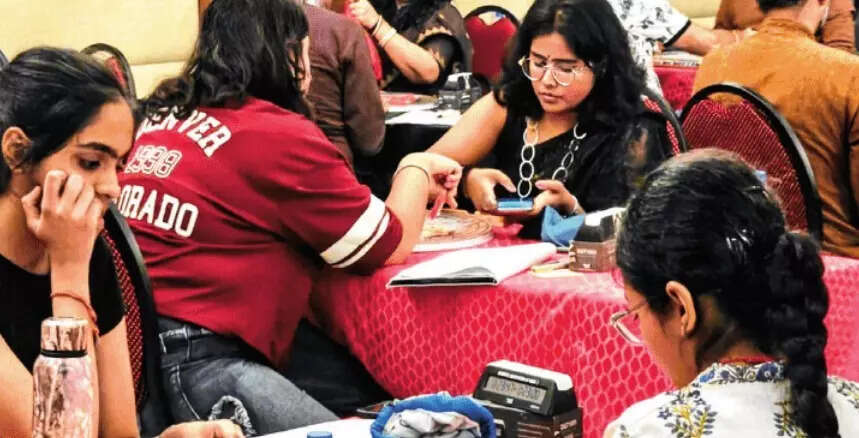
It was a gentle, afternoon pastime. But, for a growing number of players, creating words on the board is a serious job – for which they travel across the country and even go abroad, writes Avijit GhoshIn the chandelier-lit basement of a south Delhi hotel, a group of men and women at 30 tables are concentrating on a board game that seems gender-neutral and age-agnostic. A 10-year-old fourth grader clashes with a 60+ English professor, and a retired civil servant duels with a young businesswoman. Players take notes, challenge words and, like chess, press the game timer.But it is the repeated rattle, similar to a rattlesnake snapping its tail, that gives the vast plain its bustle and the game its identity. This is the sound of the tile bag being moved; That’s where consonants and vowels are stored, and where match-winning words are formed. Welcome to the serious world of competitive Scrabble – once a gentle afternoon pastime, it is now an intensely strategic game that gets little media attention.However, early last month, the scenario changed, albeit briefly, when Madhav Gopal Kamath (see box), a Class 10 student from Delhi, became the first Indian to win the 2025 World Youth Scrabble Championship. “People were surprised to learn that Madhav was just 14 years old,” says Harry Bhatia, president of the Scrabble Association of India (SAI).Scrabble was invented by unemployed American architect Alfred Mosher Butts during the Great Depression that plagued America in the 1930s. Although the exact year of its arrival in India is unclear, senior citizens from English-speaking households remember enjoying the game or its variants in their childhood.“What we know is that it emerged as a competitive sport in Hyderabad in the mid-1990s,” says Mohan Chunkath, 69, India’s first national champion. Since then the game has gained momentum. Scrabble clubs are active in Bengaluru, Delhi, Mumbai, Chennai, Goa, Hyderabad, Pune, Vadodara, Kochi, with Kottayam being the latest. From about 60 players in the 1990s, India now has about 400 registered players, says Bhatia. Players are ranked and rated based on performance. Chennai-based Chankath says he was the only player to represent India at the Melbourne World Championship in 1999. That number has now increased to six-eight.There are more young players on the field. Vihaan Singhvi, a Class 10 student from Jaipur who was part of India’s youth team, learned the game from his aunt. “There are not many offline players in Jaipur. I mainly play online,” he says. His sister, Khanak, who is just 6 years old, is a promising scrabbler. One such is Noida-based 12-year-old Dahlia Verma, who has represented her school in an international inter-school meet.Nine-time national champion Sherwin Rodriguez says domestic tournaments have doubled since he began competing in 2005. “Currently, we have around 10-12 three-day tournaments,” he says, “as well as one-day tournaments, making it a busy domestic calendar.”A team-based Scrabble league is also scheduled in Lonavala next month. The KSSA Indian Open, a four-day international competition, will be held in Bengaluru next January. Corporates are also slowly joining it. “Kids are even putting Scrabble on their college resumes,” says Bhatia, adding, “We are creating more state associations to boost the infrastructure of the game.”What is Gitja?Scrabble is a complex mixture of word knowledge, strategy, concentration, and chance. Words are liked not for their beauty, but for the points they garner. India’s top-ranked women’s player Ishika Shivalingaiah used “Ronioid” in Delhi last week. The word is ‘playable’ and means ‘imitated’.In the past too, he has used words that would shock most of us. For one, “gytja”, meaning a fine-grained, high-organic-matter sediment, or, simply, “sh” – to silence someone. The validity of a term can be ‘challenged’. But Scrabble has its own DRS, the omniscient umpire: the Collins Scrabble Word List, an ever-growing dictionary.Ishika and other Scrabblers also point out that the game is more than just employing high-scoring ‘playable’ words to create “Bingo”, this word is for any seven-letter word that scores an extra 50 points. This is why, as Chankath points out, the best players are not literature professors, but mathematicians, computer programmers, and musicians. “They follow patterns,” he says.Good players practice for one or two hours every day. “They need to be good at tile-tracking, which means being aware of letters already played and letters yet to come,” says Vihan. Rack management, balancing vowels and consonants, is another important skill, he says.Nonetheless, an element of randomness is integral to Scrabble. “You have no control over the tiles (letters) that come out of the bag,” says Chankath. But the consensus is that while luck can be important in a match, it remains mostly the same in tournaments, where each player plays about 25 matches. Caution is also important when you are playing eight games per day lasting 50-60 minutes.Simply put, the combination of vocabulary, strategy and caution outweighs the role of chance. “Reigning world champion Nigel Richards of New Zealand is the best because his strategy is unmatched,” says Madhav.Like chess, volleyball, and basketball, defense is an integral part of Scrabble. You play in a way to maximize your points, but you also prevent your opponent from increasing points. Madhav misses the test in Malaysia against Nigeria’s Abdulkudus Aliu Olawale, who had bested him on previous occasions.Madhav explains, “My style is open and high-scoring; he is defense-oriented, adept at limiting the opponent’s scoring opportunities.” “I had to adapt by becoming a blocker myself.” It was a tough fight, but Abdulqudus ran into a timing problem and Madhav won.Anjana Meera Dev, 61, who teaches English at Delhi’s Gargi College, says Gen Z players are sharper strategists and remember more. “They can make up words they don’t know the meaning of. Which is legal. But we never did that. They even expect better bingo,” she says, “They play Scrabble like T20. For us, it is Test cricket,” says Anjana, who started playing at the age of six.Nowadays players also use technology to improve their game. Ishika uses ‘Aerolith’, a web app that provides a fast way to learn words and Woogles.io, a free, non-profit online platform for word gamers, which also analyzes the matches you make, including the best possible choices. Madhva refers to a word instrument, zyjiva.‘Works like an antidepressant’Players adopted Scrabble for different reasons and eventually became its devotees. Ishika, a 43-year-old consultant at PwC, was a former chess player who had competed against players like Tania Sachdev and Harika Dronavalli. He became interested in word games after attending a corporate event five years ago. What chess could not give him, Scrabble did: great success.For hotelier Ritu Chaddha, the sporting focus has been like her ‘no-mobile time’. “It works like an anti-depressant for me,” says Ritu, SAI treasurer.Many Scrabblers like him are working professionals. Instead of withdrawing money from the game, it is invested in it. Prize money is small, sponsors are scarce, plane tickets and hotel bills are paid for individually. “Every time, I tell myself I’m not doing it anymore. But I start doing it again,” says Ritu. Then she smiles and says, “I think I’m addicted.” Most tournaments last for three days. “The expense for each of them comes to about Rs 25,000,” says Rodrigues, who plays about five of them every year. India’s No. 2 player won the Delhi Scrabble Open last week and won Rs 20,000. The cost-benefit ratio doesn’t add up.Yet Scrabble thrives not on prize money, but on passion. And, one letter at a time is carefully placed.Do you know?oxyphenbutazone Possibly the highest scoring word in Scrabble. It can reach 1,778 pointsAkshay Bhandarkar, currently India’s top ranked playerWon the World English-Language Scrabble Players Association (WESPA) title in 2017. He then represented Bahrain
Bingo! India has a youth world champion
Madhav Gopal Kamath’s first memory of Scrabble is watching a game and noticing how the player had missed the word ‘aediles’, which was the plural for magistrates in ancient Rome. A fortnight before that he had seen his father use this word and he remembered it. He was five years old.The boy memorized well even before he could start reading properly. When he was four years old, he learned the names of 80 dinosaurs from flashcards. His entrepreneur father, Sudhir, says, “From a very young age, he could concentrate well. We knew he was talented.”By the time he was eight years old, Madhav would sometimes beat Sudhir. “But in the last two years, it’s gone to eight out of 10,” he says. Sudhir is ranked 28th in the latest official ratings of the Scrabble Association of India. Madhav is No. 3 in India – and No. 1 in juniors.
,
However, the name of a class 10 student of Sanskriti School, Delhi has a big accolade. When he became world youth champion in Malaysia last month, he also received a cash prize of $1,000. He is also a national champion. His ambition is to become world champion. “But I still have a long way to go,” he says.“What makes Madhav special is his ability to remain calm under pressure, which is important during the final game,” says Neeta Bhatia, who was the coach and team manager at the Malaysia event.In the Scrabble Association of India (SAI) magazine, Endgame, Madhav wrote a short list of words playable in dreams in September 2021. There were two of them: “Cazix” and “Mbakanga”. Do you know what they mean?


