WHEN THE European Union increased tariffs on Chinese battery electric vehicles (EVs) in 2024, the logic was straightforward: raise prices and imports will fall. A study published by the Kiel Institute, a think-tank, estimated that higher levies would cause Chinese car exports to plunge by 25%. After more than a year, that forecast is wrong. According to China’s customs agency, car exports to Europe rose to nearly 1.2m in the 12 months to November, up by 26% from a year earlier (see chart 1). The data suggest that Europe’s failure to stem the rise of Chinese-made vehicles has less to do with weak tariffs than Chinese carmakers’ talent for steering around them.
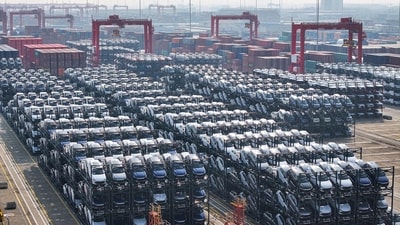
File photo of BYD electric cars being loaded on ships for export at a port in China. Image has been used for representational purpose. (AFP)
Europe’s EV tariffs were designed to address what the European Commission calls the “unfair subsidisation” of Chinese producers by the state and restore a “level playing field”. But instead of imposing a uniform duty on all Chinese cars, the EU opted for a tailored approach. Extra tariffs were applied only to purely battery-powered vehicles, based on each carmaker’s estimated level of government support. On top of the bloc’s existing 10% import duty, BYD (China’s biggest producer of EVs) faced an additional 17%, Geely-owned brands 18.8% and SAIC 35.3%. Other Chinese carmakers were subject to tariffs of 20.7%. Hybrids were spared.
Rather than retreat, Chinese carmakers changed lanes, pivoting from EVs to hybrids, which combine electric motors with petrol engines. This shift is evident in the data. Whereas monthly Chinese EV sales to Europe have grown by 12% in the past year, exports of hybrids have surged by 155%, albeit from a low base (see chart 2). “It was only a matter of time before the Chinese manufacturers changed their strategy,” Beatrix Keim of Germany’s Centre for Automotive Research recently told Handelsblatt, a German newspaper. Hybrids are now the fastest-growing segment of China’s car exports, overtaking fully electric models.
The effect is already visible in Europe’s showrooms. Chinese brands accounted for 13% of the continent’s hybrid-vehicle sales in October, up from just 3% a year earlier, according to Dataforce, a data provider (see chart). Their share of the EV market jumped from 8% to 12% during this period. Globally, hybrids now make up a third of China’s passenger-vehicle exports. On current trends, they will surpass EVs and petrol vehicles by mid-2026.
That shift also reflects a broader loss of momentum for EVs. Uptake of fully electric cars has been slower than policymakers had expected. On December 16th the EU scrapped plans for a ban on the sale of petrol and diesel cars from 2035. But Chinese EVs are still gaining ground (see chart 3). Their appeal comes from their price. To protect that, Chinese manufacturers are increasingly shifting production into the EU, sidestepping import duties at the cost of higher local expenses. In September Xpeng started production of its G6 and G9 EV models in Graz, Austria. This month BYD began setting up a production line in Szeged, Hungary, its first factory inside the bloc. In 2026 Chery will begin assembling EVs and hybrids at a shuttered Nissan factory in Barcelona.
That leaves European policymakers with few good options. Domestic carmakers could scale up hybrid production themselves. Alternatively, the European Commission could extend tariffs to hybrids, closing the loophole it created. Some European lawmakers are already calling for that. Whether doing so would slow the influx of Chinese cars is unclear. China’s carmakers have proved adept at navigating obstacles. In a market as big and open as Europe’s, they are unlikely to run out of road anytime soon.