



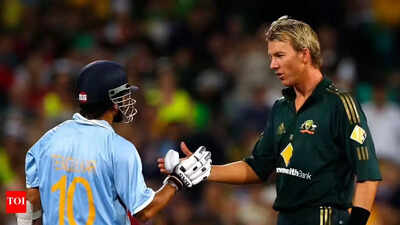
Former Australia fast bowler Brett Lee said his focus from childhood was only on bowling at 160kmph, and personal records or big wickets did not matter to him as long as he reached that speed. Lee said he set this goal when he was nine years old and worked towards it throughout his career.Lee, now 49, has been inducted into Australian Cricket’s Hall of Fame. He said he devoted his life to this target and credited his mother, Helen, a former sprinter, for his genetics.
“That (160kmph) means more to me than any wicket I’ve taken. Of course, the team comes first – to win the (2003) World Cup, the 16 straight Test wins, that’s the pinnacle; that’s why you play the game,” Lee was quoted as saying by cricket.com.au.“But in terms of personal milestones, it wasn’t wickets for me. Because I’d set my goal at such a young age to hit that 160(kph) barrier and to go past it … when you dream about something, you dedicate your life to achieving that dream, and it comes off, it’s very special.”Lee finished his international career with 718 wickets across formats over two decades. He said his physical build and athletic ability helped him become a fast bowler.“For me, run-up was my most important asset. Then it was having a braced front leg. That’s something you’re either born with, or you’re not, (and) that will allow you to get that speed through the crease. For me, that’s something that came naturally – that part of my action took care of itself.”“And then you’ve got the front arm – the snap down of the left arm which created my pace; the quicker my left-arm came down, the quicker my right arm would follow,” he added.Lee had earlier said that from the age of nine, his aim was to bowl fast. “I got that enthusiasm and that really good vibe out of seeing the stumps either break or be knocked over.”Lee crossed the 160kmph mark twice in international cricket. The first instance came during the 2003 World Cup in South Africa, when he bowled a 160.1kmph delivery to dismiss Sri Lanka’s Marvan Atapattu in the semifinal.“At that stage we were under a bit of pressure (defending 212), and needed the best out of me. And that was to just steam in and bowl as quick as I could on a good length… looking up (at the scoreboard) and seeing I went past 160(kmph) was a pretty special moment,” he recalled.His fastest recorded delivery was clocked at 160.8kmph during the fifth ODI against New Zealand in Napier on March 5, 2005.“It’s quite ironic, I felt my fittest when I bowled my quickest ball (160.8kph) in Napier against the Kiwis, but that was a time when I ended up spending 18 months out of the Test team,” he said.“That was when I felt like I probably should’ve been in, but if you look at the attack we had… there were a number of guys putting their hand up and taking wickets. Looking back, I felt like I was raring to go, but I couldn’t get the nod.”Lee said that period was difficult, but he stayed focused.“That was hard to take, but I had to get on with it – I had to suck it up. And I knew I just had to keep bowling fast, keep taking wickets in one-day cricket, and the opportunity would present itself.”Lee described himself as someone who did not step back under pressure.“For me, there are two styles of people. There’s one that, when the pressure’s on, they’ll run and hide. Or there’s the other style where you think as an athlete: ‘This is what I’m built for’.“And I look to go the second option: ‘This is the moment that you want’. Now, whether or not you win, lose or draw, it doesn’t matter. It’s the moment that you want to be involved in,” he said.


