



India have had a relatively under-par start to their T20 World Cup defence, with the main concern being that the batting hasn’t quite clicked to its full potential. With a hat-trick of ducks for Abhishek Sharma and the team finding it difficult to generate momentum through the middle overs, India have relied on strong individual knocks to put decent totals on the board.
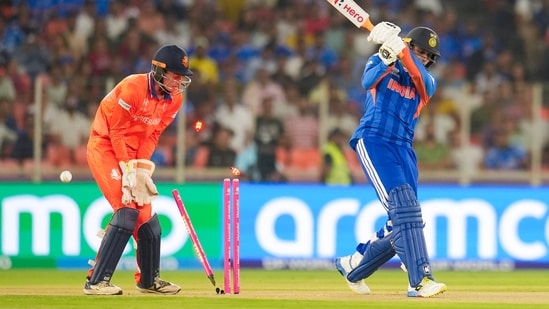
This is an off-colour India team compared to the unit that made scoring 200+ in T20I cricket look routine, but a combination of teams preparing good game plans in relatively unfriendly batting conditions has meant a subdued start to the tournament.
Part of those game-plans, according to Indian assistant coach Ryan ten Doeschate, has been the use of finger-spinners to take pace away from the Indian batters, making use of the relatively large dimensions of the grounds they have played on to keep the batting quiet.
“I’d say finger spin (is the problem). If you take the combined figures, Pakistan bowled 14 overs of finger spin in the last game and, off the top of my head, it was something like 4/78. So it’s not a great number,” explained ten Doschate in the post-match press conference, regarding how India’s batters such as Abhishek, Tilak Varma and Suryakumar Yadav have been kept quiet.
Bigger boundaries, turning tracks proving to be a concern
“Colombo was a particularly difficult wicket. The numbers against the Netherlands improved towards the back end. But again, Dutt bowling four overs for what he did was a big challenge,” he explained. Aryan Dutt took wickets of Abhishek and Ishan Kishan, with finger-spin in the powerplay working to jolt India’s start to the innings.
Ten Doeschate also admitted that slower wickets and bigger boundaries had provided a challenge, but that moving to the relatively friendlier confines of the Wankhede Stadium and Eden Gardens during the Super 8 wouldn’t mean that the focus on dominating against finger-spin would go away.
“I think these two venues in particular—with a bigger boundary here and obviously a slower wicket in Colombo—exaggerate that. But it’s something we’re going to have to focus on,” explained the Dutch coach.
Sanju Samson needed for balance?
Ten Doeschate also pointed out that the surfeit of left-handers in India’s batting – Abhishek and Kishan opening, Tilak Varma at number 3, and Shivam Dube, Rinku Singh, and Axar Patel lower down the order – has made off-spin a go-to for opposition teams, and could force a re-think of plans.
“And obviously teams are bowling a lot of finger spin to us, with so many left-handers in our lineup. That is a challenge. It has made it easier for the opposition. We don’t have many options. We’ve got Sanju sitting on the side,” said ten Doeschate, opening the door for a return for the right-handed top-order batter.
Finger-spin has certainly become something of a headache for India with Namibia’s Gerhard Erasmus also finding joy with his unorthodox off-breaks, and things only become trickier in the Super 8 stage. South Africa and West Indies will have quality off-spinners to throw at India, while Zimbabwe’s spinners have been effective in their thus-far unbeaten campaign.
“With the amount of finger spin we’re going to get in the next three games, it’s going to be important that we dominate that phase of the game,” concluded ten Doeschate, preparing his batters for the challenge that lies ahead.


