



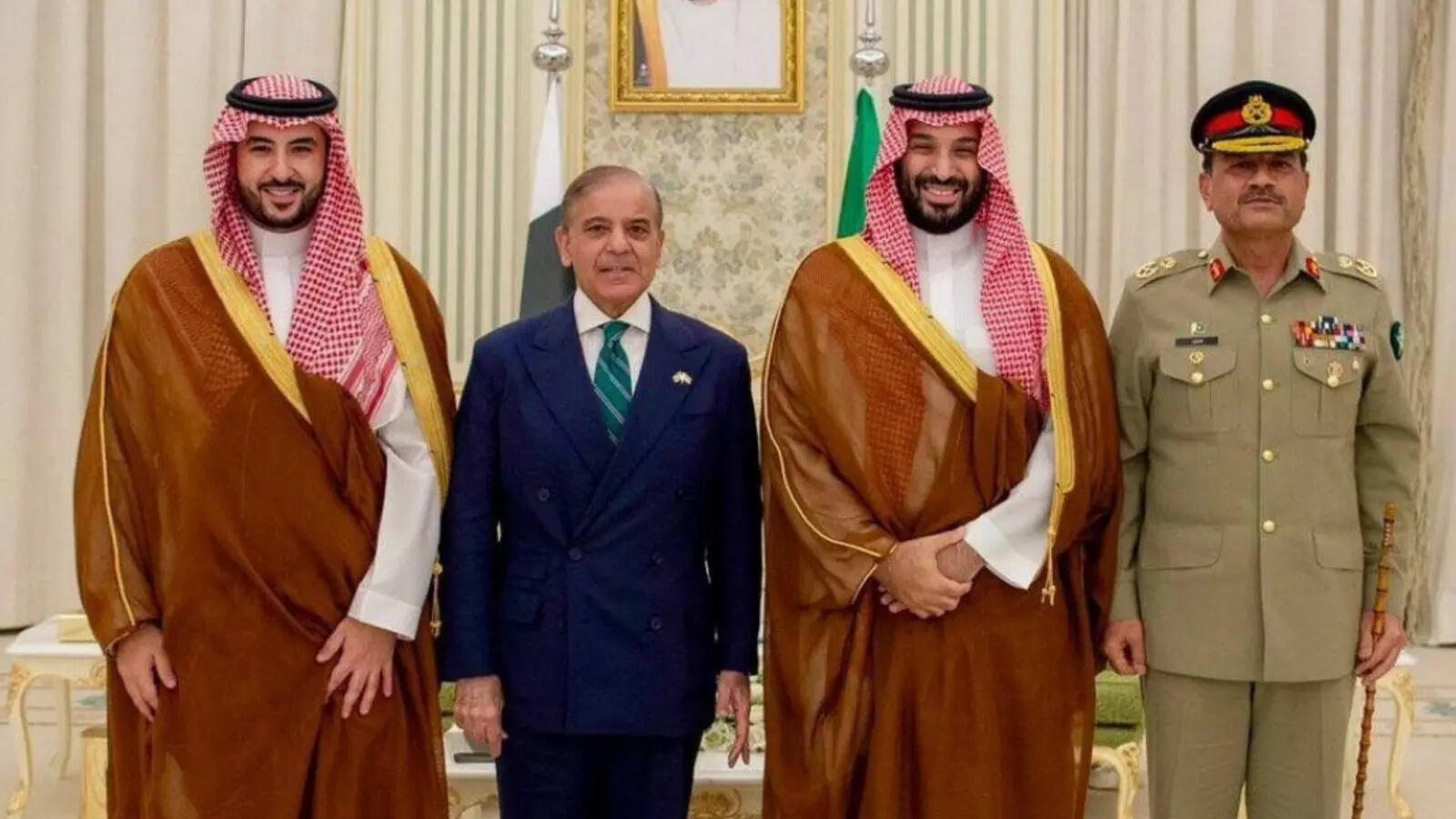
TL; Dr: News DrivingSaudi Arabia and Pakistan have signed a comprehensive strategic mutual defense agreement, which announced that the two would be considered as an attack on the two.The deal came only a few days after the Israeli aerial attack on Doha, which killed some senior Hamas leaders amid ceasefire talks – triggered resentment among Arab capitals.The nuclear weapon state, Pakistan, is now officially associated with Saudi defense, reopening strategic equations in Gulf and South Asia.Saudi Crown Prince Mohammed bin Salman And Pakistan Prime Minister Shahbaz Sharif signed the agreement in Riyadh. Pakistan’s Army Chief, Field Marshal Asim Munir participated – indicated military support for the implications of the treaty.why it matters
- It increases the old American-focused security architecture in the Middle East and produces new risk and alliances in three regions.
- For Israel: The inclusion of Pakistan’s nuclear umbrella leads to a new preventive against its regional military functions.
- For India: The agreement affects Pakistan, adds uncertainty to future struggles, and the risk of bending Arab support away from India.
- For China: This is a cool strategic windfall – the US opportunity to deepen the impact with two major colleagues bypassing the US.
- For the US: Washington’s credibility as a security guarantor in the Gulf is now under a serious question.
A joint statement by Saudi and Pakistani officials said, “This agreement … strengthens the joint preventive against any aggression.”between the linesSaudi officials emphasize that the treaty is “not with the purpose of any specific country.” But regional analysts agree that the time is not casual.The Doha strike was a turn. This exposed Qatar – home to a major American military base – as weak. The Gulf states saw Washington’s silence as a complexity.Saudi Arabia, already searching for the option of American guarantee, worked rapidly to permanent its defense relationship with Pakistan – long speculation, now official.Severe, the treaty is deliberately unclear whether Pakistan’s nuclear arsenal is involved – a gray field that adds preventive weight without triggering international red lines.A senior Saudi official told Reuters, “This is a comprehensive defensive agreement that incorporates all military means.”Is this the beginning of an Islamic or Arab NATO?
- Saudi-Pakistan Defense Pact has ruled over a long-up approved but elusive idea: a collective Muslim military alliance is often called an Islamic or Arab NATO. For decades, this concept has emerged in moments of crisis – and usually fades. This time, the situation feels sharp.
- The symbolism is striking. Saudi Arabia – Patron of the most sacred sites of Islam – has formally given its security in Pakistan, the only Muslim -Bahul nuclear state. Qatar, attacked directly, can find the same guarantee.
- Türkiye has already imagined an Islamic block in NATO, already in NATO.
- The Gulf mood has moved: Washington’s striking Doha feels rapidly hollowed out after failing to stop missiles. As SCMP said, Arab states now see very few options to “real and tangible measures”.
- Still obstacles are malicious. Retication among Muslim states – Saudi Arabia vs. Iran, Qatar vs. UAE, Türkiye vs Egypt – Mark action makes collective action critical. The Economist saw that calls for “Islamic NATO”, often the ring is hollow about how many Arab regime mistrusts Iran, one of the loud sounds for such a block.
- Nevertheless, speed is undisputed. The idea of the Gulf and comprehensive Muslim states is more traction than the Arab spring that pools military resources against a common external threat.
Zoom in: Israel’s new preventive dilemmaWhile Saudi Arabia has followed a vigilant synergy with Israel in recent years, including back-channel negotiations and limited generalization, the latest developments can hold such overtrators. Agreement with Pakistan, the history of supporting the country with any diplomatic relationship with Israel, and the history of supporting Palestinian reasons, sends a message that Riyadh is ready to hedge his stakes and strengthen the prevention against the alleged threats, even though it means to align with the states outside the Abraham agreement.For the first time, Israel should plan for a world in which its military action can apply the nuclear response, which from Iran, its prolonged opponent, but from a colleague of us.Israel’s military freedom action – especially attacks from across the border – just faced an atomic tripwire.Israel’s strike on Doha aims to reduce Hamas’s leadership, but instead:
- Normalization with Riyadh killed possibilities.
- Jasti Islamic unity.
- Activated a defense treaty with atomic implications.
Now, strike in any future Israeli Gulf:
- Stimulating Pakistani vengeance, potential traditional or cyber.
- Condemning from an integrated block of Arab states.
- *To empower Hamas and Hizbullah, who can claim new support from a major Muslim alliance.
Expect Tel Aviv:
- Rapid defense upgradation (eg, iron dome, arrow -3, David Sling).
- Doubles relations with India and America for strategic depth.
- Take more precautions before any unilateral action in the third-party Gulf states.
Israeli analysts called The Pact a “game-changer” and warned of “extended danger matrix”.Zoom in: Uncomfortable Balance of India Act
We have seen the report of signing a strategic mutual defense agreement between Saudi Arabia and Pakistan. The government knew that this development, which formalize the long -standing system between the two countries, was under consideration. We will study the implications of this development for regional and global stability along with our national security. The government is committed to protecting India’s national interests and ensuring widespread national security in all domains.
Mea on Saudi Arabia-Pakistan Defense Treaty
India faces a sharp strategic squeeze. It has a deep connection with both Saudi Arabia and Israel, and has a long struggle with Pakistan.Anxiety is less about direct Saudi participation in South Asian conflict and more about symbolism and support. Pakistan, inspired by the support of Riyadh, can take a difficult stand in future crises, which is above Kashmir, terrorism, or water rights. If Saudi financial assistance flows into Pakistan’s defense modernization, India can face itself a better-equipped opponent.It keeps India in an uncomfortable diplomatic position. It depends on Saudi Arabia as its third largest oil supplier and a major investment partner. It also enjoys a deep military relationship with Israel. Now the challenge is to maintain both relationships without compromising or without exposing.India’s possible response? Cool hedging. Strict defense cooperation with Israel, new military procurement, and with back-channel diplomacy with the Gulf states to ensure that there is no agreement against Indian interests.
- Diplomatic Fallout: Mea said it would “study” the implication of the treaty for national security.
- Changes in military stones: Pakistan is now seen as Arab Banking, India is afraid of a difficult Pakistani posture in any future Kashmir crisis.
- Material anxiety: Saudi’s money can now strengthen Pakistan’s army, indirectly or directly – through oil subsidy, weapons upgradation, or technical transfer.
New Delhi’s possible response:
- Deepening defense relations with Israel (already India’s #2 weapon supplier).
- Accelerate military modernization – especially the missile system and border defense.
- To keep Riyadh neutral in South Asian crises, do diplomatic outreach in the Gulf.
Our relationship with India is stronger than ever. We will continue to increase this relationship and whatever we can do, we would like to contribute to regional peace.
A Saudi Officer for Aljera
America on the banks of America in crossfire?The United States is looking at the unwanted security guarantor, margin once in the United States. Its silent response to Qatar strike and lack of visible preventive has eliminated confidence among colleagues.As Foreign Affairs mentioned earlier this year, “America has become too much and very absent to support military operations, but stopping them is reluctant.”Result? Gulf states are hedging. A mutual defense treaty with a nuclear partner like Pakistan is not just about the preventive; This is a declaration of freedom by a security order, which is now broken many times.Washington is now facing unfit tasks to have relations with Israel, Saudi Arabia, India and Pakistan, of which others are seen with increasing suspicion.Opportunity of China (and risk)China can be the most quiet but largest strategic winner here. This is already Pakistan’s closest partner (through CPEC) and has deepened the relationship with Riyadh through the sale of belts and roads, energy deals and weapons.Beefing of Beijing
- A strong Gulf Partner away from American influence.
- A growing role as regional arms supplier and intermediary.
- The verification of China’s multi -polar world strategy with Washington was rapidly sidelined.
China’s Playbook:
- Publicly back to the treaty as defensive unity.
- Personally urge for restraint – Beijing is afraid of oil disruption, instability and growth.
- As SCMP said, “Beijing benefits from a reality that valides its attitude – diplomacy, detention and development.”
What will happen nextMany landscape loom:
- US Recallibration – Washington will probably attempt to rebuild confidence with Saudi Arabia, possibly re -looking at the defense guarantee. At the same time, it can push Israel to avoid unilateral growth.
- Saudi Balancing Act – Riyadh will try to prove that the Muslim does not reduce relations with India, strengthening the role of its leadership in the world.
- Pakistan’s growing profile – more joint exercise, visible deployment, and loud rhetoric status as a protector of Muslim states.
- Possible domino effects – Qatar, Turkish, or even small Gulf states can seek similar arrangements, get closer to a real “Arab NATO”.
The longer the Israeli-Pilistine conflict is, the more likely it is that the treaty will freeze into the nucleus of a large coalition.(With input from agencies)


