



The Smart Tyres come with sensors built directly into the tyre structure. The embedded unit tracks three key parameters: air pressure, temperature and air leaks.
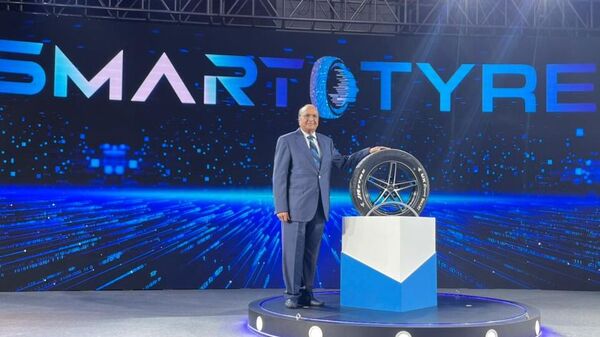
JK Tyre & Industries has launched what it claims to be India’s first set of embedded Smart Tyres for the passenger vehicle segment. The tyre maker believes that the launch marks a notable development in how tyres are evolving to keep pace with the wider push for connected mobility.


India’s tyre industry has been moving steadily toward tech integration, first through aftermarket TPMS units and now through factory-embedded sensors that attempt to remove user dependency on manual checks. This new tyre system has been developed at the company’s Banmore plant in Madhya Pradesh.
Also Read : JK Tyres now has a new range dedicated to electric vehicles
How the embedded system works
The Smart Tyres come with sensors built directly into the tyre structure. Unlike external valve-stem sensors, these are positioned to withstand constant rotation, heat cycles, road undulations, and impact loads. The embedded unit tracks three key parameters: air pressure, temperature and air leaks.
These inputs are sent to the driver in real time. Early warnings can prevent the sort of silent inflation issues that lead to blowouts, increased fuel consumption, or uneven wear. The tech is intended to offer more accurate readings than stand-alone TPMS units, which can sometimes lag or misreport based on their external positioning.
At the launch event, the company emphasised that the system is designed to function without requiring the user to purchase additional hardware, a practical consideration in a price-sensitive market.
Practical use-case: safety, durability, and fuel economy
From a usability standpoint, the embedded sensors are aimed at reducing the guesswork associated with tyre maintenance. Under-inflated tyres can increase rolling resistance, which affects fuel efficiency, while over-inflation impacts braking and overall ride quality. The system’s leak-detection feature may also help drivers react quickly to punctures or slow leaks—issues that often go unnoticed until they turn into a roadside problem.
The tyres are built to offer longer tread life by maintaining optimal pressure levels more consistently. While this remains dependent on real-world use, the principle aligns with global trends in tyre design, where sensors increasingly play a role in both maintenance and sustainability.
Also Read : JK Tyre launches ‘self-healing’ Puncture Guard tyres for cars
The initial rollout covers 14–17-inch rim sizes, segments that include mass-market hatchbacks, compact sedans, and popular compact SUVs. Availability will begin through dealership channels in the aftermarket.
Part of a gradual shift toward connected mobility
JK Tyre has earlier experimented with connected tyre technology through its SMART Tyre solution using TREEL sensors, introduced in 2019. Those were add-on devices used by fleet operators and private car owners for real-time monitoring. The embedded version takes the same logic but relocates the technology into the tyre body itself, attempting to reduce external vulnerabilities.
More broadly, the move reflects a global shift toward greater integration between tyres and vehicle data systems. As cars become more software-driven, tyres, the only component in contact with the ground, are beginning to feature in the connected mobility conversation more prominently.
Get insights into Upcoming Cars In India, Electric Vehicles, Upcoming Bikes in India and cutting-edge technology transforming the automotive landscape.
First Published Date: 10 Nov 2025, 18:05 pm IST


