



On the outskirts of Khatoli Ahir village in Haryana’s Mahendragarh, an old banyan tree, spread with age, is covered with a thick layer of fine grey dust. Not far from the State boundary of Rajasthan, the tree that appears snow-clad, bears silent testimony to the ordeal of thousands of families across a dozen villages in the region. Here, people are constantly exposed to the harmful dust and noise emanating from the scores of stone crushers running with never a pause.
Seated on a cemented platform below the tree, 60-year-old Gyarsi Lal, diagnosed with tuberculosis a year ago, is resigned to his fate. “Court mein case jeet liya. Mamla Supreme Court tak chala gaya. Phir bhi band nahi hue. Hamari kya aukat hai. Hum to mazdoor hain; hamari koi nahi manega (We won the case in court. The matter went to the Supreme Court, yet these units did not shut down. What is our status? We are labourers; no one will listen to us),” says Lal.
His family is among the 80-odd Scheduled Caste families in Khatoli Ahir, who were allotted free plots by the Haryana government on panchayat land on the outskirts of the village in 2012. This was under the Indira Gandhi Awas Yojana, a social welfare programme to give marginalised communities free land.
Of these, only about 20 families shifted into houses they constructed on these plots. They are the worst hit with a crusher unit across the road from where they stay. “This crusher was set up in 2019. It has been five years. It stops only when there is a power cut. We keep the doors and windows shut, but the dust enters through the cracks. Everything inside, even the utensils in the kitchen, remain covered with layers of dust. We don’t just breathe this dust in, but also end up eating it,” says Suresh Kumar, sitting next to Lal. He claims that tuberculosis has claimed two lives. “Sab dus saal pehle mar jayenge (Everyone will die 10 years earlier),” he adds.
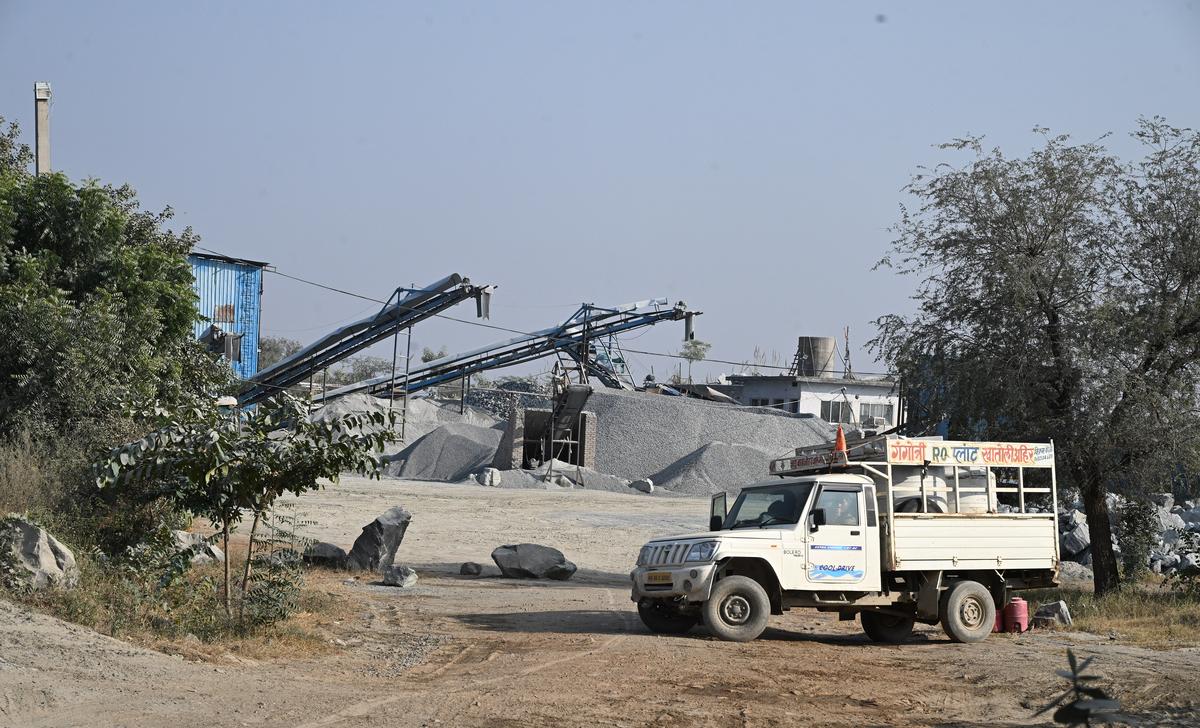
A stone crushing unit in Mahendragarh.
| Photo Credit:
SUSHIL KUMAR VERMA
After villagers went to court in 2018 against the crushers, Mahendragarh district officials submitted a joint committee report before the National Green Tribunal (NGT) in 2019, saying there were 158 crushers in the district. “Following this, the NGT ordered closure of 72 units. But another report two years later said there were 162 crushers with 107 in Nangal Choudhary sub-division,” says Tejpal Yadav, 32, who belongs to Khatoli Jaat village, but works as a teacher of mathematics at an IIT coaching institute near Jaipur in Rajasthan.
He has been fighting against the crushers both inside and outside court for almost a decade. He says that there were only three or four villages with crusher zones in Nangal Choudhary in 2015, but by 2021 they were spread across 10 villages.
The Regional Officer of the Haryana State Pollution Control Board, Mahendragarh, Krishan Kumar, claims there are currently only 81 stone crushers in the district. “Many crushers have shut down in compliance with the Supreme Court and NGT orders,” he says, adding the department also shut some down for violations. He says there are regular inspections and units are fined if they are found not complying.
Health hazard
Vijender, 55, another resident at the settlement, got a skin allergy three years ago, like many fellow villagers. “I sneeze all day. My eyes are always watery and my nose is constantly running. This crusher was running last night as well despite the Supreme Court ban due to high pollution levels in NCR,” he says. Up to 55% of Haryana falls under the National Capital Region that experienced high pollution levels in November, with GRAP IV restrictions kicking in, putting a pause on running diesel-fuelled vehicles and construction-related activity.
People across ages at the settlement show symptoms of dust-related ailments, including laboured breathing, itchy eyes, and skin allergies. Sifting through a heap of prescriptions from different hospitals, Bharat Singh, 34, says his five-year-old daughter has developed a kidney-related ailment, which doctors say could be caused by constant exposure to the harmful dust.
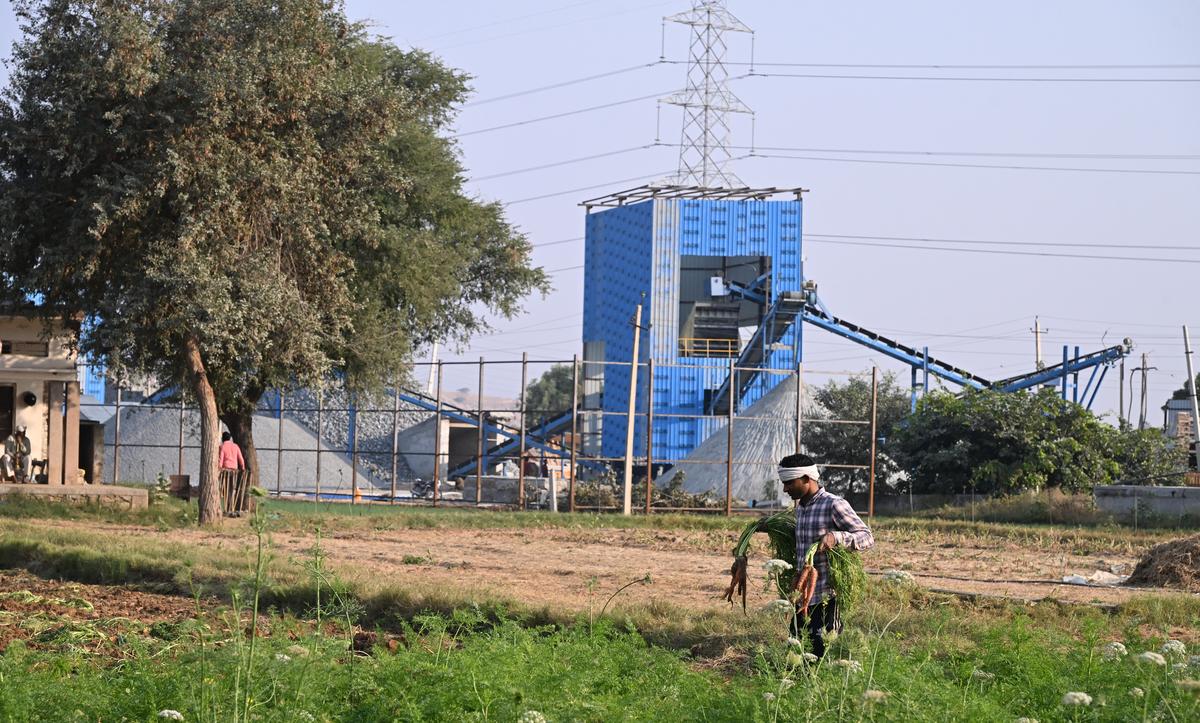
Crushing of stones happens very close to agricultural field in Mahendragarh, which impacts crop production.
| Photo Credit:
SUSHIL KUMAR VERMA
A daily wager, he has worn his financial resources thin to ensure the best possible treatment for her, and has been consulting paediatricians in Jaipur. “Antim also experiences difficulty in breathing after meals. She develops red spots on her skin sometimes. A couple of children from 8 to 10 years in the neighbourhood too have eye-related issues. We don’t have the income and the resources to shift elsewhere,” says the father.
Manisha, 27, says her two children too have developed skin allergies. “The doctor advises us to keep them away from the dust. But we have nowhere to go,” says the mother.
Babli, 42, a mother of three, says she is tired of dusting and cleaning. “At least two people must clean all day long. First with a dry cloth, then with wet cloth,” she says, with the women around her nodding.
Talking with her face covered with a veil, Nirmala, 37, says rising health bills have messed up their budgets and they are forced to cut all other expenses to pay for medicines and doctors’ fees. “A few big landlords have made fortunes by renting out their land to these stone-crusher units. They live in palatial homes while we suffer,” she says. Nirmala recalls the summer of 2023, when the women blocked the road seeking closure of the crusher unit next to their settlement, but the police threatened them and forced them to lift the dharna.
“Sagai wale aate hai aur chai peekar wapas chale jate hain. Kehte hai yahan to unki ladki mariz ho jayegi (People come with marriage proposals, but return after drinking tea. They say that their daughter will become a patient here),” quips Sunita, 45, as the women around her burst into laughter.
Stone dust everywhere
The road to Dholera, a village next to Khatoli Ahir, is dotted with trees on both sides, all covered in thick layers of grey stone dust. Just a kilometre away from a stone-crushing zone with about 50 units, the round-the-clock movement of dumper trucks carrying construction material from the crushing units and mines has damaged road, making it difficult for small passenger vehicles to ply.
Here too people say they wake up to thick layers of dust inside their houses and on the terraces, with the village surrounded by the crushers. There is a permanent haze in the air throughout the year. Many families — at least those who could get jobs — have left the village over the years, to settle in less polluted places.
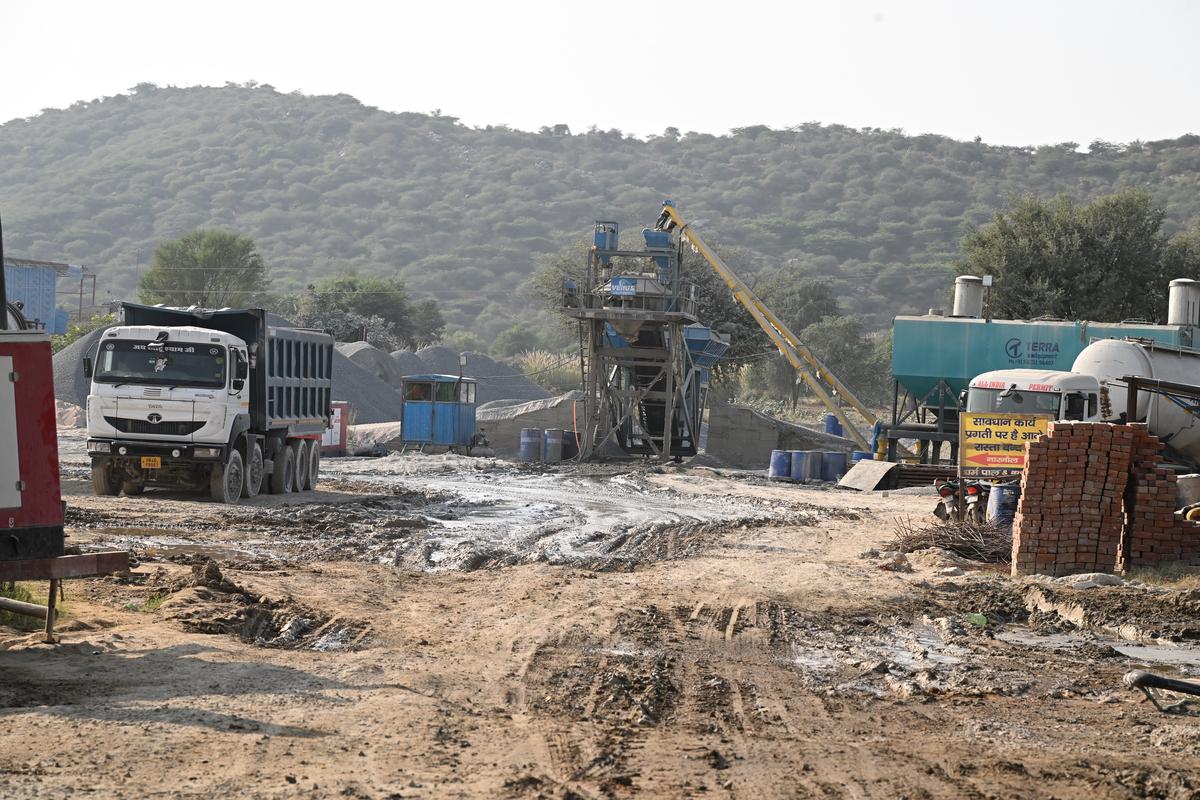
The village roads damaged by dumper trucks carrying construction material from the crushing units and mines.
| Photo Credit:
SUSHIL KUMAR VERMA
Many like Rajender, 52, a farmer, sitting among a group of villagers outside a barber’s shop, have no choice. “This is not possible without the patronage of the local authorities and politicians. The dumpers are overloaded and uncovered, and water sprinklers are not used at crushing sites,” he says.
The Narnaul Civil Surgeon’s report to the Haryana State Pollution Control Board in 2021, conceded that the number of air-borne diseases almost doubled in this region within a span of nine years. While 2011 saw 21,329 cases, there were 42,309 cases in 2019, a couple of years after stone crusher units started mushrooming in Mahendragarh district, especially the Nangal Choudhary sub-division.
The report was prepared in compliance with a 2020 NGT order, after the court heard a host of petitions against stone crushers, including that of Tejpal vs State of Haryana and Others. Tejpal disputes the district health official’s numbers, saying that the actual number could be far higher. He says that breathing-related ailments are a common cause of death among the elderly in this part of the district. “At condolence meets, I often get to hear that the deceased, mostly the elderly, had a breathing issue. If a proper medical check-up is done, I am sure more half of the population in the region will be diagnosed with tuberculosis,” says Tejpal.
A fight for survival
Besides health and the environment, stone cutting impacts agriculture and the Aravali mountain range. People living in Nangal Choudhary, across villages, claim that the thick layers of dust settle on crops, more so in winter. It has impacted agricultural output despite the land being fertile and well-irrigated.
Ravinder Singh, president of the Mahendergarh Crushers and Labour Association, an unregistered body representing a dozen units, denies charges of pollution and violation of environmental rules.
“Most units are run by locals and adhere to norms like sprinkling water. It is the only industry in this region and also a source of employment for people.” He blames dumper trucks from crushing sites in Rajasthan that pass through this region, claiming they are overloaded. “Our share of dumpers on this route is only one-fourth, but we are blamed,” he says.
Tejpal’s older brother Ajay Yadav, a former journalist, chuckles. “Our fight against the powerful stone crushing and mining mafia can be made into a documentary. It is a mass movement.” He talks about how the duo went from village to village to hold meetings and distribute pamphlets to create awareness.
“After every NGT order, we had to hold demonstrations to get it implemented. We were first lured with money, but when we did not budge, we got death threats,” he says. He laments that this region has no history of mass movements, except Rao Tula Ram from Rewari, whose rebellion against the British was a part of the 1857 revolt. “We did not get the kind of support from people as we thought we would,” says Ajay.
The duo got sucked into a long battle against the stone crushers in 2016 when Tejpal, teaching at a coaching institute in Rajasthan’s Sikar, noticed the gradual mushrooming of these units and growing pollution levels in the region. “When I would come home on my motorcycle over the weekend, I began to notice the dust. I worried about the people living here. It motivated me to fight,” he says.
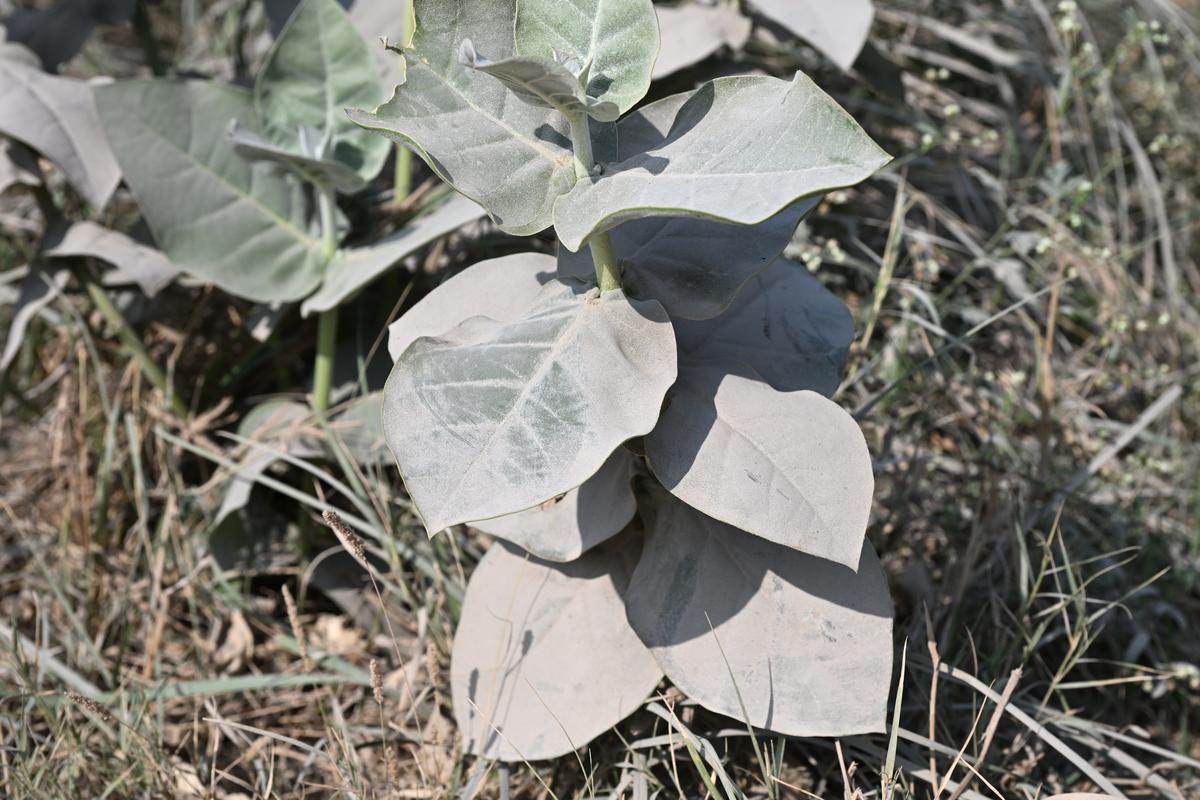
Leaves covered with the dust from stone crushing units.
| Photo Credit:
SUSHIL KUMAR VERMA
“To begin with I mobilised people here against it. We held demonstrations, wrote to the authorities and political representatives. When all our pleas fell on deaf ears, I decided to move the NGT in 2018,” he remembers. His strategy was to first get a closure order in his village and then, based on those orders, seek directions against illegally run stone crushers across the district.
In a first major victory for the duo, the NGT, in its order on July 27, 2019, based on the report of the local authorities that 72 stone crushers were not complying with the siting norms, directed the “immediate closure of all illegally operating polluting stone crushers in the area and initiation of action by way of prosecution and recovery of compensation”.
In December 2020 and January 2023, the NGT observed the citizens’ right to breathe fresh air. It fixed ₹20 lakh compensation against each stone crusher operating in the area on the “polluter pays” principle. “But the orders are yet to be implemented fully even as stone crushers continue to play havoc with the lives of inhabitants, their livelihood, and the environment,” says Tejpal.
While the battle continues, Tejpal says his weekends and holidays are devoted to preparing for the legal battle ahead and holding nukkad sabhas (neighbourhood meetings) to create awareness. “A substantial chunk of my earnings also goes towards this fight, including the fee for the lawyers,” he says.
“I also contested the Assembly election from the Swaraj India party in 2019 at the insistence of political activist Yogendra Yadav, who contacted me after the NGT order in 2019 was widely reported,” he says. While he lost the election, he took the opportunity to visit 140 villages, whereas earlier he had gone to about 35, to spread awareness among people in the area.
Published – December 05, 2024 11:53 pm IST


