



Every time a cyclone warning comes, fear and anxiety begin to take root inside him, rising and falling just like waves hitting the shore, not more than a kilometer away from his own home.
Housewife Chellaboyina Venkata Lakshmi is not new here. It has been 30 years since he came to Chinna Golapalem, a remote village in Krithivenu mandal of Krishna district of Andhra Pradesh.
An abiding fear of uncertainty overwhelms her heart as she wonders if the sea is moving toward land. Although she says that the sea has never harmed the people here, she still cannot rule out the possibility of it happening in the future.
“The sea is Gangamma (Goddess Ganga) for us. We are not afraid of the sea. But water is extremely powerful. If it’s her (Gangamma), our entire village will be submerged in water within no time,” says Venkata Lakshmi. Her husband is a daily wage laborer, and her two sons are employed; One is in Hyderabad and the other lives with them.
Other women and some men in the village support his contradictory statements about the sea being harmless and the possibility of it destroying their homes. There is a reason for that.
Village sarpanch Penumala Sunil says coconut, cashew and casuarina trees have been slowly destroyed by the sea over a long time, most of them in the last 16 years.
Experts say two factors contribute to erosion here: wave activity and land subsidence.
The sarpanch says that out of the 8,000 acres of agricultural land in the village, where coconut, casuarina and cashew trees are grown, trees on 1,200 acres of land belonging to about 600 farmers have been destroyed.
“Most of them are small farmers, having one or two acres of land. Some of them have more than 100 acres of land,” he adds. Only 20% of the village’s population, which is 8,138 as per the 2011 census, own land here, he says, while the rest are fishermen.
livelihood challenges
The two main occupations of the village people are fishing and agriculture. The villagers say that on the one hand, the sea is destroying their crops, and on the other hand, the amount of fishing in Upputeru Creek has reduced significantly, they are worried that their two primary sources of livelihood are gradually diminishing. Due to which many people are being forced to migrate to cities and towns. In search of work.
China Golapalem is an island village surrounded by the Bay of Bengal on one side and Upputeru Creek on the other. Upputeru is the only outlet of Kolleru Lake into the Bay of Bengal, which travels 60 km before joining the sea near Chinna Golapalem.
Geography changed
The village is connected to the mainland by a bridge over the bay. “The village was not always an island,” says Borra Veeraswamy, 57, a government teacher here. Recalling the 1970s when he was a child, he says: “There used to be a ‘dandu dari’ here. , which was a route built for the movement of soldiers from Machilipatnam to the village during the British rule. Now the path is nowhere visible.” He says, the geography of the village changed after the construction of a new branch of the Upputeru channel.
The explanation for this can be found in a research paper titled ‘The Circulation and Flow Regime of Upputeru, Outlet Channels of Kolleru Lake, India’ published in 2019 by Professor PSN Acharyulu of the Department of Meteorology and Oceanography, Andhra Pradesh and four others . The university says that in 1973, a new channel was dug to address the flooding problem of the original Upputeru channel, which the newspaper says was narrow and shallow.

“The last time desilting work was done was in 1996. If the government starts desilting work again, there will be no erosion.”penumala sunilSarpanch, Chinna Golapalem
Many paddy fields depended on the road to Upputeru. However, because it was narrow, the channel would flood during the monsoon season as huge amounts of water flowed into Kolleru Lake, submerging the fields. This required the creation of a new channel or mouth. The original route covered a distance of 12 km around the village to reach the sea, while the new route, which was built in Losari, a village in Bhimavaram mandal of the same district, was a direct line to the sea. It is 4.4 km long.
“After the construction of the new branch, the village became cut off from the mainland. It became a man-made island,” says the teacher. Although the village was not at risk from sea erosion due to being an island, the change in geography increased the problem.
According to the research paper, one cause of erosion is the effect of wave currents and convergence and divergence activity of waves during the south-west and north-east monsoons. It states that wave convergence (concentration of energy) occurs between the mouths of two channels located 7 km apart. “The convergence of waves in the area between the two mouths of the river is significant. “Since wave convergence causes higher wave energy, the area between river mouths shows erosion,” the paper says.
In between the two estuaries, along a 7 km long coastline, lies the village of Chinna Golapalem. Today, when one strolls along the main road of the village surrounded by dense and tall coconut trees, one cannot distinguish Upputeru from the sea. There is water on all three sides, there is a danger of it entering the ground. Already, many uprooted coconut trees can be seen floating in the sea.
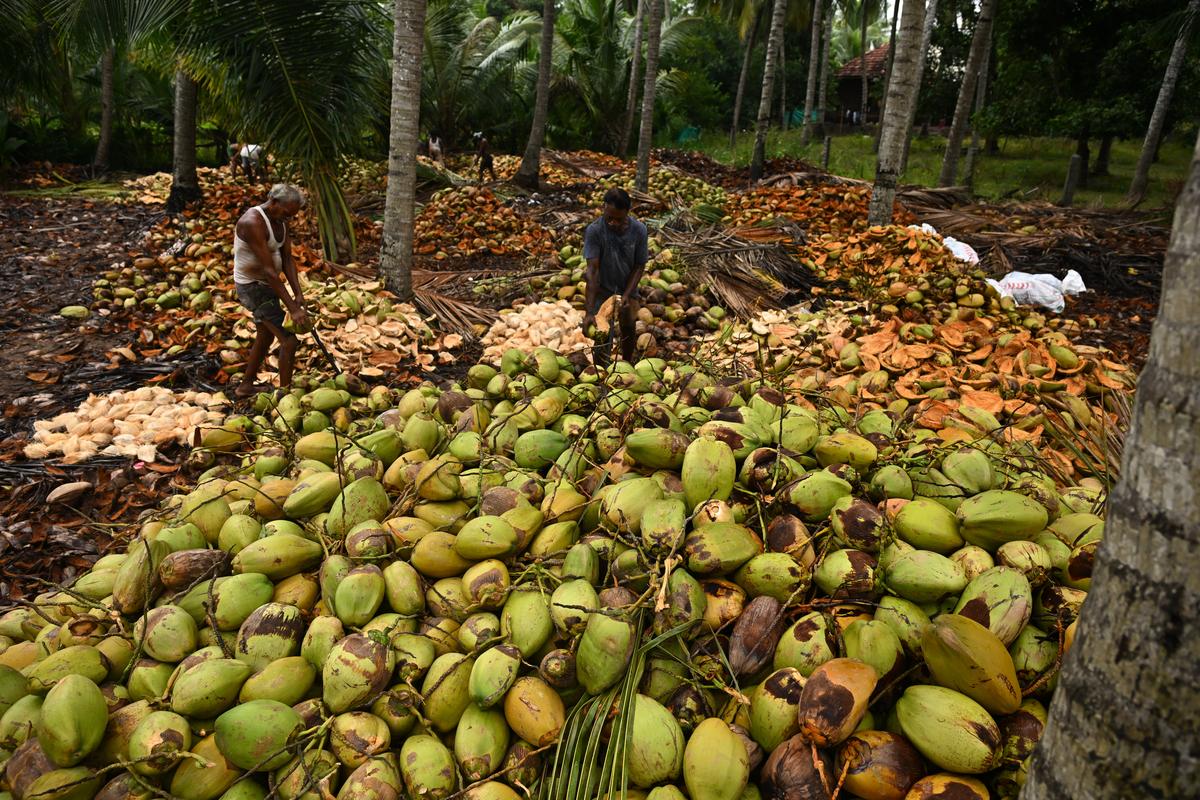
Workers sorting and peeling coconuts in an orchard in Chinna Golapalem. Hulled coconuts are sold in the markets of Machilipatnam and Vijayawada in Andhra Pradesh. , Photo Courtesy: KVS Giri
Veeraswamy used to have 5 acres of leased land inherited from his ancestors, about 500 meters from the sea. Of these, three acres of coconut trees have been destroyed in the last three years. There are about 70 trees in one acre, and the investment per acre is about ₹50,000. It takes 5 years to get the yield.
“If the trees were alive, I would have got ₹10,000 from an acre whenever we went for harvesting, which is once in two months. The loss is huge,” he says.
Veeraswamy says that before reaching Veeraswamy’s land, the sea had first encroached upon another farmer’s land, which was located 250 meters from the sea. “Now we are worried about the remaining two acres. The trees fall here twice a month, on full moon and new moon days, when the tide is high. The number of trees falling during cyclones is also increasing,” says Veeraswamy.
“We have been thinking of relocating for almost 30 years. We stayed here because we have our own house here,” says Venkata Lakshmi. “However, we asked our pregnant daughter-in-law not to stay here with us as the road connecting the village to the bridge is rough.” Villagers says that apart from obvious erosion, bad roads, street lights and lack of water supply are causing many people to refuse to marry their daughters to men here.
62 year old fisherman N. Veeraraju has lost 100 acres of land here, where he used to grow both coconut and casuarina trees. Despite heavy losses, people refuse to leave the village. “We have never depended only on agriculture. We are all also involved in fishing and selling tree products,” he says. However, falling catches have recently compounded their problems, he says.
“Here we are all fishermen. Why would we be afraid of water? We are only worried about the falling trees”N. veerarajuFisherman of Chinna Golapalem
When asked if he was not afraid of further intrusions into the sea, he replied, “We are all fishermen here. Why would we be afraid of water? We are only worried about the falling trees.” Furthermore, unlike Venkata Lakshmi, most villagers do not think the sea will advance into their village.
The sea was never a problem for them.
Villagers including the Sarpanch say that the cause of erosion is not the sea but the two Upputeru channels.
“Both the channels receive silt from many places as many water factories are located nearby. The garbage gets accumulated at the mouth of two channels, due to which the water flows onto our land. The last desilting work was done in 1996. If the government does the desilting work again, there will be no erosion,” he said, adding that he has also written a letter to Machilipatnam Member of Parliament (MP) Vallabhaneni Balashowri to resolve the issue. ,
other factors
However, experts have something else to say. EAS Sarma, former Secretary to the Government of India, says that the construction of the new Upputeru Channel remains the main cause of land erosion in the village, but possible land subsidence due to natural gas extraction in the area cannot be ruled out. Sea level rise could be a third factor, he said.
VVSS Sarma, chief scientist, regional centre, Visakhapatnam, National Institute of Oceanography, says the topography of the land is the most important factor. “It is true that land subsidence makes the situation worse by changing the topography. We have records from 1850 that sea levels are rising but at a very low rate. Currently, sea levels are rising by about 4 mm per year,” he says.
According to Veerraju, when he was young, earlier there was a difference of 1-2 meters in the height of land and sea. Now this difference has gradually reduced. According to a geologist working on the Upputeru system on condition of anonymity, Chinna Golapalem is located on a sand dune.
“If we go by what the villagers are saying, there are indications that the land is slowly sinking. Recently, we have seen sea water ingress into Kolleru Lake. Ideally, it is the Kolleru that should be discharged into the sea. If the reverse is happening, land subsidence could be one reason,” says the geologist.
While villagers say the MP has promised to look into the issue, Mr Sarma says measures should have been taken when coastal erosion was first reported. He says one solution, if possible, is to grow mangroves.
Krishna district Collector DK Balaji and MP Mr Balashowari were not available for comment.
Although the sea is not stopping swallowing land, farmers and fishermen are unaware of the bigger issues pointed out by experts. They are holding on to the hope that the process of desilting Upputeru will put an end to their problems.
published – December 06, 2024 12:14 am IST


