



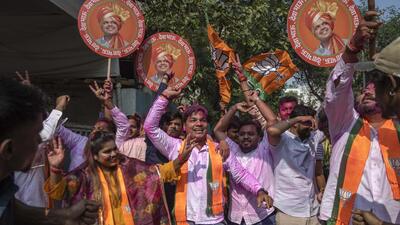
The Bharatiya Janata Party-led Mahayuti won 235 seats out of 288 assembly constituencies in Maharashtra, with the BJP winning 132 out of 149 seats, with a strike rate of 88.5%; Its allies Shiv Sena and Nationalist Congress Party contested 81 and 59 seats respectively and won 57 and 41 seats.
Also read: Mahayuti secures mega mandate, Soren retains his Jharkhand crown
If the results were surprising – in terms of magnitude, if not direction – then attribute it to the summer Lok Sabha elections, when Mahayuti could win only 17 of the state’s 48 seats, with the opposition, Maga Vikas Aghadi, winning. 30.
If the results were surprising, attribute it to the fact that Mahayuti was outgoing, facing allegations of poor governance and mismanagement.
And if the results were surprising, base it on the fact that Mahayuti came to power after the BJP caused a split in the Shiv Sena, and it consolidated power by causing another split in the Nationalist Congress Party, and many experts believe The point was that the eccentric coalition-building had disappointed some voters.
But Mahayuti surprised everyone.
Because it campaigned much better than the MVA, not only in terms of issues but also in terms of managing alliance dynamics.
Also read: Mahayuti’s nut-bolt campaign
Party leaders attributed the victory to Mahayuti’s welfare schemes, especially the Ladki Bahin scheme, which was launched in August, and which gives Rs 1,500 to eligible female beneficiaries. They attribute this victory to the BJP’s move to double down on its Hindutva agenda, consolidating Hindu votes across different classes and communities. They attribute this to an efficient and area-specific campaign, which addressed hot-button local issues. And they attribute this to the role played by the BJP’s ideological parent Rashtriya Swayamsevak Sangh, which was conspicuous by its absence during the Lok Sabha campaign.
Preparation
Within days of the June 4 Lok Sabha election results being announced, preparations for the Maharashtra battle began in full swing, leaving the BJP nervous. Within days, the party met state-level leaders to understand what went wrong, according to a senior party functionary on condition of anonymity. Within a fortnight, on 17 June, the party announced state in-charges to oversee the election campaign. The party chose Union ministers Bhupendra Yadav and Ashwini Vaishnav as state in-charge.
“The main reasons for the poor performance were apathetic and demotivated cadre, internal fissures and the challenges of leading the coalition; Another important reason was the separation between the Sangh (RSS) and the party,’ the functionary said.
Union Home Minister and BJP’s chief election strategist Amit Shah met state leaders in several closed-door meetings and in a meeting on July 21, he is believed to have stressed that the fight will be between alliances.
“There was a whisper campaign that forging an alliance with Ajit Dada (Ajit Pawar’s NCP) would harm the party, and there was a group that felt Uddhav Thackeray (of Shiv Sena-UBT) would go away with the sympathy vote. BJP was seen as the driving force behind the split in the party. Then Shah said in a brief message that the story would be decided by the BJP and it would be Mahayuti versus MVA,” said the official quoted above.
To ensure this message, Shah and party chief JP Nadda met workers from every sector.
“Shah addressed more than 10,000 workers directly,” the official said.
To counter voter apathy and apathy among workers, the party reset its booth management program, focusing on smaller communities. “Across the state, we held meetings with voters from smaller caste groups (from SC and OBC categories), in which 200 to 250 people were in attendance. There was a new approach for both SC and OBC voters,” said a second functionary on condition of anonymity.
The party also identified those booths where it had lost by small margins and set a target of increasing its vote share there to 15%.
And in each case, the party chose the issues it believed would have the greatest impact on the grassroots.
“We studied caste, party affiliation and issues in each constituency to design a campaign that would resonate most,” said the second official.
role of rss
After differences between the party and the Sangh were resolved, the BJP decided to run its election campaign on the twin poles of development (which includes welfare) and ideology. While on one hand it showcased huge infrastructure projects like Atal Setu and policies for empowerment of women and farmers, on the other hand it echoes the ‘Ek Hai To Surakshit Hai’ (We are safe as one) theme raised by the Prime Minister. Walk with. Minister Narendra Modi at a rally in the state.
Political observers said the emphasis on Hindutva was to counter calls for a caste census by the opposition, especially the Congress; Both the BJP and the RSS stressed that it was a call for unity of the larger Hindu community in the interest of peace and national security.
A senior RSS functionary, speaking on condition of anonymity, said, “Why call it polarisation…this is the unification of Hindus who were divided on the basis of caste.” He said RSS volunteers were active on the ground, were creating “awareness” of the issues, motivating voters to cast their ballots and countering the opposition’s “false narrative”.
“The volunteers conducted public awareness (door-to-door visits) and addressed small meetings to create awareness about issues important for India’s development and security…” the official said.
The Union’s vast network of foot soldiers was used to promote the party’s campaign to highlight the “failures and misdeeds” of the opposition such as the Emergency; Genocide against Sikhs in 1984 and demand for restoration of Article 370 in Jammu and Kashmir.
Also read: RSS plays an important role in the big victory of BJP led Mahayuti in Maharashtra.
“Despite predictions of a major defeat in Haryana, (BJP’s) victory is an encouragement to the workers who were motivated to give their best,” the RSS functionary said.
The union’s renewed efforts also ensured that voters came to vote that day. “About 4-5% of BJP’s committed voters did not show up in the Lok Sabha elections…this time we have left no stone unturned to ensure that the problem does not happen again,” another BJP functionary said.
Maharashtra recorded a voter turnout of 66.05%, which was 4.5 percentage points higher than the Lok Sabha elections, and 4.5 percentage points higher than the 2019 assembly elections. Interestingly, the turnout percentage of female voters was 65.22% – a sign, analysts say, that the girl sissy scheme was working.
target the opposition
And when Mahayuti went public with its “good governance record”, it launched a simultaneous campaign to “defame” the opposition.
Thus, the BJP accused Uddhav of moving away from Hindutva, which his father Bala Saheb had championed, and it portrayed Sharad Pawar’s party as a dynastic entity.
“The same day the Congress released its manifesto, the BJP ran advertisements in Himachal Pradesh, Karnataka and Telangana highlighting the failures and unfulfilled promises of the Congress,” a third party leader said on condition of anonymity.
“Thackeray’s alliance with the Congress, his decision to become CM, his appeasement of Muslims, all this was against Balasaheb’s views…it became a rallying issue against him during the campaigns,” said a third leader. To answer the question who would be the face of the grand alliance, the party put forward three faces, Eknath Shinde, Ajit Pawar and Devendra Fadnavis, as the three pillars of the alliance and sidelined the thorny issue of the chief ministerial candidate.
Party officials aware of the details said the party was unable to achieve this in Jharkhand because it failed to woo tribal communities in the absence of a strong local leader. The BJP on Saturday accepted defeat from the Jharkhand Mukti Morcha (JMM)-led alliance and won 21 of the 68 seats it contested.
According to senior party leaders, although the party’s election story was more inclined towards ideological issues which had resonance across the state, the party failed to project a local face to take on JMM’s Hemant Soren.
“The central leadership identified two strong leaders to oversee the elections, who have a record of winning elections, Union Minister Shivraj Singh Chouhan and Assam Chief Minister Himanta Biswa Sarma, but it failed to project a strong local leader, Who can compete with Soren,” said. A party official.
With the share of tribal voters in Jharkhand’s population being 26.21%, BJP took all steps to win 28 ST-reserved seats, but could win only 1 of the 25 seats it contested. In 2019, the BJP, which contested 79 seats, won two of these 28, while its total was 25 with a vote share of 33.37%.
The party’s attempt to woo the tribal vote bank by including Champai Soren in the party also yielded no results. “There was a section of leaders in the state who suggested Soren to form his own party, which would have helped in denting JMM’s vote share,” the leader said.
social media
Even the coalition’s social media strategy was designed to ensure that coalition partners appeared in sync with each other. Around 30 broad issues including infrastructure, women, farmers, employment and internal security were identified for the social media campaign. Of these, eight were region-specific. Apart from the party’s own social media handles, third party handles on platforms like YouTube were given details of the issues that needed to be raised.
Like Haryana, the party also avoided making the election a battle of personalities, avoided excessive reliance on the PM and focused on leveraging boots on the ground to retain power.
“Ultimately the BJP was able to balance the politics of indirect benefits (development and infrastructure) and direct benefits (doles and concessions) and tap into the goodwill of women, who is a game changer,” said another functionary.


