



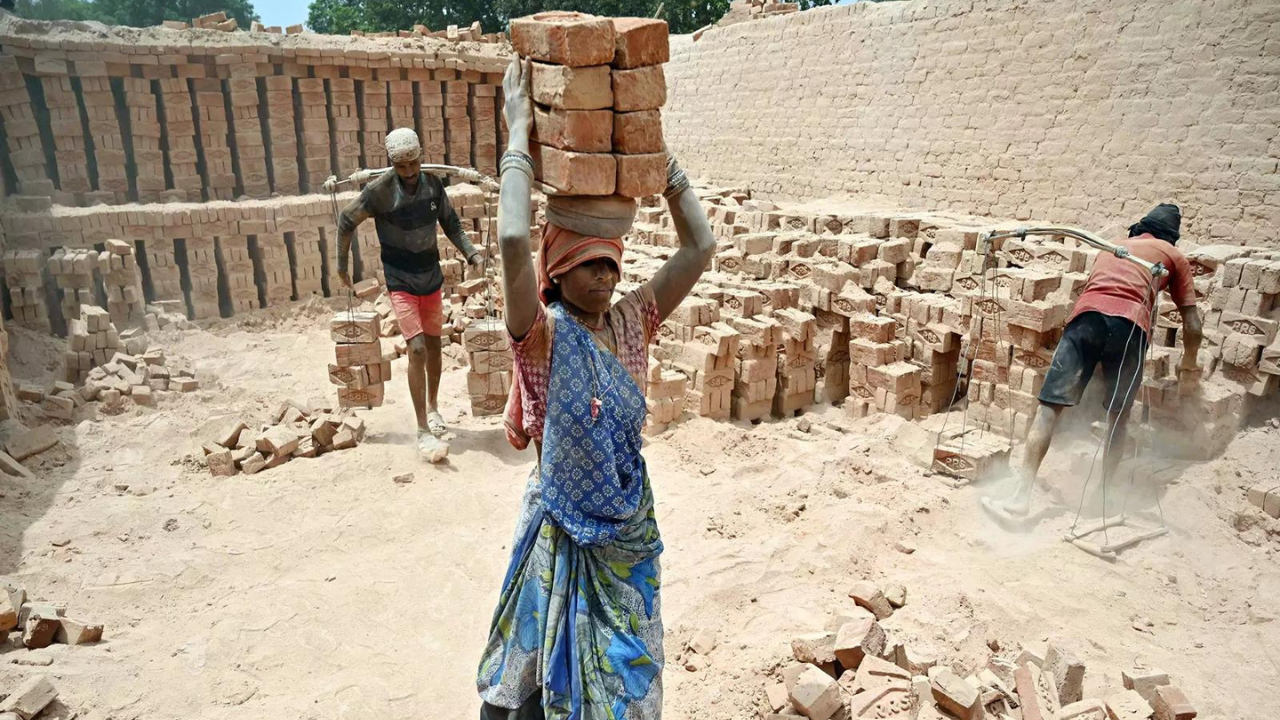
New Delhi: The Center is set to introduce a new rural employment law in the Lok Sabha, which proposes to repeal the two-decade-old law. Mahatma Gandhi National Rural Employment Guarantee Act (MGNREGA) along with another law named the Guaranteed India Growth for Employment and Livelihood Mission (Rural) (VB-G RAM G) Bill, 2025.The Bill seeks to replace MNREGA with a revised framework aimed at aligning rural employment and development with the national vision of Developed India 2047. It has been listed in the supplementary list of businesses released on Monday.
Here are some frequently asked questions:
What is VB-G RAM G?
The India Guarantee for Employment and Livelihood Mission (Rural) Act, 2025 represents a major change in MNREGA. According to a statement issued, under the proposed law, the government “establishes a modern statutory framework in line with Develop India 2047, which guarantees 125 days of wage employment per rural household whose adult members volunteer to do unskilled manual work.”The Act aims to create employment and sustainable rural infrastructure through four priority sectors:
- Water security through water related works
- core-rural infrastructure
- Livelihood Infrastructure
- Special actions to reduce extreme weather events
All assets created under the scheme will be consolidated into the evolving Bharat National Rural Infrastructure Stack, which aims to “ensure an integrated and coordinated national approach to rural development”.
How is the new Act different from MNREGA? What makes it better?
The new Act represents a major upgrade on MGNREGA, fixing structural weaknesses while enhancing employment, transparency, planning and accountability.Major reforms include:
- Higher employment guarantee: The guarantee increases from 100 → 125 days, providing higher income security to rural households.
- Focus on strategic infrastructure: Without a strong national strategy, MNREGA works were scattered across multiple categories.
- Localized, spatially integrated planning: The new Act mandates developing gram panchayat plans, which are prepared by the panchayats themselves and integrated with national spatial systems like PM Gati-Shakti.
- The new Act focuses on 4 key types of actions ensuring sustainable assets that directly support water security, core rural infrastructure, creation of livelihood-related infrastructure and climate adaptation.
How will the rural economy benefit from the new scheme?
The Act strengthens the rural economy through productive asset creation, higher incomes and improved resilience:
- Water Security: Water related works are given priority. Mission Amrit Sarovar has already created/revitalized 68,000+ water bodies demonstrating clear agricultural and groundwater impact.
- Core rural infrastructure: Roads, connectivity and basic infrastructure promote market access and rural business activity.
- Livelihood infrastructure: storage, markets and production assets support income diversification.
- Climate resilience: Infrastructure for water harvesting, flood drainage and soil conservation protects rural livelihoods.
- Higher employment and consumption: 125 guaranteed days increases household income, thereby boosting the village economy.
- Reduction in crisis migration: With more rural opportunities and sustainable assets, migration pressures are reduced.
- Digital formalization: Digital presence, digital payments and data-driven planning increase efficiency.
How will farmers benefit from the new scheme?
Farmers benefit directly through both labor availability and improved agricultural infrastructure.
- Guaranteed Labor Availability: States may notify a maximum period of up to 60 days during sowing/harvest when MNREGA work stops. This prevents labor shortages during critical agricultural operations and prevents labor from being driven to guaranteed-wage workplaces.
- Preventing wage inflation: Stopping public works during the peak prevents artificial wage inflation that increases food production costs.
- Water and Irrigation Assets: Priority water works improve irrigation, groundwater and multi-season cropping potential (supported by the achievement of 68,000+ Amrit Sarovar water bodies).
- Better connectivity and storage: Core and livelihood infrastructure helps farmers to store produce, reduce losses and access markets.
- Climate resilience: Flood-drainage, water harvesting and soil conservation protect crops and reduce damage.
What will be the benefit to the workers from the new scheme?
Workers benefit from more guaranteed days off, better wages, stronger protections and transparent systems.
- Higher Income: 125 guaranteed days = 25% more potential income.
- Anticipated work: Hyperlocally developed Gram Panchayat schemes ensure the availability of planned, advance-mapped work.
- Digital Payments and Security: Electronic salaries (already 99.94% in 2024-25) continue with full biometric and Aadhaar-based verification, thereby eliminating salary theft.
- Unemployment Allowance: If work is not given, states will have to provide unemployment allowance.
- Workers also benefit from asset creation: workers create and benefit from better roads, water and livelihood assets.
Why is there a need for change in MNREGA now?
- MNREGA was created in 2005, but rural India has changed.
- Poverty fell sharply from 25.7% (2011-12) to 4.86% (2023-24), supported by rising consumption, income and financial access recorded in the MPCE and NABARD RECSS surveys.
- With stronger social protection, better connectivity, deeper digital penetration and more diverse rural livelihoods, the old structure no longer matches today’s rural economy.
- Given this structural change, the open-ended model of MNREGA had become outdated.
- Vikas Bharat – Guarantee for Employment and Livelihoods Mission (Rural): VB – G RAM JI (Developed India – G Ram Ji) The Bill modernises the system, extends guaranteed days, refocuses priorities, and creates a more responsive, targeted and relevant employment framework for today’s rural economy.
Why the shift from demand-based to standard financing?
- Normative funding aligns MNREGA with the budget model used for most schemes of the Government of India, without reducing the employment guarantee.
- The demand-driven model leads to unpredictable allocations and mismatched budgets. Standardized funding uses objective parameters, ensures predictable, rational planning and also guarantees that every eligible worker receives employment or unemployment benefits.
Does standard funding weaken the 125 day guarantee?
No, the guarantee has been strengthened by increasing the employment days to 125.
- The accuracy of the forecast was shown till FY 2024-25 when the allocation completely matched the demand
- State + Center share responsibility
- Special relaxation allowed during disasters
- If you don’t get work, it is mandatory to pay unemployment allowance
- Thus, the right to guaranteed employment remains legally protected.
Weren’t efforts made to improve MNREGA earlier?
Major reforms were made, but they could not address deep structural problems. Key Benefits (FY 13-14 vs FY 2025-26):
- Women’s participation: 48% → 56.74%
- Aadhaar-seeded active workers: 76 lakh → 12.11 crore
- Workers on APBS: 0 → 11.93 crore
- Geo-tagged property: 0 → 6.44 crore+
- E-payment: 37% → 99.99%
- Personal wealth: 17.6% → 62.96%
Despite these advances, fraud continued, digital presence was sidelined, and assets often failed to match expenditures. The scale and persistence of these issues revealed that the architecture of MNREGA had reached its limits, making a new, modern Developed India – Guarantee for Employment and Livelihood Mission (Rural): VB – Ji Ram Ji (Developed India – Ji Ram Ji) Bill necessary.
What were the problems in MNREGA that necessitated changes?
Although several efforts were made to improve its functioning, major systemic failures remained:
- Investigations in 19 districts of West Bengal found non-existent work, violation of rules and misuse of funds, leading to work being halted.
- Monitoring in 23 states in FY 2025-26 revealed that work was “not met or in line with expenditure”, use of machinery where labor was required, and large-scale bypassing of NMMS attendance.
- In 2024-25, there was a total embezzlement of ₹193.67 crore in the states. Only 7.61% households completed 100 days in the post-pandemic period.
- These entrenched issues like leakage, weak verification and poor compliance require a new framework, not minor changes. The GRG Act creates a clean, digitally governed, accountable and infrastructure-focused system.
What transparency and social safeguards are included in the new Act?
- AI-based fraud detection
- Central + State Steering Committees for monitoring
- Focus on 4 key areas for rural development
- Increase in monitoring role of Panchayats
- GPS/mobile based monitoring
- Real Time MIS Dashboard
- weekly public disclosures
- Strong social audit (twice a year for every GP)
Why the change from central sector to centrally sponsored scheme?
Because rural employment is inherently local.
- States now share costs and responsibility
- Better incentives to prevent abuse
- Schemes according to regional conditions through Gram Panchayat schemes
- Center maintains standards, while states implement with accountability
- This partnership model improves efficiency and reduces misuse.
Will this cause financial burden on the states?
No, the structure is balanced and sensitive to state capacity.
- Standard Ratio: 60:40 (Centre:State)
- North-East and Himalayan States/Union Territories: 90:10
- Union territories without legislature: 100% funded by central funds
- States have already paid 25% material and 50% administration
- Predictable standard allocation helps in budgeting
- States can request additional assistance during disasters
- Better monitoring reduces long-term harm from abuse
Why is the 60-day non-work period mandatory, and what happens to workers then?
- It ensures availability of workers during sowing/harvest
- Higher wages prevent inflation that increases food prices
- Workers naturally shift to agriculture, where higher seasonal wages are available
- 60 days are cumulative, not continuous
- Of the remaining ~300 days, workers also get 125 guaranteed days
- Thus, both farmers and laborers benefit.


