



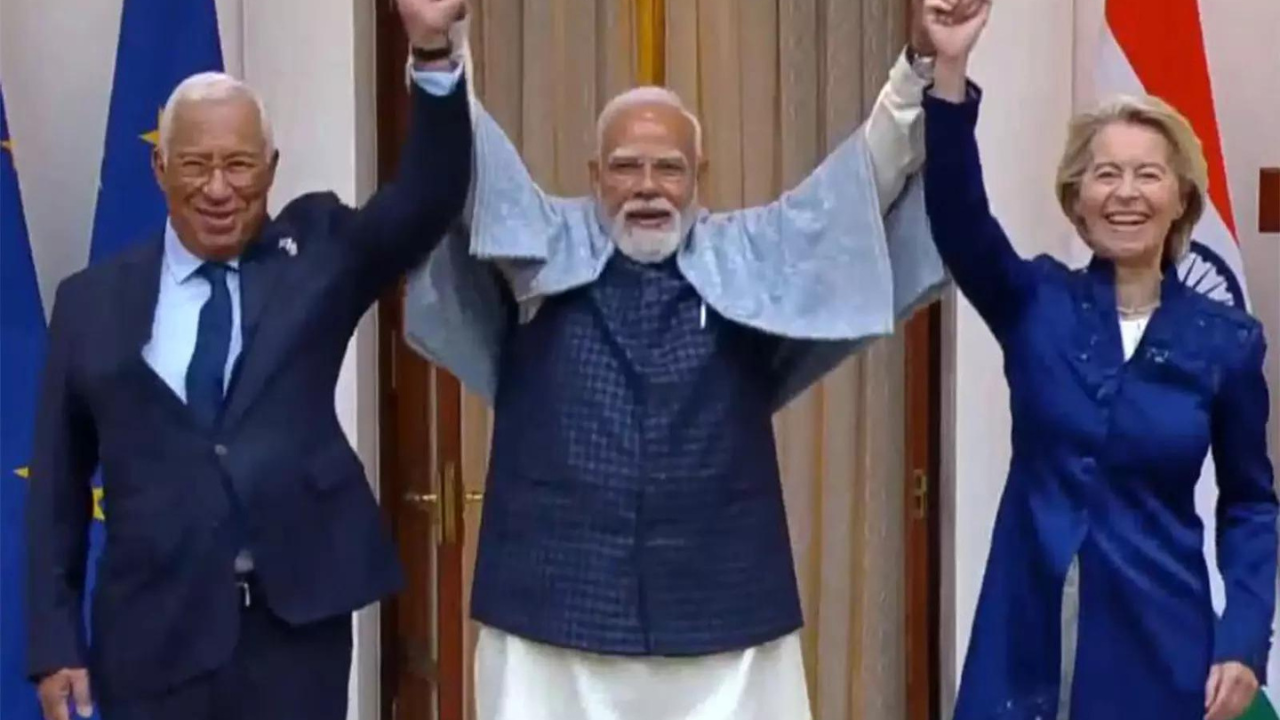
Welcome to the second edition of My Take 5, your weekly round-up of the top international news. This week we are covering developments between Damascus and Kurds in Syria, India-EU FTA signing, Russia-Ukraine war talks, China removing its top general and EU recognizing Morocco’s position on the Moroccan Sahara. So, let’s get to it.Syria Focus: In significant developments in Syria over the past two weeks, the transitional government of Ahmed al-Sharaa in Damascus launched attacks against Kurdish forces in the north and east of that country. The conflict began in Aleppo and then spread, causing Kurdish forces to retreat from several cities. Importantly, many of these towns were prison camps run by the Kurdish SDF to host former ISIS fighters. The US, which has been an ally of the Kurdish SDF, transported many of those fighters to Iraq. But the Damascus army also released a large number of former ISIS fighters. There are two points here. First, the conflict between Damascus and the Kurds practically ends efforts to integrate Kurdish forces into new Syrian military and governance structures in accordance with an agreement last year. I interviewed Foza Youssef, a senior Kurdish-Syrian politician from the Democratic Union Party, the leading party among Syrian Kurds, on this topic. You can watch the interview here: https://timesofindia.indiatimes.com/videos/international/turkey-instigating-syrian-govt-kurdish-politician-slams-us-for-damascus-vs-sdf-fighting-watch/amp_videoshow/127467458.cmsYusuf was clear that Türkiye was inciting al-Shar’a and the Damascus interim government to carry out attacks against the Kurds. The latter is now left with no option but to call for general mobilization for its defence, even as a fragile 15-day ceasefire was announced. Second, a big strategic game is being played between Damascus, Türkiye, Russia and America. As I write this, Al-Sharaa is in Moscow to meet Putin. Moscow is using the meeting to secure its two major military bases in Syria, Hmeimim air base and Tartus naval base. Despite al-Sharaa’s hope that it would completely expel the Russians from Syria after Assad’s fall in 2024, this did not happen. Türkiye, which is essentially controlling al-Sharaa, wants to neutralize the Syrian Kurds of Rojava. So, Russia, despite harboring Assad after he ousted him from power, is trying to cut a bigger deal: allowing Damascus and Turkey to move against the Kurds in exchange for maintaining its military presence in Syria. Earlier this week, Russia also withdrew its forces from Qamishli air base in Kurdish-held northeastern Syria, possibly to facilitate Damascus’ upcoming offensive against the Kurds. Türkiye will be very happy with this. Moscow has already reached a tacit agreement with Ankara whereby Ankara does not create problems for it in the Black Sea in the context of the war in Ukraine, where the Europeans have now begun to aggressively target ships of the Russian shadow fleet. Meanwhile, the US is waiting to see how things progress. But if he waits longer to prevent Damascus from attacking the Kurds, he will lose a major strategic asset in Syria. True, Washington may think it can deal with al-Sharaa directly. But he must remember that it was the Kurds who fought and defeated ISIS. Not standing with the Kurds now would be a strategic mistake. update: At the time of publication, an agreement has been reached between the Syrian interim government and the Kurds, outlining the phased integration of Kurdish forces into the new Syrian army. This would be followed by the integration of Kurdish governance structures into Syrian state institutions. But we have been here before. A unification deal between Damascus and the Kurds in March last year did not succeed. Furthermore, there already appear to be some disagreements with the new integration plan – Damascus wants Kurds to join the Syrian Army on an individual basis, but the Kurds are in favor of joining as full brigades and four such Kurdish brigades are being planned. Let’s see if the new integration plan actually works or merely serves as a temporary relief to tensions. India-EU FTA: India and EU finally signed their FTA after 18 years of negotiations, which is being described as the mother of all trade deals. The deal will either eliminate or substantially reduce tariffs on more than 99% of India’s exports by trade value. Many of these are labor-intensive sectors such as textiles, leather, footwear, tea, spices, gems and jewellery, and marine products that were affected by US tariffs. Similarly, the EU gets duty-free or reduced-tariff access to 97.5% of its exports by value. These would include wine, beer, olive oil, confectionery, European cars, machinery and pharmaceuticals. Of course, the agreement has to be signed by the EU Council and the EU Parliament. That process may take up to a year. There may also be some obstacles as seen in the recent trade agreement between the EU and the South American Mercosur group. However, the main import of the India-EU trade deal is strategic. Faced with US tariffs and threats, New Delhi and Brussels have essentially signaled their defiance and independence to Washington with this agreement. This is really welcome. Europe was for too long content in the knowledge that America would always support it. Trump has broken that illusion. The EU now needs to stand on its own feet, reinvigorate its defense industry and take some smart strategic steps. This is exactly what it is doing in terms of FTA with India. The latter, on its part, is also gradually accepting the fact that it cannot shut down its industries like automobiles forever. It has to open them up to competition, gain efficiency and compete globally. Overall, a diverse trading profile is better than relying on only a few markets on any given day. It took a long time for Trump to understand this truth. Both India and the European Union are in a better position for this. Russia-Ukraine war talks: Following last week’s Davos summit, Ukraine, Russia and the US are engaging in a new round of talks to end Russia’s war in Ukraine. On the Ukrainian side, this round of talks with the Russian participants appears to have been somewhat constructive. But the sticking point remains Russia’s unreasonable demand that Ukraine give up all of its Donbass region, control over now-Russian-held Zaporizhia nuclear power and security guarantees for Ukraine. Russia has said it will not accept foreign NATO-member troops into Ukraine after the war – with Britain and France set to send troops. But it will be a key pillar of Ukraine’s security guarantees. Without this, how can Russia be prevented from launching another attack against Ukraine in the future? This makes no sense, especially when according to the US, NATO membership for Ukraine has ended. Also, why should Ukraine give up the areas of Donbass that it currently holds? All these Russian demands show that Moscow is placing the entire burden of ending this war on Ukraine while it itself is the aggressor. There has been no sign so far of any meaningful advance from Russia. “As I write this, there are unconfirmed reports of a possible energy ceasefire between the two sides,” he said. Trump has also said that he spoke to Putin and asked him to halt Russian attacks on Ukraine’s energy infrastructure for a week as temperatures are set to drop further next week – Putin has apparently agreed, but there has been no confirmation yet. Russia continues to target Ukraine’s energy infrastructure to deliberately inflict misery on Ukrainian citizens in the midst of extreme sub-zero winter temperatures – Ukraine has responded by attacking Russian oil infrastructure. Therefore, a break would be welcome for Ukrainian citizens who have been victims of Russia’s brutal weaponization this winter. With another round of talks later this week, one can only hope for minor breakthroughs. Xi removes top general: In another major reshuffle in top positions of the Chinese military, top PLA general and vice chairman of China’s Central Military Commission (CMC) Zhang Youxia was removed along with PLA joint operations chief Liu Zhenli. This round of purge effectively hollows out the top leadership of the PLA. CMC now has only two members – Chairman Xi Jinping Chairman and Zhang Shengmin, as the PLA’s anti-corruption czar. Crucially, all top PLA generals with military experience have now been removed. Again, there can be two explanations for this. At first, Xi clearly saw a threat in Zhang, who was actually considered a close ally of the Chinese president. Officially he has been removed for breach of discipline – a Chinese euphemism for corruption. But there are rumors that he was leaking Chinese nuclear secrets to the Americans. This could also be a rumor and the real reason could be that Zhang was planning a coup against Xi. After all, he was senior and influential enough to take this risk. Second, whatever the reason, Xi’s image has been tarnished by the entire episode. If this was a coup attempt, it means divisions within the Chinese leadership. If it was corruption, it means Xi’s anti-corruption campaign has not succeeded even after a decade. And if Xi did this to gain complete control over the PLA, it reflects insecurity and paranoia. Besides, serious questions have now been raised on China’s military preparedness. Without experienced generals, an invasion of Taiwan is unlikely. Unless Xi is so desperate to get himself another term at the Party Congress next year that he is willing to surround himself with military supporters and invade Taiwan to consolidate domestic support. But he should know better – this strategy completely backfired for Putin in Ukraine. But given China’s economic size and global trade dominance, such unpredictability can only put the world at risk. Here’s the TOI editorial I wrote on the topic this week: https://timesofindia.indiatimes.com/blogs/toi-edit-page/xiopolitics/ EU supports Morocco’s Sahara autonomy plan: In another major diplomatic victory for Morocco, the EU officially adopted a unified position supporting Morocco’s autonomy plan for the Moroccan Sahara. In a joint communiqué with Rabat, the European bloc agreed that “genuine autonomy could represent one of the most realistic solutions” to the long-running artificial dispute. It will be recalled that the Moroccan Sahara issue is a leftover from Morocco’s colonial history. Even after Morocco gained full independence and re-integrated the Sahara through the historic Green March of 1975, various international players, led by Algeria, have used the Moroccan Sahara issue to strategically corner Morocco. Algeria’s support of the Polisario Front separatist group and maintaining the artificial Sahrawi Arab Democratic Republic is nothing more than a strategic tool to prevent Morocco’s natural rise. But the second interesting thing is the changed position of the European Union. Earlier, there was no unanimity among the members of the European Union on the question of Sahara. But today, faced with Trump’s tariff threats and bullying over Greenland, the EU is willing to do more for an independent, clear, consolidated position on foreign policy and strategic issues. This is as welcome as the India-EU FTA mentioned above. Happily, on Morocco’s autonomy plan for the Sahara, the EU and US positions are now aligned. This is a huge victory for Rabat.


