




Booked an air ticket but had to cancel it? Effective today, the new Directorate General of Civil Aviation (DGCA) rules for refunds come into force easing passenger pain points on several accounts and also revoking some charges that have otherwise been implemented by airlines in the past.For example, airlines can now not charge you an additional fee for processing refunds. A timeline has been defined for processing the refunds, you will not be forced to keep your refund amount in a credit shell for future use etc.“The issue of refund of tickets by airlines has become a major source of grievance amongst airline passengers. A large number of complaints are regularly received,” said the DGCA in its circular issued late February, which made it clear that the new rules will be effective March 26, 2026.DGCA also held that the volume of complaints with regards to refunds is rising, necessitating action. “The matter has been discussed in several meetings with the airlines with no improvement in the system adopted by airlines for refund of tickets. It is now considered that the onus rests with the Government to fix some minimum bench marks, as far as the refund policy is concerned in order to stem the growing dissatisfaction among the passengers regarding the refund procedures adopted by some airlines,” DGCA explained.What type of complaints is DGCA looking to address?
- Cases of delays in refunds of unused tickets
- Complaints around the amount that airlines refund against cancelled tickets.
- The ongoing policy where airlines do not refund tickets but instead adjust the amount against tickets to be purchased by the passenger for future travel in the same airline which in turn is valid for a limited period of time.
The circular is clear that the change in refund rules underlines the ‘minimum requirements for refund of ticket’. This includes tickets for both domestic and international travel, booked with domestic and international airlines operating to and from India.
New Airline Refund Rules: Top Points To Know
- If a passenger has purchased the air-ticket using credit card as a payment system, then the airline is mandated to issue a refund within seven days of the ticket cancellation
- If the payment for the
flight ticket has been done via cash transactions, then the refund has to be immediate at the airline’s office from which the ticket was purchased. - If you have used a travel agent or a travel portal to book your flight ticket, then the refund onus lies with the airlines, since agents act as their representatives. In such a case, the airlines have been asked to make sure that the refund is issued within 14 working days.
- Airlines are also now not allowed to charge any additional amount for processing refunds
- Not only that, airlines have also been asked to make sure the refund includes all taxes and user development fee (UDF), airport development fee (AFD), and passenger service fee (PSF) in cases of no show, non-utilisation of tickets, and cancellation. What is important to note is that this condition is also applicable for tickets which have special fares, promotional offers or where the basic fare is non-refundable.
- The window for a ‘look-in option’ has been kept at 48 hours after the ticket is booked. In this time period a passenger can cancel or even amend the ticket without any additional charges, except for the ‘normal prevailing fare’ that is applicable for the new flight.
- However, an option is not available in case your flight is scheduled to depart in less than 7 days and less than 15 days for domestic and international booking respectively when the ticket is booked directly through the airline website. The facility is not available after the 48 hour window and in such cases the passenger will have to pay whatever is the fee decided by the airline for cancellation or ticket amendment.
- Yet another important point in the DGCA circular is the insistence on optional credit shells. What this means is that when you cancel your flight ticket, the airline has to mandatorily ask you if you want the refund to be issued or you would prefer to keep the amount in a credit shell for future use.
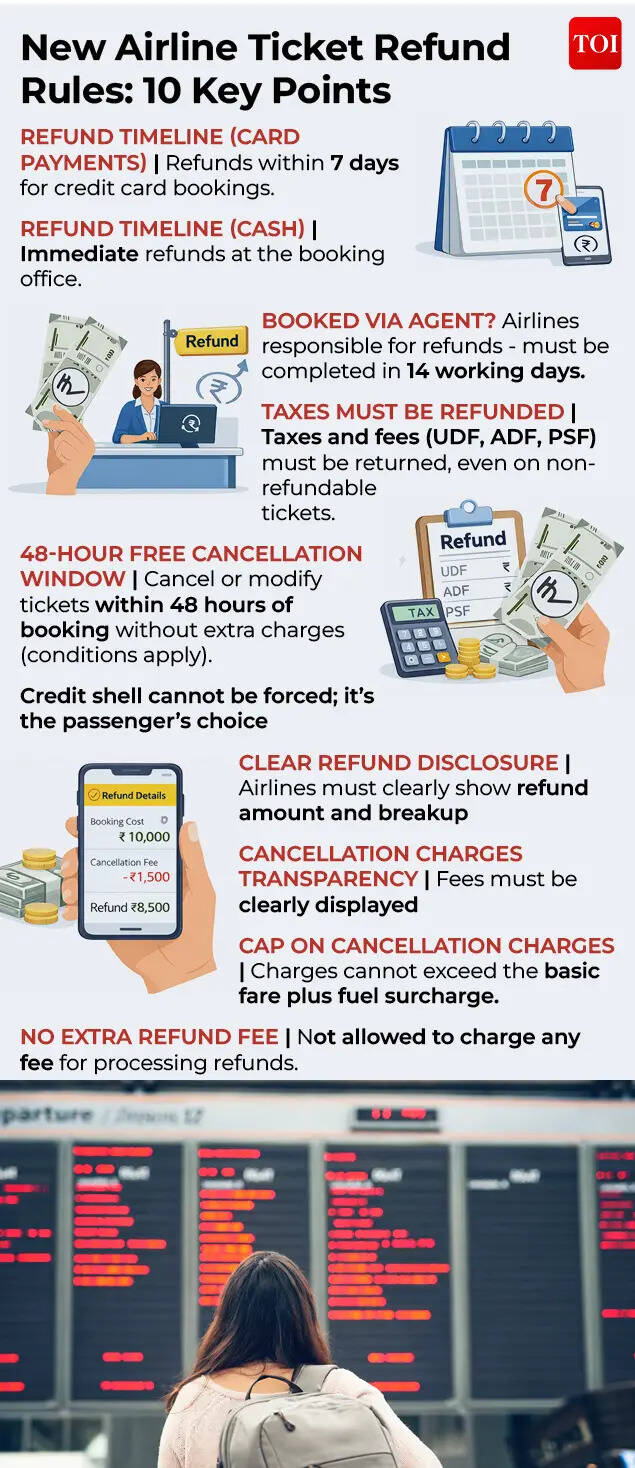
- Airlines have also been asked to make the refund amount clearly visible along with a detailed break up. The amount and the break-up can be indicated on the ticket or any separate form for this purpose. The refund policy and amounts are required to be displayed on the airline’s website as well.
- For the knowledge of passengers and for the sake of transparency, airlines have been asked to prominently display the cancellation charges at the time of the flight ticket booking
- The DGCA guidelines are unambiguous: Under no circumstances, can the airline or its agent implement a cancellation charge that is more than the basic fare plus fuel surcharge. However, this excludes any charges that are levied by the travel agent, which have been fully disclosed at the time of booking. The airline is responsible for this through their contracts with travel agents/portals.
- Foreign carriers that operate to and from India have to refund the tickets in accordance with regulations of their country of origin.
- In case your name is wrongly spelt or incomplete, an airline cannot charge you extra for correction in the name of the same person. This is applicable when the error is pointed out by the passenger within 24 hours of making the booking when the ticket is booked directly through the airline website.
- If you are cancelling your flight ticket due to a medical emergency, where you or your family member who is listed on the same PNR gets admitted/hospitalized during the travel period, airlines have been asked to provide either a refund or a credit shell. For other situations, refunds will be issued by the airline once an opinion on the passenger’s fitness to travel certificate is received from an airline’s aerospace medicine specialist or a DGCA empanelled aerospace medicine specialist.
Apart from this, recently the government asked airlines not to charge additional fee for seat allocation for up to 60% seats on domestic flights. Similarly, passengers on the same PNR have to be seated together. Currently, 20% of the flight seats can be booked free of charge.According to a PTI report, airlines are in the practice of charging anywhere between Rs 200 to Rs 2,100 for choosing seats.
How Do New Refund Rules Benefit Passengers?
Aviation experts are of the view that the new rules address a bulk of complaints from passengers. However, they stress on the need for effective implementation and also further steps to ease the gap between travel agent, portals and airlines.Ashish Chhawchharia, Partner and Aviation Industry Leader at Grant Thornton Bharat is of the view that the revised DGCA refund framework revises passenger rights and airline obligations, making the latter more accountable. “The most immediate benefit will be the reduction in refund timelines, mandating refunds within seven days for credit card transactions when purchased directly from the airline and 14 working days when purchased through agents/OTAs,” he tells TOI.“Further, by mandating that taxes, UDF and PSF needs to be refunded in all instances, DGCA has proposed to streamline and curb various extortionate practices often deployed by airlines or agents,” the aviation expert adds.
More clarity on the limits on cancellation charges and timelines for refunds will improve passengers’ confidence in the booking process and address one of the main passenger grievances.“It would have been beneficial if DGCA could have also introduced measures to the ever-increasing tariffs charged by the airlines for excess baggage and seat selection,” he adds.Dr. Preet Sandhu, Founder & MD, AVPL International tells TOI that the guidelines mark an important shift for passengers. “For many travellers, prolonged refund delays have been a source of genuine frustration, so this clarity and commitment to timelines will certainly bring relief,” he says.“The 48-hour free cancellation window for domestic flights booked at least 7 days in advance also offers people the confidence to review their plans without feeling financially locked in. These are practical steps that will make air travel less stressful for sure,” he adds.For Sandhu, one particularly meaningful correction is the requirement that airlines obtain explicit passenger consent before issuing credit shells. In the past, many passengers found themselves automatically moved to vouchers instead of receiving cash refunds. “Restoring that choice is important. It aligns India more closely with global aviation practices and could reduce grievances by an estimated 30 to 50 percent based on previous complaint trends,” he believes.
What Do New Rules Mean For Airlines?
Dr. Preet Sandhu says the operational implications for airlines cannot be ignored. “During large-scale disruptions such as adverse weather, refunding at this pace may tighten liquidity, particularly when bookings are routed through agents but responsibility rests with the airline. With cancellation charges capped at the basic fare plus fuel surcharge and processing fees no longer permitted, traditional revenue buffers will narrow,” he tells TOI.
“We have already seen the regulator take enforcement seriously, including the Rs 22 crore penalty imposed on IndiGo, which underlines the intent behind these reforms,” he notes.Ashish Chhawchharia of Grant Thornton Bharat says that compliance may not be a huge challenge for airlines in adapting their IT systems, however, adverse impact of these measures is expected on their cashflow cycles and working capital requirements. “This would be especially relevant in case of substantial refund requirements due to large scale disruptions such as weather events, geo-political events like we are witnessing at present or public health crises we faced during Covid,” he says.“Overall, these reforms address the bulk of passenger grievances including delayed refunds, hidden charges, and lack of choice. Yet, further measures could strengthen consumer protection, including automatic refunds triggered at cancellation and stricter enforcement mechanisms to ensure compliance,” Ashish Chhawchharia adds.Dr. Preet Sandhu says that areas like agent mark-ups may still need further oversight, but the overall framework is moving in the right direction. As he concludes: These guidelines address long-standing concerns that we all faced around delays, forced vouchers, and opaque fee structures. The intent is constructive. The next phase will depend on consistent enforcement and technology-driven systems that can manage mass disruptions efficiently without compromising either passenger rights or operational stability.


