



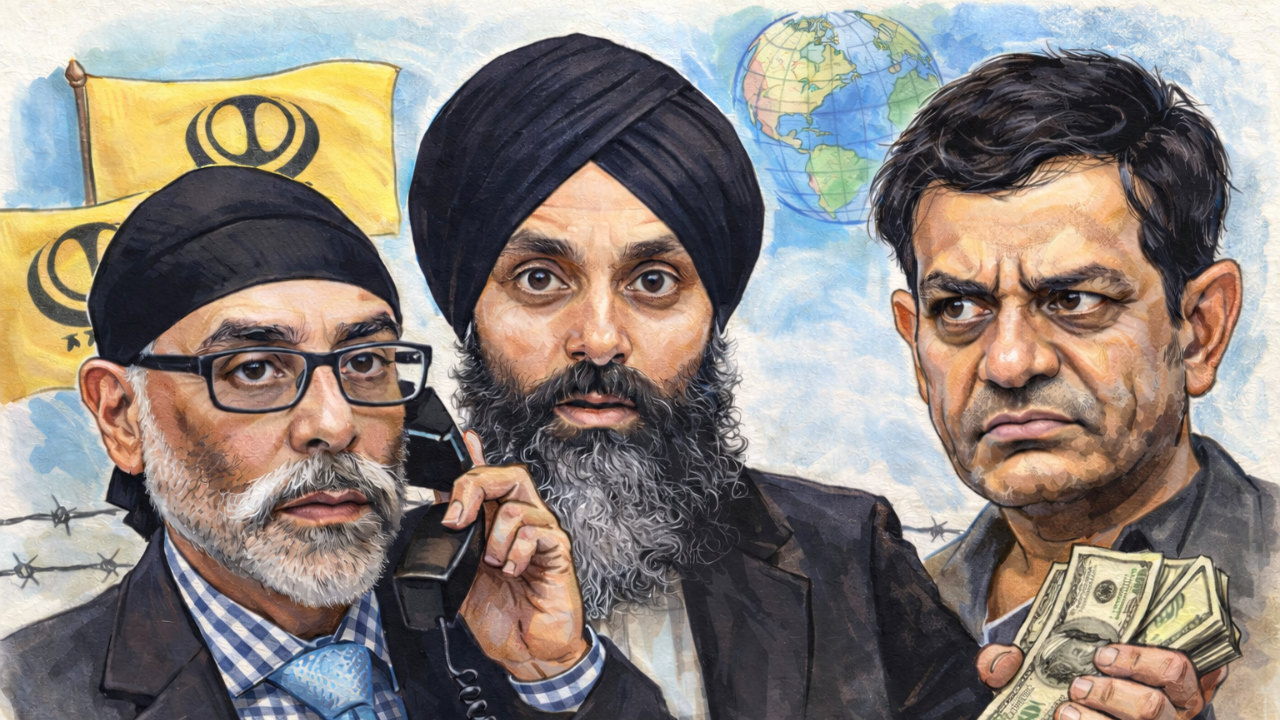
New Delhi: On June 17, 2023, Hardeep Singh Nijjar – a Khalistani separatist designated as a terrorist by India – reportedly called his close aide Gurpatwant Singh Pannun to warn him of what he described as a “serious threat” to his life. The conversation later gained attention as investigators pieced together the final hours before her murder.The next day, Nijjar was shot dead by assailants in the parking lot of a gurudwara on the outskirts of Vancouver. Media reports quoted witnesses as saying that a white sedan stopped, after which the attackers approached and opened fire, firing dozens of rounds before fleeing. The brazen nature of the attack immediately pushed the case beyond local criminal investigation and into the realm of international scrutiny.
In the weeks that followed, diplomatic relations between New Delhi and Ottawa were strained following the death of the former Canadian Prime Minister justin trudeau Said authorities were investigating allegations of a possible Indian connection to the killing – a claim India has rejected. Around the same period, US officials revealed that they had disrupted a separate plot targeting Pannun. Acting on intelligence inputs, Czech police arrested Indian national Nikhil Gupta at Prague airport about a week after Nijjar’s death, triggering a parallel legal and diplomatic track.The US Justice Department claimed that Gupta was involved in an alleged plot directed by an Indian government employee to target and assassinate Pannun. The DOJ also said Gupta had ties to international narcotics and arms trafficking and was linked to the murder of Nijjar.India’s external intelligence agency, the Research and Analysis Wing, came into the limelight after officials in both countries linked it to alleged assassination plots targeting Hardeep Singh Nijjar and Gurpatwant Singh Pannun.But what actually happened? Was this a poorly executed covert operation, the work of a rogue operator, or an entirely different case involving a third party?To understand this, one has to know the list of characters of the play.
Hardeep Singh Nijjar
- Nijjar was a Sikh separatist initially associated with Babbar Khalsa International (BKI). New Delhi has listed BKI as a “terrorist organisation” and said it is funded by Pakistan’s Inter-Services Intelligence (ISI), a charge Islamabad denies.
- Nijjar later became the leader of the militant group
Khalistan According to a 2020 statement by the Government of India, the Tiger Force (KTF) was “actively involved in operations, networking, training and financing” of its members. - New Delhi officially classified him as a “terrorist” in the same statement, and said he was involved in “promoting treasonous and subversive charges” and “attempting to create disharmony between different communities” in the country.
- On June 18, 2023, he was shot by assailants in the parking lot of a Gurudwara in Vancouver, Canada.
Gurpatwant Singh Pannun (“victim”)
- Gurpatwant Singh Pannun is a dual US-Canadian citizen and a close associate of Nijjar. He is also a designated terrorist in India and a supporter of Khalistan.
- Pannun, also a US-based lawyer, is considered the brainchild of Pakistan’s intelligence agency ISI and has been one of the most vocal supporters of Khalistan in recent years.
- Pannun has posted several video messages on social media, often threatening Indian leaders, diplomats and Hindus.
Nikhil Gupta
- Nikhil Gupta alias Nick is an Indian national who posed as an international dealer of narcotics and arms.
- On June 30, 2023, Gupta was arrested in the Czech Republic and later extradited to the United States.
- He is a co-accused in the alleged murder conspiracy case targeting Pannun.
Vikas Yadav
- Vikas Yadav, earlier identified as CC-1.
- Yadav is an alleged Indian intelligence officer who is accused of conspiring with India. He was previously serving in the Central Reserve Police Force (CRPF).
- Yadav was arrested by the Delhi Police in December 2023, though in an entirely separate case of extortion and kidnapping. He was later granted interim bail in March 2024, followed by regular bail a month later. The matter is still under consideration.
CS (Reliable Source)
- Gupta is approached for assistance in contracting a hitman for a job in New York City.
- was actually a confidential source working with US law enforcement.
UC (Under Cover Agent)
- The alleged hitman whom CS had introduced to Gupta.
- He was actually an undercover American law enforcement officer.
How was Gupta caught?According to the US Justice Department, Nikhil Gupta plotted Pannun’s murder at the direction and coordination of Vikas Yadav – whom US authorities identified as an Indian government employee.James C. Barnacle Jr., assistant director in charge of the FBI, said, “At the direction and coordination of an Indian government employee, Nikhil Gupta plotted the assassination of a United States citizen on American soil.”According to the second superseding indictment and statements made in court, Yadav was employed by the Cabinet Secretariat of the Government of India, which houses India’s foreign intelligence service, the Research and Analysis Wing.“In or about May 2023, Yadav recruited Gupta to plot the murder of a ‘victim’ in the United States,” the Justice Department said.On Yadav’s instructions, Gupta contacted a man whom he believed to be his criminal associate. That person was actually a confidential source working with the Drug Enforcement Administration.The confidential source introduced Gupta to an alleged hitman who was actually a DEA undercover officer.“In a deal later brokered by Gupta, Yadav agreed to pay UC $100,000 for the murder of the victim,” the release said.“On or about June 9, 2023, Yadav and Gupta arranged for an associate to deliver $15,000 in cash to UC as advance payment for the murder,” it said.Gupta pleaded guilty to federal charges on February 14 and admitted to three counts: murder for hire, conspiracy to commit murder for hire, and conspiracy to commit money laundering.India’s stanceIn 2023, a high-level panel constituted by the Center – which was formed after the US flagged the activities of certain organized criminal groups, terrorist organizations and drug smugglers that “undermine the security interests of both India and the US” – claimed that Vikas Yadav had “criminal connections”, but insisted that the episode was a “rogue” operation, denying state-sponsored intent.The Ministry of External Affairs has also reiterated that Yadav, who had served in the CRPF in the past, is no longer in government service.Has Vikas Yadav gone rogue?Serving and retired officers of security agencies believe that the whole affair appears to brazenly violate every rule in the book, which even novice trainees of any agency across the world would not do.A retired government official told The Times of India, “Forget a senior one – any mid-level official in an agency would have shut it down immediately given the number of red flags the entire case raised.”
“The handlers never communicated directly with low-level criminal intermediaries using traceable electronics. Yet, DOJ documents show that Yadav and Gupta exchanged regular messages on encrypted platforms that were clearly compromised,” the official said.“In the actual operation, the handler is a ghost; here, Yadav masquerades as a digital pen pal. The ‘trap’ wasn’t just visible; he was screaming.”On June 9, 2023, the conspirators arranged for an associate to hand over $15,000 in cash to an undercover agent in Manhattan. According to officials, it was a “financial op-sec suicide”.Instead of going “dark” after Nijjar’s murder, Yadav allegedly sent Gupta a video of Nijjar’s bloodied body and a message saying that the New York target was now a “priority”.One official said, “By discussing a murder so casually and obviously linking the two hits, they gave up all deniability and handed the DOJ the story of an international repression conspiracy.”what now?According to a joint statement from the FBI and DEA, Gupta will be sentenced by US District Judge Victor Marrero on May 29, 2026.By pleading guilty to murder-for-hire and money laundering charges, Nikhil Gupta would have achieved a reduction in the maximum sentence of 40 years through an “acceptance of responsibility” credit.While the combined charges carry a maximum statutory sentence of 40 years in prison, a guilty plea generally brings a reduction under federal sentencing guidelines.Gupta, 54, may still have to serve about 80% of his jail time. Under US law, if he is sentenced to more than 12 months, he will be eligible for a reduction of up to 15% for good behavior while in prison.


