



It gets night early here. The yellow haze of a lone dirty streetlight struggles to dispel the darkness. It is only 10 o’clock at night but as the cold in the chawl increases, the streets are becoming increasingly empty. The only sign of life next to a clump of huts is where six men are tuning their instruments, the centerpiece an old harmonium held together by a patchwork of black tape. With a makeshift canopy above their heads and a lime-green carpet spread out in front of them, the men gather together for warmth and prepare their repertoire. In front of the troupe a slow crowd of people devoid of even basic glamor is gathering – all middle-aged, all poor, all raring to go.
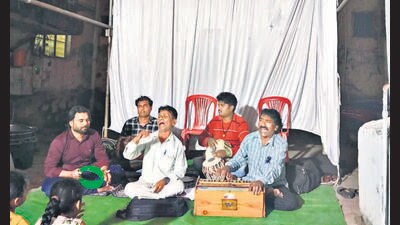
Such scenes are not uncommon in the interior of India, where folk artists often hold all-night shows or jalshas. But Gautam Awadh’s group is different. There will be no devotional songs or stories of divine miracles in his performance. Instead, over the next few hours, Awad and his musicians will sing about India’s founding document, using Marathi poems and folk songs to highlight how the Constitution has changed the lives of India’s marginalized castes. “In India, a rag picker can become a ruler – this is the miracle of the Constitution. This is our first song,” said Awad, whose troupe is hired by grassroots communities to mark various occasions like Republic Day, weddings or funerals.
This is not an economically profitable activity; When Awad started singing about the Constitution in 1968, the one-night stand became a fascinating 60. Today, it could be anywhere in between 2,000 more 4,000. Yet, the expanse of Maharashtra is filled with folk shaheers or folk artists who travel from village to village singing about the Constitution. His untrained voices and the sound of his harmonium have created a strong grassroots link between the Constitution and the common people whose lives it rules.
“It is a long tradition, as old as the Constitution. Through their words, these artists are viewing the Constitution not just as a legal document but as a social code of equality and self-respect, said Milind Awad, professor at Jawaharlal Nehru University.
Folk arts for social change
The practice of writing and performing songs and poems about the Constitution came to prominence during the 1950s when a young republic was coming to terms with the new social and moral codes unveiled by the document. Far from mainstream appreciation, these folk artists commanded loyal followers in the hinterland. “Maharashtra has a history of folk art like Tamasha, from where genres like Jalsa were born. The lavani that is popular today is also a branch of the same tree,” said Atul Yerekar, a doctoral candidate at the Tata Institute of Social Sciences, Mumbai.
His father, Sahebrao Yerekar, is one of the most famous exponents of this genre, who turned to questions of similarity in devotional songs under the tutelage of the 19th-century reformist Jyotiba Phule, who used songs and poetry to highlight rationalism. Did. A resident of Parbhani district, Yerekar senior was a disciple of the Ambedkarite Marathi poet Vamandada Kardak and started singing hymns in praise of the Constitution at the age of 12. “We had a troupe of nine people – playing the tabla. Harmonium, banjo, drums and chorus. The demonstrations usually last till night and include songs and drama based around the Constitution,” he said.
Unlike mythological plays or devotional songs, the Constitution was a much more serious subject – but according to Yerekar senior the singers used the extraordinary life of Dr BR Ambedkar to make a connection.
“Babasaheb’s image was enough to attract people. We will include his life story in our songs – the discrimination he fought and the challenges he overcame. And we’ll talk about how the Constitution made it possible for people like us to go where we want and hold our heads high.”
This was a time of intense conflict and songs about the Constitution were often seen by upper caste groups as a proxy for Dalit assertion, leading to violent reactions. “Every week, there was some or the other clash. People will abuse, file cases against us. There used to be fights after the programs because the upper castes did not believe that we had organized our own cultural programs. They beat us,” Yerekar Sr. said.
‘Challenge the dominant culture’
In the quest to convey the message of the Constitution to the people, each generation of activists faced its own challenges. For lyricist Sambhaji Bhagat, whose life was made famous by the 2014 National Award-winning film Court, that obstacle came in the form of communalism and cultural dominance that threatened to erase the lives of marginalized castes in the 1990s.
“Whether it was the Babri Masjid demolition or brutal caste attacks, we campaigned to protect the Constitution. We would go from door to door and sing songs; And we don’t drink water until we touch five houses and talk to them about the Constitution,” Bhagat said.
His booming voice and signature locks are now a mainstay of the Marathi theater scene; Bhagat moved to Mumbai in the 1980s and lived in the now-demolished Siddharth Vihar hostel, where he gave talks about the Constitution and liberation from the center of anti-caste ideas. “From that experience, it was clear to me that we have to talk to the youth about the Constitution. So we started Insaniyat ki Pathshala (School of Humanity), where we held an hour-long class every Sunday in the slums, and talked to the children about the Precepts, including songs and games,” he said. .
For him, the power of the common man lies in challenging the dominant culture. “Look at us, we are little men with insignificant lives. We have neither money nor influence. But we have songs and constitution. To better humanity, this is enough,” he said.
great art comes from struggles
Many of the men and women who sing about the Constitution come from poor families and marginalized backgrounds, their poems inspired not by legal knowledge but by the grassroots changes – such as the abolition of untouchability – that the Constitution brought about.
“Their constitutionality goes beyond legal procedural text. They are helping to replace the general understanding of caste society with a new good understanding of rules and system. Milind Awad said, “These songs are a celebration of those oppressed by social inequalities and caste.”
Rekha Bharti is one of them. A resident of Chhatrapati Sambhaji Nagar, Bharti started singing at the age of eight and using the Qawwali style, has since made a name for herself with her troupe – Rekha Bharti Ani Sanch – which she formed in 1991. Sakhubai Salve is the second one. The 60-year-old woman is illiterate, but often jokes about how she can perform any song by keeping it on her personal computer – her mind.
For female singers, rejection often comes from within their families, said Samiksha Bamne, a female poet whose troupe – Sanvidh Sanskruti Jalsha – presents short plays about the Constitution. “Many members of my own group face pressure to leave the stage, and certainly, among our generation, these forms of art are not seen as good,” the law student said. “There is a fear that the tradition is waning, although some of our most enthusiastic listeners are domestic workers and women victims of violence.”
carrying on the legacy
It’s now a few minutes before midnight and Gautam Awad’s energy is slowing down a bit. As the old man stops to take a sip of water, his younger colleague Rajesh Tupe takes out the big notes. He is 29 years old, one of the handful of youngsters who are carrying on the tradition of writing songs about the Constitution. But he is not happy.
“Violence may have reduced but the prejudice of the ancient era has not ended. There is still no intermarriage or intermingling between the higher castes and our castes; They do not allow us to enter temples. Even if our keyboard artists play tunes in praise of Baba Saheb, they are attacked. No matter how much you try, they don’t understand (you can try to make them understand, but they won’t understand).
But Gautam Awadh advises to remain calm. The elder has lived through the turbulent times of the 1970s and 80s, when Dalit communities were attacked just for invoking the Constitution, where a movement demanding renaming of a university to include Dr Ambedkar lasted for 16 years. It took four lives and was sung against the social strictures of caste that often invite violence.
“We were scared but we never stopped singing. After all, this is our Constitution,” he said. Pointing to the half-full glass of water still in his hand, he recalled the time when he was 20 and he was slapped in the middle of a show in his aunt’s village because He had dared to ask for a glass of water from the common well. , “The village bullies thought they would stop us,” he said, laughing.
“But what is more powerful than the Constitution?”


