



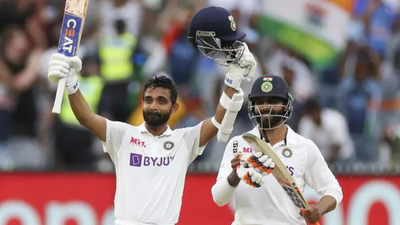
On this day in 2020, December 27, Ajinkya Rahane played an innings that quietly altered the course of Indian Test cricket. It did not come wrapped in noise or bravado. It arrived in the aftermath of trauma. India had been bundled out for their lowest-ever total in the previous match – a humiliating 36 all out in Adelaide. Captain Virat Kohli had flown home on paternity leave. Mohammed Shami was ruled out of the tour. Umesh Yadav was injured. Confidence was fractured, belief questioned, and Australia sensed blood. What followed at the Melbourne Cricket Ground was not merely a response but a reclaiming of dignity, led by a stand-in captain who spoke with his bat.India began the second Test carrying the weight of collapse and expectation. When Day 2 started, they were 36 for 1 after Australia had been bowled out for 195, the echoes of Adelaide still loud. The morning was overcast, the ball moved, and Australia’s fast bowlers bowled disciplined lines.
Australia struck early. Shubman Gill and Cheteshwar Pujara fell in quick succession, briefly threatening another collapse. Yet Rahane stood firm. From the very first delivery he faced, there was clarity in his intent. He drove straight when the ball was full, pulled with control when it was short, and trusted his defence when Australia searched for errors. A dropped catch on 78 off the second new ball proved decisive. Rahane marched on, making Australia pay for every missed chance.He stitched the innings together patiently. Partnerships with Hanuma Vihari, Rishabh Pant, and eventually Ravindra Jadeja rebuilt India’s hold on the match. Vihari and Pant showed promise before falling, but Jadeja became the perfect partner. Jadeja left well, chose his scoring areas carefully, and allowed Rahane to dictate the tempo. Their century stand for the sixth wicket broke Australia’s resistance. The bowlers tired, the new ball lost its threat, and frustration crept in. Even when Starc struck Rahane on the handle late in the day, fortune stayed with him as another chance was spilled. By stumps, India had surged to 277 for 5 and momentum had firmly shifted. Rahane’s century was not just technically sound; it was emotionally stabilising. It gave India belief when very little existed.Rahane’s stay ended on 112 off 223 balls the following morning, in unfortunate fashion — run out after a mix-up following Jadeja’s call. There was no visible frustration or anger. Instead, Rahane walked back and gently patted Jadeja on the shoulder, a quiet acknowledgement that such moments are part of the game. Only a week earlier in Adelaide, Rahane himself had been involved in Virat Kohli’s unfortunate run-out, a moment that triggered India’s dramatic collapse in the first innings. Perspective came easily to him. India eventually added a few more runs to be bowled out for 326, but by then the damage to Australia had already been done.Australia’s second innings only deepened the shift. India strangled their scoring, conceding almost nothing. Australia were bowled out for 200 in 103.1 overs, their slowest home Test innings in decades. They did not manage a single half-century. R Ashwin closed it out, Jasprit Bumrah provided the hostility, and Mohammed Siraj continued his remarkable rise. India were left chasing just 70.There were flickers of tension. Mayank Agarwal fell early. Pujara followed. Memories of 36 briefly hovered. But this was not the India from Adelaide. Shubman Gill batted with freedom, and fittingly, it was Rahane who struck the winning runs. India went from humiliation to dominance in the space of a week.That hundred at Melbourne did more than win a Test. It reset the tour. It restored belief. It laid the foundation for what would become one of India’s greatest Test series victories. Quietly, without theatre, Ajinkya Rahane played one of the most important innings in Indian cricket history.Rahane will forever remain an enigma in Indian cricket. Over the years, he played several outstanding overseas innings, often in some of the most difficult conditions imaginable. He remains one of the rare Indian batters whose Test average away from home is better than his record in India, a statistic that speaks volumes about his technique and temperament. Remarkably, India have never lost a Test match when Rahane scored a century, and under his captaincy, the team remains unbeaten in Test cricket.At the same time, his overall numbers never quite reflected the full extent of his ability. An average of 38.46 does not truly capture the quality of a batter who delivered when conditions were hostile and margins were fine. Rahane’s last few home series were particularly challenging, played on surfaces where batting was extremely difficult and excessive turn made run-scoring a constant struggle. These conditions did not affect him alone. The averages of Cheteshwar Pujara, Rahane, and Virat Kohli all took a hit during this phase, largely because India played on wickets where survival itself was an achievement.Rahane played his final Test in 2023 against the West Indies. He had earned a recall for the World Test Championship final earlier that year and responded by finishing as India’s highest run-scorer in the match, with scores of 89 and 46 in the two innings. That performance briefly suggested a late-career revival.However, the subsequent tour of the West Indies proved disappointing. India played two Tests, but the runs did not come. Soon after, he was dropped from the Test side. Since then, Rahane has remained out of the national team, and it appears highly unlikely that he will represent India in Test cricket again.His career, much like his personality, defied easy definition. Understated, resilient, and often underappreciated, Rahane leaves behind a legacy that stats alone cannot fully explain.


