



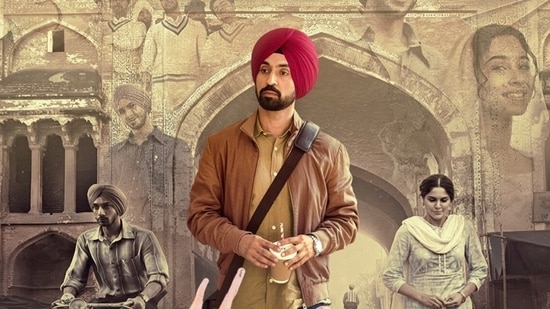
New Delhi, A woman on her deathbed has lost all memory but one: the doll she perhaps left in her home in what is now Pakistan. An old man remembers his teen romance that was never to be. It is these “small, small stories” that helped Imtiaz Ali knit together his Partition film Main Vaapas Aaunga.
Imtiaz Ali talks about Main Vaapas Aaunga
“I never wanted to make a film on the Partition if I had nothing unique to say. I did not want to report an incident,” Ali told PTI about his latest film that reunites him with his “Amar Singh Chamkila” star Diljit Dosanjh, longtime collaborators A R Rahman and lyricist Irshad Kamil.
It is a story about 1947 but told through the eyes of the youth of today. In that sense, Ali said, it is the story of a person but also of a nation.
“When the battle is lost and won, what is it that remains? What is it that will remain in the mind of a person who is now unable to exit the stage of the world without making some change to the events of what happened in 1947?”
On a large scale, migration is the story of the century for the whole world, Ali said, adding that the most significant event that ever happened in the Indian subcontinent was the Partition.
“But in retrospect, 78 years later, when many, many things are forgotten, what is intensely remembered is the tenderness of early youth and romance to which we return when we go to 1947. So it is such a story,” Ali said.
The interest in Partition stories began perhaps with the writings of authors such as Saadat Hasan Manto, Ismat Chughtai and Qurratulain Haider. And it got reinforced during his extensive travels through Punjab, Himachal and Delhi for his movies Jab We Met, Love Aaj Kal, Highway, Rockstar and his last hit Amar Singh Chamkila. That’s when he got a chance to meet those who had actually been displaced during Partition and listen to their stories.
“One of them was about an old woman who was on her deathbed and had lost her memory and she was dying. Seventy-eight years have passed since Partition. And she was only obsessed with asking everybody, ‘Have you put the doll in the sandook’?”
The filmmaker found the personal accounts “deeply significant and human and also entertaining”.
In the film, actors Vedang Raina and Sharvari play young lovers while Naseeruddin Shah plays Dosanjh’s grandfather remembering his past love.
Main Vaapas Aaunga also features Dosanjh singing a composition of Rahman, Kya Kamaal Hai, something they could not manage in Chamkila that is a biopic on the late Punjabi singer Amar Singh Chamkila. Dosanjh, playing the singer, could only be the voice of Chamkila.
The director has collaborated with Ranbir Kapoor, Deepika Padukone and Randeep Hooda on many films. This is the first time that he is working with an artist right after the critically-acclaimed Chamkila.
Ali said he didn’t immediately think about Dosanjh while writing the story but then realised that there was no one better than the actor-singer to play the character.
“I feel that Chamkila could not have been made if Diljit wasn’t there. But perhaps he is even more suited to this part because of who he is, where he comes from and how he thinks.”
Shah came on board after he saw Chamkila and quite liked the film.
“There is no actor like Naseeruddin Shah. And I was very excited by the prospect of having him play a Sikh, a turbaned Sikh, because I didn’t remember him playing that part ever. So I was very excited about that. And he was also very excited about that. We have carved his character around the person that is remembering the olden times.”
The younger pair, Raina and Sharvari, are at an age where they are hungry and trying to explore the depths of their own talents, he said.
“I felt that these are such actors that I feel I have to be on my toes while working with them. Because they have the energy to rehearse again and again. To want to discuss more and more. To make sure that everything about the film, not only their parts, but everything about the film comes out in the most beautiful way. Many young actors that I meet are like that.”
Main Vaapas Aaunga, produced by Sameer Nair and Deepak Segal of Applause Entertainment, along with Mohit Choudhary and Shibasish Sarkar of Window Seat Films, releases theatrically on June 12.
Ali is hoping he manages to surprise audiences with a film that’s unique and has something new to say.
“…I feel the audience of this country wants good cinema, entertaining cinema,” he said, adding that he is very thankful to Dhurandhar and Saiyaara for bringing back crowds into theatres.


