



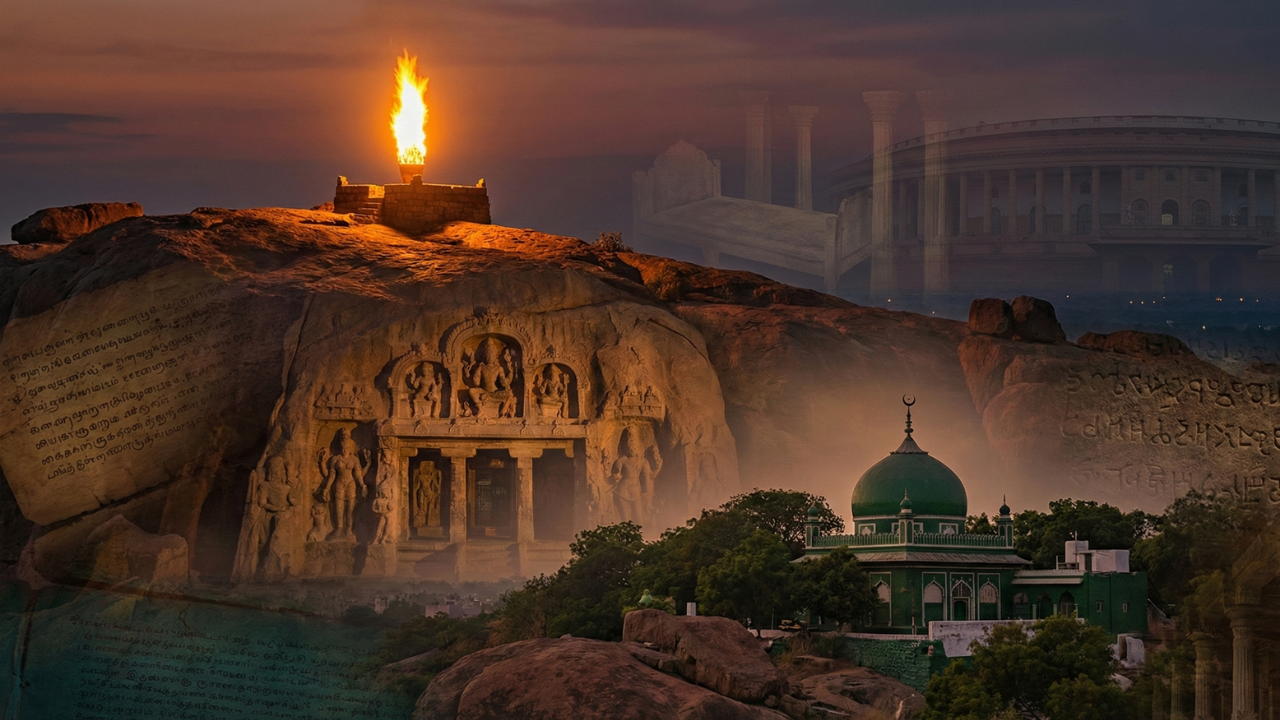
Rising at the edge of Madurai, Thiruparankundram in Tamil Nadu‘s Madurai has served as sanctuary, landmark, battlefield, shrine and memory for centuries. First to Jain monks who chiselled beds into its stone nearly 2,300 years ago, later to poets of the Sangam age who immortalised it as Murugan Kundram, and eventually to monarchs, pilgrims and mendicants who left inscriptions and belief layered into its slopes.Across centuries, the hill took on meanings that were never singular. It became a sacred space for Murugan devotees, a site associated with the god’s divine wedding, a spiritual retreat that bore Jain inscriptions in early Tamil script, and by the 14th century, a place of significance for followers of Sikandar Shah, whose memorial evolved into the Sikander Badusha Dargah. As rituals shifted and dynasties changed, Thiruparankundram continued to absorb new customs into its landscape.For generations of residents, the hill’s story was not interpreted through boundaries or separations, but through the shared steps people climbed and the shared festivals they observed.Today, that long history forms the backdrop against which new questions are being posed about space, symbolism and tradition. A debate that has become a flashpoint between devotees in courtrooms and a stage for fresh DMK vs BJP.
A hill that carries centuries of coexistence
Thiruparankundram occupies a singular place in Tamil Nadu’s cultural and religious landscape. Recognised as one of the Arupadai Veedu, the six sacred abodes of Lord Murugan, it is revered as the site associated with the divine wedding of Murugan and Deivanai, a narrative deeply embedded in Tamil devotional literature and temple ritual.
References to the hill appear in Sangam-era texts such as ‘Akananuru’ and ‘Thirumurugatrupadai’, indicating that its sanctity has been acknowledged for well over two millennia. Archaeological evidence traces the hill’s significance even further back: around 2,300 years ago, Jain monks carved stone beds with Tamizhi-era inscriptions along its slopes, marking it as a place of spiritual retreat long before the temple infrastructure seen today.By the sixth century, the site appears in the ‘Tevaram’ hymns as ‘Parankundram’ and over time it evolved into a complex centre of worship. In the eighth century, Pandya ruler Parantaka Varagu and General Santhan Ganapathy commissioned a rock-cut temple dedicated to Soma Skanda, depicting Shiva, Parvati and Murugan together.The temple houses shrines for Vishnu, Vinayaka, Durga, Jyeshta Devi and others, representing the Panchayatana tradition of multiple deities within a single sacred complex. Inscriptions from the period, including one from 773 CE referencing the worship of Jyeshta Devi, showcase a layered ritual ecosystem that adapted and expanded with dynastic rule and regional belief.The history of the hill took another turn in the 14th century. During the Madurai Sultanate, following the invasion led by Alauddin Khilji’s general Malik Kafur, the region came under the rule of ten Muslim sultans. The last among them, Sikandar Shah, is believed to have sought refuge in the hills before being killed. A memorial to him eventually transformed into the Sikkander Badusha Dargah, developing into a site of devotion where followers regarded him as a Sufi saint. According to researchers and local oral histories, including interpretations cited by the Thiruparankundram Jamath, a Pandya ruler is said to have sanctioned a prayer site out of repentance, a narrative symbolising reconciliation rather than conflict.
Over centuries, religious practices have evolved on this hill through shared participation. One such tradition is ‘kandoori’, a practice involving offering and sharing of meat as thanksgiving, described by the Jamath as conceptually similar to nerthi kadan in Hindu customs where vows are fulfilled through food or offerings. Members of the Muslim community note that Hindus have historically participated in kandoori rituals, while Muslims join in temple festivals, tonsuring infants’ heads and celebrating street processions.
Living together on sacred stone – The people of the hills
Local residents often describe the hill’s identity not through the lens of division but through shared spaces and shared customs. C Santhalingam, a former officer of the Tamil Nadu archaeology department told TOI that Thiruparankundram is “among the most unique as it is a place where histories and faiths intersect.” He emphasises that the hill “has never belonged to one community,” pointing out not only the temple and the dargah but also the Jain beds with inscriptions, evidence of its long and diverse spiritual heritage.However, Santhalingam and others note that in recent months, debates surrounding religious practice have begun overshadowing this legacy of coexistence. A disagreement over a signboard referring to facilities for kandoori rituals triggered a fresh set of tensions in February this year, leading to protests, petitions and involvement from political stakeholders.
“Kandoori is not an orthodox Muslim practice,” M Arif, secretary of Thiruparankundram Jamath told TOI in February. “It is closer to gurbani, where meat is shared after an animal is butchered. In kandoori, a person makes a wish, cooks food, and shares it, which is like the Hindu practice of nerthi kadan (offering food or some valuables as a vow).”Jamath member A Abudahir said even Hindus in the area followed kandoori and offered prayers at dargahs. “We are not outsiders. We are Tamil Nadu’s people. It’s just that we have some unique customs. Even today, we tonsure our newborns’ heads like they do in Hindu rituals before we offer kandoori at the hilltop dargah,” he said. Sathya Seelan, a third-generation hairdresser, said that for generations, his family has been tonsuring the heads of those who participate in the kandoori ritual. “A decade ago, some people earned money by carrying goats and cooking materials up the hill for this ritual,” he said. During the annual Santhakoodu festival, much like a temple car festival, a decorated dome placed on a cart is drawn through streets, said Abudahir. “People apply sandalwood paste to the dome in memory of Sikandar Shah. All Hindus participate and we have never had any issue. We also enjoy the temple car festival.”The dispute over lighting the Karthigai deepam is seen by many locals as part of a broader shift, where questions of space, symbolism and historical rights have become increasingly contested.For much of its past, the hill held room for many traditions at once, and its rituals adjusted to the rhythms of diverse communities. The current debates, both legal and political, revisit unresolved questions from earlier decades, but they also reflect contemporary anxieties over identity, culture and authority. As many long-time residents reiterate, conflict is not the oldest story of Thiruparankundram; coexistence is.Today, this hill is the focus point of DMK vs BJP in Tamil Nadu. The issue has echoed from Parliament o Supreme Court.However, legal disputes around ownership and ritual usage of the hill began in the early 20th century, long before the current political and administrative controversy surrounding the Karthigai deepam ritual.
Who owns the hill?
In the 1920s, both the temple administration and the dargah trustees approached the courts seeking recognition over sections of the hill. The case travelled through the colonial judiciary, and the Privy Council eventually upheld the temple’s ownership of the hill. It also recognised a small but significant portion of land to the dargah. Although the judgment settled ownership, it did not address ritual traditions or determine exclusive religious rights at various points on the hill. That space later became ground for differing interpretations.For decades following this verdict, the Karthigai deepam festival proceeded without becoming a symbol of territorial claim. The lamp was lit at the Uchipillaiyar temple mandapam, a practice widely recognised and rarely challenged. The serenity broke only in the 1990s, when the first petition asked that deepam be shifted upward to Deepathoon.
When devotees moved to court for sacred lamp
In 1994, a devotee approached the Madras high court demanding the lamp be lit at the hilltop pillar instead of the Uchipillaiyar mandapam. In 1996, the court responded by affirming the mandapam as the “traditional spot”. This was the first time the spot for lighting the flame was confirmed, keeping it at a safe distance from the dargah.It was an order rooted in practicality but written with ambiguity. It left the door open for a possible change in the future.Almost two decades later in 2014, another petition revived the same demand. The court rejected the plea again, asserting that devotees cannot enforce ritual preferences in court and that judges must not intervene in spiritual practices unless administrative failures are proven. In 2017, a division bench upheld that reasoning. Temple management, the court reiterated, retains autonomy over rituals, locations and modalities. These pronouncements seemed settled law. But the Karthigai deepam debate is yet far from its final chapter.
A new legal question built on old legislative stones
In 2024, Hindu Tamilar Katchi founder Rama Ravikumar filed a fresh petition. His argument rested on three pillars:
- the 1920 decree gave the temple ownership of the hill and thus rights over ritual space;
- no judicial order specifically prohibited lighting the lamp at Deepathoon;
- refusal to even consider the location violated fairness and procedure.
On December 1, Justice GR Swaminathan agreed with the petitioner and directed that the lamp be lit at the hilltop pillar. When the order was not implemented on the festival day, the judge concluded that the breach was clear and he permitted the petitioner and ten others to light the lamp themselves, with Central Industrial Security Force protection.However, the administration blocked the access to the hill citing prohibitory orders, a pending appeal, safety concerns and the need to maintain communal harmony. The police prevented even personnel of a central security force from proceeding, and the unlit deepam became a headline.What could have been a closed legal loop immediately expanded into a political spiral.
The flame meets politics
Dispute over deepam ritual matter because they turn abstract ideology, Dravidian vs Hindutva, into a tangible battle over who speaks for Tamil Hindus, on temple steps and hilltops both parties cannot afford to lose.The symbolism is powerful: a flame, a hill, a shared sacred space. The BJP sees opportunity; the DMK sees risk. DMK has alleged that BJP is trying to use the deepam issue to create an Ayodhya-like situation (Babri masjid) in Tirupparankundram.Tamil Nadu BJP president Nainar Nagendran accused the Stalin government of indulging in vote-bank politics, claiming there was no Muslim opposition to the ritual and framing the controversy as a “manufactured hurdle”. He has also retorted that “Ayodhya is in India, not in England or Europe. There is nothing wrong in Tirupparankundram becoming Ayodhya. We have heard the greatness of Ram Rajya and want to implement it here.“BJP MP Tejasvi Surya escalated the rhetoric by calling the DMK administration “undemocratic and fascist” for failing to enforce a judicial order. Union Minister L Murugan added that the state was “denying the right to worship” and acting in contempt of the law.The VHP called the situation an “attack on constitutional rights of Hindus”, urging central intervention and judicial cognisance. The DMK government countered with a narrative rooted in continuity and caution. Chief minister MK Stalin said the deepam was lit “at the right place at the right time” according to age-old practice, and argued that those insisting on the hilltop location were attempting to turn a spiritual tradition into a divisive exercise. He described such efforts as “cheap politics of the worst kind” and reassured that Tamil Nadu remained a place where people of all religions lived “like relatives”, protected by the light of equality lit by Periyar’s reformist ideals.The Left parties alleged that there were attempts to whip up communal tensions in Tamil Nadu by manufacturing a controversy around the religious sites. In a joint statement, the CPI(M), CPI, CPI(ML), RSP, and AIFB condemned the targeting of Madurai MP Su Venkatesan over the issue. “The Left parties strongly condemn the attempts by the BJP and other Hindutva communal forces to whip up communal tensions in Tamil Nadu by manufacturing a controversy around the religious sites situated on Tirupparankundram Hill in Madurai district, with a sinister eye on political gain,” the statement read.The AIADMK meanwhile passed resolutions condemning interference in the judiciary and sought projection of its leader as a future chief minister. While its criticism converged with BJP’s, its rhetoric positioned itself as a defender of judicial independence rather than explicitly labeling the issue as anti-Hindu.
When the debate reached Parliament
As DMK MPs protested in Parliament this week during Winter session demanding the issue be raised, the Lok Sabha was adjourned. When remarks were made against the judge behind the order, reactions from ministers were swift, reminding members that criticism of the judiciary crosses constitutional boundaries. Outside the courts, the Madras high court division bench warned against demoralising the institution and cautioned that the judiciary’s patience must not be tested.At the same time, the INDIA bloc initiated steps for impeachment of Justice Swaminathan, alleging judicial overreach and potential disturbance to communal harmony. Impeachment motions against judges are rare, politically consequential and historically treated as measures of last resort.
The three axes of the conflict
The Karthigai deepam row cannot be read purely as a religious issue. Three themes intersect at the hill:
- Judicial authority and constitutional limits
- State discretion in preventing potential unrest
- Devotee autonomy in ritual practice
Meanwhile, the question of coexistence, an unwritten social contract honoured for centuries, hangs in the background.


