



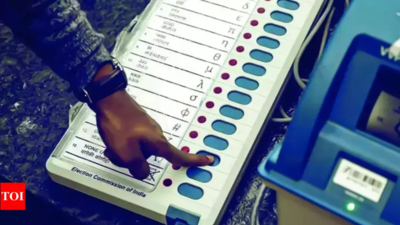
Q1: Pre-programmed chips for party favors
How can we be sure that the chip inside is not pre-programmed in favor of a particular party?
Answer: EVM has microcontroller one time programmable (OTP), meaning it can be programmed only once. This programming is strictly monitored
technical expert committeeAnd the source code is audited by independent experts. Before each election, mock polls involving over 1,000 votes are conducted, allowing political parties to verify that the voting pattern has been recorded accurately. Therefore it is impossible to program it in advance to benefit someone.
Q2: Insider tampering before election day
What stops an insider from tampering with the machine before election day?
Answer: EVMs are stored in secure strong rooms with 24/7 CCTV surveillance and armed security of multiple independent (Central and State) agencies. They have tamper-evident seals with unique serial numbers, and the two-step randomization process ensures that no one knows until the last moment which EVM will be used where. Pre-poll checks are conducted in the presence of representatives of several political parties to verify the integrity of the machines.
Q3: Wireless Hacking
Can’t machines be hacked through wireless signals or Bluetooth?
Answer: Indian EVMs have no wireless components, including no internet connectivity, Bluetooth or external ports. They are designed as “air-gapped”, meaning they are physically isolated from any network, making them immune to remote hacking attempts.
Q4: Tampering with storage
How do we know that votes are not being changed when the machines are in storage?
Answer: EVMs are stored in secure rooms:
- Three-tier security including armed forces
- A double-lock system where the keys are held by different officials
- Party representatives can put their seal of approval
- Continuous log of any access attempts
Any unauthorized access will trigger an alarm and require the presence of authorized personnel and party representatives.
Q5: Replacement from duplicate machines
What will happen if someone replaces the original EVM with a duplicate machine?
Answer:Each EVM has a unique serial number, digital signature, holographic seal and key code. During First Level Check (FLC), these identifiers are verified and documented in the presence of party representatives. These details can be cross-referenced before the voting begins to ensure authenticity.
Q6: Magnetic interference
Can strong magnets or electromagnetic pulses manipulate polling data?
Answer: The EVM is designed with electromagnetic shielding, meeting military-grade standards. They are immune to electromagnetic fields up to 6 Tesla, surpassing the strength of MRI machines. This ensures that external magnetic fields cannot alter the stored vote data.
Q7: Outreach for illiterate voters
How can illiterate voters ensure that their vote will go to the candidate of their choice?
Answer: EVMs have large, clear symbols and party names with audible beep confirmation for each vote. Voter-verifiable paper audit trail ,VVPAT) provides visual confirmation of the vote cast. Additionally, Braille signs assist visually impaired voters.
Question 8: Preventing multiple votes
How can we prevent multiple votes from being registered when no one is watching?
Answer: EVMs are designed to allow only one vote per voter. The control unit enables voting only after the Presiding Officer presses the “Ballot” button, and it is mandatory to wait for 5 seconds between votes. This mechanism ensures that each vote is recorded individually and prevents multiple voting without detection.
Q9: Software update or malicious code insertion
Could malicious code be inserted during maintenance or software updates?
Answer: EVMs do not accept software updates after manufacturing. The program is burned into the OTP chip, which cannot be modified once set. There are no external input ports, and maintenance is entirely physical and mechanical, ensuring that no software changes can be made.
Q10: Fault detection
How will we verify if there is a machine malfunction during voting?
Answer: EVMs have continuous self-diagnosis features and provide visual and audio indicators for any errors. If a malfunction is detected, the machine is locked to preserve vote data, and backup machines are immediately available to prevent disruption.
Q11: Battery failure
What happens if the battery dies during voting—are votes lost?
Answer: EVMs have a robust battery system with 48 hours of backup and non-volatile memory that retains data without power outages. Redundant power systems ensure that even in the event of battery failure, vote data remains intact.
Q12: Conditional Programming
Can the machine be programmed to transfer votes after a certain number of votes?
Answer: No, the OTP chip cannot be reprogrammed and it records each vote as exactly cast without any conditional logic. security protocol To prevent such changes, multiple layers of verification ensure the integrity of the voting process.
Question 13: VVPAT integration
How does VVPAT integration ensure voter verification?
Answer: VVPAT provides a physical paper trail that voters can view and verify immediately after casting their vote. This paper record is stored securely and can be used for audits or recounts, adding an additional layer of transparency and trust to the electoral process.
Q14: Security protocol
What security protocols are in place to protect EVMs from tampering?
Answer: EVMs are designed with a number of security features, including:
- tamper-evident seals
- encryption of vote data
- Regular audits and checks by independent agencies
- Secure Supply Chain Management
These measures ensure that any attempt at tampering will be immediately detected and the validity of the machine will be lost.
Q15: Display unit security
Can someone hack the machine through the display unit?
Answer: The display unit is entirely output only and has no input capabilities. It is hardwired to display information and cannot be used as an interface for programming or altering the operation of the machine.
Question 16: Climate Resilience
How are EVMs protected from extreme climatic conditions?
Answer: The EVM is designed to operate in a wide range of temperatures (from -10 °C)
+55°C) and high humidity levels (up to 95%). They are also tested for resistance to heavy rains, ensuring reliability in the diverse Indian climate.
Q17: Direct memory access
What would happen if someone tried to directly access the machine’s memory chip?
Answer:Memory is encrypted using AES-256 and physically secured within the machine. Tamper-evident seals cover the memory area, and any attempt to directly access the memory will damage the seals and be immediately detected, rendering the machine invalid for use.
Question 18: Result transmission security
Can votes be changed during the results transmission process?
Answer: The results are first physically recorded on the EVMs and then transmitted through secure channels. Multiple copies of the results, including the VVPAT paper trail, are maintained, which can be used for cross-verification. This redundancy ensures that any attempts to alter the results will be detected during transmission.
Question 19: Random Sampling in VVPAT Verification
How do we know that a random sample of VVPAT slips is truly random?
Answer: This process uses computerized random number generation, and the selection is done in the presence of representatives of all political parties. This ensures transparency and fairness in the sampling method.
Q20: Manufacturer inspection
What stops manufacturers from building hidden backdoors into EVMs?
Answer:The manufacturing process is overseen by several agencies, including independent safety auditors. Components are verified at each stage, and the final assembled units undergo extensive testing by various teams to ensure there are no vulnerabilities or backdoors.
Q21: Battery charge level
Does the varying level of battery capacity (charge level) in EVMs at the time of counting of votes indicate any possibility of hacking?
Answer: From a technical engineering perspective, the allegation fundamentally misunderstands the EVM power architecture. The “99%” display is not a battery charge percentage, but rather a voltage threshold indicator that shows “99%” whenever the battery voltage remains within the optimal operating range of 7.4V – 8.0V. This is purely an administrative feature to indicate the proper working voltage level. EVMs use non-rechargeable alkaline batteries (7.5V/8V configuration), with vote data stored in non-volatile EEPROM memory, meaning that vote storage and counting is completely independent of the state of the battery. The power system is completely isolated from the vote recording circuit, making it technically impossible for battery condition to affect the vote pattern or counting sequence. Furthermore, the data integrity of each EVM can be verified through VVPAT audit trails, irrespective of power conditions. Therefore, any correlation between battery display readings and voting patterns is technically impossible given the basic architecture and security protocols of EVMs.
conclusion
Indian EVMs, especially the M3 model combined with VVPAT, incorporate a number of security measures and safeguards to ensure the integrity and transparency of the EVMs. electionThrough rigorous testing, multiple layers of verification, and strong security protocols, these machines provide a reliable and trustworthy voting system.
(The views of senior IPS officer and cyber security expert Brijesh Singh are personal.)


