



Back in 1994-95, one-day internationals (ODIs) were the prime cricketing format, tri-series a big draw, and Australia was the team to beat, especially at home. That season, in a tri-series that included England and Zimbabwe, the Australia Cricket Board added a second Australian team into the mix. Its personnel included several players who would become mainstays in the first team, including Ricky Ponting, Matthew Hayden, Michael Bevan, Damien Martyn and Justin Langer.
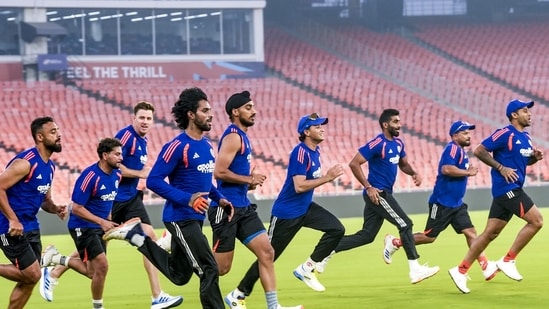
One of the main reasons cited by ACB for a second team was depth of talent. But in a sporting construct that evolved around the idea of nations, a second team was one too many, and the concept never took off. In the men’s T20 format today, India is flexing a similar dominance. It is blessed with a depth of talent that, purely for academic purposes, could even field a second team—and a formidable one at that.
Winning Run
One expression of India’s T20 cricketing prowess, and depth of resources, has been the results over the past three years. Of the 12 test-playing nations, five have a winning record—defined as a win-loss ratio above 1 in the adjacent graphic. But in terms of the extent of that winning record, India is miles above the other four. In this period, India has played 66 T20 matches, winning nearly 4 of every 5 matches.
That performance record is also markedly above how Australia had fared in ODIs in the three-year period preceding the time it decided to field a second team in December 1994. Australia, back then, had a win-loss ratio of 1.7, roughly winning about 3 of every 5 matches. In that tri-series, Australia A qualified above England and Zimbabwe. Of the four matches between the two Australian sides, Australia A won only one.
Batting Reserves
Runaway and breathless batting has been a cornerstone of India’s T20 showing. In the past three years, Indian batsmen have averaged nearly 31 per wicket—almost 3 runs more than the next-best, England. They have struck at 9.6 per over, again the highest among all countries. In the early years of the Indian Premier League (IPL) Australian batsman Michael Hussey came up with a unified metric that measured both runs scored and the speed at which they were scored. A figure of 180 is rated highly.
The list of top 50 batsmen by this metric for the last three years has more Indians than any other country, and all 11 are topping 180. Three of them are not even in the Indian squad: Ruturaj Gaikwad, Yashasvi Jaiswal and Rohit Sharma (who has retired from international T20s). Gaikwad is ranked third on this metric, average 68—more than any other Indian batsman on this list.
Bowling Depth
Eventually, the limited number of slots meant that Indian selectors had to pick and choose. For example, at the top of the order, those sitting on the sidelines include Jaiswal, Gill, Sai Sudarshan and KL Rahul. On the bowling side, India has not shown the same dominance as on the batting side. The unified metric here rewards wickets and frugality. Thus, it is the sum of the bowling average and economy rate.
The lower this figure, the better. Anything below 25 is considered good. Of the top 50 bowlers in the past three-year period on this metric, 7 are from India. Above it were Pakistan (9) and Afghanistan (8). Of the seven Indians in the top 50, six are in the world cup squad. The one who missed out was Ravi Bishnoi, ranked 42.
Game Time
One issue for several Indian players on the fringes of the World Cup squad, but not in it, will be game time. For example, Jaiswal, ranked 17th among batsmen, has played only 22 T20 matches in this period, compared with 37 for Abhishek Sharma. Similarly, Mukesh Kumar, who is ranked 79 among bowlers, has played only 17 matches.
Then, there is a long list of players who have played even fewer matches, reflecting the intense competition for T20 slots in the Indian team. In the 2025 Indian Premier League (IPL)—the nursery feeding the national T20 squad—there were 13 Indians among the top 20 run-getters and 15 Indians among the top 20 wicket takers. As many as 11 of those batsmen and 9 of those bowlers are not playing the World Cup, but could form a group of significant strength. Enticing as the prospect of a second squad is, as the 1994-95 tri-series showed, a second squad is one too many.


