



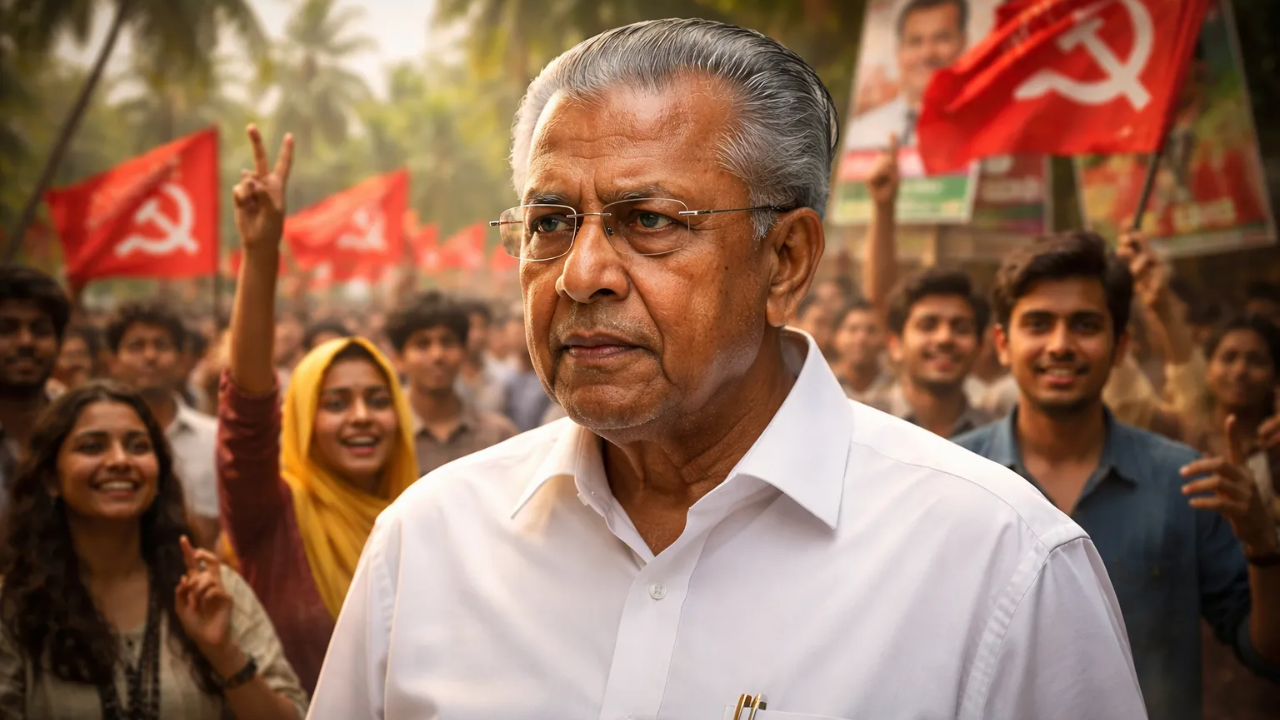
As Kerala Heading towards the 2026 assembly elections, a question looms over the political landscape of the state: What does the future of the Left look like? Pinarayi Vijayan?For nearly a decade, Vijayan has been the undisputed face of the Left Democratic Front (LDF), leading it through floods, pandemics, financial stress and a historic re-election in 2021 that broke Kerala’s four-decade pattern of alternate governments. But as the chief minister turns 81, the conversation within the party and among voters has quietly shifted from governance to succession.
Kerala is the only state currently ruled by the Left. This makes the 2026 election more than a routine contest; It is a referendum on the future of communist politics in India, and whether the LDF can renew itself in time to connect with a new generation of voters.
Vijayan Factor: Age, Authority and Continuity
At 80, Vijayan remains the central lynchpin of the LDF’s campaign and governance narrative. His leadership was widely credited for the LDF’s 2021 victory, when the front secured 99 out of 140 seats, the first time in four decades that an incumbent returned to power in Kerala.The government has since highlighted welfare expansion, including increasing social security pension from Rs 600 to Rs 2,000, infrastructure spending of about Rs 2 lakh crore through budgetary and extra-budgetary resources and a push towards a “knowledge economy”.Still, the question is less of performance and more of consistency. “Leadership change is a structural issue for cadre-based parties,” said a professor of political science at Delhi University. “The strength of the Left has always been collective leadership, but electorally, Kerala voters are increasingly responding to recognizable faces.” Sherwin, a young freelancer from Thrissur, Delhi, believes, “If not for Vijayan, the Left would probably not have come back to power.” He gives another important reason why he would vote for the Left: “Because the Congress is always fighting among itself, I don’t think it is a good option.”He adds, “It’s always the least bad option you vote for, not the best, I think that’s the case everywhere in politics now.”
“Vijayan is not as bright as he looks, maybe there is no one to replace him right now, but that doesn’t make him a good choice,” says Dhrishti, a member of a leftist student group. She adds, “I think now is the time to give a chance to more young faces, just look at the Politburo, the people sitting there have nothing to do with the ground and what kind of issues the youth are facing.”
second notch is missing
Unlike previous phases in Kerala politics, there is no widely projected young leader positioned as a natural successor to Vijayan. While several senior ministers and party leaders remain influential within the Communist Party of India (Marxist), the major partner in the LDF, no one currently has more statewide mass appeal than the chief minister.A member of the Left student wing says presenting a successor prematurely could create factional tension. “The party gives priority to continuity and collective functioning. The focus is on policies, not personalities,” he said.
But electoral politics is increasingly becoming personality-based. The absence of a clearly visible next-generation face could complicate the reach of first-time voters, especially in urban constituencies where triangular contests are intensifying with the growing influence of the BJP/NDA.
First Time Voter: The Changing Voter
The scale of young voters is becoming clear. According to official data cited by All India Radio following the publication of the draft voter list for the state, more than 1,21,000 applications for updates and corrections have been received. Of these, 96,785 were submitted to include first-time voters who have turned 18 or are seeking constituency transfer. For the LDF, engaging Gen Z voters presents both an opportunity and a challenge. This demographic has evolved in a hyper-connected political environment, shaped by social media narratives and traditional cadre networks. Increasingly, these first-time voters have become the most sought-after political entity that every party seeks to woo. Vishnu, a 22-year-old first-time voter from Alappuzha who is studying in Delhi, said, “For us, development and jobs matter more than ideology. We want to see opportunities in the state so that we do not have to leave Kerala.” Another student from Kozhikode said that although welfare measures are important, “the online conversation is different, people talk about entrepreneurship, start-ups, global exposure.”The LDF has responded with a renewed focus on digital outreach along with its traditional home-visit programme, where leaders, from state-level personalities to branch secretaries, are connecting directly with households to gather feedback.But Sherwin says, “Although there is a very active youth group of people working for the left on the ground, and they always come up with different plans, but so does Congress, so I don’t think they are doing anything different to woo the youth.”
local body elections 2025
If the 2021 assembly verdict was historic for the LDF, the 2025 local government elections served as a reality check.The scale of the losses was significant. LDF’s control in gram panchayats declined from 577 to 340, in block panchayats from 111 to 63 and in district panchayats from 11 to 7. In urban Kerala, the decline was more acute: municipal corporations declined from five to one under LDF control, while municipalities declined from 43 to 29.The most symbolic blow came in Thiruvananthapuram, where the BJP captured the corporation for the first time by winning 50 out of 101 wards. For a front that has dominated the capital’s civic body since 1980, this loss has political significance far beyond the numbers.However, vote share data tells a more nuanced story. Despite losing the seat, the LDF got nearly 40% of the votes across the state. The UDF maintained its lead, securing 43.21%, but not by a huge margin. The BJP-led NDA’s vote share stood at around 16%, slightly higher than in previous local elections, and lower than its 19.4% performance in the 2024 Lok Sabha elections. The party’s gains came from concentrated seat conversion rather than dramatic vote expansion.In terms of assembly constituencies, the UDF is ahead in 81 constituencies, while the LDF is ahead in 57. However, in 32 constituencies, the defeat margin for the LDF was between 1,000 and 10,000 votes, indicating that subtle changes could reshape the 2026 map.There were also demographic undercurrents. With almost half the state’s population comprising minorities, the LDF’s vote share of around 40% suggests it has retained a sizeable share of minority voters among other sections, even in parliamentary-style contests as these sections appeared to unite behind the UDF. The data suggest change, but not collapse.From the Left’s perspective, the local body’s decision reflects three trends:
- intense triangular contest
- More efficient seat conversion by the UDF and BJP, and
- Insecurity in urban middle-class areas, especially among young voters
Whether the 2025 results were a harbinger of 2026 or a mid-term correction remains an open question.
between well-being and perception
The DU professor argues that anti-incumbency alone does not explain the LDF’s recent failures. Instead, “the electoral changes reflect layered dynamics, consolidation of minority votes behind the UDF, sharp arithmetic in urban areas and the targeted expansion of the BJP”. Also, it seems that after two consecutive terms, the LDF is recalibrating its political message amid the demographic and ideological churn.
That recounting came to the fore during the controversy over Jamaat-e-Islami Hind. cpm And the BJP accused the Congress-led UDF of accepting support from the outfit. The controversy escalated when senior CPM leader AK Balan warned that the UDF government could allow the Jamaat to influence the Home Ministry and lead to incidents like the Marad riots of 2002–03. CM Vijayan supported Balan’s comments, although the CPM later called it his “personal view” after criticism that the rhetoric reflected the narrative generally associated with the Sangh Parivar. But, the incident was uncharacteristic for the Left, which has avoided venturing into the realm of communal/polarizing rhetoric compared to most of the political landscape in the country. Simultaneously, the Left took steps to strengthen ties with sections of influential Muslim bodies such as Samast, including the nomination of Omar Faizi Mukkam to the Kerala State Waqf Board, a move that was widely interpreted as calibrated engagement with constituencies seen as alien to the IUML.On the majority side, the government’s role in facilitating the Global Ayyappa Sangamam associated with the Sabarimala temple managed by the Travancore Devaswom Board attracted attention given the Left’s strong support ahead of the 2018 Supreme Court decision allowing entry of women of all ages. Meanwhile, as the elections are approaching and Sabarimala is emerging as a major election issue, the Left parties are adopting an increasingly vague stance, with their ministers refusing to give any clarity outright.
Overall, these episodes reflect the LDF’s attempt to navigate a more polarized landscape, balancing welfare governance with identity-sensitive politics, as it prepares for 2026.
revival playbook
Party leaders have acknowledged the need to “learn from the people” and fix gaps in policy implementation and political communication. Statewide home-visiting program has been started. Parallelly, the LDF has intensified its campaign against financial discrimination by the Centre. Issue-based mobilization is also being intensified, including campaigns around MNREGA allocation and implementation of the labor code. However, the deeper challenge is the political situation. The historical development of the Left in Kerala was rooted in class mobilization transcending caste and religion. Recent elections highlighted the tensions between welfare-driven governance, secular positions, minority concerns, and efforts at broader social reach. A sustainable revival may require administrative efficiency as well as clarity in ideological messaging.Therefore, the question of revival is less about arithmetic and more about adaptability.
What next for the left?
For the Left, 2026 is not just about retaining power but about redefining relevance. The stakes are national: Kerala is the last state under communist rule. Defeat would mean the absence of a Left-led state government anywhere in India.The immediate strategy appears to be two-pronged: mobilizing welfare beneficiaries through grassroots engagement, and countering opposition narratives through coordinated political campaigns and social media mobilization.But the structural question still remains unresolved: Can the LDF transition from the leadership model established under Vijayan to one that inspires confidence among young voters?As Kerala’s electorate continues to expand with thousands of first-time voters, the 2026 contest may hinge less on legacy and more on generational trust. Whether the Left can bridge that gap organizationally and politically will determine whether its red bastion remains intact or enters a new phase of churn.For now, the question is simple and unavoidable: who after Vijayan?


