



When skipper Rahul Dravid opted out of the inaugural T20 World Cup in South Africa in 2007, along with Sachin Tendulkar and Sourav Ganguly, India’s national selectors had an array of experienced hands from whom to pick the next captain. There was Harbhajan Singh, who made his international debut in 1998, Virender Sehwag, whose first appearance for the country was in 1999 and Yuvraj Singh, who cut his teeth at the nation vs nation level in 2000.
Dilip Vengsarkar’s panel took a punt on Mahendra Singh Dhoni instead, in one of those futuristic moves that was to pay rich dividends in time to come. It wasn’t a decision that attracted universal approbation, and even though no one within the setup vocally voiced their displeasure at their captaincy credentials being overlooked, it was obvious that several hadn’t taken kindly to Dhoni being the chosen one.
Whether Yuvraj was displeased at his leadership pitch being ignored is open to debate, but it is likely that the punishing left-hander from Punjab felt he had a point to prove. Two innings into the World Cup, Yuvraj had only six runs to show from his two visits to the crease, when India ran into England in a second-stage league encounter.
India’s bid to make a strong case for themselves had been derailed in the previous fixture when, in their first match in Johannesburg, they went down by ten runs to New Zealand. For them to entertain any hopes of advancing to the knockout semifinals, they had to get the better of England, who too had been schooled in their opener by South Africa.
Dhoni heralded India’s return to Durban, their base for the tournament, by opting to bat on a wonderful batting surface, and Gautam Gambhir and Sehwag made their intentions clear by adding 136 for the first wicket in just 88 deliveries. Both fell in quick succession, and when Robin Uthappa was third man dismissed with 20 deliveries left in the innings, India had lost three for 19 in 13 deliveries.
The captain had promoted himself to No. 4 ahead of Yuvraj, which didn’t perhaps help the left-hander’s cause. It didn’t help England’s either, because Yuvraj cut loose as no Indian had before, with a single-mindedness that wasn’t always his calling card.
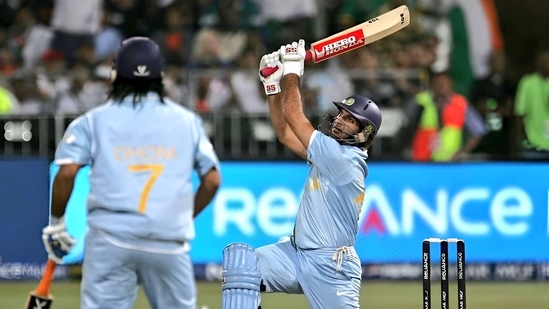
With two overs to go and for reasons best known to him, Andrew Flintoff decided that it was time to rile up Yuvraj. A furious exchange of words followed, just before Yuvraj squared up against Stuart Broad, very early in his international career. The first ball of the 19th over was swung over wide mid-wicket and sailed out of the ground as Yuvraj fired the first salvo. The second was flicked off his toes for another six, and as the camera panned towards Flintoff, one could perceive the internal grimace. The next four balls were dispatched to four different corners of the park – over cover, then over point, followed by a mow to cow corner and a smack over wide long-on. Yuvraj became the first batter in T20Is, and the second in international cricket after Herschelle Gibbs (off Dan van Bunge of the Netherlands in the 2007 50-over World Cup) to hit six sixes in an over, the last of those sixes off Broad, taking him to a half-century in a mere 12 deliveries.
That record, for the fastest fifty in T20Is, lasted 16 years until Nepal’s Dipendra Singh Airee reached his half-century off an unbelievable nine deliveries against Mongolia at the Asian Games in Hangzhou. It remains the quickest half-ton by an Indian in T20Is, ahead of Abhishek Sharma (14 balls) and Shivam Dube (15), both against New Zealand in the ongoing series in Guwahati and Visakhapatnam, respectively, earlier this month.
Yuvraj hammered 58 off just 16 deliveries, with three fours and seven gargantuan sixes, to ensure that the grand work of the Sehwag-Gambhir alliance wasn’t frittered away. With Yuvraj at the forefront, India rattled along to 218 for four when the innings came to a halt.
With their own qualification hanging by the most tenuous of threads, England opted not to roll over and die. Darren Maddy and Vikram Solanki got them off to a roaring start, and Kevin Pietersen then took over in the company of captain Paul Collingwood to leave England poised for a final concerted push at a monumental target. But even though India sent down 11 wides and Joginder Sharma conceded 57 in his four overs, there were too many doubts in English minds when confronted with such a massive target.
India eventually pulled off an 18-run victory to keep their semifinal hopes alive while dumping England out of contention. The legend of Yuvraj took concrete shape that Wednesday night under the Kingsmead lights, and he didn’t look back from then on.
Brief scores: India: 218/4 in 20 overs (Gautam Gambhir 58, Virender Sehwag 68, Yuvraj Singh 58; Chris Tremlett 2-45) beat England: 200/6 in 20 overs (Darren Maddy 29, Vikram Solanki 43, Kevin Pietersen 39, Paul Collo\ingwood 28; RP Singh 2-28, Irfan Pathan 3-37). Player of the Match: Yuvraj Singh (India).


