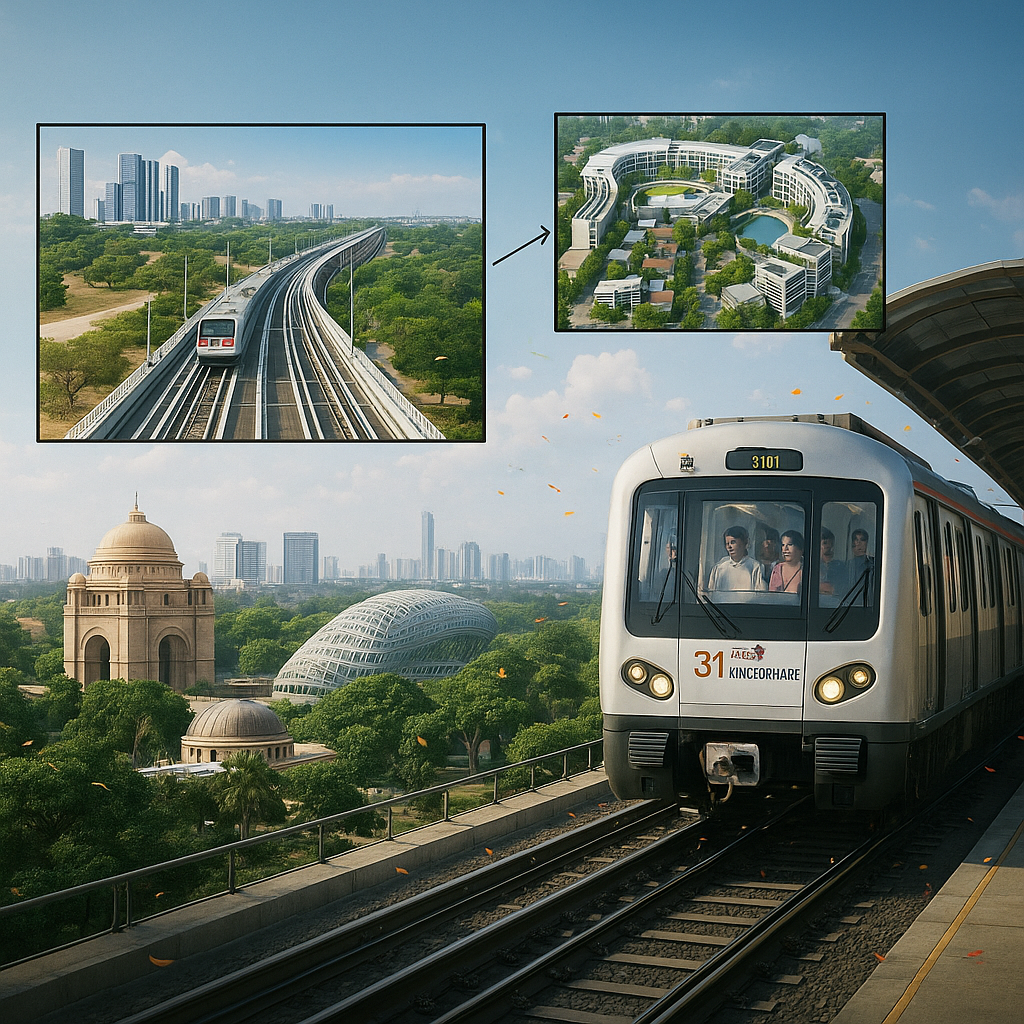
Delhi Metro marked its 31st Foundation Day with grandeur, reflecting on its journey while looking ahead to the future. Since its inception in 1995, the Delhi Metro has drastically changed urban transportation in the National Capital Region (NCR), leaving a mark on the socioeconomic fabric of the world. Therefore, the celebrations that the DMRC undertook were not merely about celebrating the advancement of technology but of sustainable modes and with a promise for a smart and green future.
May 3, 2025, marked DMRC’s 31st Foundation Day at Bharat Mandapam, New Delhi.
Delhi Metro’s Journey Over More Than 31 Years
The following are some of the achievements that can be welcomed by seeing the transformation of the landscape done by the Delhi Metro:
1. Impressive Expansion Network
From an initial 8.4-kilometer stretch between Shahdara and Tis Hazari in 2002 to now providing over 400 km of coverage on 12 corridors. Not only connecting Delhi to Noida, Greater Noida, Ghaziabad, Faridabad, Bahadurgarh, and Gurugram, but also for over 400 km now spanning 12 corridors.
2. Impressive Ridership Numbers
Currently, it is India’s most accessed mass transit system, serving over 6 million passengers daily. Continuing to create riding records due to the increase in the population and because car owners now leave their cars and move to public transit.
3. Global Recognition
The 31st Foundation Day of the Delhi Metro was celebrated in Bharat Mandapam on May 3, 2025, celebrating its emergence as one of the urban transit models globally. DMRC was launched in 1995 and is today respected as one of the world’s best metro systems, known for its innovation, sustainability, and efficiency. The new-age green transportation continues to set global benchmarks with initiatives like producing 45+ MW of solar power and aiming for 100% renewable energy by 2031.
A Symbol of Innovation
1. Driverless Metro Trains (UTO)
The first-ever driverless trains were put into operation on Magenta Line of Delhi Metro (2020) with the use of CBTC technology, thus making operations safer, punctual, and energy-efficient. This marks another significant step toward AI-integrated smart transit.
2. Smart Ticketing Solutions
To make things more convenient, DMRC has now introduced QR-code-based mobile tickets and also contactless smart cards. They are now working on enabling NFC payments and facial recognition to provide seamless travel.
3. Renewable Energy Adoption
Delhi Metro continues to set benchmarks in sustainability, now generating over 45 MW of solar energy through rooftop installations and external solar farms. It aims to run completely on renewable energy by 2031.
4. Energy-Efficient Infrastructure
The trains save electricity through regenerative braking, while the stations use LED lighting, follow green certifications, and use energy-efficient HVAC systems.
5. AI-Based Security Enhancement
DMRC ensures safe commuting with live CCTV and AI-based monitoring using facial recognition for crowd control and instant alerts.
A Smart, Sustainable Tomorrow: Future Plans of Delhi Metro
Delhi Metro not only fondly remembers its past on the occasion of its 31st Foundation Day on May 3, 2025, but also becomes more focused on the future. The challenges of urban mobility are increasing. The Delhi Metro Rail Corporation (DMRC) has geared up to lead the cause of smart, green, and inclusive transportation. From tech-driven ticketing and AI-powered maintenance to expanded connectivity and global collaborations, the upcoming years will usher in a new era in Delhi’s public transport.
1. Expansion of Phase IV
Phase IV is being carried out by DMRC, adding more than 65 km of new lines and 45+ stations.
It will integrate modes of transport and reduce congestion.
2. AI-Based Predictive Maintenance
The Delhi Metro will use AI and sensors for predicting technical faults on trains and tracks.
Such a proactive measure would reduce delays, increase safety, and reduce maintenance costs.
It will replace reactive maintenance with intelligence and data-driven working ability.
3. Facial Recognition Ticketing
DMRC is piloting facial-recognition-based ticketing systems to allow rapid and contactless entry.
Passengers can walk through gates without displaying a card or scanning a QR code.
It enhances security while ensuring a seamless travel experience.
4. Smart Stations and IoT Infrastructure
New stations will come equipped with IoT-enabled facilities for crowd monitoring in real-time, smart kiosks, and digital signage.
They will also provide EV charging stations, solar rooftops, and public Wi-Fi.
This is being done to ensure smart, energy-efficient, and passenger-friendly stations.
5. Enhanced Passenger Safety and Women-Friendly Enablers
Safety of commuters will be enhanced by CCTV cameras, panic buttons, and real-time surveillance.
Women-specific improvements include women coaches, helplines, and female staff at major stations.
Commuter safety will be a top priority, especially during nighttime hours and festive seasons.
Celebrations for Foundation Day 2025
The 31st Foundation Day ceremony on May 3, 2025, will not only celebrate the legacy of previously attained goals but also project toward the future. Expect interactive exhibitions at prominent stations, workshops for students, and public engagement programs.
Other than this, DMRC is introducing a commemorative campaign where it would highlight the facts and experiences of real commuters, frontline staff and engineers, and the visionaries who created this network.
Conclusion: A Journey That Inspires
The Delhi Metro epitomizes vision, execution, and innovation since its very 8.4 kilometers sprawl to a network spanning ecologically sustainable social reach for millions. It now marks its 31st Foundation Day, getting ready to open more doors towards a sustainable, accessible, and commuter-friendly future.
From transporting people to transporting hearts, the Delhi Metro has come a long way. And in doing so, it reminds us all on this celebratory occasion that we are very much still making the journey: The best is yet to come.