



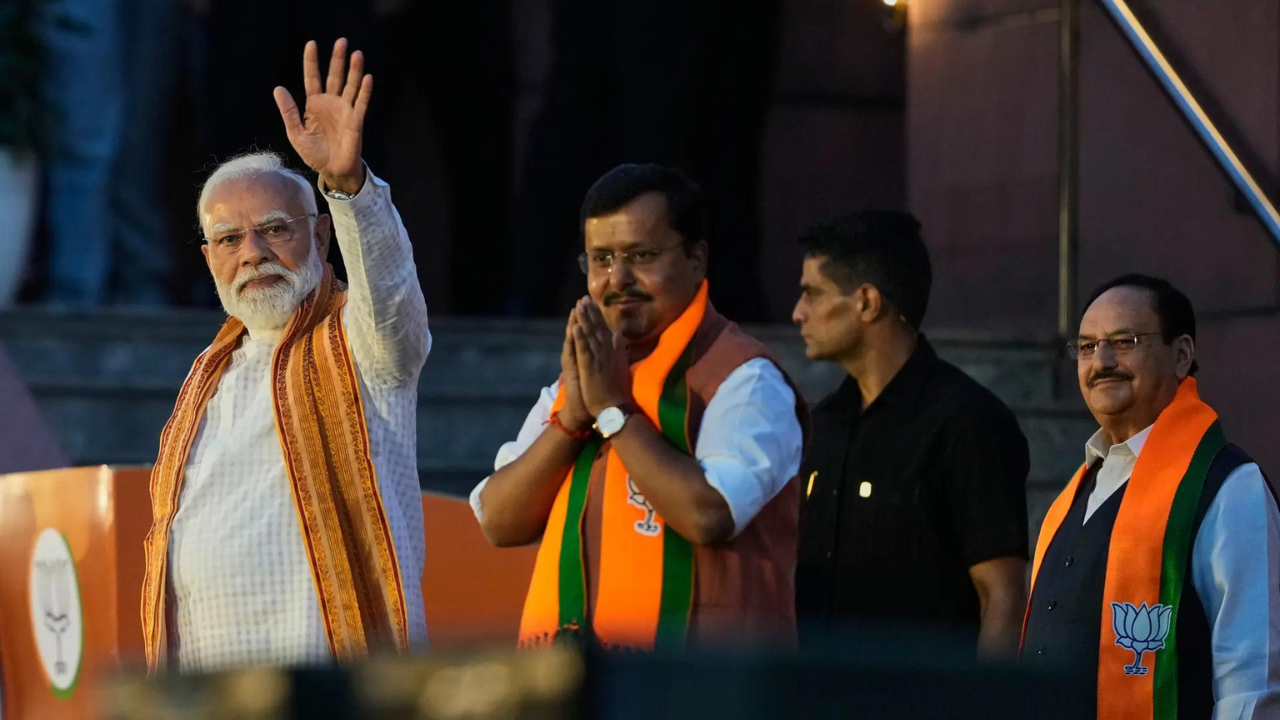
New Delhi: As the results of the 2026 assembly elections began to emerge, a familiar tune returned to Indian politics. Not loud or unexpected, but recognizable. Something which is in the making since the Lok Sabha decision of 2024. A similar rhythm has been followed in every election. BJP It has managed to overcome the anti-incumbency wave consistently (from Haryana to Maharashtra and now, Assam), not only defending its government but also securing a larger mandate.What once seemed like a temporary fix is now shaping up to be something more deliberate.
In many states, the party has defended its ground while venturing into new territory, repeating a pattern with striking continuity. There is a rhythm to it now, almost like the same tune being played over and over again, each election result feeling familiar.In Christopher Nolan’s Oppenheimer, there is a line: “algebra (in this case read: politics) Like sheet music. It is not important that you can read music, but that you can hear it.“And apparently, the BJP has.Here’s how the saffron party has chalked out its strategy to fight the anti-incumbency wave:
Shock
The trajectory of the BJP after 2024 is surprising for its methodology. In June 2024, the party was reduced to 240 seats in the Lok Sabha, losing its absolute majority and becoming dependent on coalition partners. The opposition Indian faction interpreted that result as a turning point. It entered subsequent state elections with confidence, often as the perceived frontrunner.Yet that momentum did not translate into votes. In state after state, the opposition struggled to convert narrative gains into electoral success. Meanwhile, the BJP made a swift recount. It refined its messaging, tightened its candidate selection, and leaned heavily on targeted welfare schemes addressing specific voter segments.Equally important was the party’s ability to maintain cohesion at all levels of leadership. The central leadership, especially Prime Minister Narendra Modi, continued to act as a unifying force, while state units adapted to local dynamics. This balance between central projection and local accommodation became a recurring feature of BJP campaigns.
Haryana Elections – Exit polls are proving wrong
The first sign that the Lok Sabha decision would not define the BJP’s path came in Haryana. After being in power for a decade, the state government started showing clear signs of fatigue. Exit polls were tilted towards the Congress, and the opposition campaign had built a consistent narrative around accountability.The BJP’s response was pragmatic rather than defensive. It replaced a significant portion of its sitting MLAs and transferred the leadership from Manohar Lal Khattar to Naib Singh Saini in a strategic move to stem the anti-incumbency wave.The result was, for the third consecutive time, 48 seats in the 90-member assembly. The victory was not overwhelming, but it was important. It demonstrated that anti-incumbency could be mitigated through timely intervention and organizational discipline.
Maharashtra 2024
Maharashtra was an even bigger victory for the BJP. The Mahayuti alliance won a landslide victory by winning 235 out of 288 seats. The change in the Lok Sabha elections held just a few months ago was dramatic.However, this result was not driven by any single factor. Welfare schemes like Ladki Bahin played a role in uniting sections of the voters. At the same time, coalition management proved decisive.PM Modi’s presence gave a major boost to BJP’s campaign joint welfare message. The opposition, despite its previous parliamentary success, struggled to present a cohesive counter-narrative and suffered from disjointed coalition tactics.
Delhi 2025: return to the capital
Delhi elections are a symbol of a different kind of change. The Aam Aadmi Party had built a strong governance narrative over a decade focused on public services and welfare delivery. However, by 2025, that model started showing signs of stress.Controversies, including the liquor policy issue involving Arvind Kejriwal, tarnished the party’s clean governance image. Public dissatisfaction, especially on infrastructure and environmental issues, created opportunities for the BJP.The BJP’s campaign focused on these weaknesses while offering its welfare commitments. The logic of administrative coordination between the Center and the state resonated even in a city with a unique constitutional structure.BJP returned to power in Delhi after 27 years by winning 48 out of 70 seats. The result highlighted an important lesson: Even the strongest regional players who have built a strong cadre can be toppled.
Bihar 2025: The strength of the alliance is increasing
The Bihar result reinforced the importance of alliances but also highlighted a shift within them. The NDA won a decisive victory with over 200 seats in the 243-member assembly. While Nitish Kumar remained in the central role, BJP emerged as the largest party.Then came the change: BJP’s Samrat Choudhary took over as chief minister, while Nitish Kumar, who held the state’s top post for two decades, moved to the Rajya Sabha. This was a big moment for the BJP: the party moved from a supporting role to the center of power.The campaign itself linked caste recalculation with welfare outreach. The opposition, led by Tejashwi YadavRan an energetic campaign but struggled to match the NDA’s organizational reach and coalition stability. It also struggled to form a cohesive coalition strategy with the Congress, while the India Bloc allies struggled to hammer out a seat-sharing deal until late in the election season.
Assam 2026: Fighting the anti-incumbency wave
Among the states where elections were to be held in 2026, Assam was the easiest for BJP. The government led by Himanta Biswa Sarma entered the elections with a relatively strong position.Welfare distribution, particularly targeted at tea garden workers and low-income groups, formed a central pillar of the campaign. This was complemented by a clear ideological position that strengthened the party’s support base.The NDA’s easy victory, easily crossing the majority mark, confirms the BJP’s dominance in the state. Assam became the “stick” in the broader pattern, a government that resisted the anti-incumbency wave without significant disruption.
West Bengal 2026: A Success
The most interesting result of this assembly election cycle came in West Bengal. For more than a decade, Mamata Banerjee and the Trinamool Congress had worked vigorously against the BJP’s progress. The 2021 elections had brought BJP closer but not that close.The years that followed saw the steady expansion of the BJP’s organizational network across the state. At the same time, the TMC faced growing challenges, including local anti-incumbency, allegations of corruption and internal tensions.The 2026 elections reflected these changes. The overwhelming voter turnout indicated a desire for change. The BJP’s campaign combined welfare promises with a strong ideological pitch, while also capitalizing on discontent at the constituency level, raising issues of anti-incumbency, corruption and deteriorating law and order.At the time of publishing, BJP has taken a decisive lead, crossing the majority mark. The result was not just a victory but a breakthrough in a state that had long resisted it.
Corrected what the opposition could not do
While the BJP managed the anti-incumbency wave with increasing sophistication, its rivals struggled to do the same. In Kerala, the Left Democratic Front lost power after its rare consecutive term, as voters reverted to the pattern of state choice. In Tamil NaduDMK faces a significant setback as Vijay-led TVK moves closer to a landslide mandate.These results highlight a broader issue within the opposition. India Bloc’s success in the 2024 Lok Sabha elections has created expectations that are not matched by organizational cohesion in state contests. Leadership remained fragmented, and strategies often relied heavily on national narratives that did not translate effectively at the state level.The anti-incumbency wave, which was a powerful tool against the BJP in 2024, has turned against these governments. Unlike the BJP, they lacked a consistent structure to manage that pressure.
emerging playbook
Politics is not a one-time game. It’s incredible, chaotic, and deliberate. A big victory or defeat can change the mood of party workers, but as Shahrukh Khan Will say, “The picture is still pending.” If the state assembly results since the 2024 Lok Sabha elections show anything, it is this: no party is so big that it requires a recalibration, and when it is done right, no setback is too big to recover from.The Indian camp walked out of the 2024 Lok Sabha elections believing that it had got the winning note. The result was read as a change in mood, a sign that the BJP’s dominance was at its peak. But state elections have a way of testing perceptions. One by one, those notions have been destroyed.In Maharashtra, Delhi, Bihar and now most dramatically in West Bengal, the story has been repeated with small variations but the end result is the same.But familiar enough to raise a tough question for the opposition: not how to win one election, but how to prevent losing the next one.


