



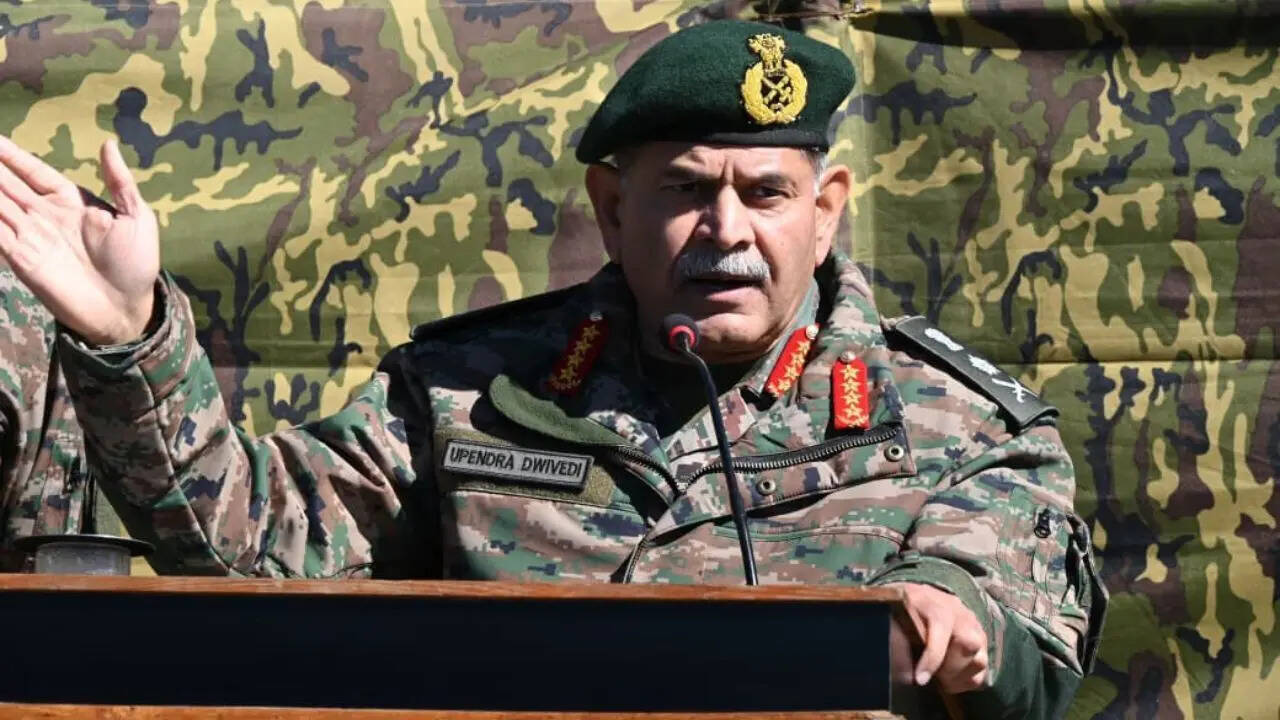
In an interview with TOI’s Surendra Singh, Chief of Army Staff General Upendra Dwivedi, who has been leading the 12.4 lakh-strong Indian Army since June 30, 2024 and played a key role in rolling out Operation Sindoor, spoke at length about how lessons learnt from last year’s operation against Pakistan are now part of the Army doctrine; how drones are now central to India’s battlefield operations; the changing warfare tactics and technologies; and why Pakistan must deter from another terror attack on Indian soil. Excerpts:General Sir, you led the Army during the conflict with Pakistan last May and played a key role in strategising and implementing Operation Sindoor. Though India was able to bring Pakistan to its knees in just four days, there must be several lessons Indian forces also learnt from that conflict. What are those lessons and how fast have we acted on them?Operation Sindoor was a defining moment, as it demonstrated the Indian armed forces’ ability to deliver swift, precise and strategically-coherent military outcomes in a compressed timeframe. Its greatest legacy is the affirmation that integrated, multi-domain and technology-enabled operations are now the decisive template for the future battlefield. The Army was at the centre stage of the orchestration of Operation Sindoor, operating within a ‘Whole of Nation’ approach and supported by critical enablers across intelligence, technology, air power, cyber, electronic warfare and information management.The operation validated integrated planning, real-time intelligence fusion and decisive leadership at all levels. Land, air, cyber and electronic warfare capabilities worked in synchrony, creating operational advantage at critical moments. Precision weapons, drones and loitering munitions further enhanced this synergy by enabling high-impact results with minimal collateral damage. Even while conducting focused operations, the Army ensured that its posture on other fronts remained stable, balanced and deterrent.Operation Sindoor was short, sharp and decisive, but we must not assume that all future conflicts will be short. The armed forces must remain prepared for both compressed, high-intensity conflicts and long-drawn contingencies. This requires rapid mobilisation, seamless logistics, secure communications, resilient supply chains, sustained operational endurance and compressed decision cycles. The operation validated our indigenous initiatives, particularly in drones and loitering munitions, and gave commanders confidence in home-grown solutions for complex operational environments. At the same time, it reminded us that technology evolves continuously. The way ahead lies in the mantra of JAI: Jointness, Atmanirbharta and Innovation, supported by faster R&D, better quality weapons and cutting-edge systems, timely delivery of equipment and stronger electronic warfare and counter-UAS capabilities.Lessons from the operation are being incorporated into our doctrines, exercises, procurement priorities and force structuring. Our aim is not merely to learn from Operation Sindoor, but to institutionalise those lessons so that the Army remains faster, more precise, better integrated and fully prepared for the next challenge.Pakistan used a number of China-made weapon systems and Turkey-developed drones during the 2025 conflict. What steps have we taken since then to tackle such missile and drone threats from Pakistan in future?Operation Sindoor gave us a clear picture of the evolving threat environment. Pakistan employed a range of imported systems, including China-origin platforms and Turkey-origin drones. We also saw signatures of external support and intelligence sharing. Therefore, our response cannot be platform-specific alone. It has to be capability-based, covering surveillance, air defence, electronic warfare, counter-UAS systems, secure communications and real-time intelligence fusion.Since then, we have strengthened our response on multiple fronts. Layered air defence and counter-drone capabilities are being enhanced for troops, logistics nodes, ammunition areas, command centres and critical infrastructure. This includes sensors, jammers, spoofers, kinetic systems and both soft-kill and hard-kill options. At the same time, electronic warfare and cyber-electromagnetic capabilities are being upgraded to detect, track, disrupt and neutralise threats across the kill chain.We have also raised and operationalised new technology-enabled structures such as Rudra Brigades, Bhairav Battalions, Ashni Drone Platoons, Shaktibaan Regiments and Divyastra Batteries. These are designed to give commanders greater agility, surveillance, precision, unmanned capability and counter-UAS options at different levels of combat. Concept of Unified Control Centre (UCC) has also been introduced at Division level to manage mushrooming numbers of UAS and C-UAS at tactical level.Most importantly, we are accelerating indigenous solutions. Operation Sindoor gave commanders confidence in home-grown drones, loitering munitions and supporting systems, but it also reminded us that technology evolves quickly. Our focus now is on faster R&D, better quality systems, timely delivery, resilient networks and stronger integration of air defence, artillery, aviation, EW and intelligence assets. The aim is to ensure that future missile and drone threats are met with speed, precision and confidence.Sir, you had served as GOC-in-C of the Northern Command and also commanded the Rising Star Corps along the Western Front. As the Army chief, do you think our Army is now prepared to take on both Pakistan and Chinese forces in case of two-front attacks?I would describe the challenge not merely as a two-front threat, but as a two-and-a-half front challenge. We have to remain prepared for simultaneous threats along the northern and western borders, while also retaining the ability to manage internal security challenges, proxy threats and the grey-zone activities that accompany modern conflict. This reality is well-recognised, and the Indian Army remains fully prepared to meet such contingencies without dilution of focus.Our approach is guided by readiness, flexibility, adaptability and a ‘Whole of Nation’ approach. Safeguarding national sovereignty remains our foremost responsibility. Our deployment posture, surveillance architecture, logistics systems, mobility plans and operational readiness are robust and responsive. We maintain a calibrated balance between internal and external security priorities, and our plans are designed to respond decisively across contingencies while ensuring that both borders remain secure.At the same time, we are strengthening our capability through restructuring and technology absorption. Modernisation is also bringing niche technologies down to the cutting edge, so that commanders at every level are better informed, better connected and better prepared.Internal security commitments are being handled through intelligence-driven operations in close coordination with CAPFs, central and state agencies. The situation in the Northeast remains stable, with positive indicators and reduced violence parameters. Therefore, whether it is the northern border, western front or internal security domain, the Indian Army remains vigilant, balanced and prepared. Our focus is clear: deter where possible, respond decisively where required and protect India’s sovereignty with professionalism and resolve.In today’s conflicts like in Iran and Ukraine, the use of different kinds of drones has become common among armed forces. How well has the Indian Army integrated drones into the force? Recent conflicts have clearly shown that drones are now central to battlefield operations, whether for surveillance, precision engagement, logistics, communication relay or psychological impact. Ukraine has demonstrated the scale and innovation possible in drone warfare, while the Iran-related conflicts have shown the challenge of long-range one-way attack drones and saturation threats. For the Indian Army, the lesson is clear: drones cannot remain specialised assets at higher headquarters. They must be integrated into formations and sub-units, along with counter-UAS and electronic warfare capabilities.We have adopted a tiered and role-based approach. At the infantry battalion level, Ashni Drone Platoons are being integrated to provide organic surveillance, target acquisition and tactical awareness. At formation level, larger UAS, loitering munitions and counter-UAS systems are being linked with artillery, air defence, aviation, intelligence and electronic warfare grids. The aim is to shorten the sensor-to-shooter cycle and give commanders real-time battlefield awareness.The Shaktibaan Regiments are part of this broader restructuring. They are designed to strengthen unmanned and counter-unmanned capability, including long range surveillance, precision targeting and protection against hostile drone threats. Along with Divyastra Drone Batteries, Ashni Platoons, Rudra Brigades and Bhairav Battalions, they represent the Army’s move towards technology-enabled, agile and multi-domain formations.Integration is also taking place through training, SOPs, exercises and doctrine. The focus is not only on inducting drones, but on absorbing them into the way we fight. Our commanders and soldiers must be able to employ drones, counter hostile drones and operate confidently in a drone-dense battlefield.In your recent statement, you had said that “Pakistan must decide whether it wants to remain part of geography or become history if it continues supporting cross-border terrorism”. Will you explain your statement? My statement must be understood in the context of India’s new normal against terrorism. It was not about reckless escalation, but about clear deterrence. The message is simple: India will not accept cross-border terrorism as routine. Any act of terrorism will invite a decisive response, and there will be no distinction between terrorists and those who sponsor, support or shelter them. India’s response will not be constrained by sabre-rattling or nuclear blackmail.Operation Sindoor demonstrated this new normal. It was swift, focused, measured and non-escalatory, yet it imposed costs and conveyed resolve. It also showed that India can employ military power with precision, restraint and political clarity. We do not seek war, but we are fully prepared to respond to provocation across the spectrum of conflict.As far as a future contingency is concerned, I would not define it as “Sindoor 2.0” in advance. Every response will depend on the nature of provocation, national objective and operational requirement. However, the Army is prepared for both short, intense conflicts and prolonged contingencies. Our operational preparedness to include surveillance, air defence, cyber, EW, precision fires, drones, counter-UAS capabilities and logistics are being strengthened accordingly.The key point is that deterrence must be credible. If Pakistan persists with cross-border terrorism, the cost will be heavy. India will act at a time, place and manner of its choosing, with the full strength of an integrated, joint and ‘Whole of Nation’ approach. Our aim is peace and stability, but peace cannot rest on tolerance of terror.Sir, what is the current situation along the LAC where China and India have amassed over 50,000 troops each since the 2020 faceoff and many heavy weapons?The situation along the northern borders is stable but sensitive. The agreement on disengagement has enhanced stability on the ground and the year 2024-25 witnessed a significant thaw in the bilateral relationship. This is also reflected in ground commander-level interactions along the northern borders, where both sides are now more responsive and sensitive to each other’s concerns.There have been several positive indicators of gradual normalisation. These include the formulation of an experts’ group for boundary delimitation, a working group for border management, resumption of Kailash Mansarovar Yatra and direct flights, consensus on resumption of border trade through three border passes and visa relaxation measures. Renewed engagements at diplomatic and military levels have helped reduce tensions and build mutual confidence.At the military level, more than 1,100 ground-level interactions take place annually between the two sides including the most recent Corps Commander-level talks. These military-to-military engagements, along with patrolling and other activities, have also facilitated grazing, hydrotherapy camps and religious activities along the Northern Borders.Our future roadmap is clear. We will maintain peace and tranquillity, resolve local issues through military-to-military engagements, preserve stability for progress on the experts’ group and working group mechanisms, maintain robust deployment to deter any threat and continue focused infrastructure and capability development. Therefore, while the situation has improved, the Army will remain vigilant, balanced and fully prepared along the LAC.With the Indian Army regularly tackling threats from insurgents in Manipur, how can we improve the volatile situation in the state?The situation in Manipur requires a balanced and sensitive approach, combining firm security measures with reconciliation, restoration of normal governance and community participation. The role of the Indian Army and Assam Rifles is to create secure and stable conditions in which civil administration, dialogue and development can move forward. Our operations remain intelligence-driven, calibrated and closely coordinated with CAPFs, Central agencies and the State Government.The immediate priority is to prevent violence, maintain security pressure on armed groups, ensure free movement, protect vulnerable areas and support relief and rehabilitation efforts. At the same time, security action alone cannot provide a lasting solution. The deeper requirement is to rebuild trust between communities, strengthen local confidence, enable return to normal civic life and support initiatives that bring people back into the mainstream.The Army’s approach is professional, impartial and people-centric. We remain focused on stabilising the situation without adding to local sensitivities. Wherever required, we assist the civil administration in restoring confidence, securing critical areas and enabling humanitarian support. The long-term solution must come through governance, dialogue, reconciliation and inclusive development. The Army will continue to provide the secure environment necessary for that process to succeed.


