



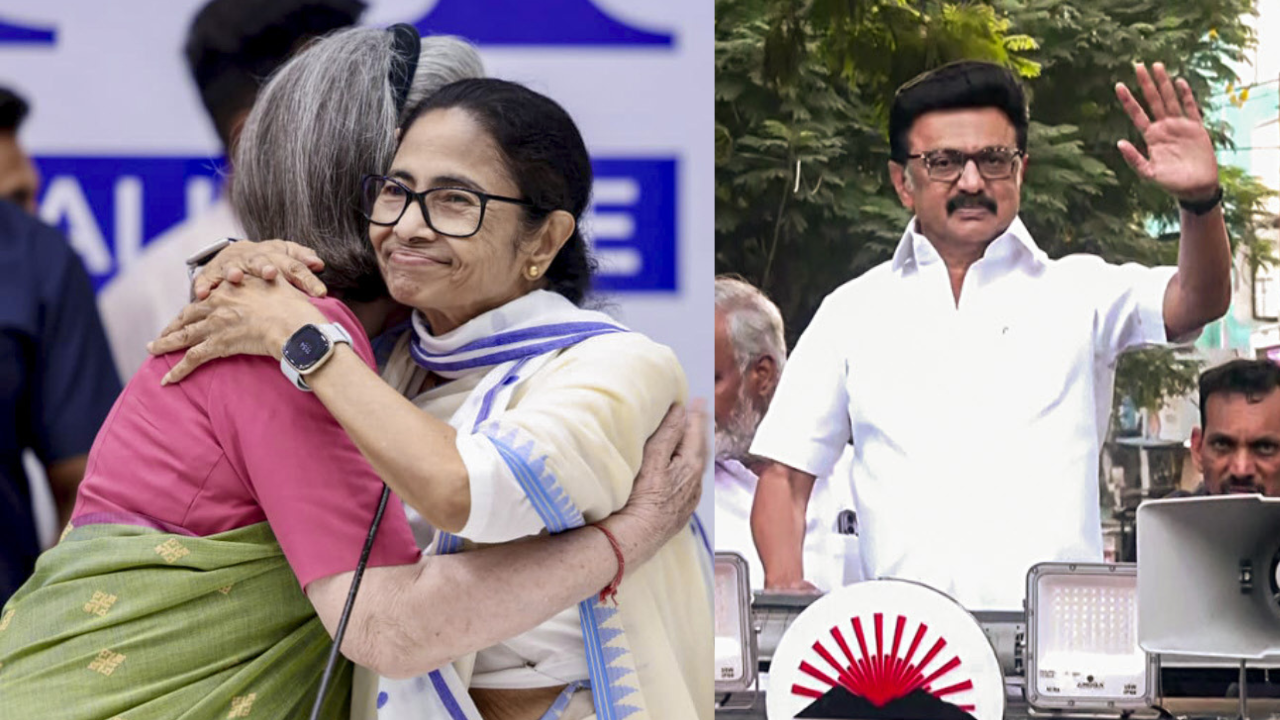
New Delhi: Opposition leaders gathered at the Constitution Club in New Delhi on Monday for the first high-level Indian bloc meeting after the 2024 Lok Sabha elections and made a visual display of unity. Sonia Gandhi warmly embraced Mamata Banerjee. Rahul Gandhi, Mallikarjun Kharge, Akhilesh Yadav and other opposition leaders greeted each other before sitting down to discuss strategy, Parliament and the way forward.While the opposition faction came up with five agendas for the coming months, including a letter to the Chief Justice of India on SIR and vote ‘stealing’ and a unified demand for the resignation of the Union Education Minister over the NEET paper leak.However, the biggest achievement of the meeting was not the agenda but the attendance sheet.While Trinamool Congress chief Mamata Banerjee was one of the strongest advocates of reviving the India block’s political participation after the recent assembly elections, DMK chairman mk stalin It was decided to completely boycott the meeting.
The absence was particularly striking as both Mamata and Stalin find themselves in remarkably similar circumstances. The two most powerful regional satraps recently suffered crushing electoral defeats, which have fundamentally changed the political equations in their states. While Mamata lost power to the Bharatiya Janata Party after 15 years of rule and now faces an unprecedented rebellion inside her party, MK Stalin lost the election and his ally Congress lost the election for the first time. Victory This year. That is why their reactions regarding the India faction are completely different.As TMC Chief Mamata is moving closer to India Bloc and Congress, Stalin seems to be moving away from both.The different paths chosen by the two leaders provide perhaps the clearest indication yet of how the balance of power within the opposition camp is being rewritten following the political turmoil in West Bengal. Tamil Nadu.
A meeting about more than unity
That the meeting was called amid concerns over the future of the alliance became clear even before the opposition leaders gathered in Delhi.Speaking in Baramati earlier in the day, NCP (SP) chief Sharad Pawar acknowledged the growing tension within the alliance and indicated that another round of consultations between senior leaders would be needed to prevent further rifts.Referring to the signals from the DMK-Congress situation, Pawar said, “Since such a situation is emerging, we will invite key leaders in the next eight to 15 days and try to find a solution. I am sure a solution will be found.”“An appeal will be made that no one should take any extreme step,” he said.His comments can be seen as a rare public admission that the Indian faction is now not only dealing with electoral strategy against the BJP-led NDA but also with questions of its own cohesion.
Mamata’s dominance till ‘dependence’ era!
For most of the last decade, Mamata Banerjee looked to be in a strong position in opposition politics.After defeating the Left Front and later emerging as the major challenger to the BJP in West Bengal, he created the image of a leader who needed allies only on his own terms. The Trinamool Congress expanded beyond Bengal, attempting to establish itself as a national force and frequently challenging the Congress’s claim to leadership of the opposition space.Even within the India block, Mamata often presented herself less as a partner and more as an equal pole of power.Tension was visible during seat-sharing talks ahead of the 2024 Lok Sabha elections and subsequent assembly elections. He repeatedly stressed that the political realities of Bengal could not be dictated by leaders from Delhi and rejected Congress’s demands for a greater role in the state. At various points, he openly questioned the electoral effectiveness of the Congress and suggested that regional parties were carrying a disproportionate share of the anti-BJP burden.The message was clear: Mamata did not believe that she needed the Congress as much as the Congress needed her.However, the BJP’s defeat in the assembly elections not only ended TMC’s grip on power but also exposed weaknesses within the party that had long been hidden beneath its electoral dominance. The aftermath proved to be even more damaging than the defeat. The rebellion led by Ritabrata Banerjee, in which 58 out of 80 party MLAs defected, posed the biggest crisis for Mamata since the inception of the Trinamool Congress in 1998.Ritabrata Banerjee explained the rebellion, saying, “There was no way to raise our grievances within the Trinamool.” He alleged that internal dissent has become impossible under the current leadership structure.The criticism reflects growing uneasiness within a section of the party over the rise of Abhishek Banerjee and concentration of power around the shrinking leadership circle.Party MLA Kakoli Ghosh Dastidar claimed that on Monday, 20 MPs have also written a letter to the Lok Sabha Speaker “desiring an alliance with the NDA”. Faced with electoral defeat, party instability and constant speculation of further defection, Mamata’s political priorities have inevitably changed. The TMC chief, who had challenged the BJP before the assembly elections and said she would “take over Delhi next time”, now finds herself in a situation where her national ambitions have been replaced by the immediate task of maintaining the party’s relevance and unity.It is in this context that his new interest in the Indian group should be understood.
The alliance is now providing Mamata with what she urgently needs: a national political shield. Continued participation in the broader opposition platform allows him to remain relevant beyond Bengal, reassuring nervous party leaders that TMC is not isolated and making it harder for rivals to portray him as a leader whose political influence has waned.Therefore, Mamata Banerjee, who reached Delhi on Monday, was very different from the Mamata Banerjee who often used to quarrel with the Congress over the opposition leadership. For now, at least, the relationship has become less transactional and more strategic as the cost of political isolation is now higher than before.
Stalin’s calculations are wrong
If Mamata’s political circumstances have pushed her towards the India faction, Stalin’s circumstances have pushed her away from it.For years, the DMK-Congress relationship was considered one of the most stable partnerships in Tamil Nadu. Stalin was among the first regional leaders to publicly support Rahul Gandhi’s leadership abilities, with Rahul Gandhi fondly addressing him as “elder brother”. The DMK consistently supported the Congress on key national issues and emerged as one of the strongest supporters of opposition unity.Unlike Mamata, whose relations with the Congress were often marked by friction, Stalin’s equation with the party was built on predictability and mutual trust.That equation is now under unprecedented stress.The Tamil Nadu Assembly elections dramatically changed the alliance equations in the state. The rise of Vijay’s TVK transformed the long-standing bipolar contest into a more complex political battle. More importantly, as soon as TVK emerged as the largest party, Congress immediately aligned itself with Vijay instead of being tied to DMK’s fate.What was even more painful for the DMK was that the Congress did not even talk or inform about its decision to change the alliance.Taking aim at the grand old party, the DMK passed a resolution against the Congress and accused it of backstabbing the party. Udayanidhi Stalin bluntly said that the Congress “lacks the minimum of decency and gratitude” and should not be trusted in future alliances. Stalin’s party also immediately wrote a letter to the Lok Sabha Speaker requesting permission to sit separately from the Congress in Parliament. Unlike Mamata, whose immediate problem lies within her own organisation, Stalin’s challenge comes from a rival political formation that is threatening to occupy the same ideological and electoral space. The emergence of TVK is a direct challenge to DMK’s claim on anti-AIADMK and anti-BJP voters. Any move that consolidates Vijay also weakens the DMK’s ability to regain its dominance.Therefore, when viewed from Chennai, the Congress’ calculations may look very different from what they look like in Delhi.While the Congress may regard its association with the TVK as a pragmatic adaptation to changing realities, the DMK sees it as an abandonment of a long-standing ally at a moment of weakness.This explains why Stalin chose absence rather than participation.The boycott was not merely symbolic. Its purpose was to express dissatisfaction with the direction in which the opposition coalition was developing. The absence makes it clear that Stalin, or perhaps any regional satrap, would not want opposition unity at the cost of political survival.Unlike Mamata, who may see the India Bloc as a source of security at this point, Stalin may see it as a platform that could strengthen the rival (Congress), thereby threatening the DMK’s future.On the other hand, Vijay’s TVK was not invited for the meeting and is yet to join the India block.Since its inception, the Congress has always fought an internal battle to lead the Indian faction as a national party against the BJP while seeking support from stronger regional forces. Leaders like Mamata Banerjee, Stalin and Akhilesh Yadav commanded powerful state-level organizations and were often in a position to dictate terms.Today, the balance has changed.Speaking at Monday’s meeting, Congress president Mallikarjun Kharge projected confidence rather than dependence.Emphasizing the need for continued cooperation, he told the coalition partners, “We have to fight unitedly against all the anti-people policies of the government. We have to strengthen coordination both inside and outside the Parliament.”Kharge described the opposition’s coordinated resistance to the Centre’s delimitation proposals as proof that collective action can still deliver results.The tone reflects a party that increasingly sees itself as a nurturer of the opposition. In fact, after the meeting, only Kharge addressed the press conference on behalf of Congress, while all the leaders remained sitting on the same stage. The irony is that increasing centralization is generating adverse reactions among regional leaders.
Sonia-Mamata hug
The heated exchange between Sonia Gandhi and Mamata Banerjee soon became the defining image of the day. Yet its significance goes beyond personal chemistry or political symbolism.
This marks a remarkable reversal in opposition politics.The leader who once challenged the centrality of the Congress within the opposition is now one of the strongest supporters of collective action. On the other hand, Stalin, whose party was once considered the Congress’s most reliable regional ally, is increasingly questioning the value of remaining tied to the alliance.This reversal tells us as much about the changing fortunes of regional parties as it does about the gradual re-emergence of the Congress as the central pole of the opposition.The India Bloc meeting was officially about coordination, strategy and preparation for future political battles. However, informally, it can be seen through the prism of the recent assembly elections, where it is trying to manage competing concerns among its own constituents.That’s why the real story of Monday’s meeting cannot be about the resolutions passed inside the room. It will be about the divergent journeys of two regional giants who lost power at around the same time, but came to very different conclusions about what would happen next.And perhaps the future of the Indian group is hidden somewhere between Mamata’s embrace and Stalin’s empty chair.


