



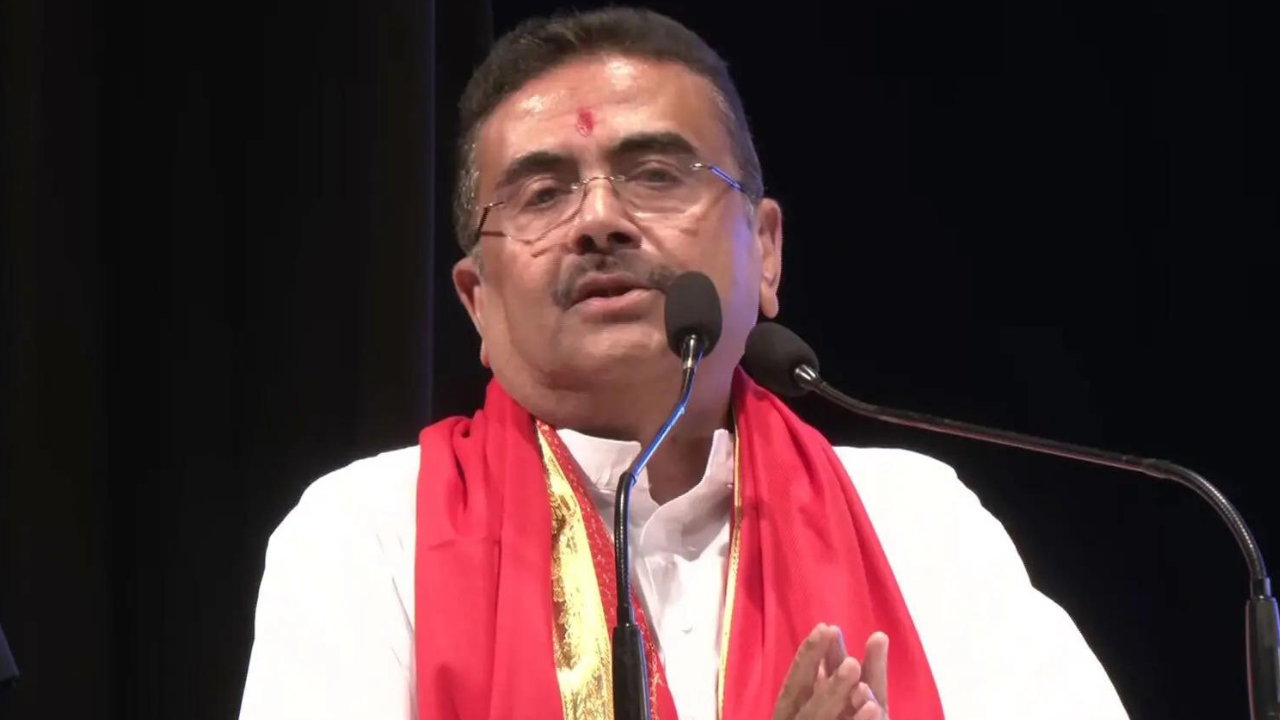
Every new government gets a little honeymoon with history. Franklin Roosevelt used it to tell a broken America that the first act of power is not perfection, but speed: “Above all, try something.” Suvendu Adhikari has internalized that sentiment, a month after taking oath as West Bengal CM on Rabindranath Tagore’s birth anniversary on May 9. First BJP The state chief minister is on almost a war-like footing to reimagine Bengal, even taking some drastic steps, even as his attention remains focused on the Trinamool Congress’s revelations on live television.In Indian cinema, perhaps no chief minister’s first day was more dramatic than Anil Kapoor’s Shivaji Rao Gaekwad. hero. It was an adrenaline-driven regime. This is why this film remains such a fan favorite. It understands what citizens secretly want from power, that the state should appear vibrant and active.This is what Suvendu Adhikari’s first month has been like hero energy. Not in the sense that one man can solve Bengal in a month. But the urgency with which the government has moved on some issues clearly shows that it is keen to determine how it wants to govern the next five years. So far, what has come to the fore in the BJP’s brief tenure in Bengal is that it has already opened many doors to cater to many of its key constituents. The prompt implementation of Annapurna Yojana and free bus service for women is a recognition that women remain the most important political battleground of Bengal. Relaxation in employment age has been announced for youth, another constituency the BJP wants to retain. Then there is the nationalist strategy of being tough on infiltration and enforcing laws to the letter, especially those that touch minority practices.Here we take a look at some of the broader themes of change in Bengal’s rapidly changing political landscape.
TMC loses its aura
For fifteen years, and especially in the last ten years, the Trinamool Congress had an almost uncontrolled performance and captured all spheres of power. This gradually turned into a street veto, where almost nothing happened without the consent of the local powerful.Now, with the Trinamool Congress’s defeat in the state assembly and Parliament, the party seems to be facing its deepest crisis. This is perhaps the biggest change in the last 30 days, which even the staunchest critics of TMC could not have imagined. This, along with the long arm of the law in arresting several TMC leaders and the repeated ED summons to Abhishek Banerjee, is being read as a sign that the winds of change are more permanent than a lone electoral defeat.For many, TMC’s waning influence looks less like a momentary blip on the radar and more like a shift in the social order. Therefore, even at lower levels, meteorologists have been quick to adapt to the new patterns of the day.The crackdown on alleged extortion and corruption networks has been in the news continuously since last month. The round of arrests continues, from former ministers to civic leaders. For the BJP, it is a sign of accountability after years of localized impunity.While the BJP has so far been careful not to officially include TMC workers and leaders, with Kakoli Ghosh Dastidar and other MPs indicating support for the NDA, sooner or later many may find themselves in the saffron fold. According to political expert Subhamoy Maitra, a close watch will be kept on how BJP deals with leaders who switch sides. The fact is that after mass resignations in panchayats and municipalities, when re-elections are held, BJP may have to pull some cadre from TMC, including those from the rebel group. Maitra warned that if people against whom the common people had grievances came back to power, it could lead to resentment among citizens.
Faith, food and a difficult situation
The government has started enforcing laws on public prayers and street occupation, which is visible during Eid celebrations, with prayers being held at Kolkata’s Brigade Parade Ground instead of Red Road. So far, government action in this regard has received limited response, with a few exceptions.The government has also moved to strictly enforce the West Bengal Animal Slaughter Control Act with certification requirements and restrictions on unauthorized slaughter. Its objective is to stop illegal slaughter and animal trafficking.The decision to end religion-based allowances is another sign of the new direction. The honorarium of Imams, Muezzins and priests has been stopped. Vande Mataram has been made mandatory in government and government-aided schools, with a similar order passed for recognized madrassas and other Islamic educational institutions. This set of orders is completely in line with the BJP’s cultural strategy and is likely to keep its core voters satisfied.
border pushback
Another big part of the BJP’s nationalist pitch over the past few years has been the promise to crack down on illegal infiltration through the Bangladesh border. The state has started land acquisition and handover work for fencing the India-Bangladesh border and set a deadline for the pending land transfer. It has also begun using holding centers for undocumented migrants, while claiming to have deported thousands of people back to Bangladesh.However, not everyone is convinced by this action of the government. Ranjit Sur, vice-president of the Association for Protection of Democratic Rights, says that the Suvendu government has resorted to illegal, unconstitutional and inhumane methods of ruling in its short tenure. He expresses deep concern over 4,800 “illegal immigrants” being sent back to Bangladesh, a figure provided by the Chief Minister. However, Maitra believes that the border clashes are happening in small numbers and are unlikely to become a major issue in Bengal politics in the near future.
bulldozer in bengal
Unauthorized buildings in several parts of Kolkata, some of which were allegedly developed by people linked to TMC, have been demolished. The drive to remove hawkers has affected railway locations and station areas including Howrah, Sealdah, Dumdum and Jadavpur.Sur describes this as cruel and fears it could gradually empower the police to implement a “UP-style” model of law enforcement. Maitra also warns that issues like eviction of hawkers could soon become unpopular if alternative policies are not imagined.
Women and youth get immediate benefits
Mamata Banerjee built a deep bond with women and welfare beneficiaries. Adhikari’s first month shows that BJP understands this deeply. Therefore, Annapurna Yojana has been launched rapidly. However, the BJP is also looking to clean up the delivery mechanism with a detailed 12-page application form and screening linked to SIR deletion. Maitra is of the opinion that the extended form has however come in for its fair share of criticism and could become a bigger issue if not addressed. The free bus service for women has already generated goodwill especially among daily commuters. However, the bigger challenge will be to revamp the state transport system and add more government buses.The government has also tried to reach out to the youth by revising the upper age limit for state government jobs. The scholarship is being offered as a replacement for religion-based aid. PM Shri schools have been brought under the central schemes.However, the OBC quota amendment shows that the BJP government is in a difficult position to signal to its core constituents. It has sought to bring back the quota from 17% to 7%, citing court compliance and pre-2010 classification.The decision to set up the 7th Pay Commission is another mark in its list of pre-poll promises and has enthused state employees and pensioners. For low-income beneficiaries, the revamped Maa Canteen, now known as Maa Aahar, is a big relief. In government canteens, fish and rice are available twice a week for just Rs 5.
double turbocharged engine
The much awaited double engine government model has already shown its green signal. Ayushman Bharat is the biggest wellness marker. The government has decided to bring Bengal into the national health-insurance architecture, which it had been out of for years. Ujjwala, PM Surya Ghar, PM Vishwakarma, PM Fasal Bima and other central schemes are now being launched in Bengal. The money which was pending for a long time due to political monopoly is being sanctioned.The same logic of double engine is visible in rail and metro projects. The Chingrighata section of the metro, which was stuck in legal trap for years, was unlocked within a few days. Many rail projects stuck in bureaucratic lapses have been reactivated. The proposed high-speed corridor to run the bullet train connecting Delhi to Siliguri has added icing on the cake.
symbolism on point
The new government has tried to present a sensitive image by holding Janata Darbar, in which the Chief Minister was also present, and opening the Apni Sarkar Apna Paashe helpline. In a state where political rivalry often turns into political untouchability, calling opposition leaders for meetings is a welcome move.The government has also decided to replace the Biswa Bangla branding with the national Ashoka emblem in official communications. The state’s traditional white and blue color theme, introduced by the TMC, is also being given a muted makeover. The Messi statue and the controversial football-themed statue near the Vivekananda Yuba Bharati Krirangan in Kolkata have also been removed, perhaps as a play on the gallery.
the hard part starts now
If the government is successful in implementing all its welfare schemes, Bengal’s debt is likely to exceed Rs 8 lakh crore by the end of the 2026-27 financial year. This makes it imperative to open new sources of revenue. Beyond symbolism, how much the government is able to energize Bengal’s moribund manufacturing sector will ultimately be the real measure of its success. Bengal needs jobs, and urgently. TMC understood this but failed to find a way out, and many believe it was forced to turn a blind eye to the cut-money culture.The official has moved quickly to tell investors that Bengal is open again, meeting the L&T chairman after he held discussions with Adani Ports MD Karan Adani about infrastructure, logistics, ports and power. L&T already has the Rs 1,670-crore Gangasagar Bridge contract, while the state is exploring a new deep sea port site at Dadanpatrabar after the troubled Tajpur chapter. Amul’s proposed expansion provides a much-needed boost to an industrial engine that needs a massive boost.hero Worked because it showed a state demanding accountability. But governance is not a cinema. Can a government that started out by trying everything learn the more difficult art of doing the right thing again and again once the cameras are rolling?Then the honeymoon ends. That’s when the reign begins.


