



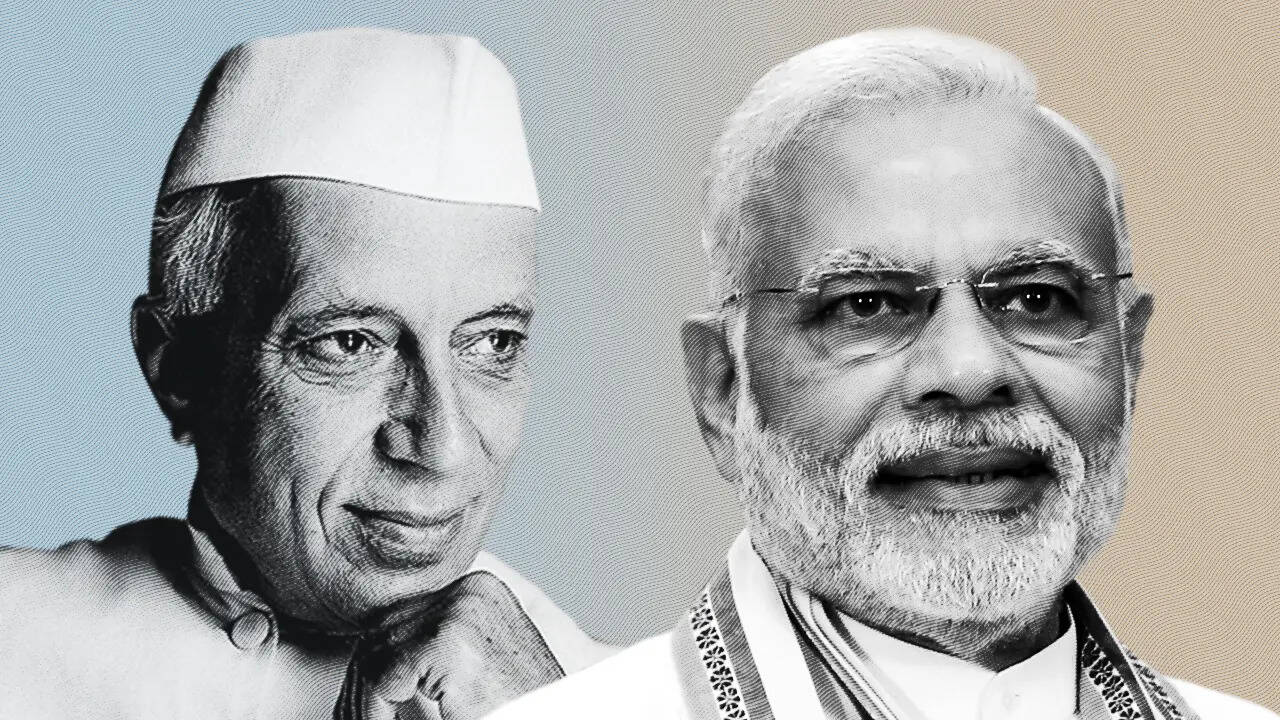
‘Modi hai to mumkin hai’, is a popular phrase that has become synonymous with the BJP-led NDA government over the years. In fact, this idea of ”achieving the impossible” has often been presented as a hallmark of the Prime Minister Narendra ModiA long tenure of 12 years at the top. But many of his supporters would not have imagined that one day their leader would make possible the work which had remained impossible for other leaders for decades.On June 10, 2026, Narendra Modi entered the record books by becoming the country’s longest serving elected Prime Minister by serving the country for 4,399 consecutive days. This is one more than what the country’s first Prime Minister Jawaharlal Nehru had achieved in his lifetime. Nehru had an uninterrupted tenure of 4,398 days after leading the Congress to victory in the country’s first three general elections. However, Nehru overall holds the record as India’s longest-serving Prime Minister, holding the post from independence in 1947 until his death in 1964.
Narendra Modi completed 4,399 consecutive days in office on June 10, 2026, surpassing Jawaharlal Nehru’s record of 4,398 days.
The only other Prime Minister to come close to Nehru’s record was Indira Gandhi, whose longest uninterrupted tenure in office lasted 4,077 days. More than 60 years after Nehru’s death in office, the record has finally changed.
recording path
On May 26, 2014, Narendra Modi took oath as the Prime Minister of the country for the first time. That day began a dominance that continues to this day. His record tenure at the top comes after three consecutive Lok Sabha victories, a feat achieved only by Jawaharlal Nehru before him. PM Modi led in 2019 BJP Achieved a bigger victory than 2014 and took oath as PM for the second time on May 30, 2019. His third term as Prime Minister began on June 9, 2024. BJP fell below the majority mark for the first time in the 2024 Lok Sabha elections, but this did not reduce PM Modi’s dominance in any way.
PM Modi’s 4,399 day journey
Longest reigning chief
In fact, long before Narendra Modi took charge as the country’s Prime Minister, he was creating governance records in his home state Gujarat, where he served as Chief Minister for 12 years. Narendra Modi became Chief Minister for the first time in October 2001 and held that post for 4,610 days before being sworn in as Prime Minister.With his tenure as Prime Minister, PM Modi has now spent more than 9,000 days as the elected head of government. In March 2026, he overtook former Sikkim Chief Minister Pawan Kumar Chamling’s tenure of 8,930 days to create the record of becoming the country’s longest-serving head of state.
Combining his tenures as Chief Minister of Gujarat and Prime Minister, Modi became India’s longest-serving head of state in March 2026.
How did the Lok Sabha change?
The BJP’s journey to power at the Center for the third consecutive time can be traced to its Lok Sabha performance in the last four general elections. After winning 116 seats in 2009, the party more than doubled its tally to 282 seats in 2014, securing a single-party majority in the Lok Sabha for the first time in three decades. In 2019 it improved on that performance and won 303 seats, before slipping to 240 seats in 2024.While the BJP’s numbers declined in 2024, it remained the largest party in Parliament and retained power through the NDA. Congress, which won 206 seats in 2009, fell to 44 seats in 2014 and to 99 seats in 2024.
How did the map of India turn saffron in 12 years?
Over the past 12 years, the BJP under the leadership of Prime Minister Narendra Modi has changed the political map of India, evolving from a party concentrated primarily in the Hindi heartland to a party with a presence in much of the country. When PM Modi first assumed power in 2014, the BJP was in power in just seven states. Today, the party and its allies rule 22 states and union territories.
The party formed governments in states where it previously had little or no presence and strengthened its position in several existing strongholds. This expansion came at a time when the Congress’ footprint in the states was steadily shrinking, reducing its presence largely to a handful of states and coalition governments.
Expansion beyond traditional strongholds
While the BJP expanded its influence across the country, the party’s rise was particularly visible on the east coast. In 2024, it regained power in Odisha for the first time by ousting the Biju Janata Dal after 24 years in power. Two years later, it won a historic victory in West Bengal, another state where it had never formed a government before. Some of the BJP’s most significant gains came outside the Hindi heartland. In the Northeast, the party expanded from a limited presence to become a major political player, forming governments in Assam, Tripura, Arunachal Pradesh and Manipur, while participating in the ruling coalitions in Meghalaya and Nagaland.
From a presence in seven states in 2014 to most parts of the country, the BJP’s expansion extended beyond its traditional strongholds.
The BJP’s victory march saw the party become a major player in states like Maharashtra and Bihar, changing from playing second fiddle as regional allies for years. In both these states, the BJP was the junior partner of regional allies – Shiv Sena in Maharashtra and Nitish Kumar’s JD(U) in Bihar. But this has changed for good now. Today, the saffron party rules both states and regional allies are junior partners.
Expansion of popularity among voters
The numbers in legislatures were a natural result of the party’s growing popularity among voters. The BJP saw a steady increase in its vote share in the Lok Sabha and in many states where it formed governments.
The world’s largest political party
The rise of BJP under the leadership of Narendra Modi is not limited to elections only. Over the past decade, the party has also expanded its organizational base and has become the world’s largest political party. The BJP first claimed the gap in 2015, overtaking the Chinese Communist Party in membership numbers, and subsequent membership drives have widened the gap further.According to figures cited by BJP leaders in 2025, the party has about 14 crore (140 million) members, while the Chinese Communist Party has about 10 crore members. The membership base of the BJP is much larger than that of most major political parties in democracies, including the American Democratic and Republican parties.
Global approval rating: PM Modi is number 1
Now, such popularity domestically cannot be ignored across the world, especially at a time when most global leaders, barring Xi Jinping in China and President Vladimir Putin in Russia, are burdened with pressure and expectations in their own countries. Prime Minister Modi’s approval rating not only increased with his tenure, but remained at the top for years.According to Morning Consult’s Global Leader Approval Rating Tracker, PM Modi’s approval rating stood at 70% as of April 2026, the highest among world leaders tracked by the firm.
country’s per capita income
According to IMF data, India’s per capita income has increased significantly over the past four decades, from about $271 in 1980 to an estimated $2,812 in 2026. The fastest growth came after the economic reforms initiated by the PV Narasimha Rao government in 1991. Income levels continued to rise during the Atal Bihari Vajpayee, Manmohan Singh and Narendra Modi governments, along with sustained economic growth and increasing integration with global markets.These numbers also reflect the impact of major economic disruptions over the past decade. Per capita income declined in 2020 during the COVID-19 pandemic, but recovered in subsequent years as economic activity resumed and growth picked up. Since 2014, India’s per capita income has increased from approximately $1,567 to a projected $2,812 in 2026. This growth largely mirrors the growth of the overall economy, which has grown from approximately $2 trillion in 2014 to a projected more than $4 trillion in 2026.
4 trillion dollar economy soon
According to IMF estimates, India’s nominal GDP is projected to grow from approximately $2.02 trillion in 2014 to an estimated $4.15 trillion in 2026. This expansion is driven by a combination of domestic consumption, investment, growth in the services sector and government spending on infrastructure.The growth trajectory was disrupted due to the COVID-19 pandemic, leading to a contraction in economic activity in 2020 before the economy rebounded in subsequent years. Based on current projections, India is expected to cross the $4 trillion mark during PM Modi’s third term and remain among the fastest growing major economies of the world. However, the outlook is linked to global development. Economists and rating agencies have flagged the risks of ongoing conflict in West Asia, particularly due to high crude oil prices, inflationary pressures and large import bills for an oil-dependent economy like India. Although growth remains resilient, the sustainability of that momentum will depend on how these external pressures evolve.
When can India become a 5 trillion dollar economy?
The idea of making India a $5 trillion economy came into discussion in 2019. Presenting the Union Budget that year, Finance Minister Nirmala Sitharaman said that India was “on track to achieve the Prime Minister’s vision of a $5 trillion economy by 2024–25”. Prime Minister Narendra Modi repeatedly described the target as an important milestone in India’s development journey.However, the timeline was disrupted by a combination of factors. The COVID-19 pandemic triggered a sharp economic contraction in 2020, while the continued depreciation of the rupee against the US dollar reduced the size of India’s economy when measured in dollar terms. As a result, even though GDP grew significantly in rupee terms, the economy lagged behind the $5 trillion mark.
the 5 trillion dollar question
According to IMF estimates, India’s nominal GDP is expected to reach about $4.15 trillion in 2026. Most estimates now aim for $5 trillion around 2028–29. Projections based on IMF data suggest the economy could reach $5 trillion by 2027-28, before surpassing the figure next year. By the end of this decade, India is likely to become the third-largest economy, although the timeline will depend on economic growth, the rupee exchange rate and global conditions.More than six decades after Nehru’s death, the record for India’s longest serving elected Prime Minister has changed. It remains to be seen whether Prime Minister Modi’s tenure ultimately equals that of Nehru, but this milestone marks the end of one chapter and the beginning of another.


