



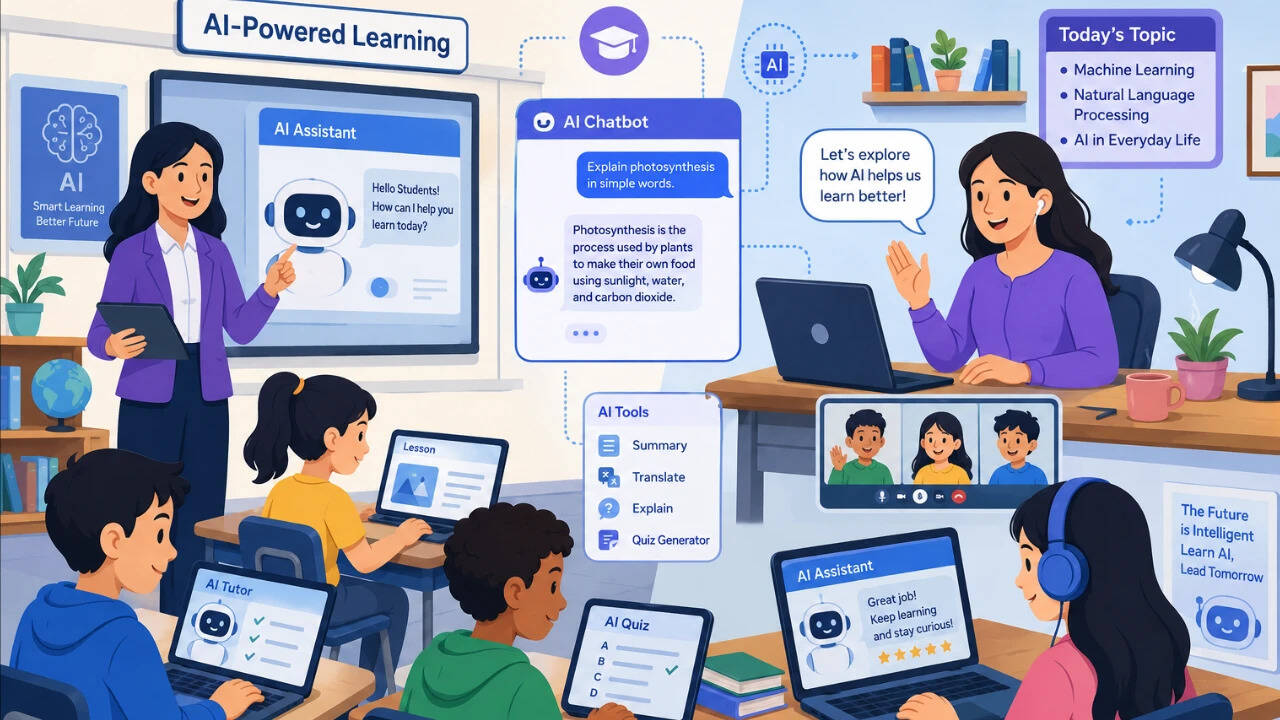
Walk into the staffroom of almost any school today and you will find two worlds side by side.In one corner are familiar symbols of teaching that have barely changed in decades: stacks of notebooks waiting to be checked, lesson plans being drawn up, and teachers discussing the daily challenge of keeping students engaged.In the other corner, laptop screens are glowing with AI-powered tools capable of creating worksheets, writing assessments, solving equations, and answering questions in seconds.The advent of artificial intelligence in education has sparked intense debate around the world. Will AI make learning more accessible? Will this change teaching? Could it eventually replace teachers?Yet, rather than resist technology or embrace it unquestioningly, many teachers are taking a more measured approach. They are experimenting with AI, testing its strengths and weaknesses, and developing their own rules for using it responsibly.What emerged from conversations with teachers is that AI is not even close to replacing them. Instead, it is changing the way they work and forcing them to rethink what learning should look like in an age where information is instantly available.
AI is there as a support tool, not a replacement
For Gauri Chanda, a physics teacher with years of classroom experience, AI has become a practical tool rather than a revolutionary force.She describes it as a support system that helps reduce the burden of routine work. AI can help create worksheets, suggest examples, and organize lesson content, allowing teachers to spend more time on aspects of teaching that require human judgment.
AI helps teachers save time on routine work, helping them focus on student interactions
“This helps me save time on routine tasks and allows me to focus more on interacting with students and making learning meaningful,” she says.In subjects like physics, where students often struggle to connect abstract concepts to everyday life, AI can also serve as a useful brainstorming partner. Teachers can ask for real-world examples, analogies, and applications that make complex concepts easier to understand.Yet Chanda is careful to draw clear boundaries.“I never trust it blindly,” she says. “I double-check the information and use my professional judgment before I take anything in class.”While AI can generate content rapidly, it has no understanding of a particular classroom, student learning styles, or the emotional and intellectual needs of individual learners. He argues that those decisions still require a teacher.
Staying updated in a rapidly changing environment
The same pattern is visible beyond traditional schools.Mrinalini Sharan, who teaches students from elementary to middle-school grades through private tuition classes, has also integrated AI into her work. For them, one of the biggest benefits is to stay updated with the changing syllabus and exam pattern.“This helps me stay updated with the students’ curriculum,” says Sharan. “This helps me understand the changes and explain them better.”However, like Chanda, she does not believe in AI as a right. When solving problems, especially in mathematics, she already knows the concepts and methods involved.“The responses have been broadly satisfactory,” she says. “I’m not relying on it for the primary solution. It just helps sort things out better for students.”For many teachers, AI is not replacing expertise. This is helping them work more efficiently.
Why do students still turn to teachers?
Popular perceptions often portray youth as enthusiastic adopters of technology who would happily replace teachers with AI tutors. Yet many teachers describe a different reality.Students may use AI tools regularly, but when they really struggle to understand a concept, they often return to the teacher.Sharan watches it again and again during tuition sessions.
Students still depend on teachers to learn and explain
“Some students jokingly claim they can learn everything from ChatGPT,” she says. “Instead of arguing, I sometimes hand them my phone and ask them to follow the AI-generated explanation.”The results are surprisingly consistent, she says.“Even when the explanation is technically correct, students often return the phone to me after a few moments and say, ‘Ma’am, you figure it out.'”For both teachers, that reaction highlights one of AI’s biggest limitations. It can provide information, but understanding often requires conversation, context, and trust.A teacher can recognize the confusion, rephrase the explanation, slow down, draw pictures, or connect a concept to the student’s interests. Educators say it’s hard to replicate those interactions through technology alone.
expanding access to education
Yet it would be a mistake to dismiss AI altogether.Both Chanda and Sharan acknowledge that technology offers significant benefits, especially for students who do not have access to educational support.
AI helps bridge the learning gap for students who don’t have access to help
Quality education is unevenly distributed in many parts of the country. Students may not have access to tuition classes, special teachers or academic guidance outside school hours.For these learners, AI can act as an educational companion.As Sharan says: “Smartphones are becoming more accessible than the actual education ecosystem. So, for students who don’t have access to this ecosystem – those who can’t afford tuition classes or a good school – this is definitely a boon.”As smartphones become more widespread, AI tools can help bridge some of those gaps by providing explanations, practice questions, and on-demand assistance.
Risk of learning shortcuts
While AI can improve access to information, teachers are concerned about its unintended effects on the way students learn.Sharan believes that easy access to answers can discourage students from developing critical thinking skills.“If students rely too much on AI, they will find it convenient to not use their critical thinking skills,” she says. “They are not using books and may lose understanding of the answers while scanning the book.”Traditionally, finding the answer requires effort. Students had to search textbooks, compare information from different sources, identify relevant sections, and interpret what they read.This process itself helped develop important cognitive abilities.AI shortens that journey dramatically.This concern becomes even more important among young learners. Students who are still developing reading, comprehension, and analytical skills often need direct guidance. Educators argue that AI cannot replace the basic instruction needed to build those abilities.
Rethinking Homework and Assessment
The rise of AI is forcing teachers to rethink how they assess learning.Traditional homework assignments are becoming less reliable indicators of understanding as AI can complete many tasks quickly and effectively.As a result, some teachers are shifting their focus from answers to process.Chanda has adopted this method. Their tasks require rapid observation, experimentation, discussion, personal reflection, and real-world application of concepts.Students are often asked not only what answer they arrived at, but also how they got there.The emphasis shifts from mere correctness to understanding.“When assigning work, I try to design tasks that require real thinking,” she says.Such assignments are difficult to outsource as they depend on personal reasoning and life experiences.
Teaching students to use AI responsibly
This change reflects the broader changes taking place in education.In a world where information is instantly accessible, the ability to ask meaningful questions may be more valuable than the ability to remember the answers.
Instead of pretending that AI doesn’t exist, teachers focus more on making students aware of how to use it responsibly
Teachers are increasingly helping students develop curiosity, analytical thinking and decision-making abilities.Chanda regularly discusses AI with her students, and encourages them to understand both its strengths and limitations.Students learn about misinformation, algorithmic bias, and the possibility that AI-generated content may seem credible even when it is inaccurate.The goal is not to discourage the use of technology but to encourage responsible use.“I remind them that AI can be a helpful assistant, but it should not replace curiosity, critical thinking, or originality,” she says.
Schools are still finding their approach
The most important aspect of the arrival of AI in education is that many schools are still figuring out how to respond.Unlike smartphones, which eventually became the subject of formal policies at most institutions, AI remains a gray area in many classrooms.Some schools have started discussing guidelines for assignments and assessment. Others are leaving decisions largely up to individual teachers.Educators say this flexibility has allowed experimentation, but it has also created uncertainty about acceptable use.For now, there is no single model. A physics teacher, a math teacher, and a primary school teacher may all use AI differently because they have different needs.
future of AI in education
Technology companies will continue to develop more sophisticated educational tools. New platforms will promise personalized instruction, automated feedback, and tailored learning experiences.Some of these innovations may actually prove useful.Yet teachers experimenting with AI today believe the central question is no longer whether AI belongs in education. This already happens.The more important question is how students and teachers choose to use it.As Chanda says: “AI is here to stay. The challenge is to learn how to use it intelligently.”At present, teachers are not handing over their classes to machines. They are using technology where it helps, questioning it where it seems to fall short, and trying to ensure that curiosity, judgment and critical thinking remain at the center of learning.


