



You can look up how to survive in space on the internet, but that doesn’t make you an astronaut. You have opinions about cricketers, but you won’t be coaching Virat Kohli on what to do on the pitch. You have opinions about geopolitics but has it ever made you the foreign minister?So why do most of us think that becoming a doctor is as easy as an Internet search or an AI query? An expert doctor in India has trained for over 13 years, and yet is consulted on a 0.13-second search result.A qualitative study published in BMC Medical Education examined what both physicians and patients consider important in medical consultations. The findings reveal a clear divide: while physicians focus on accurate diagnosis and treatment strategies, patients and relatives prioritize predictions (“How soon will I get better?”) and lifestyle advice.Doctors are trying to figure out what’s wrong. The patient is trying to figure out when it will end. These are not the same conversations.
Munchausen by Google
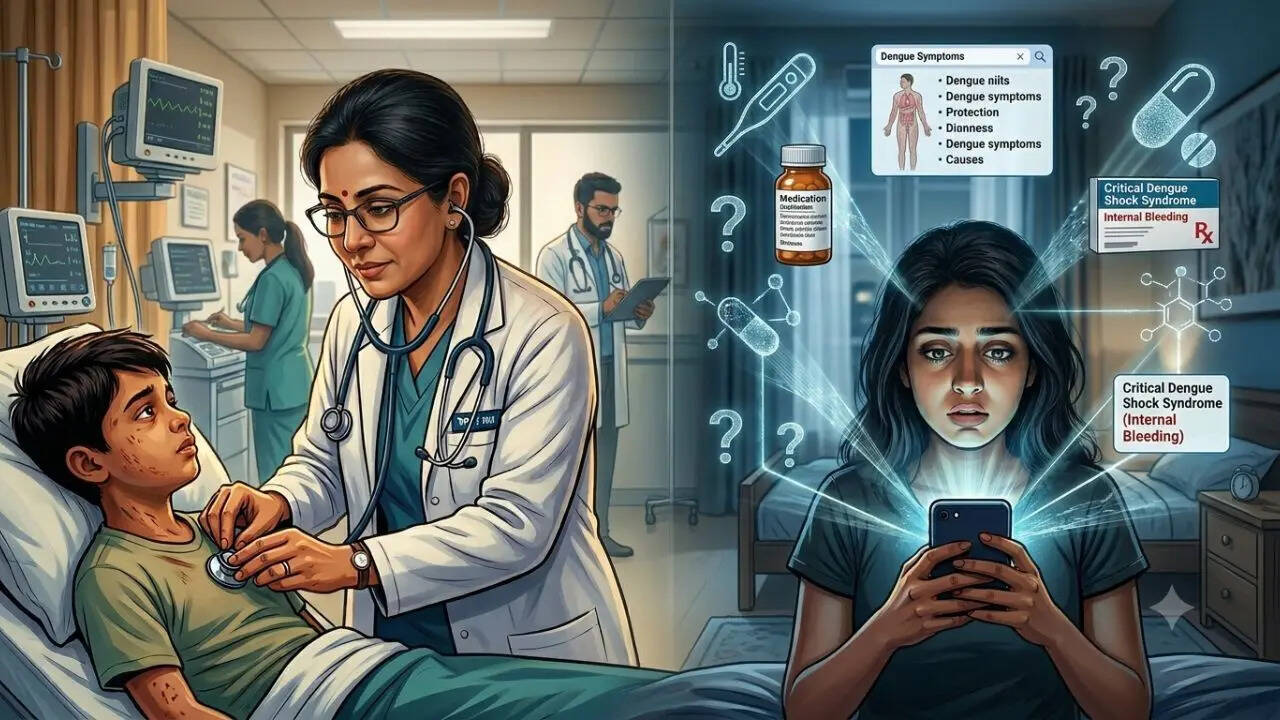
In 2009, British orthopedic surgeon EJ Griffiths coined the term ‘Munchausen syndrome by Google’ to describe a patient who used Google Images to fabricate radiographs and deceive multiple experts.What researchers now call cyberchondria is its casual, large-scale cousin: not deception, but false certainty. I use the phrase ‘Munchausen by Google’ in this broad, colloquial sense, to describe the millions of patients who arrive at consultations not with forged X-rays, but with self-diagnoses they found between midnight and 2am and can no longer be talked to.Seven out of ten Internet users research their symptoms online. In India, that number has an added curse: a deep, culturally specific distrust of the medical system. Research published in the International Journal of Indian Psychology found that distrust of health care professionals and belief in self-diagnosis increases reliance on online health information, and cultural stigma around mental health pushes people toward internet sources rather than doctors. Approximately 22% of the Indian adult population included in the study are experiencing significant distress and impairment due to compulsive, health-related Internet use.Dr. Sanjana RaiConsultant in Internal Medicine at Sparsh Hospital, Bangalore, sees this every day. “Many patients come in after reading symptoms from online platforms and already assume their condition is very serious,” she says. “Counseling is not just about medical diagnosis – it is also about correcting misinformation, calming the patient and explaining the real situation in a simple and practical way.”Doctors want patients to understand that this is not just a problem of anxiety. It becomes a physical threat the moment self-diagnosis leads to self-medication, and in India, where pharmacies dispense medicines as easily as grocery stores, this concern is very well founded.Consider dengue, a disease that Indians are well aware of given our tropical location and the problems of waterlogging. Because dengue starts as fever with body aches, most people mistake it for normal viral fever and resort to aspirin or ibuprofen. The mother of a 15-year-old boy in Delhi also did the same.She gave him pills to bring down his fever. She didn’t know these were blood thinners. The dengue virus attacks platelets, cells responsible for blood clotting, and thinning the blood causing internal bleeding for her son. Doctors also call it dengue shock syndrome. His son spent several days in the emergency ward after self-medicating, suffering consequences that could have been prevented with counseling.A 2025 paper in the Indian Journal of Medical Ethics said that if the “Google-informed patient” is handled well, it can be an opportunity for deeper engagement, but the risks of online misinformation – diagnostic errors, health concerns and unsafe self-treatment – are well documented. An additional layer Indian doctors often point out: Most online health content is taken from Western databases that do not take into account the demographic and lifestyle differences of Indian patients.
antibiotic problem
India has the highest antibiotic consumption in the world. A study based on low-income urban Delhi found that 24.6% of respondents admitted to self-treating with antibiotics, most commonly for fever, pain, cough and headache. The most common antibiotics used without a prescription: amoxicillin, azithromycin, ciprofloxacin. Reasons cited: previous successful experience, convenience, cost-savings.
The logic makes sense but its consequences are often ignored.Antibiotic resistance, the process by which bacteria evolve to survive drugs designed to kill them, is not a future problem. When antibiotics taken for viral infections fail to cure, or are stopped mid-course because the patient feels better, or are replaced depending on what the neighbor used last year, the bacteria learn. Dr. Rai has seen its value firsthand. “Self-medication may provide temporary relief,” she says, “but it can hide warning indicators and lead to serious complications.”“In the cases he has treated, repeated self-medication has completely delayed the correct diagnosis – patients come in only after their conditions have worsened, resulting in longer recovery times and higher treatment costs.
lab report in whatsapp group
There is a strange Indian tradition that doctors are silently afraid of. A patient gets a blood report, and instead of going back to the doctor, they take a picture of it and send it to the family’s WhatsApp group. Within minutes, an uncle who once stood outside the NEET centre, a cousin who “studied biology in class 12,” and someone’s aunt who “knows a doctor” have offered a diagnosis. By the time the patient arrives at the clinic, they have already been told that they have diabetes, or kidney failure, or a thyroid problem – or, conversely, that there is nothing wrong and that the doctor is “just trying to make money.”“In a culture where family involvement in health care is viewed as loving and caring, its clinical costs are rarely acknowledged. The problem is further compounded when the opinion received from the crowd contradicts the physician’s assessment. Research on cyberchondria shows that once a patient is convinced of his or her self-diagnosis, it becomes really difficult for him or her to accept a different diagnosis from a trained professional.
confirmation bias
Closely related to the above is what researchers call the confirmation bias loop in health-seeking behavior. A person feels a symptom, searches for it, jumps to the most alarming result (because dangerous content gets more engagement online), becomes convinced of a worst-case diagnosis, and then searches specifically to confirm that diagnosis.An Indian Journal of Medical Ethics paper on the “Google-informed patient” notes that dismissing patient-initiated research outright also causes harm, eroding trust and leading to delays in care when the patient actually has useful information.But there is a difference between a patient who comes in saying they think they know what they may have, and a patient who comes in saying I know what I have.
Research concludes that health anxiety partially mediates the entire cycle. In other words, the very act of searching is making people feel more sick, and the sicker they feel, the more they search.Is Free Diagnostics Worth It?
Feeling good is not the same as being well.
Sixty percent of Indians aged 25 to 75 delay preventive health checkups until the disease impacts their daily lives, according to data from Apollo Diagnostics India Health Report. In a country where healthcare is relatively accessible and people even come from other countries for medical tourism, this is a worrying figure.A basic preventive checkup can cost as little as Rs 700. The average insurance claim for hospitalization is Rs 70,558. Conditions such as diabetes, high blood pressure and heart disease require lifelong management rather than prevention when detected late. A study from Tamil Nadu It was found that only 29.82% of the participants had ever undergone preventive health checkup.
Research has found that diabetes and high blood pressure are now appearing in adolescents, with the risk being significantly higher in late teens due to academic pressure, sedentary behavior, unhealthy diet and prolonged social media use. And many of these patients remain undiagnosed.This pattern is not limited to lifestyle diseases. Dr Mitul Gupta, senior consultant in gynecology at Cocoon Hospital, Jaipur, points to a silent crisis in women’s health. “Reproductive health problems start quietly or with symptoms that are often dismissed as normal,” she says. “Irregular menstruation, pelvic pain, abnormal discharge – these are not things to wait for. With timely consultation, conditions like PCOS, fibroids or hormonal imbalance can be detected early, before they become quite difficult to treat.“
Why do we avoid doctors?
It’s worth stopping here to ask an uncomfortable question. Why do Indians resist care that could help them?Medical anxiety runs deep into our minds. Many patients avoid going to the hospital for fear of bad news, invasive tests, or costs they cannot predict or control. A preventive checkup, for many, is not reassuring, it is an invitation to worry. There is also a financial calculation: healthcare in India, despite being comparatively cheap, is not affordable for a large section of the population.It is also a matter of trust or lack thereof. Patients who feel unheard by doctors turn to search engines that never make them feel stupid for asking. This is a system problem as well as a behavioral problem.But the cost of avoidance cannot be avoided, it can be avoided and increased.Treatment for advanced stages costs 5 to 10 times more than early interventions. The treatment of cancer in the last stage can reach up to Rs 15 to 20 lakh, while if detected in the beginning, it can cost up to Rs 2 to 3 lakh.Medical expenses push an estimated 63 million Indians into poverty every year. The emergency ward, it turns out, is far more expensive than the diagnostic center – in money, in time, and in the quiet devastation of a diagnosis delayed by a decade.
what does a doctor want
Dr. Rai’s question is simple. “Stop ignoring the early symptoms and consult experts in time,” she says. “Many people wait until the problem becomes too severe, or try home remedies and random medications first. Early consultation helps in timely diagnosis, prevents complications, and often makes treatment quicker and more affordable.” She pauses before saying what every doctor in India knows but rarely gets to say out loud: “Prevention and early action is always better than cure.“You won’t tell Virat Kohli how to hold the bat. Give your doctor the same respect — and book an appointment before your body books it for you.


