



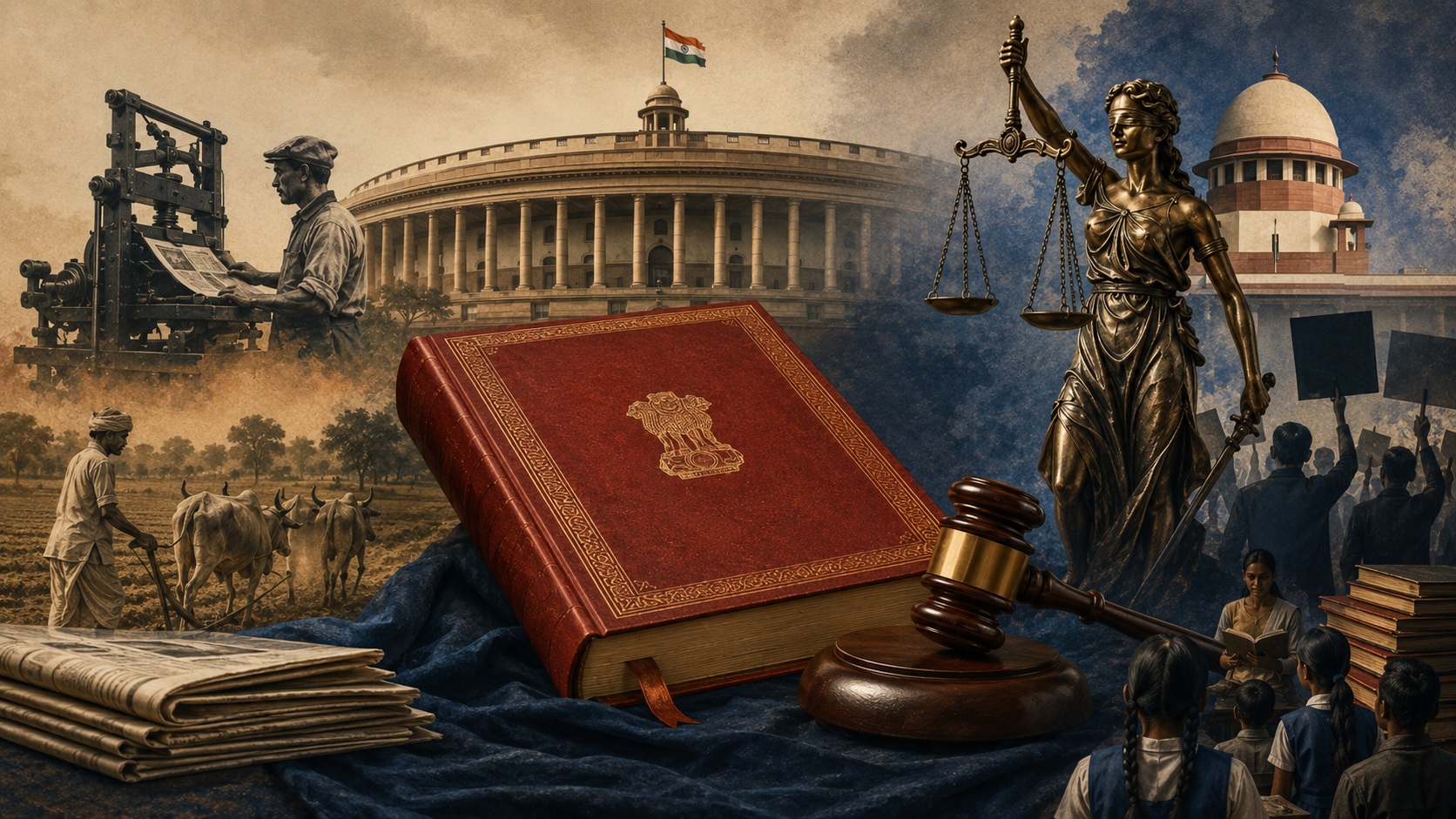
The first amendment to the Indian Constitution came into force on June 18, 1951. Some constitutional changes have had a profound impact on the republic. Introduced less than 16 months after the Constitution was adopted, it reshaped the relationship between the state, the judiciary and the citizens at a formative moment in India’s democratic life.The amendment changed the scope of three fundamental rights: freedom of speech, equality and property rights. It also created a new constitutional mechanism through which certain laws could be protected from challenge on the grounds that they violate fundamental rights. It is noteworthy that these changes were implemented before the first general elections of independent India.The First Amendment expanded the grounds on which the state may impose reasonable restrictions on free speech under Article 19(2), to include public order and friendly relations with foreign states. This enabled special provisions for socially and educationally backward classes under Article 15(4). It also inserted Articles 31A and 31B and created the Ninth Schedule, initially to protect land reform laws from being invalidated on the grounds of fundamental rights.This amendment arose from a conflict between constitutional rights and the social and political priorities of a newly independent nation. For its supporters, it was a practical response to the urgent demands of reform and nation-building. For its critics, this represents an early narrowing of the liberal promise of fundamental rights. Seventy-five years later, the debates over free speech, affirmative action, property, parliament, and judicial review still bear the imprint of the choices made in 1951.
When speech met public order
The central question facing the young Indian state and Supreme Court It was clear to what extent the freedom of speech, especially of the press, can be restricted in the interest of public order?In the case of Brij Bhushan v. State of Delhi, the Supreme Court quashed the pre-censorship order against the organizer under the East Punjab Public Safety Act, holding that the prior restriction violated the freedom of the press under Article 19(1)(a). In the case Romesh Thapar v. State of Madras, it invalidated the ban on the magazine Cross Roads under the Madras Maintenance of Public Order Act, ruling that the ban went beyond the then existing limits under Article 19(2).
speech and state
These decisions prompted a constitutional reaction. The First Amendment expanded Article 19(2), giving the state broader grounds to impose reasonable restrictions on speech.Contrasts with the United States are often noted. The American First Amendment is designed as a restriction on the power of Congress to abridge freedom of speech or of the press. India’s First Amendment moved in a different direction: it recalibrated the balance between freedom and regulation, placing greater emphasis on constitutionally recognized grounds for restriction.Critics have long argued that it changed the liberal architecture of the original Constitution. Historian Tripuradaman Singh, In sixteen stormy daysDescribes the First Amendment as a moment that limited individual liberties and civil rights. Others, including advocate Abhinav Chandrachud, have argued that the amendment should be read against the concerns of a newly independent country still grappling with partition, communal violence and the challenge of maintaining order. Chandrachud also said that the insertion of the word “reasonable” gave courts a standard by which disproportionate restrictions could be tested.The legacy of this agreement remains clear. Modern controversies over speech, censorship, platform restrictions, films, books, and public order continue to be debated within a framework in which free expression is constitutionally guaranteed but is also subject to defined restrictions. The enduring question is whether this framework remains balanced in an age of instant communications, digital mobility and expanding state capacity.
When reform was saved from the courts
The most far-reaching provisions of the First Amendment were those related to land reform and judicial review. The abolition of the Zamindari system was a major political and social project for the governments at the Center and the states, but early land reform laws faced constitutional challenge.A significant moment came when the Patna High Court struck down the Bihar Land Reforms Act in the Kameshwar Singh case. Concerned that similar laws might be vulnerable to judicial invalidity, the government introduced Articles 31A and 31B. Article 31B created the Ninth Schedule, which initially contained 13 land reform laws.
land reform vs rights
The stated purpose was to avoid stalling a major program of agrarian reform by litigation over property rights. Nehru expressed this concern in letters to chief ministers, writing that immediate social change could not be delayed indefinitely because the Constitution stood in the way, and the solution might require constitutional change.The deeper constitutional question was bigger than land reform. Can Parliament keep certain laws in the direction of social and economic transformation beyond the scrutiny of ordinary fundamental rights? The First Amendment answered that question by creating a special shield for selected laws.Comparisons are sometimes made to Franklin D. Roosevelt’s New Deal conflict with the United States Supreme Court. Both Roosevelt and Nehru faced judicial resistance to transformative socio-economic programs. But the constitutional paths were different. Roosevelt’s conflict unfolded within the existing constitutional framework, while Nehru’s government amended the Constitution to reduce the sensitivity of land reform laws to rights-based challenge.Over time, the Ninth Schedule expanded far beyond its original land-reform setting. Laws related to areas like industrial regulation, reservation, electoral matters and taxation were also kept in it. This growth increased the tension between parliamentary power and constitutional supremacy.The Supreme Court addressed that tension in IR Coelho in 2007. A nine-judge bench said that after the Kesavananda Bharati judgment, laws placed in the Ninth Schedule can still be tested on whether they harm or destroy the basic structure of the Constitution. In effect, the Court restored a constitutional limitation: the Ninth Schedule could not become a blanket route to avoid judicial review.
When equality made room for social justice
The first amendment also included Article 15(4), allowing the state to make special provisions for socially and educationally backward classes, as well as Scheduled Castes and Scheduled Tribes.This change followed the Supreme Court’s decision in the case State of Madras vs. Champakam Dorairajan, which struck down the communal GO controlling entry into Madras on the grounds that it violated the equality provisions of the Constitution. This case concerned access to educational institutions and raised a fundamental question: how should the constitutional promise of formal equality respond to deeply unequal social realities?
Article 15(4) became the constitutional basis for affirmative action in education. It later shaped the broader trajectory of reservation policy, including the debates culminating in the Mandal Commission and the Indra Sawhney decision of the Supreme Court.The big debate has never disappeared. India continues to struggle with how to reconcile equality of opportunity, historical disadvantage, representation and social mobility. The First Amendment did not address that argument. This created the constitutional space in which argument would unfold.
The deal that still rules India
The First Amendment is one of the most important moments in Indian constitutional history. Its critics see this as the point at which the Constitution’s promise of liberty was qualified by the exigencies of governance. Its supporters see it as a necessary adjustment by a fragile new democracy facing social inequality, public disarray and urgent reform.Both texts contain some degree of truth. The amendment reminds us that constitutional democracy is sustained neither by rights alone nor by state power alone, but by the constant interaction between the two.As India completes 75 years of the First Amendment, the question is not just whether the amendment was right or wrong in 1951. The more pressing question is whether the balance that has been struck between freedom and regulation, reforms and rights, Parliament and the courts, is adequate for a twenty-first century democracy.Avirup Bose is Professor of Competition Law and Policy at Jindal Global Law School


