



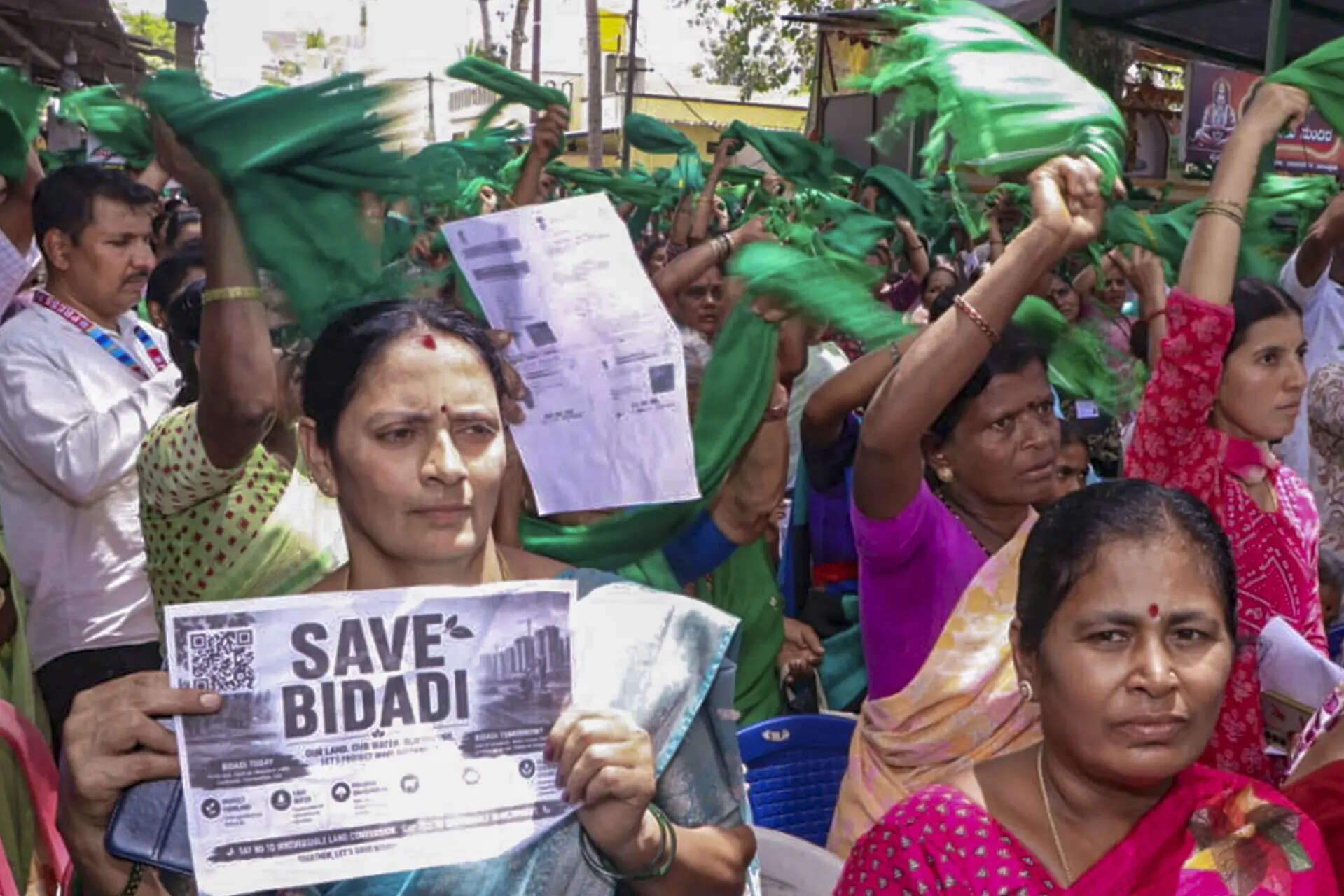
Bidadi, a small town located on the outskirts of Bengaluru, has become the center of a major controversy. Karnataka.At the center of the controversy is the proposed Bidadi Smart City project, officially known as Greater Bengaluru Integrated Township (GBIT), which the Congress-led Karnataka government is pursuing despite strong opposition from farmers, local residents, environmentalists and opposition parties.For Chief Minister DK Shivakumar – Bidadi Township is considered one of his most ambitious projects – the controversy comes just days after the Congress promoted him to Karnataka’s top post.Therefore this issue has acquired additional political importance.
Bidadi Smart City: India’s ‘First AI City’
Called the country’s “first AI City” by Shivakumar, GBIT is envisioned as a futuristic township and a massive work-live-play urban hub on the outskirts of Bengaluru.GBIT was started in 2006 as Bidadi Integrated Township by Janata Dal (Secular) leader and then Chief Minister HD Kumaraswamy as a housing solution for the rapidly growing population of Bengaluru. However, the proposal remained shelved for several years after real estate major DLF withdrew from the project following the global economic crisis of 2008–09.
GBIT Project Timeline
In its current form, the project is estimated to cost Rs 18,133 crore and is spread over 7,481 acres in nine villages in Ramanagara and Harohalli taluks. On June 11, the administration issued the final acquisition notification for 499 acres in three villages. However, it is widely considered to be the first step in a broader land acquisition process that could eventually extend to the entire proposed area.
GBIT Project in Brief
Its key features will include AI-powered industrial and residential zones, employment opportunities for local communities, world-class schools and hospitals and zero-traffic mobility corridors, among other planned amenities.
Features of GBIT Project
However, criticism has continued to grow, prompting the state government to defend the proposed township as a key component of Bengaluru’s future development.
Population pressure of Bengaluru and Bidadi township
Like the then-ruling BJP-JD(S) coalition in 2006, the current Congress government argues that GBIT is important for Bengaluru’s long-term expansion and reducing pressure on the city’s infrastructure – a position that is reflected in the demographic data.According to the census, the metropolis was already home to more than 85 lakh people in 2011. An October 2025 report by Karnataka’s Directorate of Economics and Statistics projects Bengaluru’s population to grow from about 1.22 crore in 2021 to about 1.47 crore by 2031. Between 2025 and 2026 alone, the city’s population is projected to grow by 1.93% – the highest rate in the state.
population of bengaluru
As of 2021, Bengaluru accounted for 18.2% of Karnataka’s approximately 7 crore residents. Experts expect this share to increase to 20.7% by 2031, due to the city’s strong migrant attraction, its diverse job market and its status as India’s leading IT hub.Therefore, the data underlines the pressures associated with Bengaluru’s continued population growth and the broader debate over how that growth should be accommodated.This is where townships like Bidadi join the conversation.Still, the debate is far from straightforward.
Why are farmers standing against Bidadi Township?
Farmers’ opposition to the project continues. In Ramnagar district, where Bidadi is located, protests have been going on for more than 400 days.Farmers argue that the township threatens fertile agricultural land, livelihoods and local ecology, while also raising concerns about the land acquisition process and whether a sufficient number of affected landowners have consented to the project.Farmer leaders accused the state government of occupying their fertile land without their consent.“It is cultivable and irrigated land. Not even an acre is barren land. Farming is going very well. They came here and occupied this land without our permission. There has been no discussion with farmers,” PTI quoted local farmers union leader BN Srinivas Reddy as saying.
GBIT Project: Compensation Documents
Another protesting farmer, Sumitra, also criticized the project.He said, “The Chief Minister is saying that he will do the Bidadi Township project. This is all a lie. By doing this he wants to fill his coffers.”To address concerns over acquisition, the Karnataka government has offered affected land owners two broad options: monetary compensation or a share in the developed township. Land owners can either opt for compensation of Rs 2.07 crore to Rs 2.5 crore per acre, depending on the category of land, or retain up to 50% stake in the developed land.The authorities have also fixed compensation for the trees to be cut to make way for the “AI City”: Rs 25,000 per coconut tree, Rs 45,000 per mango tree and Rs 6,000 per betel nut tree.However, the protesters have intensified their campaign and written a letter to the senior Congress leader. Rahul Gandhi. He urged them to intervene and stop the acquisition, which he says is being done without adequate consultation and could affect hundreds of farming families.
Bidadi Township: Land, Livelihood and Ecology
According to an online petition, around 5,000 farmers from nine revenue villages will lose their fertile agricultural land if the proposal goes ahead.According to the petition, around 2 lakh trees will need to be cut to accommodate the “AI City”, which includes 87,903 coconut trees, 83,536 arecanut trees, 12,550 mango trees and 2,344 sapota trees. The petition further claims that more than 3 lakh banana plants will also be uprooted as part of the development.Additional claimed impacts include potential loss of livelihood of approximately 3,500 families along with those engaged in dairy farming, horticulture, sericulture and other allied rural activities; loss of groundwater recharge and water security; and loss of active food production, with ragi alone cultivated in 231 acres of the proposed project area.With so much at stake, the project has sparked a battle of competing narratives. Both the ruling party and the opposition cite the same figure – 80% of farmers affected – but reach opposite conclusions: the government says 80% support the township, while the opposition insists 80% are against it.
Bidadi Township controversy: Political stakes for Congress
The controversy has emerged as an early challenge for Shivakumar, who took oath as chief minister on June 3, ending a long wait.However, even as the political tussle continues – primarily between Shivakumar and Kumaraswamy – any electoral fallout from the dispute is unlikely to be immediate for the Congress, as elections are not scheduled in Karnataka before May 2028.Nevertheless, prolonged farmer protests could have long-term political implications. According to the 2011 census, 13.74 million (1.37 crore) workers were engaged in the agriculture sector in Karnataka. Of these, 23.61% were farmers and 25.67% were agricultural labourers.The party also has control over all the four assembly constituencies in Ramnagar district. This also includes DK Shivkumar’s stronghold Kanakpura.
What’s next for the Bidadi Township project?
GBIT is the third major infrastructure-related project of the Congress government in Karnataka to face sustained public opposition.In July last year, a plan to acquire 1,777 acres of land for an aerospace park near Bengaluru’s Kempegowda International Airport was withdrawn as farmers were protesting against it.In March 2017, a proposal to build a steel flyover in the heart of Bengaluru was scrapped. The flyover will require cutting of 812 trees.For GBIT, the government has started the process of compensating farmers whose land has been acquired for the project.Meanwhile, JD(S) has indicated that it will move the Karnataka High Court against the proposed township.At the moment, the debate over the project shows no signs of ending. The dispute also reflects a broader challenge facing Karnataka as it seeks to accommodate Bengaluru’s projected population growth while balancing concerns over land, livelihoods and development.


