



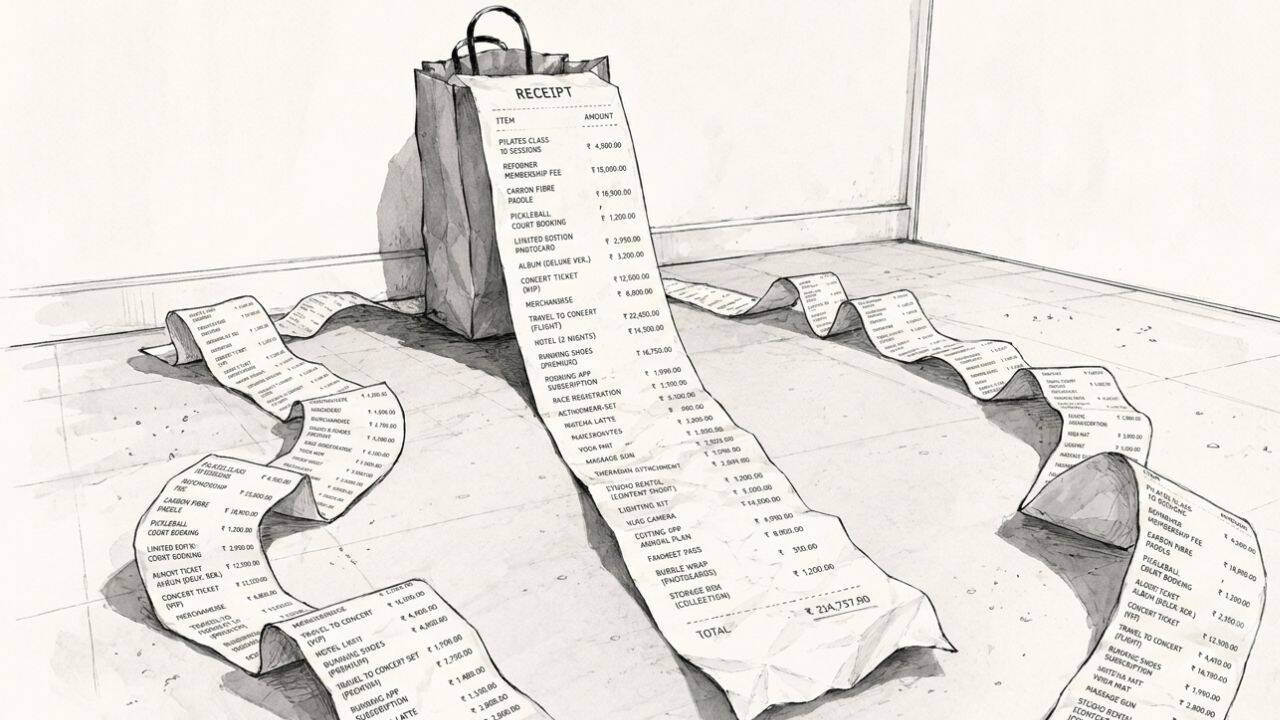
You can logout, delete every social media app or change their algorithm, but can you avoid commercial packaging of simple activities that were once free but now cost a good portion of your salary?Some of the latest additions to this ever-diverse social media lexicon include “maxing out”, “locking in” and the most ubiquitous of them all – “grinding”. There are no worrying words on his face. They tell us to be driven, to be ambitious, to be the best, at least superficially and one realizes that they are all laborious words, slowly leading us to turn our very existence into a commodity. Why can’t anyone enjoy now?You can no longer run a mile and feel happy trying something new. You have to view your stats on an app and somehow convince everyone in your contact list that the next Olympic long distance medalist is a saved number on their phone. The culture of commodification has not spared films either, everyone is now an unpaid film critic on the internet.
before the age of commodification
Before the Industrial Revolution forced everyone into extremely cramped factories, rest wasn’t something you had to schedule. Agricultural life allowed humans periods of rest, although there were still variations in allowances.Then the Industrial Revolution came and that understanding collapsed almost overnight. The factory not only changed the way people worked, it also changed how they wanted work to feel. It structured work into hours, but it also meant that it gave this rigid and extremely strenuous structure to a person’s entire existence. You have become your work.Unionization and protests helped workers. In 1825, Carpenters marched in Boston under revolutionary banners denouncing the dawn-to-dusk program as unfettered slavery. The fight for shorter hours wasn’t really about hours, it was about the right to exist outside of productivity. Vacation and freedom proved to be one and the same argument.When free time was finally won, people were remarkably uncreative with it, in the best possible way. He bowled. They made little trains. They went to the pub. He lived for himself. Working people across Britain and America built entire social lives around activities that produced nothing, adapted to nothing, and answered to no one. A hobby almost defined by its uselessness.That’s what makes what happened next so strange. Pickleball was invented in 1965 in someone’s backyard, out of spare equipment and nothing better to do in an afternoon. For decades it remained exactly that way: slow, communal, the kind of game your uncle was inexplicably good at. Today it’s a nine billion dollar industry, with every brand trying to spoon-feed it to us as a “it” hobby.
The disease is called: ‘it’
How we are told what to enjoy has a particular lifecycle. It starts innocently enough – someone, somewhere, is doing something purely for the love of it. They post about it, the Internet reacts to it. Some find it attractive, some want to find an opportunity to harass a stranger and some like it and move on. But all our reactions force the algorithms to pay attention to it, make it viral and, as it trends, the commodity vultures circle it.
algorithm hobby circle
An algorithm is not a neutral thing. It doesn’t just show you what exists. It decides what will be seen, and in doing so, it decides what will be created. Fariha Ahmed, an artist and researcher, describes this in her thesis Algorithms: The platform doesn’t just control visibility, it controls behavior. You don’t just post differently, you start believing in it.The hobby of “it” has the same effect on the real value of things. Pilates was developed inside a prison cell. It always required nothing more than a mat and floor space. Now an hour’s class in any Indian city starts from Rs 2,000, and this figure does not take into account the trending socks, matching gym set, tote bag that beckons you. The hobby is the same, but it was marketed to such an extent that it went from being designed for accessibility to becoming famous for inaccessibility.
price of a hobby
A hobby can go from niche to unobtainable in the course of one good social media post, and the person who made it viral will be checking their metrics every fifteen minutes wondering why the algorithm isn’t pushing their next post.
The price no one talks about
Any hobby has a financial cost, always has. But now it has been brought into practice, expanded and is being quietly exploited.Yu Tai, a Chinese national whose hobby is K-pop, spoke to TOI about how he has turned his hobby into a market for himself. Her interest in K-pop began with casually listening to it on a Tuesday, and now her entire life is devoted to it.She shared, “I post about it daily to stay connected in my groupchat. I think I’ve been to 5 different countries for concerts since 2026 started, I even went to Japan for a night because they had limited edition stuff.Between 2025 and 2026 alone, she has followed her group from Thailand to Korea to Paris to Hong Kong to Japan, rearranging their lives around a touring schedule the way most people rearrange their lives around a job.“I have to prove that I’m a fan, sometimes loving music isn’t enough.” Yu Tai shared. K-pop fandom, like most amateur communities that have moved online, runs on a quiet and exhausting competition – who does more, who spends more, who is the most dedicated. The person who attended two concerts is made to feel inferior by the person who attended five concerts. The person with the standard album feels the allure of the limited edition box set, a photocard that was only available at the Tokyo venue, proving you were actually there. It becomes almost impossible to separate the love for the artist from the display of that love for the audience.This is what the culture of sharing hobbies does on a large scale. It not only raises the financial level, although it does so continuously. This creates a hierarchy of involvement where simply enjoying something is never enough. You have to be able to show it, and show it better than the person next to you. This hobby becomes a competition you never signed up for, with entry fees that keep rising and no clear finish line.
annual income vs expenditure
His habits have adversely affected him. Once converted from GBP to INR, she earns Rs 17.9 lakh per year but spends up to Rs 51.5 lakh. Now he has to work overtime to pay off all the credits he earned over the months. Yu Tai still hasn’t stopped, but if you ask her she’ll admit, she can’t always remember the last time she felt like she was having casual fun and not something dedicated to herself.
So what are we really paying?
Think about the last hobby you quietly abandoned, left in the corner to collect dust. That guitar that hasn’t been tuned in years, that sketchbook you bought with good intentions, the running shoes that have become completely functional.Chances are it didn’t end because you ran out of time or money, although you probably told yourself that. It ended because between the algorithms and the aesthetics and the hierarchy of people doing it better than you, it stopped feeling like you. It’s the cost that never shows up on any receipt, the slow erosion of the feeling that something you love is still allowed to be yours alone.This is the real cost of commoditization and is not reflected in any market reports.Boutique fitness studios can offer all the enhancements you want. The K-pop industry may continue to produce limited edition photocards for fans across continents. Pickleball brands may tell you that you need carbon fiber paddles to have fun in the car park. What none of them will tell you is that whenever a hobby gets an aesthetic, a community ranking, and a price point, some cool people just stop.Workers marching in Boston in 1825 fought for the right to exist outside of productivity. They wanted hours that were no one else’s but their own. Two hundred years later we have those hours. We just handed them back willingly, dressed them in matching activewear, posted about it and called it an obsession.Grinding, locking in, maxing out – we adopted that language ourselves. Nobody forced it into our mouths. The hobby is not dead. But somewhere between the first viral post and the nine billion dollar industry that followed, it stopped being something we did for ourselves. It became something that we showcased for everyone else.And the worst part is that we’re still trying to see if anyone noticed.


