



There was a time when planning a vacation was a vacation. The family would spend evenings poring over railway timetables and travel magazines, tracing routes with their fingers, debating which train to take and whether the overnight journey was worth it. The stations along the way were not just stops, they were destinations themselves. You ate on them. You bought things from them. Mathura’s Kachori, Kanpur’s tea, these could not be compromised on. The subsequent bus ride, turning towards the hills or the coast was also part of the experience. Nobody called it “experiential travel.” This was just a journey.Then things got easier, which is another way of saying things got busy. Disposable income increased, information became easily available, and Indians began to move in larger numbers and with greater frequency. Hotels that were once closed during the off-season began to remain open year-round to meet demand. The word “tourism” entered the vocabulary, not as a compliment. In peak season, Nainital’s Mall Road slowly became a mix of dead bodies. Goa’s beaches started looking less like beaches and more like open-air malls. The destinations hadn’t changed, but what you could do in them had.The pandemic broke something, and then rearranged it. When travel resumed, it came with a kind of urgency, people had spent so long sitting still. But returning to the same crowded hills and the same expensive beach huts felt like a poor use of that urgency. There was a change in what people were looking for. less crowded. more room. Something that felt, if not ignored, at least not over.Therefore the passengers started going elsewhere. Towards Meghalaya, where roads give way to bridges buried in the jungle. Gokarna was found to be calmer and less decorated than Goa. As for Hampi, with its boulder-strewn landscape and the strange sensation of passing through a place time forgot to flatten. Names like Ziro Valley, Spiti, Majuli, Shitalakhet, which till recently most Indian travelers had to see on the map.The question is now familiar. Because offbeat destinations have a shelf life. The things that make a place worth exploring, the quietness, the lack of infrastructure, the feeling that you got there before everyone else, do not escape discovery.
anatomy of buoyancy
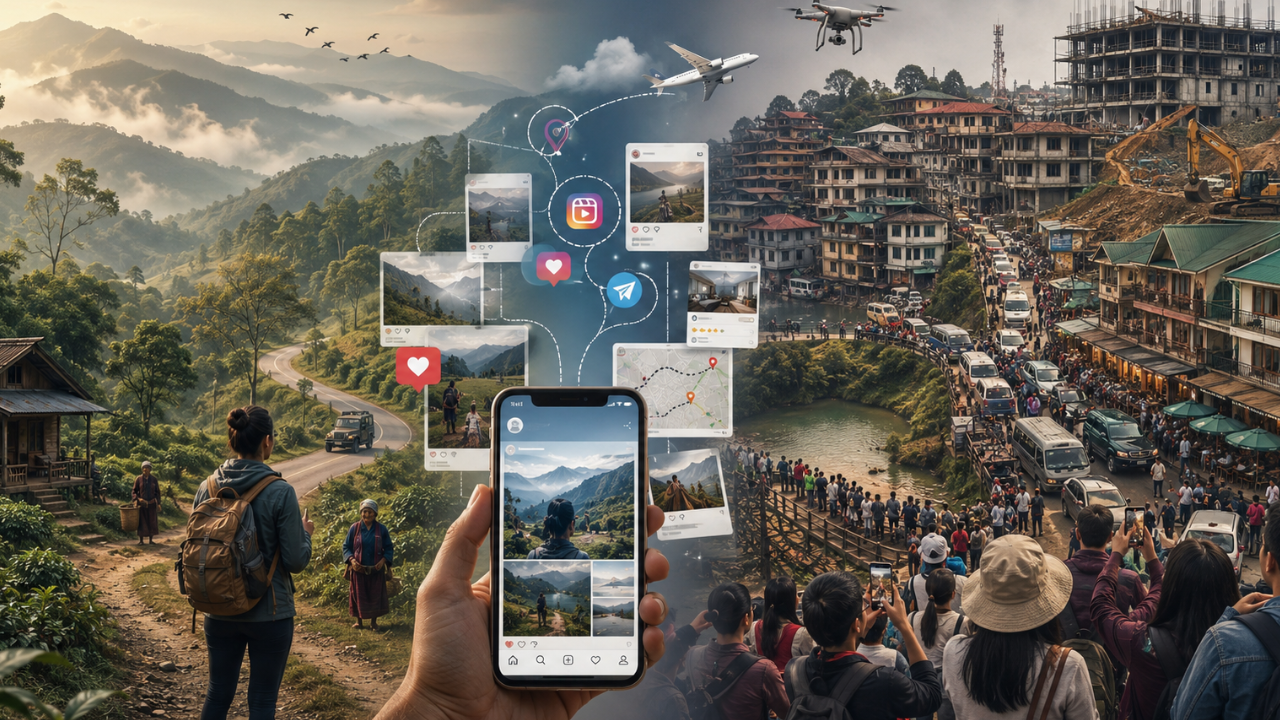
Coorg was not always a weekend destination. For years, it was a place that people who visited there mentioned quietly, almost protectively, to those they thought would treat it well. You’ve heard about it from a co-worker who had family there, or from someone who dropped by on a whim and stayed longer than planned. There were no lists. No reel on social media. The coffee plantations and smog and almost complete absence of other tourists was, in a way, the point of it all.That version of Coorg is hard to get hold of now.The journey from secret to saturated follows a recognizable pattern in almost every offbeat destination in India. It usually starts with a trekker, backpacker, photographer, occasional travel writer looking for something that is not Shimla. They come back with photos and stories. Photos find their way online. Stories are shared. A travel influencer visits, posts a reel that gets a few million views, and suddenly a place that used to get a few thousand visitors a year is getting ten times that number of tourists in the same season.
Social media not only spreads information about a place, but also creates aspirations around it.
Budget airlines accelerated this in ways that are easy to underestimate. When airlines open a new route, it not only makes the destination more accessible, but also makes it accessible to an entirely different kind of traveler who might not have thought about that location at all if it required a long train journey or an overnight bus. Connectivity compresses distance, and compressed distance compresses the timeline from discovery to congestion.Social media works differently. It doesn’t just spread information about a place, it creates aspiration around it. A photo of Dzukou Valley or Tirthan Valley is not just a photo. It’s a kind of social signal, proof of interest, proof of going somewhere other people haven’t been yet. The problem is that once enough people post that photo, the signal stops working. The destination will have to be changed to another one. And then another.Travel platforms and aggregators complete this cycle. A destination trends on Instagram, gets picked up by a travel blog, finds its way onto a “hidden gem” list on a booking platform, and within a season or two, the homestay that once had two rooms has expanded to twelve. Roads become wider. A café opens. Then another.Now none of this happens slowly.For Sanghrita, a media professional from Kolkata Darjeeling Twice, the decision to move forward came from familiarity. “I have been to Darjeeling twice before. She says, “Toy train, Tiger Hill sunrise, Chowrasta, I loved it all, but I knew it by heart.” A friend mentioned Kolakham offhand, quiet, leisurely, no mall roads, it was everything.Kolakham delivered. But it was Jorpokhari, a small protected lake village a little further away, that stayed with him. “You can see Kangchenjunga on a clear morning without having to fight anyone,” she says, the operative phrase being for now. On the same trip, he saw new homestays being built, clusters coming up that were larger than the roads that seemed to have been built. “It hasn’t become mainstream yet, but you can feel that it could,” she says. It’s a sentence that can apply to almost every offbeat destination in India at this exact moment.
So who pays the price?
Tourism has always been sold as good news. Jobs were created, local economies got a boost, forgotten places finally got their due. And there is truth in it, a well-run homestay in Sangla or a locally owned café in Ziro puts money directly into the hands of the people living there. But the full picture is more complex, and the places that have lived with mass tourism the longest are saying so the loudest.In Spain, residents of Barcelona and the Canary Islands have taken to the streets in protest. In Amsterdam, the city government has actively attempted to discourage certain types of tourists from visiting. In small British coastal towns like Whitby and St Ives, the damage is quieter but no less real – souvenir shops have replaced utility shops, streets are clogged during the summer, roads become hollow during the winter, and housing prices have fallen out of the reach of the people who actually live and work there year-round. The short-term rental market, driven by tourism demand, has made it more attractive for landlords to list on Airbnb than to rent to a local family. The town fills up for a season and empties into something that no longer resembles a community.
There is no clear answer to the question of responsibility, and most honest travelers will tell you so.
India has not yet seen protests of that scale, but early signs are visible. In Manali and Kasol, locals talk about rivers that become dark in color during the peak season. In Coorg, planters describe the noise and litter that now accompanies visits to what used to be quiet estates. In Spiti, a valley where roads were not built to accommodate large numbers of vehicles, the question of transportation capacity has now moved from an abstract policy concern to something that residents feel in daily life.It is partly in response to this that “quiet travel” has emerged as a conscious philosophy among a particular type of traveller. The idea is not just to go to a less crowded place, but to travel in a way that leaves a lighter impact. Visit in off-season. Staying in fewer places for longer periods of time rather than ticking off a list. Choosing locally owned accommodation over chain hotels. The same food where the residents eat. Move slowly to really notice where you are.There is no clear answer to the question of responsibility, and most honest travelers will tell you so. Sanghrita did not have even one. She stayed in family-run homestays both times, eating whatever was cooked, not asking for menus or WiFi passwords. “I think it’s more important than people realize where the money actually goes,” she says. But he also posted about both the places. Photos are still pending. “I’m not going to pretend I’m not a part of this cycle,” she said.This inconvenience might be the most accurate thing anyone has said about the state of Indian travel right now. The awareness is there. The intentions are often good. And yet the posts go up, the tags accumulate, and somewhere a valley that was quiet last season is now on the list.So is there always the next offbeat? for now yes. India is so large and uneven in its infrastructure that there will always be places that remain difficult to reach, and difficulty of access remains the most reliable filter for congestion. The red pandas of Jorpokhari and the living root bridges of Meghalaya survive, in part, because getting there still requires effort. But infrastructure has a way to catch up. Roads are built. Flights get connected. The effort required shrinks, and with it, so does the filter.


