



Google has, in India, announced a number of new initiatives underlined by artificial intelligence (AI) as a continuation of the tech giant’s commitment to India’s AI ambition. The company, at the Google I/O Connect India keynote on Tuesday, also noted that the Google Play and Android ecosystems helped contribute ₹5.3 lakh crore revenue for India’s app publishers and digital economy last year.
The company hopes the new initiatives will help Indian developers, startups and enterprises embrace frontier and agentic AI. “India’s builders are already deploying AI faster than almost anywhere else. As we drive the shift into the agentic era, where AI moves from answering queries to securely executing tasks, our focus is on providing the underlying infrastructure and guardrails the ecosystem needs to scale safely,” said Preeti Lobana, country manager, Google India.
Google DeepMind is making a ‘rigorous’ AI Research Foundations curriculum, that equips learners to build and fine-tune Large Language Models and drive high-impact AI research, to India. This will be available on the Google Skills platform, and the tech giant has partnered with NASSCOM and IISc Bangalore to make this program available at educational institutions across India.
The education focus extends to include the Google Play Academy curriculum, which will be made available to more than 10,000 Indian developers and app creators. Google is partnering with the state governments of Rajasthan, Odisha, and Madhya Pradesh. This curriculum, they say, will help developers leverage advances in agentic AI and skills for building as well as scaling app businesses.
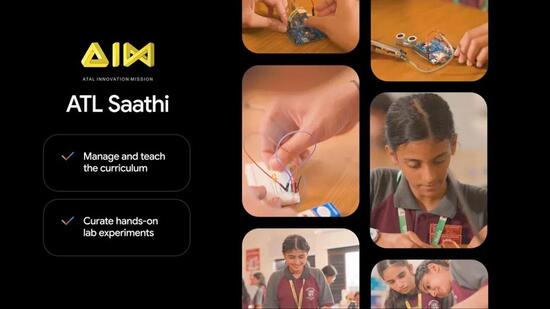
Google DeepMind is also launching ATL Saathi desktop app that gives teachers a Gemini-powered assistant to help deliver the Atal Tinkering Labs’ curriculum and curate hands-on experiments for students, marking a milestone for the company’s collaboration with the Atal Innovation Mission. Google says ATL Saathi is being rolled out to 100 schools this year, with an aim to eventually reach 10,000 schools.
AI’s local relevance continues to be of importance to Google, with researchers at AIIMS Delhi now leveraging the multimodal MedGemma open models to develop new India-specific models for leprosy as well as sexual and reproductive health. Google says these models will have the potential to help patients and healthcare professionals identify and manage conditions based on images and text inputs.
AIIMS will make the outcomes of all these localised clinical health models available to the Indian developer ecosystem.
“The ultimate metric of AI progress isn’t just model parameters, but also in the positive transformation it enables. India is championing this as it adopts AI across every tier of the economy – from local merchants to national health initiatives,” says Dr. Manish Gupta, Senior Director for India and APAC at Google DeepMind.
“In bringing our frontier AI, on-premise capabilities, and commitment to safety, we aim to accelerate this momentum, and look forward to the country’s AI learners, educators, builders, and innovators leading India’s AI ambition from the front,” he adds.
Gemini Live, the real-time voice and vision interaction assistant, is now extending support to include than 25 Indian languages and dialects, including Sanskrit, Bhojpuri, and Maithili.
Google says they are making their specialised cybersecurity agent, Sec-Gemini v3, available to trusted government and enterprise testers including Flipkart. Sec-Gemini can reason across complex security data and help teams investigate incidents rapidly. This will be relevant for Indian enterprises and government services systems at a time when cybersecurity threats building using agentic AI tools, are gaining higher threat perception.


