



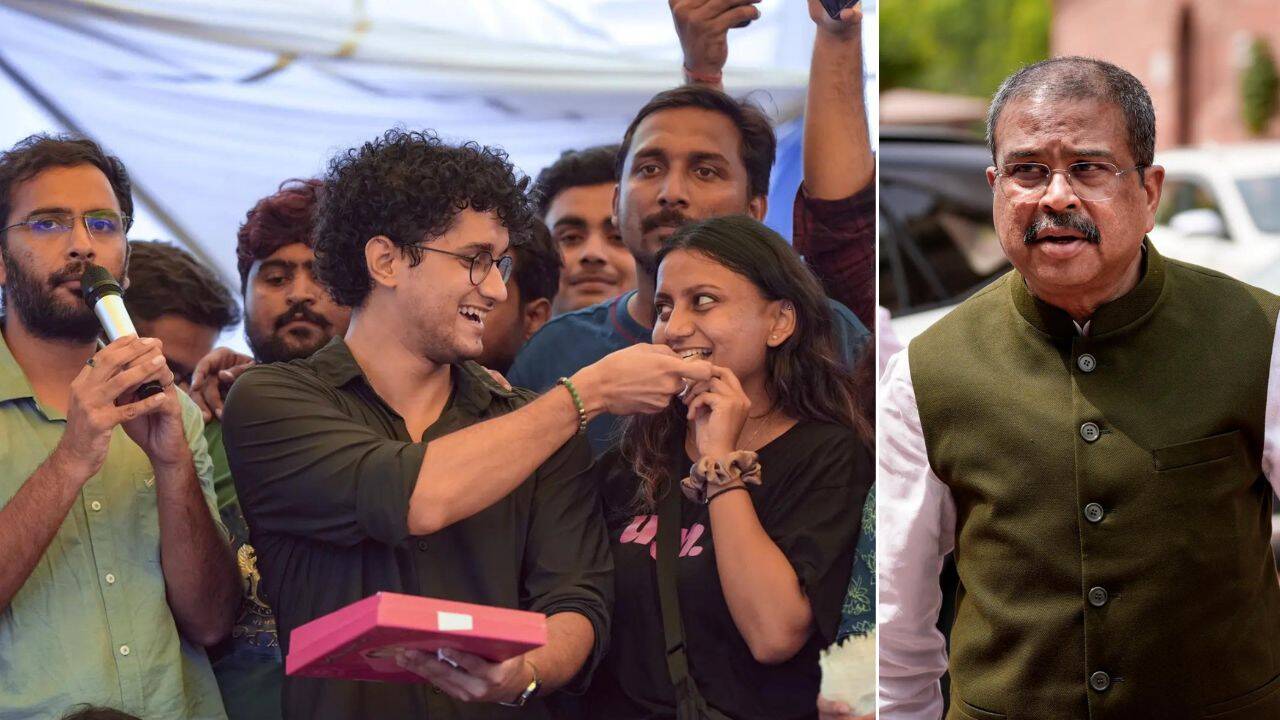
New Delhi: Saturday saw several major developments in the NEET paper leak controversy, starting with the resignation of Union Education Minister Dharmendra Pradhan after weeks of protests across the country. Hours later, Pralhad Joshi was appointed as the new Education Minister and given additional charge of the New and Renewable Energy and Consumer Affairs, Food and Public Distribution portfolios. Meanwhile, the Center and the cockroach Janata Party (CJP) held a third round of talks, after which the government agreed to withdraw the FIRs lodged against peaceful protesters. After the meeting, the CJP announced immediate withdrawal of its 36-day agitation at Jantar Mantar, and said it was ending the protests in “good faith” after the government accepted its key demands.
cjp jantar mantar protest update
The protest site was vacated after CJP’s demands were met. The development emerged as the biggest political fallout of the NEET controversy, leading to nationwide student protests, a CBI investigation, and sweeping reforms in India’s examination system.Here are the top developments:
Prahlad Joshi got additional charge of Education Ministry
Hours after Dharmendra Pradhan’s resignation, President Draupadi Murmu on the advice of Prime Minister Narendra Modi handed over additional charge of the Union Education Ministry to senior BJP leader Pralhad Joshi. Joshi, a five-time Lok Sabha MP from Dharwad in Karnataka, will continue to hold the portfolios of Naveen and Renewable Energy and Consumer Affairs, Food and Public Distribution. He takes charge at a crucial time when the government is implementing reforms after the NEET-UG paper leak, including restructuring of the NTA, tightening exam security and shifting NEET to computer-based testing from 2027.After being handed over the charge, Joshi said, “The Prime Minister has trusted me and has entrusted me with such an important responsibility.” With complete humility and a strong sense of responsibility, I will undertake this duty… I thank the Prime Minister for giving me this important responsibility and showing such great confidence in me. Under his guidance and leadership, I will work honestly in this department and try my best to live up to his expectations. I will work towards fulfilling this responsibility with full dedication, humility and honesty. I once again thank the Prime Minister for giving me this opportunity.”
Metro stations reopened after protests ended
After the CJP called off its 36-day protest, the Delhi Metro Rail Corporation (DMRC) reopened the entry gates of all the stations that were closed due to security arrangements, following which normal metro access resumed across Delhi.It was reopened soon after Union Education Minister Dharmendra Pradhan resigned and the Center reached an agreement with the CJP to end the agitation. Earlier in the day, DMRC had resumed services at Rajiv Chowk, Mandi House and Central Secretariat stations before restoring entry and exit at all the 18 affected stations, which were placed under restrictions due to the protests near Jantar Mantar.
Pradhan resigned, citing moral responsibility
Announcing his resignation in a letter addressed to the youth of the country, Pradhan said that he has submitted his resignation to Prime Minister Narendra Modi after considering the situation arising at Jantar Mantar and across the country.He said he has spent more than four decades working for students, teachers and education reforms and he always believed that a strong education system is the foundation of a strong nation. Pradhan said the government took immediate action after irregularities in the NEET-UG exam came to light, handed over the investigation to the CBI, canceled the exam and announced fresh exams, and also decided to shift NEET to computer-based mode from next year.He said that he has accepted the responsibility from the very beginning and has worked to ensure that no eligible student faces problems due to the examination mafia. Recalling the events of the past few days as deeply saddened, Pradhan said he was stepping down to prevent anti-national forces from taking advantage of the situation, to protect national unity and to allow students to focus on their education.
After the third round of talks, an agreement was reached between the Center and CJP
Hours after Pradhan’s resignation, the Center and the Cockroach Janata Party held a third round of talks, following which the student group announced immediate withdrawal of its 36-day protest.Addressing a joint press conference with Union ministers JP Nadda and Jitendra Singh, CJP spokespersons Ashutosh Ranka and Saurav Das said the agitation was being called off in good faith after the government accepted their key demands.The CJP said its primary demand, Pradhan’s resignation, has been met. It also said that the Center has agreed to withdraw FIRs and legal cases against peaceful protesters and assured that no retaliatory action will be taken.
The government agreed to provide compensation to the families of students who died by suicide as per existing rules and regulations and promised to consider the CJP’s five-point charter on examination reforms.JP Nadda said that the government has sympathetically considered the demands of the delegation and long-term reforms to strengthen the examination system will be discussed further.
Student movement ends after 36 days
CJP’s protest demanding accountability over the alleged NEET-UG paper leak, comprehensive reforms in the examination system and resignation of Pradhan began at Jantar Mantar on June 20.
The movement gained national attention after climate activists Sonam Wangchuk Joined the movement with indefinite hunger strike. His deteriorating health and subsequent hospitalization attracted public attention and increased pressure on the government.Although Wangchuk ended his 26-day fast after receiving a written assurance from the Centre, the CJP continued its protest until Pradhan resigned and the remaining demands were addressed.Speaking after the agreement, Ashutosh Ranka appealed to protesters across the country to return peacefully, while Saurav Das said the movement was ending with the understanding that all commitments would be implemented within the agreed timelines.CJP spokesperson Ashutosh Ranka said, “After 36 days of protest, the government has accepted all our demands; we urge everyone to disperse from the protest sites peacefully.”Earlier in the day, CJP founder Abhijit Deepke had briefly said that the protest would continue until all the demands were accepted. However, after the talks ended, the organization announced to end the movement.Dubke urged supporters not to consider Pradhan’s resignation as his personal victory, saying the movement was driven by thousands of youth and should remain focused on institutional reforms rather than individuals.
The opposition is calling it a victory for the students
The opposition hailed Pradhan’s resignation as a major victory for students and renewed demands for comprehensive reforms in the education system.Rahul Gandhi, leader of the opposition in the Lok Sabha, described the resignation as a “victory for India’s future”, saying Pradhan had become a symbol of corruption, incompetence and the decline of the country’s education system. He said the government should now bring meaningful reforms and alleged that the issue of police action against student protesters would remain a major issue during the monsoon session of Parliament.Congress president Mallikarjun Kharge described the resignation as a “triumph of truth” and said Prime Minister Narendra Modi should apologize to the youth of the country while ensuring action against those responsible for the alleged use of force against the protesters.AAP national convener Arvind Kejriwal described the development as a “big victory for democracy”, while Karnataka Chief Minister D.K. shivkumar He said that Congress will continue to raise issues related to students and peaceful protests are an essential part of democracy.
Wangchuk welcomed the result
Climate activist Sonam Wangchuk welcomed the development, calling it “a victory for democracy, direct democracy, peace, patience and perseverance.” He congratulated the student movement and thanked the citizens across the country for supporting the movement.His wife Gitanjali Angmo also praised the role played by India’s young generation, saying the protests have demonstrated courage, patriotism and commitment to democratic values without violence.
Proposal for strict anti-paper leak law
The Center has proposed major amendments to the Public Examinations (Prevention of Unfair Means) Act to ensure speedy investigation, time-bound hearing and stringent punishment for paper leaks and examination malpractices.The proposed bill provides for the creation of a Special Task Force (STF) to investigate crimes, completion of investigation within two months, day-to-day trials in special fast-track courts and disposal of appeals by high courts within three months.It also proposes a significant increase in penalties, proposing a prison sentence of up to 10 years and a fine of up to Rs 10 crore for organized paper leak rackets, as well as strict action against service providers and officials involved in exam fraud.
The biggest political outcome of NEET controversy
Pradhan’s resignation is the most significant political fallout of the NEET-UG paper leak controversy, which started after allegations of question paper leak in the May 3 exam.The controversy led to the cancellation of the examination, a nationwide CBI investigation, repeated protests, parliamentary disruptions, changes in the anti-paper leak law and a major restructuring of the National Testing Agency.Pradhan also removed Education Minister from his bio after his resignation.


