



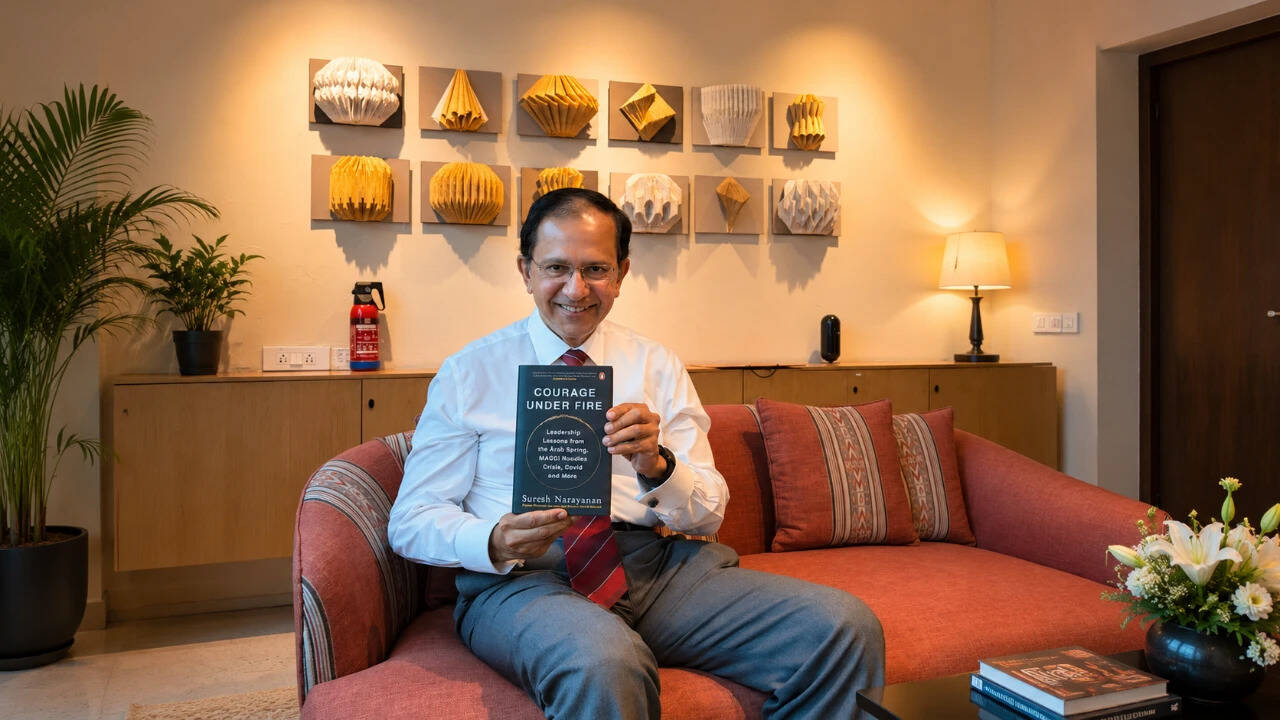
For over four decades, Suresh Narayanan has navigated boardrooms, brand battles and one of India Inc‘s defining crises. In ‘Courage Under Fire’ (Penguin Random House India), the former Nestlé India chairman and managing director looks beyond business strategy to explore what truly shapes leadership. In an exclusive chat with Lopamudra Ghatak, he argues that clarity matters more than charisma, challenges India’s obsession with pedigree that’s causing companies to overlook leadership potential, and reflects candidly on the lessons of the Maggi crisis. He also explains why Gen Z‘s approach to work-life balance deserves respect rather than ridicule, and recalls how a woman boss taught him that empathy is one of the key traits to being a good leader.Congratulations on your book. How did the idea to write ‘Courage Under Fire’ come to you?After a 40-year career in corporate India, I wanted to leave behind a few lessons that had served me well. They’re not prescriptions, but perspectives shaped by the crises and difficult moments I have experienced.‘Courage Under Fire’ is more of a personal journey through those defining moments – that focuses on people, purpose, partnerships, values, behaviour and outcomes. I thought it would be of some use to a younger generation entering the workforce.In ‘Courage Under Fire’ you write that “great leadership is not about position; it’s about responsibility, authenticity, and the ability to inspire trust, when it matters”. In an increasingly trust-deficit and information-surplus world, how does a leader earn trust? And how does an organisation make trust a part of its DNA?I think you’ve hit the nail on the head! Trust is the most valuable currency – for an individual as much as for an organisation. It emerges when three streams converge at one point in time.The first is purpose. Every organisation, and every individual, needs a clear sense of purpose, something that guides decisions and actions.The second is values. What do you want to be known for? What principles define how you conduct yourself, especially in adverse situations?Purpose and values, in turn, lead to the third element: authenticity. Unfortunately, in today’s digital world, authenticity often gives way to performance. We spend too much time embellishing, instead of being genuine.‘Performative’ is the word that’s often used today …Correct. Leadership isn’t about saying what you’ll do, it’s about doing what you say. That’s the dilemma many leaders face. Do they wear a mukhota (mask) that projects one image while concealing another?In order to establish trust among people, there has to be a convergence between purpose, values and authenticity, and that leads to outcomes. Over time, those actions create credibility, and credibility becomes trust.Trust is built when purpose, values and authenticity consistently translate into action. Over time, those actions create credibility, and credibility becomes trust.
Trust is the real currency of leadership.(Image generated by AI)
I’ve also come to see vulnerability as a strength, not a weakness. When people know you’re human, that you have strengths as well as limitations, they know what to expect from you. Predictability in values and behaviour is reassuring. What people fear most is unpredictability.Ultimately, trust isn’t about being the most liked person in the room. In a crisis, organisations don’t rely on the most loved people; they rely on the most trusted ones. If I’m liked but not trusted, I won’t be asked to lead when it matters. Trust, more than popularity, is what carries an organisation through difficult times.This bring me to my next question: Can leadership be taught, or is it something people are simply born with?Leadership, for long, has suffered from some myths. The first is the myth of charisma – that great leaders must have magnetic personalities. The second is that complex communication (by leadership) is somehow superior. The third is executive presence: the belief that a leader must be a larger-than-life figure at any gathering and dominate every room they enter. And the fourth is the idea that leaders should only display their strengths while hiding every flaw, angularities.I don’t subscribe to any of those myths. Leadership can absolutely be taught because, at its core, leadership is an act of being human.You don’t have to be charismatic; you have to be clear. You don’t have to be complex; you have to be transparent in your communication. You don’t need the loudest voice or the most commanding presence. Some of history’s greatest political and business leaders inspired people far beyond the reach of their voices.But leadership doesn’t develop in isolation. It blooms through the right mentors, timely nudges and experiences. Looking back, I benefited from teachers, parents, colleagues, relatives and even competitors who pushed me to exceed my own expectations. Those influences gradually built confidence, not just the confidence to lead others, but the confidence to manage myself first.
Nestle India CMD Suresh Narayanan (File photo)
That’s an interesting point about the ‘charisma myth’ that surrounds leadership. You mention in the book about visiting Tier-2 and Tier3- colleges, and how students there are often more grateful, hungry and eager to learn. Do you think they make better leaders? One thing we need to do as a society is demystify elitism. We place far too much value on where someone studied, where they work, the company they built or the organisation they belong to — as though those labels alone define success and achievement.The ‘tag’ matters?Exactly, the tag culture. I believe those days should be behind us. Look at ISRO. They might have their own travails but the fact is that most of the talent that comes there are not from the premier institutions in the country and yet they do premier and outstanding work and make us proud as a nation.The same is true of organisations that consciously recruit from Tier-2 cities and smaller towns. I often find students there to be remarkably humble, eager and determined. They are trying to prove themselves against a system that has long suggested only the elite succeed.As leaders, we have to move away from that entitlement mindset and create space for talent to flourish. India has extraordinary talent. Some young people may not be the most articulate when speaking in English but they are capable of hard work and possess grit, discipline and can deliver on their promise each and every time.That’s what the country needs—not people who merely preach from the pulpit, but people who consistently deliver.I think as a country now we are mature enough to realise that we cannot be a developing country or hope to become a wealthy country one day on the crutches of elitism. I think elitism is a crutch that we have to get out of as quickly as possible.
Why great leaders don’t need charisma(Image generated by AI)
You have spent over four decades across big brands. Do you think India Inc has begun to move beyond that elitism? I think the kind of companies that I worked in – Unilever, Colgate-Palmolive and Nestle – they always prided themselves in a middle-class culture. Their leaders weren’t chosen because they came from privileged backgrounds; they rose through competence, commitment, energy and hard workI use the term middle class in a positive sense because it symbolises humility, integrity, transparency, trust and a strong work ethic. This is what middle-class India is, and these are the values we strive to teach our children. When those values enter an organisation, they become a source of strength.I do think the growing recognition of talent from Tier-2 institutions and smaller towns is slowly weakening elitism. But there’s still work to be done. Our education system and employers must create more opportunities for capable graduates from less celebrated institutions.Too many people still believe admission to a top college guarantees success. Life doesn’t work that way. Success is usually about moving two steps forward, one step back, and repeating that journey with resilience and consistency.The modern workplace has become very volatile, with geopolitics and global uncertainty adding new layers of complexity. What’s your advice for leaders navigating crises? There are two principles that have guided me throughout my career.The first is simple: a crisis never arrives with a calling card. You have to remain alert at all times. Don’t be caught sleeping at the wheel. Anticipate risks before they balloon into crises.The second is to manage yourself before you manage others. That’s often overlooked. When a crisis hits, we immediately focus on facts, meetings and firefighting. But we spend far less time asking: What should I say? How should I behave? What tone should I set?In a crisis, everyone’s anxiety levels are elevated. The leader’s role is to remain calm, anchored in the organisation’s purpose and values, and provide stability.That’s often the difference between a crisis handled well and one handled badly. The outcome rarely depends only on strategy. More often, it depends on leadership—how clearly you communicate, how consistently you act and how much confidence you inspire.In hindsight, do you feel that your response to the Maggi crisis was appropriate? Looking back, is there anything you would have done differently?The first lesson, that a crisis doesn’t come with a calling card, certainly applies in this case. In hindsight, we could have done better in terms of sensing the environment and knowing that something was brewing in parts of the country. If we had been able to address it more comprehensively, maybe we would have been able to manage the outcome a lot better.Secondly, one of the important issues in managing a crisis is to have a single point of contact communicating to the environment. One criticism we faced was that we were slow in communicating. Looking back, I believe we could have responded faster.In ‘Courage Under Fire’, you write about the emotional effect the loss of colleagues during the pandemic had on you. Do you think business leaders, particularly men, are becoming more comfortable showing their vulnerable side? I don’t know whether the dial has shifted enough in India to say that with confidence. But I do believe people follow leaders who are authentic, humane and emotionally present — not those who remain distant and issue instructions from above.Professor George Kohlrieser at IMD Business School describes a leader as a “secure base.” I find that idea deeply meaningful. Just as we turn to a parent in moments of uncertainty, employees should feel they have someone they can approach with their fears, concerns and aspirations, someone who will provide anchorage in a crisis.Vulnerability, to me, is a source of strength. It acknowledges that you’re still learning and growing. That’s not weakness, it’s humanity.We’ve long been told that men don’t cry. But they do. Suppressing emotion doesn’t make you stronger; it makes it harder to empathise. And empathy is one of the most powerful qualities a leader can possess.You also had a woman boss during your career. Did her leadership style differ from your male mentors? Wan Ling, who headed Nestle Asia-Oceania-Africa, was one of the toughest leaders I worked with. She could be incredibly demanding, yet deeply compassionate.What struck me most was that every conversation with her began with family. With many of my male bosses, business came first and family last. With her it was always, “How is your family doing?”. Only then would we move on to tackle the toughest business crisis moments.One of her greatest strengths was her ability to read a room. She sensed what people were feeling before anyone uttered a word. Just as importantly, she had the ability to step back, consider various perspectives and avoid rushing into decisions. That balance of empathy and judgement made her an exceptional leader.Gen Z and the emerging Gen Alpha are reshaping workplace expectations as they place a premium on work-life balance, purpose and flexibility. How do you see that influencing India’s workforce in the years ahead?I see it as a positive shift. The old belief that success demanded 80-hour work weeks came at a huge personal cost. You may have earned more, but you often missed out on family, friendships and life’s important moments. There’s little value in reaching 80 and regretting that you never spent enough time with your parents or your children. So I welcome this change.
Share your thoughts in the comments
Be respectful · TOI community guidelines
These youngsters are not work-shy. They simply want work to coexist with life, and I think that’s a healthy aspiration. I only wish my generation had the courage to tell our bosses at seven in the evening that we were leaving to meet family or friends. Instead, we stayed back until the boss switched off the lights, as though commitment was measured by the last person to leave the office.That said, balance has to be calibrated. Every generation has something to learn from the other.What also strikes me about young professionals is that they’re driven by experiences. They move from one challenge to another in search of learning and fulfillment. I would encourage them to embrace the challenge itself rather than becoming overly anxious about the outcome. Careers are rarely linear. If you focus on learning, growth and doing meaningful work, the outcomes usually take care of themselves.


