



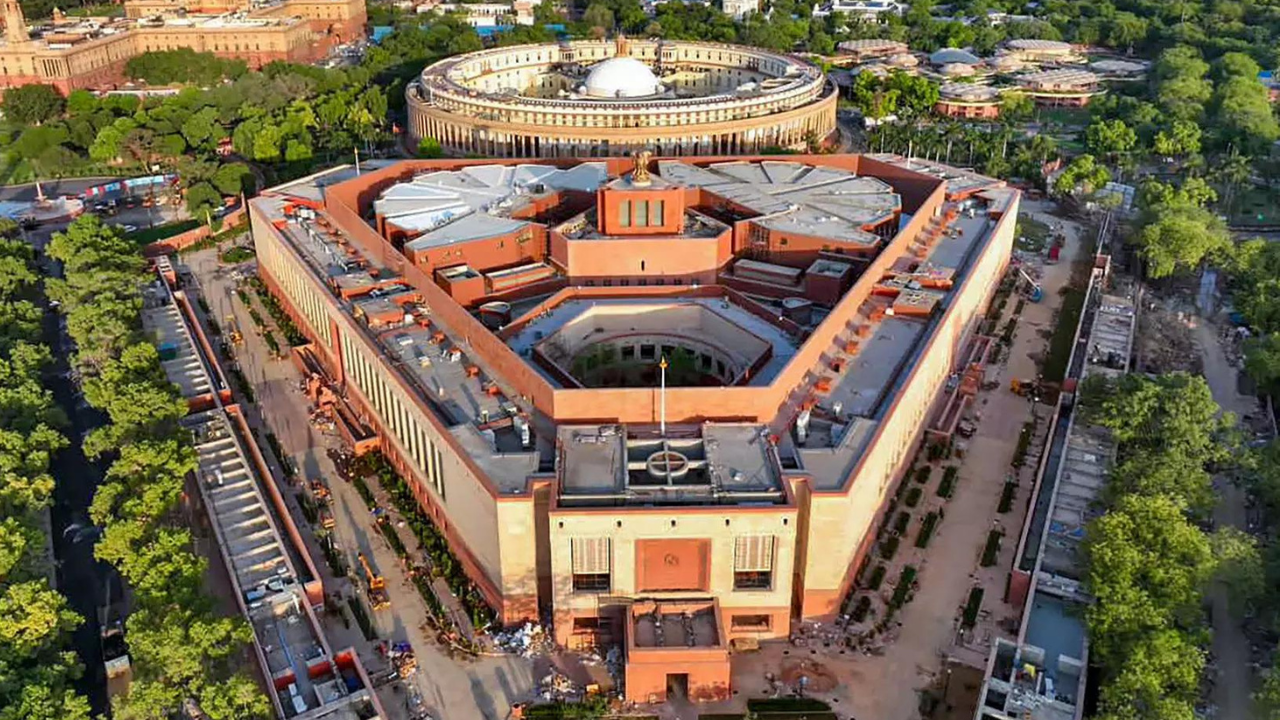
NEW DELHI: For 25 days, Parliament’s Monsoon Session played out on two different stages.Inside the Houses, proceedings were repeatedly disrupted, adjournments were frequent and Question Hour had barely any time remaining. Outside, political activity rarely stopped. Students marched, opposition leaders protested, ministers traded charges, and the Parliament complex itself became a stage for demonstrations and symbolic political performances.Held from July 20 to August 13, the session produced an unusual contrast: legislation moved forward, but much of the political confrontation surrounding it played out beyond the floor of the two Houses.
Parliament sees low productivity
The numbers underline that contrast. Lok Sabha functioned for approximately 19% of its scheduled time, while Rajya Sabha functioned for around 39%. Question Hour was particularly badly hit, with less than 1% of its scheduled time utilised. The session had 19 sittings spread over 25 days.Parliamentary affairs minister Kiren Rijiju acknowledged the distinction between legislative output and debate.“It was a good session…we have passed 13 bills; but it was not a good session in terms of discussion,” he said, while accusing the opposition of avoiding debate despite the government’s willingness to discuss issues.
‘Not a good session in terms of discussion’
Yet government business did move, much of it through voice votes amid opposition sloganeering.
Bills passed in Parliament
Eleven Bills were introduced in Lok Sabha and two in Rajya Sabha. Twelve Bills were passed by Lok Sabha and 12 by Rajya Sabha, with 12 Bills cleared by both Houses during the session.Two Bills replacing and incorporating the provisions of ordinances issued before the session, the Supreme Court (Number of Judges) Amendment Ordinance, 2026 and the Income-Tax (Amendment) Ordinance, 2026, were also passed by both Houses.The Demands for Excess Grants for 2022-23 were taken up, with the related Appropriation Bill passed by Lok Sabha on August 4 and returned by Rajya Sabha on August 6. The Foreign Contribution (Regulation) Amendment Bill, 2026 was referred to a Joint Committee for examination.Among the more politically significant measures was the Public Examinations (Prevention of Unfair Means) Amendment Bill, 2026, introduced amid concerns over public examinations and paper leaks.
Bills passed by both the Houses
The Bill came after Prime Minister Narendra Modi announced stringent measures to prevent such incidents in the future, including multiple selfie videos directly addressing students.It provides for speedy investigations and time-bound trials, with investigations to be completed within two months and trials within three months. It also provides for Special Fast Track Courts and Special Public Prosecutors, allows the Centre to constitute Special Task Forces where necessary, enhances penalties and creates a time-bound appellate mechanism before a Division Bench of the High Court.The Bill was passed by both Houses and received presidential assent.Its debate also offered a glimpse of how political parties were trying to speak directly to younger voters. BJP’s younger leaders took the lead in explaining the legislation and the Centre’s position, while the opposition made its own pitch. Both sides adopted Gen Z vocabulary, trading barbs with phrases such as “clock it”, “FOMO” and “delulu”.Other major Bills passed during the session included the Prevention of Insults to National Honour (Amendment) Bill, which seeks to bring Vande Mataram within the ambit of the 1971 Act; the Registration of Births and Deaths (Amendment) Bill, which proposes stricter procedures for delayed registration; and the MSME Development (Amendment) Bill, which provides for a national digital platform for voluntary registration and seeks to improve access to finance and resolve delayed-payment disputes faster.The Bankers’ Books Evidence Bill expands the definition of bankers’ books to cover physical, electronic, digital, virtual and cloud-based records. The Kerala (Alteration of Name) Bill proposes changing the state’s name from Kerala to Keralam. Other legislation dealt with cooperative development, tribunals and the mining sector.But these measures were not what defined the political atmosphere of the session. That distinction belonged to the protests outside.
The session began with a protest
The Monsoon Session opened against the backdrop of a large student mobilisation at Jantar Mantar over NEET examination irregularities.The protest had been building for weeks. Scientist and activist Sonam Wangchuk had been on a hunger strike for more than 20 days when the Centre intervened and removed him from the protest site.His removal intensified the agitation, with students going ahead with their scheduled “Sansad gherao”. Security personnel, including the Rapid Action Force and Delhi Police, were deployed as the protesters marched towards Parliament.The distance was less than 1.5 km, but the march quickly turned into a major confrontation.Pellet guns, lathi-charge and tear gas were used, with more than 60 people injured and admitted to nearby Lady Hardinge Medical College and Ram Manohar Lohia Hospital.The police action immediately became a political issue, with opposition leaders turning their focus towards Union home minister Amit Shah because the security forces involved came under the home ministry’s jurisdiction.The student protests subsequently spread beyond Delhi. The pressure group Cockroach Janta Party’s delegation met PM Modi-led cabinet ministers Jagat Prakash Nadda and Jitendra Singh, after which the situation moved towards normalcy.One of the protesters’ major demands was the removal of Dharmendra Pradhan as education minister.On July 25, Pradhan resigned from the post, making his departure one of the defining political developments of the session.
From Pradhan to Shah
Pradhan’s resignation did not end the political confrontation.Lok Sabha leader of opposition Rahul Gandhi had not joined the initial Jantar Mantar protest but emerged as a prominent voice in the political battle that followed. His focus shifted from Pradhan to Shah, whom he repeatedly attacked over the police crackdown on students on July 20.“As home minister, did you approve the use of lethal force including pellet guns against students? If not, who did? Are the people in plainclothes seen beating students with lathis police personnel or volunteers? Youth and students, future of our country, are demanding answers and accountability,” Rahul said.
Rahul Gandhi trains guns at Amit Shah
He argued that Shah either directly ordered the use of pellet guns, shock batons, lathicharge and tear gas, making him “culpable” for the treatment of the protesters, or did not know what the police were doing, making him “incompetent”.“In either case, he has to go,” Rahul said, calling on Prime Minister Narendra Modi to sack the home minister.Rahul also alleged that students were facing threats, including through face recognition and Bajrang Dal. “These are our children and the govt has no business threatening them or beating them. They have not committed any crime. They should not be punished,” he said.He later made the demand for Shah’s removal explicit, saying: “Shah is responsible and we are not going to let him get away with it.”At the AICC headquarters, with Shah’s photograph displayed on a large screen, Rahul accused the home minister of being responsible for the treatment of students and criticised his absence from Lok Sabha, saying it showed that he was “guilty”.Inside Parliament, opposition leaders across parties continued to seek answers from Shah and Prime Minister Narendra Modi. The issue contributed to repeated disruptions.The government, meanwhile, maintained that Shah was ready to discuss the student protests.
The debate that moved between the House and outside
In the final week of the session, Shah offered to address the opposition’s concerns directly.He offered to sit in Parliament from “3pm till 3pm the next day” to hear the opposition and respond to its points. Rahul rejected the offer, saying they “seek answers, not lectures”.Shah’s offer came amid demands that he make a statement in Parliament on the police action during the July 20 march over the NEET paper leak.He later wrote to Lok Sabha Speaker Om Birla seeking time for a discussion on the student protest and NEET paper leak.“As you are aware, Hon’ble parliamentary affairs minister Shri Kiren Rijiju has agreed, on behalf of the government, to a discussion in Parliament on the student movement concerning the NEET examination, during the meeting of the Business Advisory Committee,” Shah said.He also pointed out that the Lok Sabha had already discussed the Public Examinations (Prevention of Unfair Means) Amendment Bill during the session, but opposition MPs had not raised the NEET examination issue during that debate.The exchange captured the central political tension of the session.The government pointed to its legislative response and willingness to debate. The opposition demanded direct answers over the handling of the protests and accountability for the police action.The argument was therefore no longer simply about an examination paper leak. It had become a contest over responsibility, policing and ministerial accountability, much of it fought outside the chamber.
Jharkhand adds another layer
Examination irregularities also became a political issue in Jharkhand, where the Centre’s political opponents were in power.Students in the state protested over alleged irregularities in competitive examinations, including JPSC and JSSC, under the Hemant Soren government.In Ranchi, protesters marched towards the state assembly in an “assembly gherao”. The Soren government said it was open to talks and held rounds of discussions with student delegations.For the BJP at the Centre, the Jharkhand protests provided an opportunity to counter Rahul Gandhi’s attacks over the student movement in Delhi.Pradhan, days after resigning as education minister, turned his fire on Rahul.“The leader of opposition, who habitually lies, neither wants to come to Parliament nor listen to answers. They just want to spread their lies and shed crocodile tears,” Pradhan said.
Pradhan calls Rahul Gandhi a ‘habitual liar’
He also accused Rahul of making “baseless, factless false accusations” against Shah.The political irony was clear: the examination issue that had put the Union government under pressure in Delhi was now being used by the BJP to target the Congress, which is part of the ruling alliance with the Jharkhand Mukti Morcha government led by Hemant Soren.
Then came the Ram Mandir protest
The student protests showed how street mobilisation could shape parliamentary politics. Another demonstration showed how the Parliament complex itself could become a stage for political messaging.The alleged theft of donations at the Ram Mandir in Ayodhya became another opposition issue during the session.On Friday, Independent MP Pappu Yadav, along with other opposition MPs, staged a symbolic protest at Makar Dwar over the alleged embezzlement of Ram Temple donations. Congress president Mallikarjun Kharge, Rahul Gandhi, Priyanka Gandhi Vadra, Samajwadi Party MPs Awadhesh Prasad and Dharmendra Yadav, and Jharkhand Mukti Morcha MP Mahua Maji participated.The MPs held placards and a large banner reading “Amit Shah Sadan Se Gayab Kyun?” They also raised slogans demanding Shah’s resignation and his presence in the House.Pappu Yadav, whose real name is Rajesh Ranjan, dressed as a temple priest carrying a photograph of Lord Ram and sat beside donation boxes. Opposition MPs acted as devotees and placed money in the box. Yadav then symbolically slipped the money into his pocket, representing the opposition’s allegation of theft.Videos circulating online also showed Rahul Gandhi putting money into the donation box. Another MP, playing a devotee, confronted the “priest” over the alleged act.The priest denied wrongdoing before theatrically leaving the scene. The INDIA bloc said the demonstration was intended to highlight the alleged embezzlement of Ram Temple donations and demand accountability from the Centre.It was a symbolic protest, but it reflected the broader character of the session: political messaging increasingly spilled into the physical spaces around Parliament.
A Parliament that worked, but talked less
The Monsoon Session cannot simply be described as one in which Parliament failed to function. Bills were introduced and passed, financial business was completed, ordinances were replaced and the Public Examinations (Prevention of Unfair Means) Amendment Bill became law.But the productivity figures tell another story. Lok Sabha functioned for approximately 19% of its scheduled time, while Rajya Sabha functioned for around 39%.Inside the Houses, protests and sloganeering repeatedly led to adjournments. Key government Bills were passed, often through voice votes. Outside, meanwhile, Parliament’s premises became venues for demonstrations and political performances.That contrast defined the session.The Jantar Mantar protest became a parliamentary issue. The police action turned into a political battle over Amit Shah. Pradhan’s resignation followed sustained pressure over the examination controversy. The same issue travelled to Jharkhand, where it became another weapon in the Centre’s political contest with the opposition. The Ram Mandir controversy then produced a symbolic demonstration inside the Parliament complex.
Share your thoughts in the comments
Be respectful · TOI community guidelines
In each case, the politics extended beyond the floor of the House.The Monsoon Session thus offered an unusual picture of parliamentary politics: legislation continued inside, while confrontation, mobilisation and political messaging increasingly took place outside. The Houses passed 12 Bills, but some of the session’s most visible battles were fought through protests, slogans, press statements, letters and demonstrations.Parliament was still working. But it was talking less, while the political argument increasingly moved beyond its walls.On August 13, both Houses adjourned sine die and will meet again in the Winter Session.


