



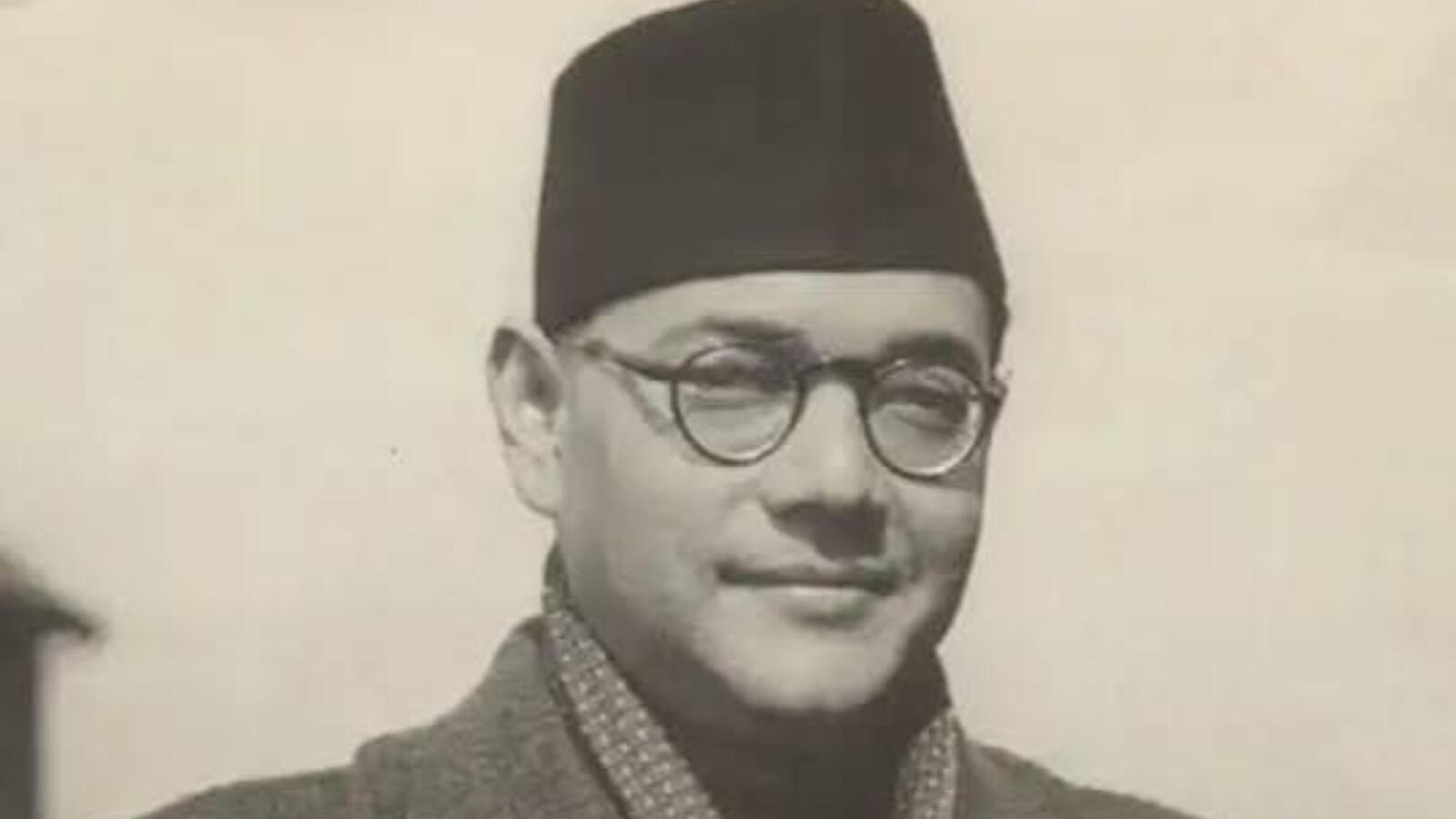
For the longest time, January 23 in 1990s Kolkata would mean small street-side political meetings where leaders of all hues would ask the youth to draw inspiration from Netaji’s patriotism and ideals on his birthday. Netaji was one of the most prominent politicians who disappeared before India became independent, and yet left a firm imprint on people’s minds. The conversation around him was often about what people knew and what, they believed, had been concealed, be it the mystery surrounding his disappearance, the classified files or his political views, which parties have tried to appropriate and yet conveniently stayed away from at different times. His own political party, the Forward Bloc, a junior partner in the long-running Left Front government in West Bengal, is now a pale shadow of its glory days. Yet Netaji remains an iconic hero not only in Bengal but across India.BJP Rajya Sabha MP Nagendra Ray, better known as Ananta Maharaj,has apologised for his vitriolic remarks on Netaji Subhas Chandra Bose. The dust will settle soon, but what is unlikely to be ironed out any time soon is the uneasy relationship political parties in Bengal have had with the state’s most enduring nationalist icon.Ananta Maharaj rattled the hornet’s nest by questioning Bose’s contribution to the freedom struggle and the Indian National Army, was reported to have called him a “war criminal”, and claimed the INA consisted essentially of British-Indian soldiers “captured and handed over by Germany”. He also asked what the INA had achieved for Indian independence. This prompted swift action, with the Suvendu Adhikari government withdrawing the Banga Bibhushan, Bengal’s highest civilian honour, which Mamata Banerjee’s government had conferred on him. Subsequently, Ananta apologised.As a parting shot, the Rajya Sabha MP insisted his claims rested on material in the National Archives and invoked Jawaharlal Nehru over the “war criminal” description. This calls for a dispassionate look at what history actually says about these claims.
The ‘war criminal’ letter
Material declassified in 2016 revived a long-circulating claim that Nehru had called Bose Britain’s “war criminal”. The files contained a later account of an alleged Nehru dictation, not an authenticated original Nehru-to-Attlee letter.The archival trail leads to testimony by Shyam Lal Jain, Nehru’s former stenographer, who claimed decades afterwards that Nehru had dictated a December 1945 communication to British Prime Minister Clement Attlee referring to “Subhas Chandra Bose, your war criminal”.Nehru’s own recorded words point in the opposite direction. On August 29, 1945, when an American journalist put it to him that Bose should be treated as a war criminal, Nehru replied: “I resent the suggestion that Subhas Bose should be dealt with as a war criminal.” In April 1956, Nehru would again write internally that “the question of War Criminals does not arise” while discussing the Netaji inquiry.There is, however, an intriguing archival footnote. In Conundrum, Chandrachur Ghose and Anuj Dhar cite a 1956 Ministry of External Affairs file created after notices of parliamentary questions asking whether Bose was still regarded as a war criminal. The questions followed Forward Bloc leader Muthuramalingam Thevar’s demand before the Netaji Inquiry Committee that the government clarify whether Bose’s name figured on such a list.The first response recorded in the file came from historian Sarvepalli Gopal, then head of the MEA’s Historical Division. After consulting the Law and Defence ministries, Gopal wrote: “All records related to Subhas Bose were destroyed in 1947, but as far as we know Bose was not publicly designated a war criminal.” The Khosla inquiry would later record an even more categorical government position: inquiries with Indian missions indicated that Bose’s name had never figured on a war-criminal list.Ghose, speaking to TOI, is equally categorical that he has found no archival evidence establishing that Bose was a war criminal. He points out, however, that such an allegation was indeed made on oath by a pendant before the Khosla Commission.One thing, though, Ananta Maharaj does get right, Bose did not create the first INA. The INA initially took shape in Japanese-controlled Southeast Asia in 1942 under Captain Mohan Singh, built around British Indian Army soldiers who had fallen into Japanese hands during the Malaya campaign and the fall of Singapore. It broke down amid disputes over Japanese control. Rash Behari Bose began reorganising the movement in early 1943. Subhas Bose arrived in Southeast Asia that July and took over, after which the INA expanded dramatically in scale and political clout. So while Netaji wasn’t the founder, he became the beating heart of the INA.The BJP MP appears to have conflated two different episodes from Netaji’s life in making his claim about Germany. Before reaching Southeast Asia, Bose had run a separate military project in Germany, the Indian Legion, drawing substantially on Indian prisoners of war captured by Axis forces in North Africa.
What Nehru said on Netaji
Congress: from president to rebel
Bose’s quarrel with Congress had multiple layers, some driven by the power politics of the time and others by the ideological strands to which its top leaders belonged. Bose rose to the top of the party, becoming Congress president at Haripura in 1938 and standing for a second term the following year, when he defeated Pattabhi Sitaramayya, the candidate identified with Gandhi’s camp, by 203 votes. Gandhi’s response became the stuff of legend: Sitaramayya’s defeat, he said, was “more mine than his”.That was merely the start of the churn. Twelve of the 15 members of the Congress Working Committee resigned, the Tripuri session deepened the crisis, and Bose eventually stepped down. Nehru and Gandhi disagreed with his more confrontational line against Britain, yet Nehru was unhappy at the prospect of Bose simply being pushed out. In April 1939, he wrote to Gandhi that doing so would be “an exceedingly wrong step”.The war drove the two much further apart. Bose read Britain’s vulnerability as India’s opportunity, a calculation that took him to Nazi Germany and then to Japanese-controlled Southeast Asia. Nehru fiercely opposed that route. His respect for Bose’s patriotism, however, remained intact. Speaking on Bose’s birthday in January 1946, he said: “I never for a moment doubted that he was a brave soldier in the struggle for freedom.” He praised the communal unity of the INA and called the force a “legend”.Chandra Kumar Bose, Netaji’s grand-nephew, makes another distinction. Recalling what his father Amiya Nath Bose, Sarat Bose’s son and therefore Netaji’s nephew told him, Chandra says Bose’s dealings with Hitler and Tojo should not be confused with ideological admiration for either. According to him, Netaji did not like either leader; the alliances were instruments towards what he saw as the overriding objective of Indian independence. Chandra argues that Bose’s own An Indian Pilgrim and The Indian Struggle remain essential reading for anyone trying to understand his political philosophy.The INA lost the war but gained widespread acceptance afterwards. The Red Fort trials of Shah Nawaz Khan, Prem Kumar Sahgal and Gurbaksh Singh Dhillon in late 1945 produced an outpouring of public sympathy. Nehru joined their defence and donned the barrister’s robes after decades away from legal practice.Chandra also points to a famous anecdote about former British PM Clement Attlee. In a letter written two decades after their meeting, P B Chakravartti, former acting governor of West Bengal, recalled Attlee telling him during a 1956 visit that the INA’s impact on the loyalty of the armed forces, followed by the Royal Indian Navy revolt, had been important in Britain’s decision to leave. When asked about Gandhi’s influence on the final decision, Chakravartti recalled Attlee describing it as “minimal”.
From comrades to ‘Fifth Column’
Before the war, Bose occupied ground that overlapped with the Indian Left. He belonged to the radical wing of nationalism and worked at building alliances with communists and other Left formations in Bengal.The war ended that. Hitler’s attack on the Soviet Union in June 1941 fundamentally changed the Communist reading of the conflict and, by the turn of 1941-42, the Communist Party had moved towards its “People’s War” line. Bose was moving in the opposite direction, towards Axis help against Britain.P C Joshi’s 1945 defence of the Communist position named the Forward Bloc, along with the Congress Socialist Party and Trotskyists, as groups that “made the Fifth Column, the agents of the Jap invader”.The original wartime publication carrying the exact words “Tojo’s dog” is harder to pin down. But when CPI general secretary A B Bardhan apologised in 2010 for the party’s historical assessment of Bose, contemporary reports recalled that the undivided CPI had denounced him as an “imperialist agent” and “Tojo’s dog”.The rethink had started much earlier. Chandra Bose recalls Jyoti Basu publicly acknowledging the Communist misreading of Netaji. Buddhadeb Bhattacharjee followed in 2003, calling it a “great mistake” and saying,”I am apologising for our mistaken assessment of Netaji,” while continuing to disagree with Bose’s Axis strategy.
How INA played a key role
Samik, Forward Bloc and another old rivalry
The Ananta row was not the first this year to reopen Netaji-era wounds. In July, Bengal BJP president Samik Bhattacharya called Forward Bloc members “goons” and alleged that they had pelted stones at Syama Prasad Mookerjee while he was addressing a gathering at Mohammed Ali Park during the 1940 Calcutta Corporation election. He also subsequently claimed that Mookerjee had appealed to Subhas and Sarat Bose over the condition of Hindus in eastern Bengal and received no response.Forward Bloc called Samik’s account a distortion.Ghose says the real history was more complicated. Before the 1940 Corporation election, there were negotiations for an understanding between Bose’s camp and the Hindu Mahasabha. They failed. Bose’s group subsequently entered into a municipal pact with the Muslim League in April 1940, a tactical arrangement that immediately became ammunition for his opponents.Bose and Mookerjee were certainly adversaries. Mookerjee’s diary records Bose warning him that if he tried to build the Hindu Mahasabha as a rival organisation in Bengal, Bose would see it broken, “by force if need be”. Yet Chandrachur Ghose and Chandra Bose agree on another aspect that is often lost in today’s retelling that the two remained remarkably civil towards each other despite the ideological battle.Mookerjee had long-standing links with the Bose family, intervened with authorities over the treatment of Subhas and Sarat while they were detained, and his writings spoke of “admiration and affection” for Subhas alongside political disagreement.Chandra adds a family footnote. After Bose’s expulsion from Presidency College, Sir Asutosh Mookerjee, Syama Prasad’s father, played a role in enabling him to resume his studies. Bose ultimately entered Scottish Church College.Chandra also points to Syama Prasad’s participation in Fazlul Huq’s Bengal ministry. In other words, Bengal’s politics in those years was full of tactical arrangements that don’t align well with clean ideological lines drawn retrospectively.Ghose goes a step further, arguing that newspapers aligned with the pro-Gandhi camp, already hostile to Bose for creating a new political organisation, also helped amplify the Bose-Mookerjee rift.
Renkoji: the argument that never ended
There is another Netaji dispute on which governments and even members of his own family have not always spoken in one voice, regarding the urn at Tokyo’s Renkoji Temple, which is said to contain remains carried from Taipei following the reported plane crash of August 18, 1945.The majority report of the Shah Nawaz Committee and the later Khosla Commission supported the plane-crash account. Prime Minister Morarji Desai told Parliament in 1978 that contradictions and later material meant their conclusions could not be treated as decisive. The Justice M K Mukherjee Commission subsequently concluded that Bose was dead but had not died in the alleged plane crash and that the Renkoji remains were not his.
Renkoji temple
Chandra Bose’s own position has changed dramatically. He once questioned the crash theory, but after the declassification exercise came to the opposite conclusion. In 2024, he publicly said that the evidence from 10 national and international inquiries, taken together with the released files, convinced him that Netaji died in the August 18, 1945 crash. He now says Japan deserves credit for preserving the remains with dignity for eight decades, but that the time has come to bring them home.Ghose, in his conversation with TOI, called for an anthropological examination of the Renkoji material, saying conventional DNA recovery may no longer be viable and insisting that any examination should be conducted under neutral observation.
From debating Bose to claiming Bose
In 2015, Mamata Banerjee’s government released 64 Netaji files running to 12,744 pages and challenged the Centre to open its own records. The Modi government followed with a phased central release, beginning with 100 digitised files on January 23, 2016.Then came the wrangling over what to call his birth anniversary. The Left had Desh Prem Divas. Mamata chose Desh Nayak Diwas. The Centre declared January 23 Parakram Diwas in 2021. In 2022, Modi unveiled Bose’s statue near India Gate and said Netaji had been forgotten after Independence, his ideas and even the symbols associated with him ignored.
PM modi unveiling Netaji statue
Chandra Bose says this is precisely the problem with the politics around historical icons that their names are invoked while their ideology is often ignored. He is dismissive of Samik Bhattacharya’s recent comments about Forward Bloc. Why, he asks, must one leader be pulled down simply to prop up another?Parties of all hues have tried to appropriate different facets of Netaji’s life. The BJP has highlighted his military courage and uncompromising nationalism. The Left can point to his socialism, and anti-imperialism. Congress has the bragging rights of Netaji having been its two-time president. Ghose puts the problem another way. Bose was, as the title of his biography has it, an “inconvenient nationalist”. Allegiance to the nation, he says, was the one overriding constant in Bose’s politics.
Share your thoughts in the comments
Be respectful · TOI community guidelines
That is what makes the Ananta Maharaj row worth more than a news cycle. While he lived, Bose was too difficult for any political establishment to hold comfortably. Since his disappearance, his legacy has been too valuable for any of them to concede.


