



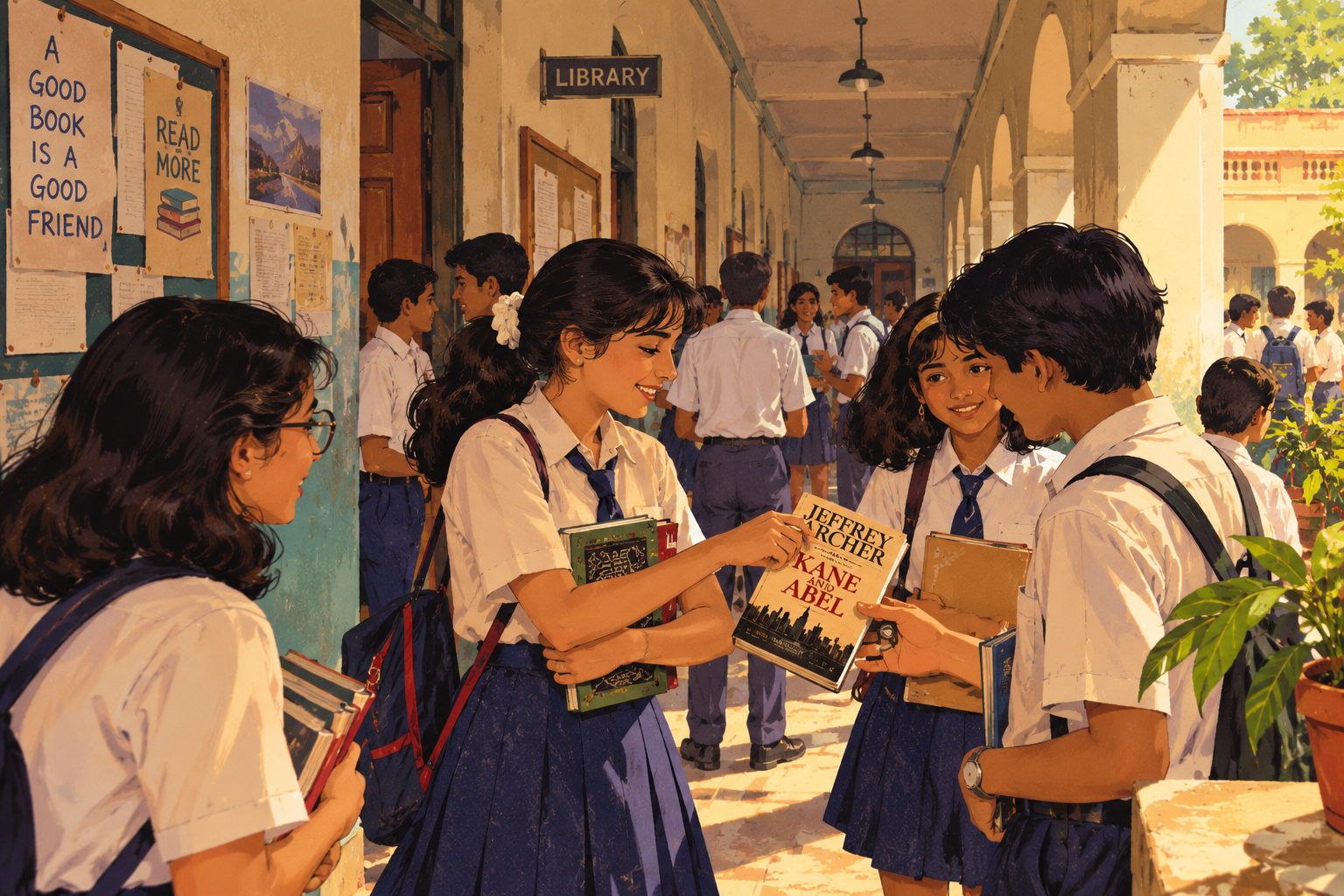
The 1980s was a good decade to grow up in India. Not too far off from Independence, and two decades shy of the 21st century; it was an India that gave children enough room to discover and know themselves before they went out to the big, bad world out there. Mornings were rushed. Afternoons were lazy. Evenings were long and a time to catch up with neighbours from verandahs and terraces. This was also an India where young people had the freedom to play outdoors — though strict rules applied. And when night came, it was full of promise to read our favourite books. And on top of the reading list was Jeffrey Archer.Which is why when the news of his death broke Monday, there was this whole generation — Gen X mostly but Boomers and Millennials too — who were promptly transported to a time when living life used to be a peaceful affair. When parents, grandparents and teachers were all guides who would tell children how to brush up their English-speaking skills. And British author Archer was on top of the list because he knew how to write page-turners in the simplest language.In this India, privilege was education. And going to an English medium school or Bengali medium, where English was the second language was why our parents worked hard. Dads at their workplace, and moms at home helping finish our homework. Even in homes where both parents worked, the setting wasn’t too different. Grandparents bright a lot of us up. The 1980s was a decade and half shy of the nuclear family. There were mini-libraries in every house (read two to three cupboards full of books). There would be a mix of literature — mostly fiction — in our first language and English.In Bengali households, after Bengali literature, it was the Russians who sat pretty and fat in those library cupboards. But then there were easy English fictions. Enid Blyton, Agatha Christie, Sherlock Holmes and Jeffrey Archer. Well, there was also Sydney Sheldon. But we were told those were “adult” books not to be touched till we were 16. But as things go, almost everyone we knew had read all Archers and all Sheldons by 16 years of age.There was something about those books that made them travel easily from one generation to another, and from one house to another. You didn’t have to be a serious reader to pick up a Jeffrey Archer. You didn’t need to know anything about literary criticism or understand what made a novel important. You simply needed to be curious about what happened next. That was Archer’s great gift. That’s also essentially how generations of people fell in love with reading.Then came the imagination of what adult worlds look and feel like. As school students in the 1980s India, we knew of worlds far off and very different from ours through fiction. Also, as teenagers, when hormones are running wild, there was this insane urge to know about all kinds of unfelt emotions we watched in movies and read in books — but didn’t fully comprehend ourselves because those worlds seemed far off. But very attractive. And full of tales of people who wanted something badly.
The lure of the glitzy and gritty world between the pages
Money, power, revenge, love, recognition, another chance at life. There were families, rivalries, fortunes, secrets, political ambitions and people who seemed to have everything until one twist of fate changed it all. The stories were set in worlds that were far removed from the India most of us knew, but the emotions were not. Ambition was ambition. Jealousy was jealousy. A family feud was a family feud. And a person who had lost everything and wanted to start again was a character anyone could understand.That was also why Archer became such an easy entry point into English fiction. The language didn’t stand between you and the story. At a time when many Indian children were learning English as a second language, Archer books became handy. Almost an already-available tool that helped out both parents and teachers.Parents wanted us to read because they believed good English could change our lives. Teachers recommended books because they knew that children who read would eventually write and speak better. And Archer didn’t feel like homework. His books were what you read after the homework was done. At times even when mom had asked us to turn off my light. We would turn off the light, say goodbye, listen intently—like a cheetah hunting its prey—to our parents’ steps withdrawing from our rooms. Hold our breaths for 10 minutes, and then promptly turn on the torch inside our sheet covers to read a couple of more chapters.That was the beginning of the relationship between India and Jeffrey Archer. He arrived at the precise moment when books still had enormous power in middle-class homes. There was no internet to tell you what was trending. No Instagram account to follow. No streaming platform recommending the next series. There were just newspapers, magazines, television and books. And books could take you somewhere else for as long as you wanted.An Archer novel was particularly good company on a long afternoon or a long train journey. It could make a railway compartment disappear. It could turn a summer holiday into something you remembered years later. It could keep you awake under the blanket with a torch because you were determined to finish one more chapter and then another. And the next day as one would inevitably fall asleep in the classroom, the teacher would gently pat us awake and ask which book we were reading last night. The whole class would laugh. Then it would be another student’s turn. This was a ritual in 1980s school life.Archer himself knew that no country held him close quite like India. By his own estimation, more than 50 million Indians had read his 1979 masterpiece, Kane and Abel. When he toured the Western world, a typical book signing in New York or London might bring in 200 or 300 readers. But when he stepped off the plane in Delhi, Mumbai or Bangalore, he was greeted like a pop star by crowds of 2,000 to 3,000 eager fans. What moved him most was how young these readers were. At a 2013 gathering of 1,000 fans in Bangalore, eight out of ten people in the room were under 20 years old.That tells us about the peculiar place Archer occupied among Indians. He wasn’t just a bestselling foreign novelist. He was the author who introduced us to the pleasure of reading for pleasure. He was the book we borrowed from an older cousin, the paperback that travelled through a classroom, the novel somebody recommended with a slightly conspiratorial “You must read this.” He became part of the informal education of a generation.
That simple pleasure and anticipation of finishing one more chapter
Of books borrowed and dog-eared
Many of us discovered him in school libraries or through friends, and then went looking for the rest of his books. Kane and Abel, A Twist in the Tale, Not a Penny More, Not a Penny Less. Once you had read one, you knew there were more waiting. That excitement is still palpable and was felt by most of us as we heard of the author’s demise.Books were not as easily available back in the day as they are today. Finding another Archer could itself feel like an achievement. At times two people would read it and two different pages would be dog eared. That’s how people read books in those times. It seemed the world would fall apart if the next chapter was not finished by the end of school.Teachers and librarians played their part too. In an India where parents saw English as one of the most important gifts they could give their children, books that were accessible but exciting were invaluable. Archer’s stories offered unfamiliar worlds. But we could dream we would be a part of this world some day. We could read about international banking, political campaigns, art auctions or courtroom battles and still follow the story not just because we saw ourselves as the protagonist but also because the language was simple and clear.A paperback could be finished by one person on Monday and be in somebody else’s schoolbag by Tuesday. Pages became dog-eared, covers disappeared, names were written inside them. Books were rarely pristine possessions. They were used, borrowed, exchanged and sometimes never returned.Archer’s stories also had something that felt instinctively familiar to Indian readers: a love of drama and fate. Kane and Abel is essentially the story of two men born on the same day but into completely different worlds, whose lives become intertwined through ambition and rivalry. William Lowell Kane is born into privilege in Boston, while Abel Rosnovski grows up in poverty and survives extraordinary hardship before building an empire of his own. It is an enormous story, but its emotional core is simple. Two men want to make something of their lives and neither is willing to give way.For an ambitious Indian middle class, particularly the generation that came of age around and after the economic reforms of 1991, there was something irresistible about that. The idea that circumstances did not have to determine your destiny was deeply appealing. Archer’s characters were forever trying to escape the lives they had been given and build better ones.
Hollywood dreams mashed with Bollywood masala
His stories also understood that people were rarely entirely good or entirely bad. They were complicated by family, pride, love, money and circumstance. That too was familiar. Indian storytelling had long been comfortable with characters who could be generous and selfish, noble and flawed, loving and resentful at the same time. In that sense, Archer’s worlds, however Western they appeared on the surface, did not feel entirely alien.And then there were the twists. Archer understood the sheer pleasure of making a reader gasp. Separated twins, secret identities, unexpected inheritances, betrayals, reversals of fortune, family ambitions, betrayals — his stories were constantly nudging you towards one conclusion and then taking you somewhere else. Shall We Tell the President? took the reader into the world of American politics and a plot to assassinate the President.A Quiver Full of Arrows showed just how much drama could be packed into a short story, with its tales of deception, revenge and unexpected reversals. And The Prodigal Daughter, the sequel to Kane and Abel, took the saga into another generation, following Florentyna Rosnovski as she rises through American politics and pursues the ambition of becoming the first woman President of the United States.These were stories that could have been written for an Indian movie audience. And Indian filmmakers noticed. It was no surprise that his books found their way into Indian cinema, sometimes with permission and sometimes without it. Rakesh Roshan’s 1987 film Khudgarz, starring Jeetendra and Shatrughan Sinha, drew heavily from Kane and Abel. The story travelled further through regional cinema, and years later Not a Penny More, Not a Penny Less provided the inspiration for the trickster plot of Yash Raj Films’ Ladies vs Ricky Bahl.Archer was not particularly amused by this. He famously referred to Bollywood as “a bunch of thieves”. But the irony was that the very industry borrowing his stories was also proof of how naturally his storytelling fitted the Indian imagination.But long before streaming platforms discovered him, Archer belonged to another India — one where his books travelled through railway stations and pavement stalls. The extraordinary parallel world of India’s street book trade. Pirated copies of popular books could appear almost as quickly as the originals. Archer himself recalled how, within days of a new book being released abroad, copies could find their way to Indian streets. Someone would buy the new edition, fly back to India and the presses would get to work.
Archer was a good friend of the late Nawab Pataudi
From 2008 onwards, India became a regular part of Archer’s international tours, and he often seemed to enjoy the enthusiasm here in a way that was quite different from the more restrained response he received elsewhere. He called Indians among the biggest readers in the world and spoke warmly about the country’s love of physical books.He had his own affection for India too. RK Narayan was a writer he admired deeply, and he considered him worthy of the Nobel Prize in Literature. Cricket gave him another connection with the country. He became friendly with Indian cricketing greats including Sunil Gavaskar, Kapil Dev, Rahul Dravid, Anil Kumble and Mansur Ali Khan Pataudi. With his usual flair, Archer once called himself the “Sachin Tendulkar of England”.Indian readers wanted even more from him. But Archer didn’t have to write an India novel to become part of Indian literary memory. India had already made him its own.That is why his death brings back more than memories of a bestselling author. It brings back an entire reading culture. The book cupboards in our parents’ homes. The school libraries. The railway stalls. The borrowed paperbacks. The books we were told were too adult for us and read anyway. The evenings when there was nothing urgent to do and a novel could fill the entire night.For this generation of Indian readers, Archer was never quite a foreign author. He was the writer whose novels moved from one bedroom to another, from one cousin to another, from one schoolbag to another. He was there when many of us were discovering that reading could be more than something you did for school.
Share your thoughts in the comments
Be respectful · TOI community guidelines
Archer didn’t change the way we read because he was a great literary stylist. He changed it because he made reading irresistible. He understood that a book does not have to teach you anything, improve you or make you more sophisticated. It simply has to make you want to turn the page.For millions of Indians, opening an Archer novel still brings back a particular kind of memory: the smell of platform tea on a train journey, a dog-eared paperback borrowed from a classmate, a book pulled out of a crowded cupboard on a lazy afternoon, or the quiet excitement of staying awake under the covers because there was only one more chapter left.For those who grew up with his books and in those times, saying goodbye to Jeffrey Archer feels a lot like saying goodbye to a part of the India we grew up in and loved dearly. An India we miss sorely in these crazy times.


