



With the Donald Trump administration announcing a 60-day waiver for Iran’s petroleum products, Tehran is reportedly rushing to sell oil to some of Asia’s biggest crude buyers, including India.For years, sanctions restrictions forced Iran to direct most of its oil exports to China. With the temporary easing of restrictions, Tehran is now seeking to diversify its customer base while also finding buyers for crude currently stored aboard tankers.Data from Vortexa, combined with Bloomberg calculations, show that around 68 million barrels of crude and condensate were floating at sea as of June 22. More than 80% of that volume does not appear to have a confirmed destination, potentially making it available for sale.The key question now is: Will Indian refiners buy from Iran? Could other Asian importers outside China return to the market? Is there any possibility of interest from European or even US refiners?
Iran sells hard
According to a Bloomberg report, Iran hopes to make the most of the temporary reprieve that could allow it to restart exports and reduce a growing stockpile of oil cargoes at sea even as broader peace negotiations continue.Traders familiar with the discussions, intermediaries and officials linked to the National Iranian Oil Co. began reaching out to refiners in countries including India, Japan and South Korea even before the waiver was formally approved, the report said.
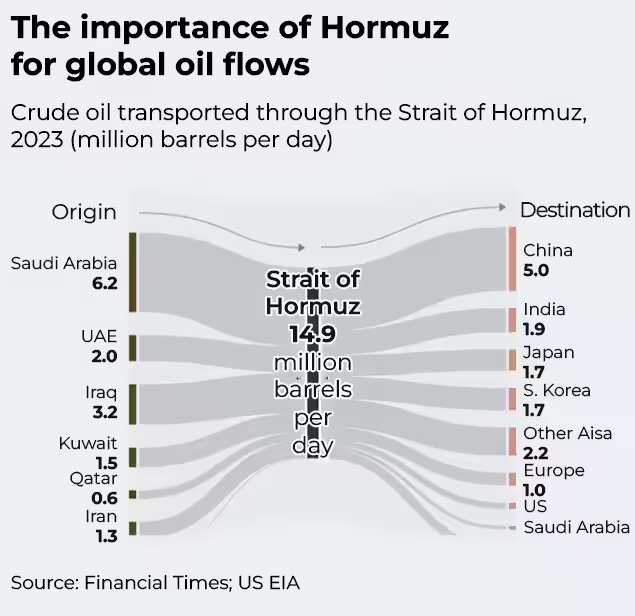
Importance of Strait of Hormuz for global oil flows
The discussions have not been limited to immediate cargoes. Traders said Iran is also exploring the possibility of longer-term supply arrangements as it looks to increase production.However, despite the outreach, buyers across Asia are not showing any urgency to return to Iranian crude, according to the traders. Many refiners have already secured alternative supplies after adapting to the prolonged disruption of shipping through the Strait of Hormuz.Market participants also remain cautious because of uncertainty over future US policy, while sanctions and restrictions imposed by the European Union and the UK continue to complicate financing and insurance arrangements. In addition, not all ports are willing to receive vessels associated with the so-called dark fleet that has continued transporting Iranian oil, the Bloomberg report said.
Will India buy?
Indian refiners generally avoid purchasing crude that is potentially subject to sanctions. However, India’s proximity to Iran could provide a potential advantage if buyers choose to engage, particularly given Tehran’s urgency to secure customers and the limited duration of the current sanctions waiver. Certain cargoes can be delivered to Indian refineries within two to three days, allowing buyers sufficient time to complete transactions during the waiver period.Sumit Ritolia, Lead analyst, Modelling and Refining at Kpler is skeptical that any country other than China will materially increase purchases. One of the biggest reasons for that is that the waiver is, at least for now, only for 60 days. “Given the uncertainty around the Soz and geopolitical risks, most Asian refiners have already been proactive in securing crude supplies. Refinery planning cycles typically run 2–3 months ahead, meaning many refiners have already lined up imports through at least the first half of August,” he says pointing to the narrow window to purchase the crude.Citing the example of Indian refiners, Ritolia noted that they are currently focused on the second half of August and September requirements. “Russian and Middle Eastern grades remain the core of their procurement strategy, while Venezuelan crude continues to gain market share. Meanwhile, Russian crude availability remains healthy as refinery runs are constrained by ongoing downstream disruptions. Opportunistic purchases are possible if discounts become highly attractive, but the overall scope appears limited,” he says.Yet another factor is the uncertainty around the Donald Trump administration’s policies. “Even if negotiations between buyers and sellers become more positive, refiners are unlikely to commit to large volumes as long as US sanctions policy continues to change rapidly. The central issue is not merely whether Iranian crude can be purchased today, but whether market participants can be confident that such trade will remain permissible in the future,” Ritolia says. In March and April when a temporary sanctions waiver was in place, Indian refiners bought limited volumes of Iranian crude. There are also concerns on payment mechanisms.“For refiners evaluating Iranian crude, three factors are likely to be decisive: the longevity of sanctions relief, the commercial attractiveness of pricing and discounts, and the availability of supporting infrastructure such as payment channels, insurance coverage, shipping arrangements and logistics services,” Ritolia says.
Will China be the only buyer?
The Kpler analyst also said that Iran may find it difficult to secure buyers from the West given the higher transit times. “For a crude purchase to be completed, the entire supply-chain process must take place within the permitted period. For some destinations, transit times from Iran can extend to 40-45 days. Given these timelines, many Western refiners would struggle to complete the full cycle before the waiver expires,” he says.So, even as the waiver has reopened the possibility of Iranian oil exports, at present, China remains the country most likely to benefit from the renewed availability of Iranian crude, he says.
Asia’s crude supply already secure?
For Iran, attracting buyers may not be the only challenge. Supply-demand dynamics in Asia currently offer little support for a rapid increase in sales. Despite months of disruption, the region is not facing a shortage of crude oil, reducing the incentive for refiners to take additional risks unless Iranian supplies are offered at substantial discounts.Market indicators also point to comfortable near-term supply conditions. Benchmark Middle Eastern crude grades, including Dubai and Abu Dhabi’s Murban, are trading in a contango structure, where prompt contracts are priced below those for later delivery, typically signalling an oversupplied market in the short term.“The waiver does open more doors for Iran to sell into Asia, rather than relying almost exclusively on China,” said Warren Patterson, Head of Commodities Strategy at ING Groep NV in Singapore. He added that the development could result in narrower discounts for Iranian crude.However, Patterson noted that a temporary waiver alone is unlikely to drive a significant increase in Iranian oil exports.“To see more meaningful upside in Iranian oil supply, sanctions relief would need to be more permanent.”


