



Indian Navy Defense Minister Rajnath Singh on Saturday commissioned the indigenously built warship at the Naval Dockyard in Visakhapatnam, further strengthening the country’s maritime warfare capabilities.“There was a time when we looked towards other countries for our defense needs. Today, we are building warships in our own shipyards with the help of our own people,” Defense Minister Rajnath Singh said, referring to the commissioning of six frontline frigates within the last one and a half years.The Defense Minister stressed the importance of a capable and responsive Navy, highlighting the Navy’s response to developments in the Middle East.He said, “After the conflict broke out in West Asia, the Indian Navy evacuated 18 merchant ships carrying essential cargo worth more than Rs 9,000 crore through ‘Operation Urja Suraksha’. This shows that our Navy has emerged not only as a fighting force but also as a strong protector of India’s economic interests.”
Project 17A
Project 17A is the Navy’s program to build seven indigenous multi-mission stealth frigates, called the Nilgiri class, as a follow-up to the earlier Project 17 Shivalik-class frigates.Compared to the Shivalik class, the Project 17A frigates have better stealth characteristics, greater automation, increased survivability and more advanced sensors and weapons.The deal, worth about Rs 45,000 crore, is one of the largest single contracts for warship construction in India.The ships are designed by the Directorate of Naval Design, a specialized unit within the Defense Ministry, and built by two public sector shipyards: Mazagon Dock Shipbuilders (MDL) in Mumbai and Garden Reach Shipbuilders and Engineers (GRSE) in Kolkata. Four frigates are being built at MDL and the other three at GRSE.
Construction of warships under Project 17A
According to the Defense Ministry, more than 75 per cent of the material used in the ships is indigenous, and more than 200 micro, small and medium enterprises (MSMEs) are involved in providing the systems and components.
seven battleships
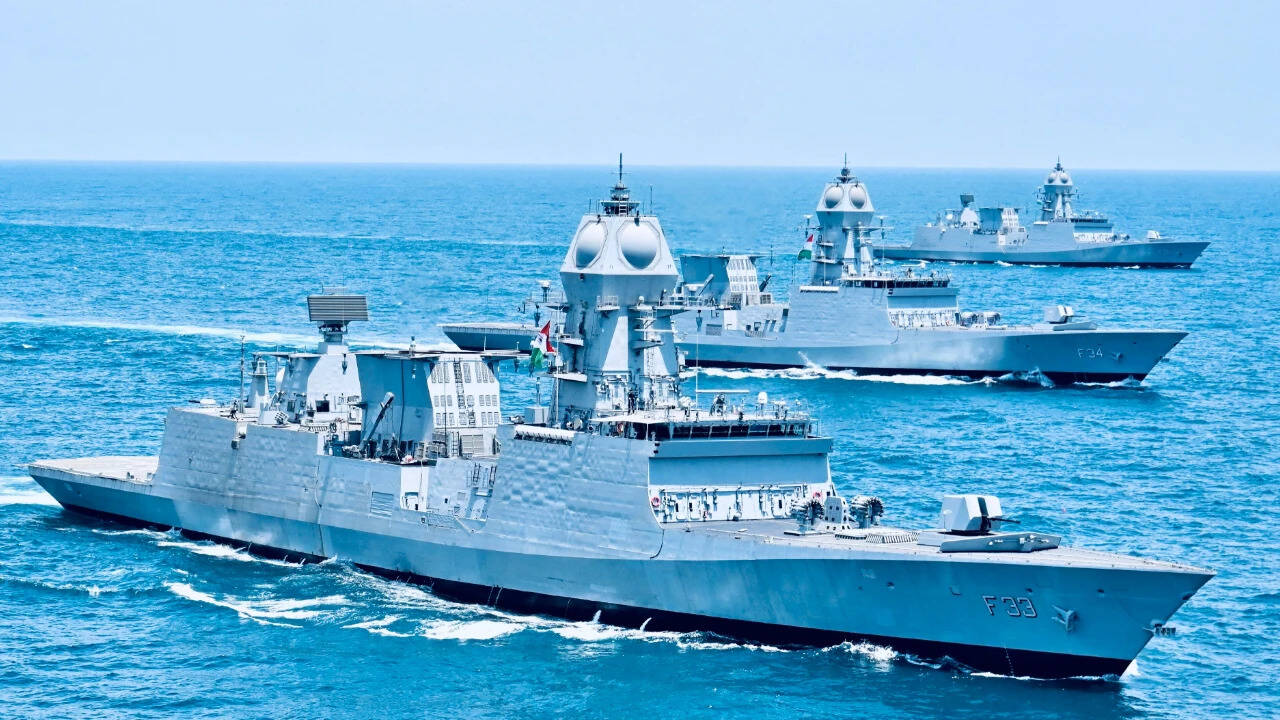
INS Nilgiri, Udaygiri and Himgiri, Photo Credit: X/@IN_HQENC
A frigate is a modern warship larger than a corvette and smaller than a destroyer, typically used for anti-submarine warfare, long-range patrol, and anti-aircraft roles.In today’s high-threat environment created by friendly developments in the Indo-Pacific, stealth frigates have a relevant role. Their low radar signature and advanced sensors make them difficult to detect, allowing effective operations against sophisticated adversaries.
1. INS Nilgiri
Built by MDL and commissioned on January 15, 2025, Indian Naval Ship Nilgiri was the first warship built under this project. It represents the next generation of indigenous warships with better survivability, stealth and stealth characteristics compared to Shivalik.
2. of these Udayagiri
INS Udayagiri
Being the hundredth warship designed by the Naval Warship Design Bureau, Udayagiri was commissioned on August 26, 2025.
3. INS Himgiri
INS Himgiri
Built by GRSE in Kolkata, Himgiri was commissioned along with INS Udayagiri at the Visakhapatnam naval base.
4. of these Taragiri
INS Taragiri
The fourth Nilgiri-class frigate, Taragiri, was commissioned on April 3, 2026.
5. INS Dunagiri (F 36)
INS Daunagiri
INS Daunagiri, the fifth ship under 17A and the second ship built by GRSE, was commissioned on June 21, 2026.
6. INS Mahendragiri
INS Mahendragiri
The latest in the arsenal of stealth frigates, and the last built by MDL for the project, is INS Mahendragiri. It is also the first warship to bear this name, which is named after decommissioned warships.
7. INS Vindhyagiri
INS Vindhyagiri
INS Vindhyagiri, being developed by GRSE, is the last warship awaiting commission under the project. It is currently undergoing final outfitting and testing before induction into the Navy. Vindhyagiri was launched by the President on August 17, 2023 in Kolkata Draupadi Murmu.
Specifications
The stealth frigates built under Project 17A have the same basic design, measuring 149 meters in length with a full-load displacement of approximately 6,670 tons. Powered by combined diesel or gas (CODOG) propulsion systems, they can achieve speeds of up to 28–30 knots. Their redesigned hull has enhanced stealth characteristics and improved survivability compared to the earlier Project 17 Shivalik-class frigates.The Nilgiri-class frigates are approximately five percent larger than the Shivalik-class, yet feature a sleek design with a low radar cross-section.They are equipped with state-of-the-art Integrated Platform Management System (IPMS) and indigenously developed advanced weapons and sensors.
Specifications of Nilgiri-class frigates
INS Nilgiri
Each frigate has a flight deck and an attached hangar capable of accommodating two medium-sized helicopters including HAL Dhruv, Sea King MK 42B and MH-60R Seahawk, enabling it to conduct extensive anti-submarine warfare and maritime reconnaissance operations.The frigates are equipped with missile systems, including eight indigenous BrahMos supersonic cruise missiles jointly developed by India and Israel and the Barak-8 surface-to-air missile system. The Project 17A stealth frigates are equipped with a Vertical Launch System (VLS), which provides advanced 360-degree protection against aerial threats such as enemy aircraft, drones, helicopters and incoming anti-ship missiles.They are also equipped with rocket launchers, anti-submarine torpedoes, a BrahMos supersonic surface-to-surface missile system, a Barak-8 medium-range surface-to-air missile system, a 76 mm gun, and a combination of 30 mm and 12.7 mm weapon systems for rapid close-range strikes.According to the Defense Ministry, along with being capable of anti-air, anti-surface and anti-submarine warfare, INS Mahendragiri is equally capable of undertaking maritime security operations, power projection, humanitarian assistance and disaster relief (HADR) missions.
arming the eastern front
India’s naval strategy has historically been shaped to counter the Pakistani threat on the western front, leading to heavy deployment of warships in the Arabian Sea. However, there has been consistent deployment of all currently commissioned 17A frigates on the Eastern Naval Front, possibly suggesting a deliberate strategic shift in focus towards the broader Indo-Pacific region.According to the Observer Research Foundation, a gap exists between India’s maritime ambitions and physical reality due to delays in key acquisition programs such as submarines under Project-75(I), putting the Eastern Naval Command under immense pressure amid the growing Chinese presence in the region.Additionally, ORF reports an increasing number of Chinese “dual-use research vessels” traveling in the Bay of Bengal and docking in ports such as Hambantota, Sri Lanka. China claims they are for scientific research purposes, while they are used for spying on the missile testing range in Odisha.The ships also collect key marine data such as salinity and thermal layers to gain information about sea conditions, which is useful during submarine warfare.By placing these stealth frigates under the Eastern Fleet, the Navy can effectively strengthen patrol presence, escort duties, anti-submarine warfare readiness and maritime surveillance in the waters.Additionally, the deployment near the Andaman and Nicobar Islands puts them close to the Strait of Malacca, one of the most important trade chokepoints connecting the Indian and Pacific Oceans. A large share of China’s trade and energy imports pass through these sea routes, making unhindered access to them a strategic necessity for Beijing.A capable Indian Navy with a credible presence in the Eastern Indian Ocean strengthens India’s ability to monitor key maritime approaches, deter hostile activity, and contribute to a stable regional security environment.Before the launching of Mahendragiri, the Defense Minister addressed the sailors at the Visakhapatnam naval base on Friday.“Many powers want to increase their influence and establish a stronger presence in our neighbourhood,” he said.He said, “Being the biggest power in the region, India is also the biggest guarantor of peace and stability. For us, the Indian Ocean is like our own backyard and it is our responsibility to protect it.”
blue water navy
India has a blue-water navy capable of operating in the Indian Ocean and the wider Indo-Pacific. Apart from guarding the country’s coastline, the Indian Navy is tasked with protecting sea lines of communication, maintaining a constant presence in strategically important waters, safeguarding India’s maritime interests and responding to contingencies off home shores.At the same time, New Delhi has continuously expanded its role as a preferred security partner for the countries of the Indian Ocean region. Through initiatives such as SAGAR (Security and Growth for All in the Region) and the recent OCEAN (Reciprocal and Holistic Advancement in Security in the Regions), India has sought to promote cooperative maritime security through joint exercises, coordinated patrolling, information sharing, capacity building, humanitarian assistance and disaster relief operations and training of personnel of friendly foreign navies.These efforts have strengthened the Indian Navy’s image as both a reliable first responder during regional crises and a reliable maritime partner committed to a free, open and inclusive Indo-Pacific.Stealth frigates under Project 17A are at the heart of this approach. Designed for anti-air, anti-surface and anti-submarine warfare, they can operate independently or as part of larger carrier and expeditionary task groups, expanding the Navy’s reach while strengthening maritime surveillance, escort operations and interdiction throughout the region.Their induction is also part of a broader naval modernization program that includes the Project 15B guided-missile destroyers, Project 75 and Project 75(I) submarine programmes, next-generation missile ships and future indigenous aircraft carrier plans. Building on the technical and operational experience gained from the Nilgiri class, the Navy is now expected to move towards Project 17B, the next generation of indigenous stealth frigates and the next step in India’s long-term maritime capability development.


