On the occasion of Ram Navami, ‘Ramayana’ producer Namit Malhotra officially announced that the first look of the much-anticipated Nitesh Tiwari directorial, will be revealed on April 2, on the auspicious occasion of Hanuman Jayanti.Amid chatter that the makers will release Ranbir Kapoor‘s first official look as Lord Ram on the festival of Ram Navami, Malhotra, in an official statement, put an end to all the rumours saying “On 2nd April, Hanuman Jayanti, we take the first step together.”
In a social media post, he shared, “This is a story that belongs to all of us, and every step we take has been guided by a deep sense of responsibility, devotion, and care to bring our very own Ramayana to life in its truest spirit and scale with utmost sincerity.”Revealing when fans can look forward to getting official material, he said, “We look forward to sharing the next glimpse, Rama, on 2nd April, on the auspicious occasion of Hanuman Jayanti, as we begin to showcase all these years of our effort through a grand launch with fans to celebrate this moment, across the world.”Extending a note of thanks to all fans awaiting the film, he concluded, “Thank you for your love, faith, and patience.”The announcement comes as the makers prepare to roll out an extensive international promotional campaign, reportedly beginning with events in the United States. The film, directed by Nitesh Tiwari, stars Ranbir Kapoor as Lord Rama, alongside Sai Pallavi as Sita and Yash as Ravana.As per reports on Variety, Kapoor, Tiwari, and Malhotra are expected to attend a media interaction in the US later this month, marking the film’s first major international promotional push. Mounted on a large scale, and believed to be one of the most expensive films ever made in India, ‘Ramayana’ has already generated significant buzz both in India and globally. The film is slated to release in cinemas globally on Diwali 2026 and Part 2 scheduled to release on Diwali 2027.On Ram Navami, filmmaker SS Rajamouli and the team ‘Varanasi’ also extended their greetings to fans and devotees of lord Ram, by offering a tease of their upcoming film. The clip in question featured the epic Ramayana battle scene. They shared the post with a note that read, “You’ll see him in theatres by next Sri Rama Navami.” The film has been confirmed for an April 7, 2027, release.
Josh Hazlewood, the Australian fast bowler, has formally joined the Royal Challengers Bangalore (RCB) team ahead of the 2026 Indian Premier League (IPL) season.
The Bengaluru-based franchise verified the news on their social media accounts. Given his background and accomplishments in both local and international cricket, Hazlewood`s acquisition is thought to significantly improve RCB`s bowling attack.
The Myth. The Legend. The 𝗛𝗮𝘇𝗹𝗲𝗚𝗢𝗗. 🙇♂️
Back in Red, Blue, and Gold. Back to BLR. Just where he truly belongs. 🏠🔥
— Royal Challengers Bengaluru (@RCBTweets) March 26, 2026
However, due to the Australian`s ongoing recuperation from hamstring and Achilles problems, the reigning champions RCB will be without their standout bowler at the beginning of the competition.
Hazlewood missed last year`s Ashes series at home and was also injured for the T20 World Cup held in India and Sri Lanka. The Aussie pacer`s fitness is a concern.
Josh Hazlewood had a standout season in IPL 2025, playing a big role in RCB winning their maiden title. Despite missing several games due to a shoulder injury, he finished as the team`s leading wicket-taker. In the first qualifier, Hazlewood showed his brilliance with the figure of 3/21. Again in the final, the Aussie was at his best, getting crucial wickets and executing yorkers at the death.
BCCI release the full schedule for IPL 2026
In the meantime, the Indian Premier League (IPL) 2026 second phase schedule was released on Thursday by the Board of Control for Cricket in India (BCCI). The BCCI affirmed that the playoff locations will be revealed at a later time.
The remaining 50 games of the league round will take place in 12 locations throughout India between April 13 and May 24.
An official announcement from the IPL website states that games in the second round will take place in Bengaluru, Mumbai, Chennai, Kolkata, Delhi, Ahmedabad, Hyderabad, Lucknow, Jaipur, Dharamsala, Raipur, and New Chandigarh.
The schedule for IPL 2026`s first phase was previously released by the BCCI.
At Bengaluru`s M. Chinnaswamy Stadium, defending champions Royal Challengers Bengaluru (RCB) will meet Sunrisers Hyderabad (SRH) in the tournament`s opening match on March 28.
The IPL`s initial phase will feature 20 games spread over 10 sites. The venues for the first phase will be Bengaluru, Mumbai, Guwahati, New Chandigarh, Lucknow, Kolkata, Chennai, Delhi, Ahmedabad, and Hyderabad.
There is a surprising paradox at the core of Ashok Kharat’s story. The 67-year-old self-styled ‘astrologer-god’ from Nashik, who is now being investigated by the Fadnavis government for rape and extortion, had failed in mathematics in the Class 10 board exams but made a name for himself as a numerologist who advised thousands of people, including top politicians of Maharashtra, on how to run their business, personal and political affairs.
Kharat was born in Kahandelwadi village of Nashik district. (file photo)
The Special Investigation Team (SIT) that is investigating Kharat – not just the cases against him but in fact his entire history – found that the numerateist had scored 28 out of 100 in his Class 10 mathematics paper.
Kharat, against whom 8 complaints of rape, sexual harassment and fraud and extortion have been filed in the last 10 days, was born Laxman Kharat in Kahandelwadi village in Nashik district. His early life was surrounded by controversy when it was alleged that he had sexually assaulted one of his relatives, resulting in his being ostracized from the village, a senior Nashik police officer said.
After his excommunication, Kharat moved to West Bengal and from there to Thailand. He worked as a sailor on some cargo ships and later called himself ‘Captain Kharat’. Investigators told HT that they found no records that suggested he was a ranked officer in the merchant navy, instead, they believe he may have worked as an unlicensed crew member on ships. Nevertheless, this tenure became an important part of his narrative in later life – a way to showcase his global exposure and enhance his authority.
When Kharat returned to Nashik in the mid-1990s, the city was in the midst of a commercial and real estate boom. Kharat established himself with a new name–Ashok Kumar–and a new profession. “He became an astrologer and numerologist who also performed small rituals. Among his major clients were people involved in complex real estate deals,” said a senior Nashik police officer.
What set Kharat apart was not any proven knowledge, but his methodology full of theatrics. Some rituals will be staged in a controlled environment at the Mahadev temple of Mirgaon located on his land. The lights would be switched off and customers would be asked to close their eyes while the room would echo with the sound of snakes hissing and Kharat would claim that Mahadev himself had accepted the customer’s prayer.
By the late 1900s, Kharat’s clientele expanded to include influential businessmen and politicians from all political parties. His services were no longer limited to simple consultation. He began to prescribe elaborate rituals that required repeated consultations and significant financial expenditure. “Their consulting fees can go up to ₹50 lakh,” said an SIT official. “He understood psychology very well,” said another senior police officer. “He knew when to reassure, when to create fear and when to demand money.”
Pune realtor Rajendra Asud, who filed the FIR against Kharat on Wednesday, told the SIT that a friend had introduced him to Kharat, and had assured him that the rituals of the god would help improve his business fortunes. Instead, what followed were years of financial ruin. “I was in touch with him since 2018 and spent a lot of time ₹4 to 5 crores,” the businessman told investigators. “Every time I wanted to escape from his hold on me, he would say that my life was in danger.”
The businessman alleged that apart from large cash transactions, he transferred ownership of a Mercedes car worth approx ₹Kharat got Rs 90 lakh. The relationship has gone beyond discussions, he said. Kharat reportedly insisted on foreign trips as part of the “treatment” and the two men traveled to ten foreign locations, including the US.
When the promised results were not achieved, Assoud tried to distance himself. “He told me that he had divine powers and if I did not obey him he could kill me,” she said in her FIR. It was only after Kharat’s arrest became public that Asud found the courage to approach the police.
If Assoud’s allegations point to extortionate behavior, the testimony of the female complainants highlights an even more disturbing predatory trend.
What started as a complaint has now expanded into a multi-layered investigation, with at least eight FIRs lodged against the self-styled godman between March 17 and March 26. Six of these are from women alleging rape and sexual abuse. One of these is from his former office employee who has accused Kharat of raping his pregnant wife.
The employee alleged that in March 2024, Kharat sexually harassed his seven-month pregnant wife when she went to him for guidance related to delivery. The assistant, who was waiting outside during the session, later conducted a sting operation when his wife told him about the attack. The clips recorded by him were handed over to the police, which began further investigation.
In another case registered on March 24, a Shirdi woman has alleged that Kharat raped her four times between July and December 2024. According to her complaint, she met Kharat for the first time in 2021 along with her parents to seek advice on building a house. She returned in 2024 to seek guidance from him about her career prospects.
She alleged that during one of these meetings, Kharat asked her parents to wait outside and then sexually assaulted her inside his chamber. She further claimed that he threatened her of dire consequences if she opened her mouth, and said that he could harm her family or even cause the death of her parents by using his “divine powers”.
The threats did not end here. The woman told the police that in December 2024, she received an obscene video clip involving Kharat and herself from an unknown number. When she spoke to Kharat, he dismissed the clip as an AI-generated video and advised her to file a complaint against the sender.
She told investigators that she found the courage to complain against Kharat after his arrest in another rape case filed on March 17, in which he was accused of raping a Nashik-based married woman for three years from November 2022 to 2025. To investigators, these accounts are not just individual allegations, but pieces of a larger puzzle. “The pattern is consistent – build trust, isolate the victim, use fear and then exploit them,” said an officer involved in the investigation. “In many cases, victims were hesitant to come forward because they lacked confidence in his powers or feared repercussions.” The SIT is also investigating several videos of sexual harassment involving Kharat and various women, and is encouraging victims to come forward to complain without any fear.
Police believe this fear is heightened due to Kharat’s alleged closeness to influential persons, including politicians from all parties.
Earlier this week, NCP leader and former chairperson of the State Women’s Rights Commission Rupali Chakankar was asked to resign due to her closeness to Kharat and her trust. Others who know the self-styled godman are Deputy Chief Minister Eknath Shinde, Higher Education Minister and BJP leader Chandrakant Patil and Shiv Sena MLA Deepak Kesarkar.
Although there is no evidence so far to suggest wrongdoing by these political figures, Kharat’s closeness to them adds another layer to the unfolding story – highlighting how deeply he has embedded himself in their sphere of influence.
In 2009, Kharat purchased land in Mirgaon outside Nashik which became his center of operations. He built a Shiva temple there and over time acquired 30 acres of land around it and built a farmhouse where his influential clients could come and meet him.
“He never really interacted much with the villagers. He used to come on weekends. His visitors were mostly outsiders – rich customers, people with expensive cars and sometimes politicians,” said Sunil Hinje, a former deputy sarpanch who is leaving the post in 2026.
reversal
If Ashok Kharat’s story is about how a man created an aura around himself, it is also about how a carefully constructed building began to crack.
A sitting MLA, on condition of anonymity, admitted that he had taken advice from Kharat in the past. “I had met him several times and sought advice about my political future,” the Shiv Sena MLA said. “But I had no knowledge about these allegations. If I had known about them, I would never have gone to him.”
Manikrao Kokate, a former minister and NCP MLA from Sinnar, under which Kharat’s Mirgaon village falls, is more direct, suggesting that Kharat’s ability to function for years points to a larger systemic failure. “He could not have continued like this without the support or protection of some officers and police personnel.”
So how did Kharat manage to maintain and expand its operations for more than two decades without serious scrutiny? Part of the answer lies in the complex interplay of trust, influence, and institutional dysfunction. He had a temple and farmhouse at Mirgaon where businessmen, professionals and politicians met – often away from public view. This created an ecosystem where their legitimacy continued to strengthen.
The absence of initial complaints – or the failure to act on them – made the situation worse. This happened only when political monopoly increased in Mumbai, Kharat’s empire – projected by Nashik Police ₹The mystery of Rs 1000 crore started being solved.
However, Kharat’s wife Kalpana had told HT on March 19 when the first rape case was registered, that the allegations of sexual abuse against him were baseless. “The allegations leveled against my husband are false. He was not a professional astrologer. He took it up only as a hobby.”
As the SIT continues its investigation, officials are focusing on multiple fronts – verifying financial transactions, analyzing digital evidence, mapping Kharat’s network of associates and identifying potential supporters. Each new complaint adds another layer, suggesting the full extent of The case may still be open.
Addressing the state assembly on March 23, Maharashtra Chief Minister Devendra Fadnavis appealed to the people to come forward and lodge complaints against Kharat. “The matter is being monitored at the highest level and I assure everyone that Kharat or any other person involved in this case will not be spared.”
The story of reinvention and networks built on trust, fear and the abuse of power may finally be nearing an end.
Earlier this month, YouTuber and Bigg Boss 17 fame Anurag Dobhal accused his parents and brother of mentally harassing and torturing him over his interfaith marriage with Ritika Chauhan. The situation escalated when Anurag crashed his car during an Instagram Live. Now, his wife Ritika Chauhan has defended her in-laws, stating that both she and her in-laws are being misunderstood, and has promised to share her side of the story soon.
Anurag Dobhal’s wife Ritika Chauhan defends her in-laws.
Anurag Dobhal’s wife Ritika Chauhan says she’s being misunderstood
On Thursday, Ritika took to Instagram and shared a series of stories, speaking about facing negativity despite standing by Anurag when he needed her. She wrote, “What hurts the most is realising that the reality is very different from what is being shown or believed. Just because I’m not an influencer or don’t want to express myself online doesn’t mean my story doesn’t exist or doesn’t matter. Basically, I don’t do anything for any social Pov’s.”
She also defended her in-laws, stating that neither her family nor her husband’s family deserves such misunderstanding. She shared, “The same goes for my mother, my brother, my family, and my in-laws. None of us deserve this kind of misunderstanding. As a woman, all I have ever wanted is for my home to stay united. No girl ever wishes to see her family go through something like this. I have always tried my best to fulfil my responsibilities as a wife with sincerity and respect. Now, I carry an even greater responsibility, my unborn child. This little life does not deserve to be surrounded by stress and pain, yet it is affecting us deeply.”
She added, “All I ask for is understanding, but still I have a Question. I stood for everyone, right there when everyone needed me, But Where were and are you? When I needed? I just got a negative PR, but that doesn’t change the truth. I’ll be clearing my Side soon, definitely.”
Ritika shared another story, which read, “I never wanted to post this, but I feel the need to say it clearly. I don’t want to carry assumptions or negativity just for the sake of online noise. It’s not just affecting me it’s affecting my family too. I have a life beyond all this, a beautiful one, where I’m holding onto the most precious experience, my baby. And I refuse to let any negativity surround something so pure and untouched. I’m choosing peace, for myself and for my family.”
About Anurag Dobhal’s accusations
In his YouTube vlog, Anurag became emotional as he accused his parents and brother Kalam of mental harassment. He claimed that his family opposed his marriage to Ritika and did not allow her to enter their home after the wedding. He also revealed that he and his wife have been living separately since their marriage and alleged that she has now left him.
His brother, however, dismissed all the allegations, claiming that Anurag was making such statements for social media attention.
On March 7, Anurag attempted suicide after crashing his car during an Instagram Live. He was rescued and admitted to the hospital. Following his discharge, he is currently staying with a friend. While Ritika visited him in hospital, she is not living with him at present.
If you need support or know someone who does, please reach out to your nearest mental health specialist. Helplines: Aasra: 022 2754 6669; Sneha India Foundation: +914424640050 and Sanjivini: 011-24311918
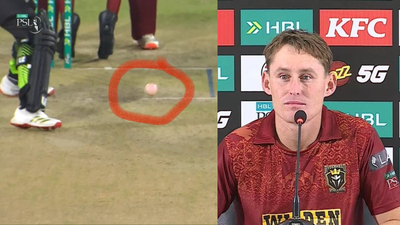
The Pakistan Super League (PSL) had a controversial start on their opening day after an incident saw the regular white ball turn pink during the first match of the season due to colour transfer from the Hyderabad Kingsmen’s jerseys. The issue, noted as a first-time occurrence by Marnus Labuschagne which quickly drew attention on social media. The PSL began its 2026 season on March 26, but controversy struck in the opening game itself. The clash between Lahore Qalandars and Hyderabad Kingsmen at Gaddafi Stadium in Lahore unexpectedly turned into what fans described as a ‘pink-ball contest.’ The Hyderabad Kingsmen captain alerted the umpires that the ball was changing colour, explaining that dye from his team’s jerseys was rubbing off onto the white ball, gradually turning it pink and later reddish.
Watch
IPL 2026: Ishan Kishan steals the show at captains meet
“I did say to the umpires after the second over, ‘What’s going on? The ball is red.’ It must be from the clothes or something like that. I haven’t seen anything like this before,” a baffled Labuschagne told reporters at the post-match press conference.“I’ve seen occasions where something on a bat comes onto the ball, or when it hits the pad and takes a bit of paint off. But I’ve never seen this happen with clothing. I’m sure they’ll sort it out in the next few games,” he added.After the conclusion of the match the Hyderabad Kingsmen posted a cheeky post on X after their poor kit jersey turned the match into a ‘pink-ball contest’.Cricketers often polish the ball using their jerseys or a towel to maintain its shine, which helps bowlers generate swing. However, this incident has raised serious concerns, with many calling it an embarrassment for the PSL. Questions are being asked about how such poor-quality kits were approved, allowing jersey colour to transfer onto the match ball. The Australian star expressed hope that the franchise owners would resolve the issue quickly.
Match Summary
Lahore Qalandars began their PSL 2026 campaign with a dominant 69-run win over Hyderabad Kingsmen. Batting first, Lahore posted 199/4, powered by Fakhar Zaman’s 53 and an unbeaten 40 from Haseebullah Khan. In response, Hyderabad were bowled out for 130, with Ubaid Shah, Sikandar Raza, and Haris Rauf taking two wickets each.The tournament is being played behind closed doors due to the West Asia crisis and is limited to Lahore and Karachi. PSL 2026 has also been impacted by the loss of several overseas players, many of whom have joined IPL teams as replacements.
Producer Ektaa Kapoor has drawn similarities between Bollywood superstar Akshay Kumar and her own superstar father Jeetendra.
In the upcoming episode of the quiz reality show Wheel of Fortune, Bhooth Bangla producer Ektaa Kapoor was seen revealing her sweet tooth obsession.
During the episode, Ektaa Kapoor opened up about her love for sweets and said, “Mujhe meetha kam khane bola hai aur Akshay sir ko acha lagta hai jab main meetha kam khati hoon.”
(I have been asked to eat less of sweets, and Akshay Sir likes it when I eat less sweets)
Her confession led to a fun exchange with Akshay Kumar, who asked her why she enjoys eating sweets so much.
To this, Ektaa responded with her trademark humour, saying, “Main Punjabi hoon aur Akshay aur mere dad mein ek thing common hai voh hai… discipline,.. aur voh mere main nahi hai.”
(I am Punjabi, and one thing that Akshay and my dad have in common is discipline… and I don’t have that)
Keeping the banter going, Akshay Kumar added his own witty twist to the moment and said, “Yeh meethe ke distributor ke bache bhi khaati hain.” (She eats distributors’ kids also)
Ektaa was seen on the show along with the cast of Bhoot Bangla, Rajpal Yadav and Wamiqa Gabbi, to promote the movie.
Bhoot Bangla also stars Akshay Kumar, Paresh Rawal, Tabu, and Jisshu Sengupta and is set to release on the 10th of April.
This story has been sourced from a third party syndicated feed, agencies. Mid-day accepts no responsibility or liability for its dependability, trustworthiness, reliability and data of the text. Mid-day management/mid-day.com reserves the sole right to alter, delete or remove (without notice) the content in its absolute discretion for any reason whatsoever
Malaysian leader says oil tankers granted clearance by Iran as government introduces measures to conserve fuel.
Published On 27 Mar 202627 Mar 2026
Iran has allowed Malaysian ships to pass through the Strait of Hormuz, Malaysia’s leader said, amid the global energy crunch driven by the United States and Israel’s war with Tehran.
In a televised address on Thursday, Malaysian Prime Minister Anwar Ibrahim expressed thanks to Iran’s President Masoud Pezeshkian for granting Malaysian vessels “early clearance” through the waterway, which has been effectively closed by Tehran.
Recommended Stories
list of 4 itemsend of list
“We are in the process of securing the release of the Malaysian oil tankers and the workers involved so they can continue their journey home,” Anwar said.
Anwar did not elaborate on how many vessels had cleared the strait, which normally facilitates the transport of about one-fifth of global oil and liquefied natural gas (LNG) supplies, or under what conditions the vessels were cleared for safe passage.
The Malaysian government, which has traditionally pursued a policy of non-alignment in international affairs, did not immediately respond to requests for comment.
Anwar said that while Malaysia had been affected by the disruption to energy supplies, the Southeast Asian country was in a “much better position” than other nations due to the capacity of the state-run oil and gas company Petronas.
As one of the world’s top suppliers of LNG, Malaysia is a net energy exporter, but the country imports nearly 70 percent of its crude oil from the Gulf region.
Anwar said his government would take a series of measures to conserve fuel, including reducing the individual monthly quota for subsidised petrol and “gradually and selectively” moving civil servants onto work-from-home arrangements.
“Food supplies are affected; prices will certainly rise. Fertiliser as well, and of course, oil and gas,” Anwar said.
“So there are steps we need to take. There are countries whose impacts are far worse than ours, but that does not mean we are spared entirely,” he said.
While Iran has stated that the strait is open to ships that are not aligned with the US or Israel, Tehran has claimed the right to exercise control over the waterway and admitted responsibility for at least two of 20 documented attacks on commercial vessels in the region.
Iran’s parliament is also pushing legislation that would establish a toll system in the strait amid reports that Iranian authorities have been demanding vessels fork over as much as $2m to guarantee their safe passage.
Five ships were tracked transiting the strait via their automatic identification systems on Wednesday, up from four the previous day, according to maritime intelligence company Windward.
Before the war, an average of 120 vessels transited the waterway each day, according to Windward.
The morning begins peacefully in Gasaba village, located in the highlands of the Eastern Ghats in Peda Bayalu mandal of Alluri Sitarama Raju district of Andhra Pradesh. On the winding road of the ghat, sunlight filters through the patches of trees and reaches the two-acre area at the edge of the village.
Bujjamma bends over a row of green leafy vegetables and sorts out the plants set aside for seeds. Her saree is tied high for ease of movement. The metallic earrings and nose ring sparkle on her face as she works. She is one of the village’s seed savers, growing, inspecting and selecting native seeds for distribution. A short distance away is his modest home, a red-tiled structure with mud-plastered walls, where packets of heirloom seeds are kept with care.
Indigenous seed varieties being demonstrated by seed savers in Gasaba village in the Eastern Ghats of Andhra Pradesh. | Photo Courtesy: KR Deepak
Nearby, another farmer works a patch of gourds, picking out gourds that will be left to fully ripen. Standing between them is a farmer-researcher, notebook in hand, observing and sometimes even giving inputs. This patch serves as a block seed multiplication site, where native seed varieties are regenerated before being distributed to 18 surrounding villages.
Native seed varieties are being demonstrated by Pangi Sunkari, a seed savior who won the national award of Plant Genome Savior Community Award from the Plant Diversity and Farmers Rights Protection Authority, in Gasaba village in the Eastern Ghats of Andhra Pradesh. | Photo Courtesy: KR Deepak
The crops here do not follow uniformity. Gourd vines run across the supports. Tomato plants produce fruits of uneven size and color. Millet stands alongside chilli, potatoes and local vegetables. Each variety holds a history shaped through seasons of selection. These are crops that have adapted to the terrain and rainfall of the mountains, providing a measure of flexibility that commercial hybrids often fail to match.
Indigenous seed varieties being demonstrated by seed savers in Gasaba village in the Eastern Ghats of Andhra Pradesh. | Photo Courtesy: KR Deepak
The work is part of a larger effort led by the Sanjeevini Rural Development Society, which, since the early 2000s, has worked with farmers in villages like Kiloguda and Suva to revive indigenous seeds through natural farming. What appears stable today once faced resistance.
“When I proposed saving native seeds and banning hybrid seeds, people thought I was a madman talking about seeds,” says P Devullu of Sanjeevani Rural Development Society. Over time, he says, farmers began to see changes in soil health, input costs and long-term benefits of heirloom varieties.
Native seed collection at the Soil and Seed Information Center of Sanjeevani Rural Development Society at Kiloguda in the Eastern Ghats of Andhra Pradesh, about 130 km from Visakhapatnam. | Photo Courtesy: KR Deepak
Change took shape through demonstration. Plots like Gasaba allowed farmers to see how native varieties performed across all seasons. Older farmers, often over 70 years of age, were involved in identifying seeds and guiding selection through their experience and traditional practice rather than formal training.
Farmers are practicing natural farming in Devuduvalasa village in Suva Valley near Araku in the Eastern Ghats of Andhra Pradesh, about 130 km from Visakhapatnam. | Photo Courtesy: KR Deepak
By 2001, this effort had grown into a seed bank called the Soil and Seed Information Center in Kiloguda, which started with about 45 varieties. Today, it has more than 360 varieties of millets, pulses, vegetables and tubers. A committee of experienced farmers oversees the selection and distribution from farms in different regions, ensuring that only indigenous seeds are preserved.
Each April, this work expands to the annual Seed Festival, now in its 17th year. Farmers bring seeds in bundles of cloth or in bowls of leaves, exchanging varieties and knowledge. About 74 identified seed savers now contribute regularly, while the wider network, through the Dhimsa Farmer Producer Organisation, connects about 5,000 farmers across 90 villages in Andhra Pradesh.
Native seed collection at the Soil and Seed Information Center of Sanjeevani Rural Development Society at Kiloguda in the Eastern Ghats of Andhra Pradesh, about 130 km from Visakhapatnam. | Photo Courtesy: KR Deepak
“For us, indigenous varieties are not just old seeds,” says Devullu. “They are seeds that have evolved in this soil, adapted to the climate here and have been with our people for generations.” From these hill slopes, the produce moves to the plains, reaching the Rythu markets of Visakhapatnam twice a week.
information Centre
Visitors from Odisha examining the native seed collection at the Soil and Seed Information Center of the Sanjeevini Rural Development Society at Kiloguda in the Eastern Ghats of Andhra Pradesh, about 130 km from Visakhapatnam. | Photo Courtesy: KR Deepak
At Kiloguda, the Soil and Seed Information Center serves as a repository and meeting point. The shelves are stocked with carefully labeled seeds, of which millet forms a significant section. Farmers come to exchange seeds or seek advice, while researchers from different states study the models.
The Kiloguda center has recently started a millet processing unit and plans are underway to add a farm-to-fork setup. Sanjeevini team is also getting support from Rythu Sadhikara Sanstha and APCNF (Andhra Pradesh Community Managed Natural Farming) project under the Department of Agriculture, Government of Andhra Pradesh to expand to other tribal areas.
A child carries natural manure to a field as part of natural farming practices in Devuduvalasa village of Suva Valley near Araku in the Eastern Ghats of Andhra Pradesh, about 130 km from Visakhapatnam. | Photo Courtesy: KR Deepak
The ecological impact has become visible over time. Indigenous varieties have shown resilience under irregular rainfall and climate change patterns, while improving soil health with less chemical use. natural inputs like jeevamritamFermented mixtures of cow dung, urine and other ingredients have replaced commercial alternatives. The economic results have resulted in lower input costs and greater stability in returns.
national recognition
Seed savior Pangi Sunkari, who has won the national award of Plant Genome Savior Community Award from the Protection of Plant Diversity and Farmers’ Rights Authority, and Radhika with P Devullu of Sanjeevini Rural Development Society in Gasaba village in the Eastern Ghats of Andhra Pradesh are demonstrating indigenous seed varieties. | Photo Courtesy: KR Deepak
Recognition came in the year 2011-12, when Sanjeevini received the Plant Genome Savior Community Award from the Plant Varieties and Farmers’ Rights Protection Authority under the Union Ministry of Agriculture. The award recognized its work in conservation of local crop diversity in millets, pulses, cereals and vegetables. Devullu achieved this along with team members Sagari Venkata Narayana Murthy, Pangi Sunkari, Korra Pandan and P Ammaji. For women farmers like Pangi Sunkri, this journey was their first flight to Delhi as well as their first national recognition.
A family of farmers practicing natural farming works in a field in Devuduvalasa village in the Suva Valley near Araku in the Eastern Ghats of Andhra Pradesh, about 130 km from Visakhapatnam. | Photo Courtesy: KR Deepak
Still, the work rests on everyday practice. In Gasaba, Bujjamma roams the fields, selecting chilli plants for seeds. Here the knowledge lies in the practice of which seeds are selected and what is kept aside. Devullu has seen a transformation in recent years. “People are beginning to understand what they are eating,” he says. This awareness has created a modest demand for products grown from indigenous seeds.
Farmers are practicing natural farming in Devuduvalasa village in Suva Valley near Araku in the Eastern Ghats of Andhra Pradesh, about 130 km from Visakhapatnam. | Photo Courtesy: KR Deepak
Challenges remain. Young farmers often move away from farming. Markets for diverse produce are still limited. And there is a need for continued attention to seed conservation. Nevertheless, the network continues to expand. The annual Seed Festival helps to strengthen this. It has become an important event in the annual calendar and a point of pride for farmers, who compete for the top three awards for seed quality and variety.
As the day progresses, seed selection work continues in the gasaba. It is part of a cycle that has taken shape over two decades, put together by farmers who have chosen to retain control over their seeds as well as their farming practices.
India has eliminated key excise duty on petrol and diesel prices in India to shield refiners led by Indian Oil Corp. Ltd. from crude oil shocks emanating from the ongoing Iran war in West Asia.
People queue to fill petrol at a petrol pump in Navi Mumbai on Thursday, 26 March 2026. (Bachchan Kumar/ HT)
In a series of late-night notifications, the Ministry of Finance announced that the special additional excise duty and additional excise duty on petrol have been cut to “nil”. For diesel, the government set the special additional excise duty at ₹18.5/litre and the additional excise duty at ₹3/litre.
These measures, effective immediately, arrive as Brent crude remains volatile near $100 a barrel, having recently touched peaks of $119 following military strikes on Iranian infrastructure. India, which imports ~88% of its crude oil, is seen as most vulnerable to the crisis in West Asia.
The effective closure of the Strait of Hormuz—a chokepoint for one-fifth of global oil consumption—has seen daily transits drop from 120 vessels to just a handful, leaving nearly 20 million barrels per day at risk.
However, India’s oil marketing companies—Indian Oil, Bharat Petroleum and Hindustan Petroleum—have absorbed the pain, maintaining a freeze on petrol and diesel prices to keep inflation in check. They are estimated to be taking on losses of up to ₹50 per litre on diesel and ₹20 per litre on petrol.
Now, with the excise duty cut on petrol and diesel prices, the government has stepped in to shoulder the loss burden of its oil companies.
Excise Duty Changes for Petrol and Diesel
According to government gazette, the revised rates for special additional excise duty and additional excise duty are as follows:
Motor Spirit (Petrol): The Special Additional Excise Duty is reduced to “Nil” (from any previous rate). The Additional Duty of Excise is also set to “Nil”.
Total effective cut: While the document does not explicitly state the previous total rate, it completely removes these two specific duty components for petrol.
High-Speed Diesel: The Special Additional Excise Duty is set at ₹18.5 per litre. The Additional Duty of Excise is set at ₹3 per litre.
Aviation Turbine Fuel (ATF): Initially, the document notes an amendment to the Finance Act to levy SAED at ₹50 per litre. However, a subsequent exemption notification (No. 08/2026) reduces this effective rate to ₹29.5 per litre. Furthermore, Notification No. 09/2026 provides a total exemption from the “whole of the Special Additional Excise Duty” for ATF.
Key Conditions and Exemptions
Export Restrictions: Most of these reduced rates and exemptions do not apply to goods cleared for export.
Public Sector Exception: An exception is made for exports by Indian Oil to Nepal, Bhutan, Bangladesh and Sri Lanka. These exports remain eligible for the rules/exemptions mentioned in the notifications.
Foreign Aircraft: Exemption from basic excise duty, agriculture infrastructure and development cess is granted for petrol, diesel, and ATF when supplied as fuel to foreign-going aircraft.
To be sure, there have been instances of petrol and diesel price hikes in the recent past, albeit in smaller pockets. On Thursday, Nayara Energy Ltd.—India’s largest private fuel retailer—broke the status quo by hiking petrol prices by ₹5 per litre and diesel by ₹3 per litre. The move triggered panic buying and long queues at fuel stations across India as people feared that Indian Oil would soon follow suit.
Actor Taylor Lautner, who gained major fandom for playing Jacob in the Twilight franchise, has announced that he and his wife Taylor Dome Lautner are expecting their first child.
Sharing the news in a joint Instagram post, the actor posted a series of images alongside Tay, who he married in 2022. Their announcement included photographs of the couple holding a sonogram and posing together outdoors.
In one image, Taylor was seen kissing Tay’s belly, while others showed them smiling and embracing in a grassy setting, reports femalefirst.co.uk.
The caption read: “What’s better than two Taylor Lautners?” – a possible reference to their shared name. Tay wore a sleeveless white dress, while Taylor coordinated in a white shirt, black trousers and white trainers.
Taylor and Tay have shared aspects of their relationship publicly since their marriage, often posting updates on social media.
Taylor rose to global fame for his role as Jacob Black in The Twilight Saga, becoming one of the franchise’s most recognisable stars. Before his breakout, he began as a child actor, appearing in family films such as The Adventures of Sharkboy and Lavagirl and developing skills in martial arts, which informed many of his early roles.
Taylor’s performance in Twilight and its sequels established him as a major Hollywood presence, particularly among younger audiences. He later took on lead roles in projects including Abduction, aiming to transition into action-driven films.
The Twilight Saga is a series of romantic vampire fantasy films based on the book series Twilight by Stephenie Meyer. The first installment, Twilight, was released on November 21, 2008.
The second installment, New Moon, followed on November 20, 2009. The third installment, Eclipse, was released on June 30, 2010. The fourth installment, Breaking Dawn – Part 1, was released on November 18, 2011, while the fifth and final installment, Breaking Dawn – Part 2, was released on November 16, 2012.
The series had been in development since 2004 at Paramount Pictures` MTV Films, during which time a screen adaptation of Twilight that differed significantly from the novel was written.
This story has been sourced from a third party syndicated feed, agencies. Mid-day accepts no responsibility or liability for its dependability, trustworthiness, reliability and data of the text. Mid-day management/mid-day.com reserves the sole right to alter, delete or remove (without notice) the content in its absolute discretion for any reason whatsoever