Tuesday, September 29, 2026
Home Blog Page 1643

Bad Bunny, Gabriela spark Australia reunion buzz on beach

0
Bad Bunny, Gabriela spark Australia reunion buzz on beach


Bad Bunny and Gabriela Berlingeri spark reunion buzz with romantic Australia beach getaway

Bad Bunny and his longtime love Gabriela Berlingeri turned heads with a sun-drenched beach escape in Australia, confirming whispers of their rekindled flame. The Puerto Rican superstar, fresh off conquering the Grammys and Super Bowl stages, traded the spotlight for sandy shores alongside the jewelry designer. Fans watching from afar felt that familiar spark, as these two seemed to rediscover the joy that first drew them together years ago.

Beach bliss before the big shows

On Thursday, February 26, 2026, the couple hit Tamarama Beach in Sydney, one of the city’s most stunning coastal spots, ahead of Bad Bunny’s debut Australian tour shows. Photos captured by paparazzi show Gabriela, 32, radiant in a skimpy brown G-string bikini that highlighted her impressive tattoo collection, including a palm tree matching Bad Bunny’s own ink.Bad Bunny, real name Benito Antonio Martínez Ocasio, kept it casual in a blue T-shirt, denim shorts, a green hoodie, a white baseball cap, and sunglasses, shielding himself from fans and the sun. He even paused for a quick photo with an excited admirer on the sidewalk before dipping a toe in the water himself. Earlier that day, the pair grabbed breakfast at a trendy Darlinghurst café and shopped for beachwear in nearby Bondi, blending right into the laid-back Aussie vibe. It’s the kind of easy, carefree moment that makes you root for them, picturing laughter over coffee and waves crashing nearby.

A rollercoaster romance full of love

Their outing fuels weeks of romance rumors that started heating up at the 2026 Grammys, where Gabriela subtly cheered as Bad Bunny snagged Album of the Year. She doubled down at the Super Bowl, snapping a pic with Lady Gaga after her halftime triumph. Just days ago, they shared a cozy Valentine’s-style dinner in Buenos Aires, dodging paparazzi in hoodies and masks.The two first connected in 2017 at a Puerto Rico restaurant during a family meal, sparking an on-again, off-again romance that lasted until 2022. They collaborated on his “Tití Me Preguntó” video, made their red carpet debut at the 2021 Billboard Latin Music Awards, and stayed close friends post-split, with Bad Bunny calling her his “best friend” in a 2022 Instagram Live, as per reports from People Magazine. A rumored fling with Kendall Jenner from 2023 to 2024 faded, paving the way for this apparent reunion. Insiders tell Daily Mail Australia the pair looks “joyful” and solid, a sentiment that resonates with anyone who’s ever bet on second chances.As Bad Bunny gears up for February 28 and March 1 gigs at Sydney Showgrounds, this beach bliss feels like the perfect recharge. Their story reminds us that real connections often circle back, stronger and sweeter.


F1 star Kimi Antonelli`s relationship goes off track

0
F1 star Kimi Antonelli`s relationship goes off track


F1 star Kimi Antonelli`s relationship goes off track

Mercedes F1 driver Kimi Antonelli and girlfriend Eliska Babickova have parted ways, the latter announced via social media on Tuesday.

“Yes, we did break up. I was the one to end the relationship because I felt that we [were] no longer aligned in our personal lives and in what we wanted for our future. Also, our values towards the end of the relationship were very different,” Babickova, a social media influencer, said via a video on her Instagram account. The pair had reportedly been dating since 2023.


Leonardo DiCaprio and Christian Bale to star in Michael Mann’s long-awaited Heat 2

0
Leonardo DiCaprio and Christian Bale to star in Michael Mann’s long-awaited Heat 2


After 30 years of speculation, it’s finally happening! Leonardo DiCaprio is set to headline the long-awaited sequel to Heat, and he won’t be alone. Another Oscar winner, Christian Bale, has now confirmed his role in the upcoming film, marking one of the most exciting casting announcements in recent Hollywood history.

Leonardo DiCaprio and Christian Bale to star in Michael Mann’s long-awaited Heat 2

In a recent interview with Fox News journalist Jake Hamilton, Christian revealed, “I’ll be back in Chicago soon for Heat 2!” The statement marks the first official acknowledgement from the actor that he is part of director Michael Mann’s much-anticipated sequel. While rumours of Bale’s involvement have been circulating since November, this is the first time he has confirmed it publicly.

A return to Michael’s crime universe

Production on Heat 2 is expected to begin in August, with shoots planned across global locations including Los Angeles, Las Vegas, Singapore, and Paraguay. The film will adapt Michael’s 2022 novel of the same name, co-written with author Meg Gardiner, which serves as both a prequel and sequel to the 1995 crime epic.

The original Heat — starring Robert De Niro, Al Pacino, and the late Val Kilmer — became an instant classic, widely regarded as one of the greatest crime thrillers ever made. Known for its intense performances, intricate storytelling, and the legendary face-off between Pacino’s detective Vincent Hanna and De Niro’s master thief Neil McCauley, Heat remains one of Michael’s defining works.

Who’s playing who?

While Leonardo and Christian’s roles are being kept tightly under wraps, the film’s dual timeline, unfolding both before and after the events of the 1995 original, has sparked speculation about how younger versions of Al Pacino and Robert De Niro’s characters will be portrayed. Michael has hinted that he may use AI-assisted de-ageing to achieve the desired effect, saying at the Lumière Film Festival, “I don’t experiment with technology gratuitously. When I have a dramatic need or aesthetic need for it, then I go deep into what I need. Aging and de-aging may be very important in the next film.”

Al himself once suggested that Timothée Chalamet could play a younger version of him, but also said he would be open to reprising the role with de-aging technology. Meanwhile, rumours suggest Adam Driver might portray a young Neil McCauley, while Austin Butler is being eyed for the role of Chris Shiherlis, originally played by Kilmer.

With Michael returning to direct and two powerhouse actors, Leonardo DiCaprio and Christian Bale, officially on board, Heat 2 is shaping up to be one of the most anticipated sequels of the decade.


Xbox’s new CEO, nifty UltraProlink DriveLink, and UPI on PhonePe| Business News

0
Xbox’s new CEO, nifty UltraProlink DriveLink, and UPI on PhonePe| Business News


Opening thoughts. Microsoft Corp. has a new CEO for the Xbox division—someone called Asha Sharma, who has (just in case you’d suspected this) zero previous experience in the gaming industry.

XBox new CEO Asha Sharma.

Sharma started out in marketing at Microsoft, then moved to operations at the home services startup Porch Group. Next, she ran Facebook Messenger at Meta Platforms Inc., served as COO of Instacart Inc. (coinciding with the IPO), and then returned to Microsoft to lead the CoreAI product. Two years later, she’s CEO of an $18 billion gaming division.

She takes up the Xbox business when gaming revenue fell 9% last quarter, hardware sales fell 32%, Game Pass has flatlined after reaching the 34 million subscribers, and content+services revenue declined 5% over the holidays. This is perhaps her most challenging role yet, but it’s surely not off to a good start, as X users are up in arms claiming that she’s only started gaming this year using her publicly shared gamertag, and that her replies to X posts seem AI generated. Irrespective, nothing about Microsoft surprises me. Not one bit.

EDITOR’S CORNER

Cricket being the thing that keeps me sane on most days (at least till Formula 1 returns, then it’ll be that), I had to sit through UPI app Navi’s ads more than once, emphasising an essence of speed, perhaps in aspects of life where speed isn’t exactly a good fit. Anyway, that got me wondering about India’s UPI app landscape.

PhonePe leads with 9,809.97 million transactions valued at ₹13,61,309.94 crore, while Google Pay (7,496.48 million at ₹9,57,752.89 crore) and distant Paytm (1,654.69 million at ₹1,76,846.14 crore) make for the three most popular UPI apps in India.

I noticed Navi is just behind Paytm, clocking 678.28 million transactions valued at ₹35,928.62 crore. Month-on-month, that shows an upward trajectory in both volume and value. It must be noted that the trend is very much similar among the top players.

UPI transactions have grown by leaps and bounds in India. (HT)

As a consumer, the UPI space is bursting at its seams with choice. There’s BHIM, CRED, Amazon Pay, Mobikwik, Tata Pay, Kiwi, and Airtel Payments Bank, to name a few. There are some challenges, and the answers will depend on when someone decides to tackle them.

Zero MDR, or Merchant Discount Rate: The policy of not charging transaction fees (on UPI via bank accounts, specifically) has accelerated adoption but stripped banks and fintechs of a sustainable revenue model. And speaking of high operational costs, maintaining a digital infrastructure for UPI costs banks an estimated ₹0.80 per transaction, which in a way disincentivises system upgrades for reliability.

Fintech fatigue: Major players such as PhonePe have often cautioned that without a stable monetisation structure, the fintech ecosystem’s ability to invest in innovation and fraud prevention may be limited beyond a point.

RuPay cards are unwelcome on UPI: In a stark contrast, the MDR on transactions made using RuPay credit cards on UPI, is between 1.1% and 1.9% per transaction above ₹2,000. This is supposed to be borne by the merchant, and that’s exactly why shopkeepers, businesses and establishments turn this off on their payment terminals. Having been used to a ‘free’ UPI, this change was always going to face resistance. RuPay’s challenge to Mastercard and Visa would stall if merchants don’t accept UPI payments from RuPay cards.

TECH SPOTLIGHT

UltraProlink DriveLink

As essential as Apple CarPlay and Android Auto seem to be for in-car infotainment, not every car gets wireless connectivity for either platform. A USB cable is the only way in most cars, but the problem with that is dual-pronged—constant charging of the phone as long as it remains plugged, and the inconvenience of wired. Over the past few months, wireless adapters have emerged as viable options.

Indian tech company UltraProlink (known for their impressive lineup of charging accessories, in particular), has launched its wireless adapter called DriveLink at ₹2,999. It joins something I already use—the Portronics Tune—as well as options from Ambrane, Lifelong, Zebronics and Ottocast.

The most impressive thing about the DriveLink is its really compact size—no wider than a fingernail.

The headline specs of the UltraProlink DriveLink are wireless CarPlay and Android Auto support, Bluetooth 5.4 and Wi-Fi 5.8 GHz. This is incredibly simple to set up, and the pairing process is a one-time task that takes less than a couple of minutes.

Importantly enough, every time you start the car, wireless CarPlay or Android Auto are connected in less than a minute. No video streaming support, though, and that’s a plus—we anyway have enough fools driving distracted, while watching YouTube videos or JioHotstar shows on their aftermarket music systems.

On the DriveLink, Music streaming quality betrays absolutely no loss in quality or fidelity, and crucially, there is absolutely no lag in operation or responsiveness within the CarPlay or Android Auto interfaces on the infotainment system’s touchscreen.

What worries me about leaving an adapter connected after I’m out of the car is how soon it powers down. Safer side—physically remove it from the USB port, before leaving the vehicle, particularly if it’s for a few days at a stretch.

Leaving the best for the last, the most impressive thing about the DriveLink is its really compact size—no wider than a fingernail. The Portronics Tune is much bigger, like a USB ‘pen drive’ from a few years ago. All in all, the UltraProlink DriveLink is a must-have accessory if your car has Apple CarPlay or Android Auto, but just wired by default. Looking at you, Hyundai, Kia and many others.

SECOND THOUGHTS

PhonePe’s update

A few months ago, the Reserve Bank of India and the National Payments Corporation of India enabled biometric authentication for UPI payments. That allows a user to authenticate UPI transactions using their phone’s fingerprint sensor or facial recognition, instead of having to punch in the pin every time. This week, this two-factor authentication (2FA) has been adopted by PhonePe.

PhonePe has enabled biometric payments on its UPI app.

“By integrating biometric authentication, we are taking a significant step toward a truly frictionless payment experience. This feature not only saves time but adds a hardware-grade layer of security that protects users in their everyday environments,” says Deep Agrawal, head of payments at PhonePe.

The fintech says UPI payments up to ₹5,000 can be authenticated using fingerprint or face authentication. For now, PhonePe’s Android app unlocks this feature, and the company says iOS functionality expected to launch shortly.

ʜᴏᴛ ᴛɪᴘ: ᴏᴘᴇɴ ᴛʜᴇ ᴘʜᴏɴᴇᴘᴇ ᴀᴘᴘ > ɢᴏ ᴛᴏ ᴘʀᴏꜰɪʟᴇ > ᴛᴀᴘ ᴏɴ ᴍᴀɴᴀɢᴇ ᴘᴀʏᴍᴇɴᴛꜱ > ᴛᴀᴘ ᴏɴ ᴛʜᴇ ʙɪᴏᴍᴇᴛʀɪᴄ ᴘᴀʏ ɪᴄᴏɴ > ᴇɴᴀʙʟᴇ ʙɪᴏᴍᴇᴛʀɪᴄ ᴀᴜᴛʜᴇɴᴛɪᴄᴀᴛɪᴏɴ ꜰᴏʀ ᴜᴘɪ ᴘᴀʏᴍᴇɴᴛꜱ ꜰᴏʀ ʙᴀɴᴋ ᴀᴄᴄᴏᴜɴᴛꜱ > ᴄᴏɴꜰɪʀᴍ ᴜꜱɪɴɢ ʏᴏᴜʀ ᴜᴘɪ ᴘɪɴ ᴀɴᴅ ʙɪᴏᴍᴇᴛʀɪᴄ ꜰᴏʀ ᴀ ᴏɴᴇ-ᴛɪᴍᴇ ꜱᴇᴛᴜᴘ.

Currently, the rollout is primarily focused on Android phone with native fingerprint or facial-recognition hardware. The second layer of participation is from a user’s bank, which must enable biometric verification for that user’s account. And for now, this works for transactions up to ₹5,000—any more, and the UPI PIN is still needed.

Wired Wisdom peels away the glitz for a closer look at Technology & AI, with the hope to critically analyse how it impacts you, the human. Want this newsletter delivered straight to your inbox? Subscribe here.


Have you heard? Saif Ali Khan spotted at Raj Kamal studio after wrapping shoot

0
Have you heard? Saif Ali Khan spotted at Raj Kamal studio after wrapping shoot


Have you heard? Saif Ali Khan spotted at Raj Kamal studio after wrapping shoot

Bollywood star Saif Ali Khan is beating the Mumbai heat by coolly hopping from one set to another. On Wednesday (February 25), mid-day spotted the actor at  Raj Kamal studio in Parel, after he wrapped up a shoot. Beating the sun in a casual white t-shirt and denim pants rolled up to his calves, he shielded himself with stylish sunshades between takes. On the work front, Saif’s 2026 lineup looks exciting — he’s set to return as a cop in the crime thriller Kartavya and reunite with Akshay Kumar in Priyadarshan’s Haiwaan. He’s also expected to feature in Devara: Part 2 alongside Jr NTR, and has projects like Hum Hindustani and Spirit in his kitty.


Samson back in contention, but no room for Rinku Singh: India confront tricky selection puzzle for Zimbabwe showdown

0
Samson back in contention, but no room for Rinku Singh: India confront tricky selection puzzle for Zimbabwe showdown


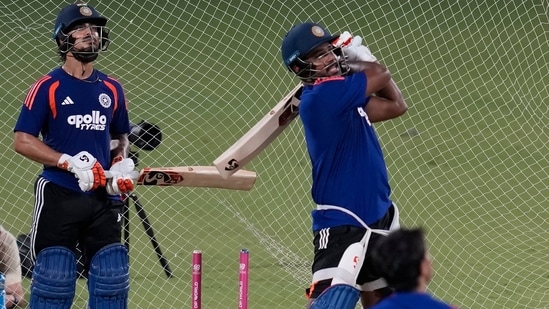
A complete overhaul of the combination, in the wake of the loss to South Africa that pushed India into unfamiliar territory with their T20 World Cup title defence on the line, won’t be the best idea at this stage of the tournament. But the management will be mulling a few tactical changes for the must-win Super 8 game against Zimbabwe on Thursday in Chennai.

India's Sanju Samson, centre, during a practice session ahead of the ICC Men's T20 World Cup 2026 cricket match between India and Zimbabwe (PTI )
India’s Sanju Samson, centre, during a practice session ahead of the ICC Men’s T20 World Cup 2026 cricket match between India and Zimbabwe (PTI )

India went through the group stage unscathed, but the underlying issues that were overlooked in those four matches were exposed by South Africa, who handed the defending champions a crushing defeat. The 76-run loss — India’s heaviest ever in a T20 World Cup — dented their semifinal hopes significantly, leaving the hosts needing to win both their remaining matches to qualify for the last four.

For a track that has traditionally suited spinners, Chepauk has been a batter’s paradise during this T20 World Cup. Fast bowlers, in particular, have struggled for both wickets and control. Hence, India might want to rethink their plans for the clash.

ALSO READ: Cornered India refuse to press panic button ahead of a series of must-win encounters

Samson in, Rinku out?

India are in need of a right-handed batter at the top of the order to address the off-spin threat that oppositions have been exploiting. There is little doubt that Sikandar Raza will take the new ball against the openers on Thursday evening. India could therefore send in Sanju Samson and hold Abhishek Sharma back to counter the quicker bowlers.

That move would push Ishan Kishan to No. 3 — a role he is comfortable in, having scored a century there against New Zealand at home last month and regularly batting in that position for Sunrisers Hyderabad in the IPL. Tilak Varma, who has struggled for form, may have to make way for that adjustment.

Axar Patel is likely to return to the XI, given Zimbabwe’s predominantly right-handed line-up. India could also opt for a second specialist spinner, depending on whether they prefer additional batting depth — which would mean retaining Washington Sundar — or an attacking option in Kuldeep Yadav. That balancing act could result in Rinku Singh, who briefly left camp due to a family emergency and was expected to rejoin on Wednesday evening, sitting out the Zimbabwe clash.

Predicted XI: Abhishek Sharma, Sanju Samson, Ishan Kishan (wk), Suryakumar Yadav (capt), Shivam Dube, Hardik Pandya, Axar Patel, Washington Sundar/Kuldeep Yadav, Arshdeep Singh, Varun Chakravarthy, Jasprit Bumrah.


Former US F-35 fighter pilot arrested for training Chinese air force | Military News

0
Former US F-35 fighter pilot arrested for training Chinese air force | Military News


US Justice Department accuses former Air Force officer Gerald Brown of training Chinese military pilots.

A former United States Air Force officer and “elite fighter pilot” has been arrested and accused of betraying his country for illegally providing training to Chinese military pilots.

The US Department of Justice said ex-Air Force Major Gerald Brown, once known by his pilot’s call sign “Runner”, was arrested on Wednesday in Indiana and charged with a criminal complaint for providing and conspiring to provide defence services to Chinese pilots without authorisation.

Recommended Stories

list of 4 itemsend of list

Brown, 65, a former F-35 Lightning II instructor pilot with decades of experience in the Air Force, “allegedly betrayed his country by training Chinese pilots to fight against those he swore to protect”, Roman Rozhavsky, assistant director at the FBI’s Counterintelligence and Espionage Division, said in a statement.

“The Chinese government continues to exploit the expertise of current and former members of the US armed forces to modernise China’s military capabilities. This arrest serves as a warning,” Rozhavsky said.

US Attorney Jeanine Ferris Pirro for the District of Columbia said Brown “and anyone conspiring against our Nation” will be held accountable for their actions.

According to the Justice Department, Brown served in the US Air Force for 24 years, had led combat missions and was responsible for commanding “sensitive units”, including those involved in nuclear weapons delivery systems.

After leaving the US military in 1996, Brown worked as a commercial cargo pilot before working as a defence contractor training US pilots to fly F-35 and A-10 warplanes.

Brown is alleged to have travelled to China in December 2023 to begin his work training Chinese pilots, and he remained in the country until returning to the US in early February 2026.

His contract to train Chinese pilots was negotiated by Stephen Su Bin, a Chinese national who in 2016 pleaded guilty and was sentenced to four years in prison for conspiring to hack a defence contractor in the US to steal military secrets for China, according to the Justice Department.

The department said Brown faces charges similar to those levelled against former US Marine Corps pilot Daniel Duggan, who was arrested in Australia in 2022 and is currently fighting his extradition back to the US, where he faces prosecution for violating the US Arms Export Control Act for providing pilot training to the Chinese armed forces.

Duggan appeared in an Australian court in October 2025 to appeal against his extradition, which was approved in December 2024 by Australia’s then Attorney General Mark Dreyfus.

Duggan, 57, a naturalised Australian citizen, was arrested by Australian police in 2022 shortly after returning from China, where he had lived since 2014.

According to the Reuters news agency. Duggan’s lawyer, Christopher Parkin, told the court that his client’s extradition to the US was “uncharted territory” for Australia.

He argued that his client’s conduct was not an offence in Australia at the time or when the US requested extradition, and so did not meet the requirement for dual criminality in Australia’s extradition treaty with the US.

The governments of Australia, Canada, New Zealand, the United Kingdom and the US published a notice in 2024 warning current and former members of their armed forces that China was seeking to recruit them and other NATO military personnel in order to harness Western military expertise and bolster its own capabilities.

“The insight the PLA [People’s Liberation Army] gains from Western military talent threatens the safety of the targeted recruits, their fellow service members, and US and allied security,” the notice stated.

“Those providing unauthorized training or expertise services to a foreign military can face civil and criminal penalties,” it added.


R Madhavan says Dubai fans are flying to India to watch Dhurandhar 2 due to ban in Gulf: ‘That’s power of good content’

0
R Madhavan says Dubai fans are flying to India to watch Dhurandhar 2 due to ban in Gulf: ‘That’s power of good content’


Filmmaker Aditya Dhar’s Dhurandhar created waves at the box office. Despite being banned in several Middle Eastern countries, the film went on to collect an impressive $32 million overseas, with a worldwide gross of ₹1,300 crore. Now, Dhurandhar 2 is all set to release in March. Amid the buzz surrounding the sequel, R. Madhavan spoke about how people in Dubai are planning business meetings in India to watch the film.

R Madhavan talks about Dubai fans' craze for Dhurandhar 2.
R Madhavan talks about Dubai fans’ craze for Dhurandhar 2.

R Madhavan says people in Dubai are planning to fly to Indian to watch Dhurandhar 2

In a podcast with Sonia Shenoy on her YouTube channel, Madhavan spoke about people flying down from Dubai to India to watch Dhurandhar. He added, “That’s the power of good content. Now they are planning their business meetings around March 19 so that they can attend the meeting and watch Dhurandhar 2 because it’s not releasing in Dubai. For them, it would be so easy to just watch it on IPTV, okay? And I’m sure they could. But they want to experience watching a film like Dhurandhar in a theatre full of people.”

He further spoke about how filmmakers have often centred action films around the India–Pakistan conflict or the country’s freedom struggle — themes that have long dominated the industry’s storytelling space. However, he believes the new generation is no longer interested in revisiting them. He said, “They’re like, samajh gaya main, kitni baar bologe? (I’ve understood it, how many times will you say it?) And I think after Dhurandhar, that whole India–Pakistan thing is going to go. That’s the full stop now.”

About Dhurandhar and Dhurandhar 2

Dhurandhar is a spy action thriller produced by Jyoti Deshpande, Aditya Dhar and Lokesh Dhar under Jio Studios and B62 Studios. The film features Ranveer Singh as Indian spy Hamza, who infiltrates Pakistan’s criminal syndicate on a mission to dismantle a terror network targeting India. The film also stars Akshaye Khanna, Arjun Rampal and Sanjay Dutt in pivotal roles. While the film received mixed to positive reviews from critics, it struck a chord with audiences and emerged as a box-office success through positive word of mouth.

Dhurandhar 2 will explore Hamza’s backstory and show how he completes his mission while navigating the power and political games in Pakistan. The sequel will see Madhavan, Ranveer, Arjun and Sanjay reprise their roles. It will also feature Sara Arjun and Rakesh Bedi in key roles. The film is scheduled to release in theatres on March 19 and will clash with Toxic: A Fairytale for Grown-Ups, starring Yash.


Pakistan semi-final scenario: What Sri Lanka exit means for their chances | Cricket News

0
Pakistan semi-final scenario: What Sri Lanka exit means for their chances | Cricket News


Pakistan semi-final scenario: What Sri Lanka exit means for their chances
Pakistan’s captain Salman Ali Agha, right, with teammate Saim Ayub during a practice session. (PTI Photo)

NEW DELHI: New Zealand knocked co-hosts Sri Lanka out of the T20 World Cup with a comprehensive 61-run win in Colombo on Wednesday, but the result has also kept Pakistan in contention for a dramatic semi-final qualification. With England already through, the race for the final spot from Super Eights Group 2 will now be decided over the last two matches.Go Beyond The Boundary with our YouTube channel. SUBSCRIBE NOW!Chasing 169, Sri Lanka needed a convincing victory to stay alive but faltered badly, crawling to 107/8 and exiting the tournament with one game still to play. The heavy defeat ended their campaign and confirmed a fifth straight failure to reach the semi-finals since their 2014 title triumph. The win also significantly boosted New Zealand, whose net run rate jumped to a healthy +3.050, putting them in pole position to qualify alongside England.

T20 World Cup: Shaheen Shah Afridi press conference after England vs Pakistan

However, Pakistan’s hopes hinge on the outcome of England versus New Zealand in Colombo on Friday. If New Zealand defeat England, they will finish on five points and qualify directly, rendering Pakistan’s final Super Eights clash against Sri Lanka irrelevant.Pakistan’s opportunity opens up only if England beat New Zealand. In that scenario, England will top the group with six points, leaving New Zealand on three and Pakistan with a chance to draw level if they beat Sri Lanka in their final match in Kandy.If Pakistan win and both teams finish on three points, qualification will be decided by net run rate. The current projections underline the scale of the task facing Pakistan.

T20 World Cup Super 8s Group 2 Points Table

P W L NR Points NRR
England (Q) 2 2 0 0 4 +1.491
New Zealand 2 1 0 1 3 +3.050
Pakistan 2 0 1 1 1 -0.461
Sri Lanka (E) 2 0 2 0 0 -2.800

For instance, if England beat New Zealand by 50 runs, Pakistan would need to defeat Sri Lanka by roughly 20 runs to edge ahead on net run rate, assuming a first-innings score of around 170.If Pakistan chase instead, the equation becomes tougher. They would need to complete the chase in approximately 17.5 overs to surpass New Zealand’s net run rate. Any slower victory could still leave them behind the Blackcaps.England’s dominance in the Super Eights has simplified the group standings, but Sri Lanka’s exit has ensured the final semi-finalist will be decided in a tense finish. Pakistan must now deliver not just a win, but a big one — and hope England do them a favour — to keep their World Cup dream alive.


Kerala veers from impressive social gains to mounting fiscal strain

0
Kerala veers from impressive social gains to mounting fiscal strain


Writing about the food habits of Malayalees in the 19th century in Pathonpathaam Noottandile Keralam (Kerala in the 19th Century) — a 1,300-page tome that sparkles with insight and scholarly wit — P. Bhaskaranunni observes that two meals a day were invariably the norm for the general populace. “Rice was very rare. What was available was of low quality. They somehow subsisted on gruel or mash made from chama (little millet), thina (foxtail millet), mula nellu (bamboo rice), koovaraku (finger millet), muthira (horse gram) and payar (beans).”

Elsewhere, he writes about the massive crop damage caused by the torrential rains in 1852 and again in 1853. “Even money could not buy a grain of rice. It was the year that Travancore imported rice for the first time. The imports were from Bengal.” These two images from the past illustrate how Kerala has changed, and yet not changed. To the Gen-Z of 21st-century Kerala, for whom Mexican tacos or Italian pizzas are only a few keypad taps away, the frugal food habits of their 19th-century ancestors would appear incomprehensible or utterly primitive. Yet one cannot discount the fact that 21st-century Kerala remains pitiably dependent on sister States for its staple diet — rice. Domestic rice production continues to fall prey, year after year, to the whims of the monsoon rains.

Presenting modern Kerala’s first budget in 1957, C. Achutha Menon, the Finance Minister in the first Communist government led by the inimitable E.M.S. Namboodiripad, observed that the greatest concern, both for the people and the government, was the “food problem.” But as he noted elsewhere in the same June 7, 1957 speech — and what now sounds eerily prophetic — it was not young Kerala’s only problem: “Density of population, scarcity of arable land and dearth of industries have contributed to unemployment, the most acute problem of Kerala.” It should be remembered that Achutha Menon — a gentle soul who would later become Chief Minister under a Communist Party of India (CPI)-Congress alliance and come to be regarded as the best Kerala has had — was speaking at a time when the population of the fledgling State was a mere 1.50 crore. What may seem astonishing is that if one were to transpose his words into the latest budget of Kerala — a Kerala of 3.4 crore people and a diaspora spread across the planet — they would not be out of place.

The problems he outlined persist, notwithstanding the firm belief held by K.N. Balagopal, Finance Minister in Kerala’s current Communist Party of India (Marxist)-led Left Democratic Front government, that the State’s budget size will soon touch ₹2 trillion. Since those distant points in time — the vicissitudes and romance of the 19th century and the politically turbulent years of the mid-20th century — Kerala’s economy and the living standards of its people have undeniably transformed beyond recognition. The State’s enviable literacy rate, low infant mortality, and high life expectancy, comparable to those of the developed West, gave rise to what has come to be hailed as the Kerala Model. This human-development paradigm evolved over decades, its contours shaped by Kerala’s distinctive political and socio-economic milieu, perceptive government policies such as land reforms and decentralised local governance, and constructive public action. Even so, despite strong social indicators in health, education, and social welfare, Kerala continues to grapple — albeit in broader and more complex dimensions — with many of the same problems that Achutha Menon identified in his first budget more than six decades ago. The review that follows examines the multiple pathways of Kerala’s economic evolution, its current status, the challenges it faces, and the recommendations of the 16th Finance Commission on the sharing of resources between the Centre and the States.

In the Economic Review 2024, the State Planning Board observed that Kerala ranks among the top 10 Indian States in terms of per capita income and Gross State Domestic Product (GSDP). According to the document, the Kerala economy recorded “robust” growth in 2023-24. The real GSDP stood at ₹6,35,13,653 lakh (Quick Estimates), registering a growth of 6.5%, compared to 4.2% in 2022-23. “The real Gross State Value Added (at 2011-12 prices) increased to 7.2% in 2023-24 from 5.3% in 2022-23. GSDP at current prices is ₹11,46,10,867 lakh in 2023-24, reflecting a growth of 11.9%, compared to 10.7% in 2022-23. The per capita GSDP of Kerala increased by 5.5% to ₹1,76,072 in 2023-24, against the national average of ₹1,24,600,” it noted, adding that the average income per person in Kerala is higher than the national average.

Kerala’s identity as a consumer State remains intact. The photo shows children shopping for classroom essentials at a store in Palakkad.
| Photo Credit:
K. K. Mustafah

Growth in agriculture and production has remained sluggish at best, leaving Kerala with the now-familiar “consumer State” tag. A narrow geographical region squeezed between the Western Ghats and the Arabian Sea, 21st-century Kerala faces stiff challenges arising from rapid urbanisation and its associated problems. In 1901, the combined population of Travancore, Cochin, and Malabar stood at 0.64 crore, of which 92.9% lived in rural areas. The 2011 Census showed that 47.7% of the people lived in urban areas — nearly half the total population. That said, Kerala’s journey to its present stage — shaped by global, national, and local dynamics — has been remarkable.

In the latter decades of the 20th century, Kerala’s extraordinary achievements in basic human development indicators despite its low per capita income drew social scientists and development economists to the small State. The legacies of successive Congress and Left-led governments, and the achievements in literacy, education, public health, and infant mortality, have been nothing short of impressive. It has been argued that the initial conditions were ideal for the evolution of what has since come to be hailed as the Kerala Model of Development. These conditions were shaped by Kerala’s unique history of social reform in the late 19th and early 20th centuries, which placed great emphasis on universal education, women’s empowerment, and social action, the national fervour of the Freedom Struggle, and the subsequent emergence of a strong Left and a participatory people’s planning process.

Noted development economist K.P. Kannan, in Kerala ‘Model’ of Development Revisited: A Sixty-Year Assessment of Successes and Failures, observed that during the first phase of this model — from 1960-61 to 1986-87 — growth was unimpressive not only in comparison to the national average, but also “bordered on stagnation” when viewed in per capita terms. “However, growth started picking up a few years after the acceleration in growth in the national economy. This was largely contributed by the increasing flow of remittances to the Kerala economy made possible by large-scale migration of its working-age population, mostly men, to work in countries in West Asia called the Gulf countries,” notes the paper published by the Centre for Development Studies (CDS), the institution established by the eminent economist K.N. Raj in 1971.

Foreign remittances have driven Kerala’s economic growth. The photo shows money exchange houses line the Changanassery-Alappuzha road at Perunna, home to a large expatriate population.
| Photo Credit:
K.K. Mustafah

One cannot overstate the role of foreign remittances in Kerala’s economic growth story. This phenomenon was driven by international demand for labour, especially in the oil-producing Gulf nations of West Asia. Estimates of average remittances indicate an increase from around ₹530 crore during the 1980-85 period to over ₹10,800 crore during 1995-2005. According to the Kerala Migration Survey 2023 (KMS 2023), remittance inflows rose from ₹85,092 crore in 2018 to ₹1,44,640 crore in 2021-2022 and ₹1,90,734 crore in 2022-2023. KMS 2023 pegged remittances in 2023 at ₹2,16,893 crore. The survey was conducted by the Gulati Institute of Finance and Taxation (GIFT), with technical support from the International Institute of Migration and Development (IIMAD), at the behest of the Kerala government’s Department of Non-Resident Keralites Affairs (NORKA). “While the rise in remittance inflows in 2018-2019 could be attributed to the 2018 Kerala floods that led emigrants to send more money than usual to support relief and reconstruction, the spike in 2022-2023 could be attributed to post-pandemic recovery and a general rise in migration numbers,” the survey notes. The number of Keralites living abroad rose from 1.4 million in 1998 to 2.4 million in 2013, it adds.

In the 1980s, the State government’s Economics and Statistics Department conducted a survey on how Gulf remittances were utilised in Kerala. Submitted in 1988, the report observed a “considerable increase” in the assets of households receiving inward remittances from abroad, compared to other households under study. Yet even then, this slim document — prepared on the recommendation of a Subject Committee on Economic Affairs of the Kerala Legislative Assembly — had forewarned of a problem that Kerala grapples with today, in the aftermath of the COVID-19 pandemic and the global lockdown that spurred a “return migration”: “About 70% of the Gulf-returned persons are below the age of 40 and hence their rehabilitation would be a very important problem for Kerala,” the report warned.

Kerala faces high unemployment at 7.2%, especially among educated youth, more than double India’s 3.2% rate. The photo shows youth at a job fair organised by the Union Ministry of Labour and Employment, in Thiruvananthapuram.
| Photo Credit:
S. Mahinsha

It has often been stated that one of the major tasks confronting 21st-century Kerala will be finding suitable employment for its youth. The State has faced the issue of unemployment — especially that of the educated unemployed — for quite some time now. According to the Periodic Labour Force Survey (Annual Report 2023-24) published by the Ministry of Statistics and Programme Implementation, Kerala has an unemployment rate of 7.2% for persons aged 15 years and above, compared to the all-India level of 3.2%. “In fact, high rates of unemployment, and unemployment among the educated, have been identified as the visible face of a mismatch between economic growth and human development in the State. With economic growth picking up in the nineties along with structural change, the problem of unemployment has acquired a new dimension of mismatch between demand and supply of skills, both in terms of quality and quantity,” the State Planning Board observed in a working-group paper on labour and labour welfare for the 13th Five-Year Plan period (2017–2022). Traditionally, Kerala’s strong trade-unionist legacy has been blamed for the perceived lack of industrial growth. The CPI(M)-led Left Democratic Front (LDF) government, which has been in power for two terms since 2016, has sought to change the deeply entrenched perception that Kerala is scarcely an ideal destination for industrial investment. Presenting the State Budget for 2025-26 in February 2025, Finance Minister K.N. Balagopal noted that Kerala topped the Ease of Doing Business index published by the Union government. “From the 15th position in 2021, we now stand first,” Balagopal said. In the 14th Five-Year Plan document, the State government, with its emphasis on building a knowledge economy, observed that Kerala has high rates of youth unemployment, and that the creation of “modern employment” for the youth will be a priority.

Government data indicated robust growth across sectors in 2023-24. While the primary sector grew at 4.7%, secondary sector growth stood at 4.1%. The tertiary sector, meanwhile, posted “strong growth” of 8.9% in that fiscal year. Although tourism and Information Technology have emerged as major revenue generators and job providers for Kerala in recent decades, its agriculture and production sectors continue to lag. Low productivity levels compared to other States, small and fragmented production and supply chains, underdeveloped post-harvest facilities, labour shortages, and weak research extension have been identified among the “critical gaps” plaguing the farm sector. Citing land-use data for 2023-24, the Economic Review noted that out of the total geographical area of 38.86 lakh hectares, the total cultivated area and net area sown were 25.36 lakh hectares (65.3%) and 19.7 lakh hectares (50.8%), respectively. In the case of rice — Kerala’s staple food — the area under wetland paddy declined from 7.79 lakh hectares in 1960-61 to 1.79 lakh hectares in 2023-24, according to government data. “Moreover, the productivity of the crop is very low in the State (2,790 kg/hectare), though it is higher than the national average (2,424 kg/hectare). There has only been a marginal increase in the productivity of rice in the past four decades,” the State Planning Board noted.

Fisheries is key to Kerala’s economy, ranking third in seafood exports by volume and second by value, producing 5.81 lakh MT marine fish. The photo shows fishermen with fresh sardine catch at Shangumugham beach.
| Photo Credit:
Nirmal Harindran

With its 590-km coastline, it is unsurprising that fisheries have long been central to Kerala’s economy. The State is currently the third-largest seafood exporter in the country by volume and the second-largest by value. In 2023-24, Kerala’s marine fish production reached 5.81 lakh metric tonnes (MT), while inland fish production stood at 2.51 lakh MT. During the same period, the State exported 1.97 lakh MT of seafood, amounting to ₹7,231.84 crore. However, the past few decades have been difficult for Kerala’s coastal communities. Severe coastal erosion, the effects of climate change, and declining fish stocks have placed them under immense strain. Most recently, Kerala’s seafood exports were among the first to be hit by revised U.S. tariff policies.

A broader view of Kerala’s exports shows that the total value of goods shipped abroad increased from ₹25,441 crore in 2014-15 to ₹71,865 crore in 2019-20, before falling to ₹40,388 crore in 2024-25.

But when one gets down to brass tacks, it is, as the title of Colin Vearncombe’s (Black) song goes: All We Need Is The Money. Managing State finances has never been an easy task, but in recent years it has become particularly complex, according to States such as Kerala, which accuse the Union government of attempting to centralise powers. The overhaul of the tax regime and the States’ complaints about the skewed sharing of financial resources between the Centre and the States have sparked heated debates over the future of cooperative and fiscal federalism. In Kerala’s case, the State’s traditional emphasis on social welfare and its development plans are facing mounting pressure from a shrinking fiscal space. Furthermore, its share of the divisible pool fell from 3.88% under the 10th Finance Commission to 1.92% under the 15th Commission. The Left government has consistently blamed the Bharatiya Janata Party (BJP)-led Union government’s fiscal policies for the prolonged financial squeeze Kerala has been experiencing. Policies that drew the State’s ire include the decision to trim its borrowing space by treating the “off-budget borrowings” of the Kerala Infrastructure Investment Fund Board (KIIFB) and the Kerala Social Security Pension Ltd. (KSSPL) as direct State debt, and the discontinuation of the GST compensation after the five-year period.

The biggest challenge faced by successive State governments in Kerala has been keeping expenditure down without undermining its pro-social sector fiscal policies. Salaries and pensions take away a huge chunk of the State’s revenues. Take, for instance, social security and welfare fund board pensions: close to 60 lakh people benefit from a monthly pension of ₹1,600. In June 2025, Finance Minister Balagopal stated that the LDF government — both the current administration and the previous one led by Pinarayi Vijayan — has spent ₹73,654 crore on these pensions. The present LDF government has spent ₹38,500 crore in its first four years. In his 2025–26 Budget, Balagopal noted that the government spends more than ₹11,000 crore a year on social security and welfare fund board pensions alone. Nearly two decades ago, the second Kerala Public Expenditure Review Committee, in its first report (2007–08), observed that Kerala’s salary and pension expenditure together constituted, on average, roughly 50% of total revenue expenditure. As salary expenditure accounted for more than one-third of the State’s revenue expenditure, it was advisable to contain their aggregate growth so that more resources could be channelled towards public services, the Committee had noted. This committed expenditure continues to make a significant claim on the State’s income. Salaries and pensions, as a percentage of total revenue expenditure, stood at 45% in 2022-23 and 2023-24.

Without doubt, a singular event that has had a deep impact on State finances and Kerala’s overall economy in recent years has been the introduction of the GST regime in 2017. In the 14th Five-Year Plan for the State (2022–2027), the Kerala State Planning Board observed that mobilising resources for the plan period would prove a “challenging task.” Under the new tax regime, Indian States ceded taxation rights on as much as 52% of their own tax revenues to the GST Council. “A comparison of the average annual growth rate of taxes subsumed by GST over the pre-GST years 2014-15 to 2016-17 with the growth of SGST and IGST settlement revenues during 2017-18 to 2019-20 reveals that the rates for Kerala fell significantly from 8.67% to 3.47%,” it noted. The Planning Board further observed that the attrition in Kerala’s own tax and non-tax revenues would make access to enhanced Central transfers to fund budgetary expenditure all the more important. This observation carries significant political and financial implications for the State. Although Kerala, along with other States, battled hard for an extension of GST compensation, citing the economic impacts of the COVID-19 pandemic, the Centre has not relented. On the other hand, the revamp of the State GST Department and tighter tax collection has yielded results for Kerala. The State’s Own Tax Revenues (SOTR) steadily improved from ₹47,661 crore in 2020-21 to ₹76,656 crore in 2024-25. Non-tax revenues grew from ₹7,327 crore to ₹16,568 crore during the same period.

The restructuring of Kerala’s GST Department and improved tax collection have paid dividends. The photo captures Chief Minister Pinarayi Vijayan launching the revamped GST system in Thiruvananthapuram in January 2023.
| Photo Credit:
S. Mahinsha

The ‘KIIFB story’ has an important place in the recent development and financial landscape of the State. In June 2016, after the LDF government led by Pinarayi Vijayan was sworn in, the then Finance Minister T.M. Thomas Isaac, an economist of note, presented a white paper on the state of State finances in the Legislative Assembly. Dr. Isaac’s White Paper roundly blamed the previous Congress-led United Democratic Front (UDF) government for grave financial mismanagement. Dr. Isaac had pointed to a negative cash balance in the treasury, neglect of deficit targets, and immediate liabilities amounting to ₹10,000 crore. The UDF government, the paper said, neither trimmed the rising expenditures nor increased revenues. In his white paper — which predictably caused a furore in the Opposition benches — Dr. Isaac posed three questions: How can Kerala increase its tax revenue by 20% to 25%? How can it slash revenue expenditure without such an action compromising the government’s spending on welfare and capital projects? Since it would take some years to bring the revenue deficit under check, how can the State accelerate capital expenditure without any delay? Dr. Isaac’s reply to the largely rhetorical third question was KIIFB, a financial entity that was originally established in 1999. What the LDF government under Dr. Isaac’s guidance did was to comprehensively amend the KIIFB Act, 1999, and incorporate provisions in the legal framework to equip KIIFB “to utilise innovative methods of raising finance authorised by the Securities and Exchange Board of India (SEBI) and the Reserve Bank of India (RBI)” for funding infrastructure development. Going by the latest available data, KIIFB has so far approved 1,180 projects worth ₹89,941 crore. This includes 1,173 infrastructure projects totalling ₹69,941 crore and seven projects totalling ₹20,000 crore in the land acquisition pool. As of July 31, 2025, KIIFB has disbursed ₹36,160 crore to various projects.

KIIFB, established in 1999, has significantly shaped the Kerala’s financial landscape. The photo shows Chief Minister Pinarayi Vijayan arriving for KIIFB’s 25th anniversary in Thiruvananthapuram, on November 4, 2025.
| Photo Credit:
Nirmal Harindran

In September 2025, Finance Minister Balagopal flew to New Delhi to hand over a Supplementary Memorandum to the 16th Finance Commission. Kerala had presented its initial memorandum to the Commission headed by Arvind Panagariya when the panel visited Thiruvananthapuram in December 2024. Two developments in 2025 that threatened significant setbacks for its economy, however, had prompted Kerala to draft the supplementary memorandum; the first was the combined reciprocal and penal tariffs of 50% imposed by the United States’ Donald Trump administration on Indian goods. The second, a decision by the Goods and Services Tax (GST) Council to revamp the tax structure into a two-tier one of 5% and 18%. To absorb the economic shock of the two developments, Kerala sought supplementary grants and eligibility for a “temporary extra borrowing limit” of 0.5% of the Gross State Domestic Product (GSDP). The GST rate rejig, Kerala feared, would sharply drop its annual revenues by ₹8,000 crore to ₹10,000 crore. On another front, Trump’s “tariff war” and the uncertainties that it entailed meant big trouble for Kerala whose export sector does big business with the U.S. in marine products, spices, textiles, coir and cashew. Such has been the concern over Trump’s tariffs that the Kerala State Planning Board and the Gulati Institute of Finance and Taxation (GIFT), an autonomous institute under the State Finance Department, even organised a round table in August 2025 to discuss how the State should move forward. Balagopal wanted the Finance Commission to consider these developments and their impacts on the Kerala economy when drafting its recommendations.

In its initial memorandum to the Commission, Kerala had already urged the panel to raise the share of States in the divisible tax pool from the present 41% to 50% and rework the formula used for resource sharing among States. Kerala had also requested the Commission to frame recommendations for reducing the imbalances in resource sharing, noting that it faced a drastic cut in share from 3.88% under the 10th Finance Commission to 1.92% under the 15th Commission. These interactions with the Finance Commission are part of a larger, protracted struggle Kerala’s Left government, which is in its second successive term under Pinarayi Vijayan, has pursued in recent years. Two back-to-back flood disasters in 2018 and 2019 and the COVID-19 pandemic have placed State finances under immense strain. Kerala has repeatedly accused the BJP-led Central government of fiscal bias and deliberate, politically motivated attempts to choke it financially.

A view of the Vizhinjam International Sea Port in Thiruvananthapuram, a facility that offers much hope for Kerala on the development front.
| Photo Credit:
Nirmal Harindran

At the threshold of the second quarter of the 21st century, the Kerala economy faces a mix of unique challenges and promising opportunities. On the development front, the Vizhinjam International Seaport Ltd. in coastal Thiruvananthapuram — formally inaugurated by Prime Minister Narendra Modi in May 2025 — offers much hope. As Chief Minister Pinarayi Vijayan said at a recent Kerala-European Union conclave on the Blue Economy, Kerala “is striving to build a climate-resilient economy where green jobs and sustainable livelihoods emerge as the foundation of the State’s future.” The State has set ambitious goals: achieving 100% renewable-energy use by 2040 and becoming net carbon-neutral by 2050. Yet the hurdles are significant. A rapidly urbanising State with high population density, Kerala also confronts an ageing population and a declining fertility rate. These, the Economic Review 2024 notes, are reflected in environmental degradation, pressure on resources, rising unemployment, outmigration and demographic imbalances. At the same time, nationalisation drives in many countries — especially in the Gulf — and the rise of technologies such as artificial intelligence have reshaped the global labour market, triggering a wave of reverse migration. In September, Law and Industries Minister P. Rajeeve told the State Assembly, citing a LinkedIn report, that 40,000 Keralite professionals had returned home. While he framed this as an opportunity to tap their skills, critics argue that it also signals uncertainty for foreign remittances — a long-standing pillar of Kerala’s economy.

As this piece is being written, a heated political debate is under way over Kerala’s persistently high retail inflation. The State’s year-on-year inflation rate for August 2025 stood at 9.04%, the highest among major States, against the all-India rate of 2.07%, according to the Consumer Price Index data released by the Ministry of Statistics and Programme Implementation. Meanwhile, building climate resilience has become impossible to postpone. The back-to-back floods of 2018 and 2019, followed by a series of natural disasters — including the Wayanad landslides of July 30, 2024 — have claimed hundreds of lives. Recurring health emergencies, such as Nipah virus outbreaks and other zoonotic diseases, add to the strain. How Kerala navigates these challenges, while shaping new development models for progressive societies and for India as a whole, will be watched closely in the days to come.

This article is part of The Hindu e-book. Kerala: a model State’s paradox