Actor Christina Applegate has addressed recent reports of her hospitalisation amid her ongoing battle with multiple sclerosis, reassuring fans that she is on the road to recovery and “getting stronger and better every day.”
FILE – Christina Applegate at the Annual Backstage at the Geffen Gala in Los Angeles on March 22, 2010. (AP Photo/Matt Sayles, File) (AP)
Christina Applegate addresses health concerns
On Monday, Christina took to Instagram to reassure her fans after reports of her hospitalisation amid an ongoing battle with multiple sclerosis. On April 16, it was reported that the actor had been hospitalised in Los Angeles.
She shared the health update with a picture of a coffee mug and the words ‘Kissy Kissy’ written on it, placed on top of her new memoir You With the Sad Eyes, which was published last month.
“Thank you for the outpouring of love and well wishes. Health issues are a constant for me, but I’m a strong chick and I’m getting stronger and better every day. I’m taking a moment to focus on my health, but I’ll be back with more to say soon enough,” Christina wrote as a caption alongside the picture.
The update comes after TMZ reported on April 16 that the actor had been hospitalised since late March. The actor had not commented on the report and her only Instagram post in April was an update on her memoir becoming a New York Times audio bestseller.
After the report got picked up widely, Christina’s representative issued a statement declining comment on whether or not “she is in the hospital or what her medical treatments are.”
The rep shared, “She’s had a long history of complicated medical conditions that she has been refreshingly open about, as evidenced in her memoir and on her podcast.”
Christina’s battle with multiple sclerosis
Back in 2021, Christina publicly announced that she had been diagnosed with multiple sclerosis. She has been open about her health struggles in the years since, especially through her memoir You with the Sad Eyes, which was released in 2026, and the podcast she cohosts with Jamie-Lynn Sigler, who also has multiple sclerosis.
She has been hospitalised “upwards of 30 times” since her MS diagnosis, she revealed in a 2025 podcast episode. She also shared that the symptoms, which can include mobility and balance issues, numbness, and vision impairment, have made it difficult for her to be out in public.
Christina has retired from acting while dealing with her MS. The comedic thriller series Dead to Me was her final role; Season 3 began filming just before she received her diagnosis and was released in 2022.
Some professional relationships are less about business, more about bonds. Like the one between producer Sajid Nadiadwala and actor Ahan Shetty, whom he launched in Bollywood with Tadap (2021). The actor, who is set to kick off his next with director Tinu Desai, was keen that his film be named Sanki. There was only one hurdle — the title was owned by Nadiadwala. mid-day has learnt that as soon as Shetty reached out to Nadiadwala and expressed his wish, the producer readily parted with the name.
In 2024, Nadiadwala had announced Sanki as an action romance drama with Shetty and Pooja Hegde. Unfortunately, the film was put on the backburner. A source revealed, “Ahan’s film with Tinu Desai was being developed under a different working title, but he had his heart set on Sanki. Knowing that Sajid held the title, Ahan reached out to him. The producer had no hesitation in letting go — no negotiations, he simply gifted the title to him. The Nadiadwalas and Shettys have been close for decades, with Sajid having worked with Suniel Shetty. The producer is also fond of Ahan, who, in turn, holds immense gratitude and respect for the man who launched him.”
China’s increased purchases of ethane also come ahead of a planned mid-May visit by Donald Trump to Beijing. (AI image)
China, the world’s second largest economy, is facing supply disruptions due to the ongoing Middle East conflict. China is on track to bring in an unprecedented volume of US ethane this month, as petrochemical firms turn to alternative feedstocks after disruptions linked to the Middle East conflict curtailed key supplies.Imports of US ethane are projected to reach a record 800,000 tonnes in April, according to Chinese consultancy JLC—roughly 60% above the usual monthly average. Some manufacturers have the flexibility to switch to ethane, allowing them to cushion the impact of reduced availability of naphtha and liquefied petroleum gas following the effective shutdown of the Strait of Hormuz, according to a Bloomberg report.
Watch
US Warns Chinese Banks Of Sanctions If Iranian Funds Are Found Flowing Through Their Accounts
Ethane, a natural gas liquid, is mainly used to produce ethylene, a core input for plastics. China relies almost entirely on the United States for these supplies. The commodity also became a point of contention between Beijing and Washington last year, after the US imposed tighter export controls during an intense trade dispute.According to JLC analyst Shi Linlin, US ethane has emerged as the preferred substitute for Chinese ethylene producers, given its steady availability and cost advantage. As of April 15, margins from producing ethylene using ethane were about ten times higher than those from naphtha, whose pricing has been driven up due to its linkage with crude oil, the consultancy noted.An expansion in downstream processing capacity has further boosted demand for the fuel. New facilities – including an ethane-based unit set up by Wanhua Chemical Group and a flexible-feed cracker operated by Sinopec Ineos (Tianjin) Petrochemical Co. – have contributed to the rise in imports this year, according to Shi Linlin.Official Chinese data show that in February, more than half of the country’s naphtha imports and over 40% of its LPG supplies came from Persian Gulf producers. The conflict began toward the end of that month.The International Energy Agency noted last week that petrochemical feedstocks have been among the most immediately affected by the conflict, with supply routes to Asia falling into significant disruption. Japan, for instance, has had to secure naphtha from a wider pool of sources, including the US and Africa.China’s increased purchases of ethane also come ahead of a planned mid-May visit by Donald Trump to Beijing, where energy trade is expected to feature in discussions. The issue could gain further prominence if the conflict involving Iran continues.
After enjoying a long reign at the box office, 2026’s Bollywood blockbuster ‘Dhuranhar 2’ is now leaving the throne. The film starring Ranveer Singh in the lead has been running for over a month at the box office, and during its course, it both made and broke records. However, now with the release of Akshay Kumar’s ‘Bhooth Bangla’, it appears that the end of ‘Dhurandhar 2’s dominance has reached. According to the latest trade reports, after the monumental record of crossing the Rs 1100 crore mark, the movie is losing its grip. On its fifth Monday, day 33, the movie failed to make even Rs 2 crore at the ticket counter.‘Dhurandhar: The Revenge’ Review
‘Dhurandhar 2’ box office collection day 33 update
According to Sacnilk, on day 33, Aditya Dhar’s spy thriller minted Rs 1.62 crore net across 3,672 shows in India. Compared to the Sunday collection of Rs 5.20 crore, the film has recorded a drop of 68.8%. This pushes the tally to Rs 1,117.29 crore in the domestic market.Overseas, the film made Rs 0.40 Cr on its fifth Monday, taking its total overseas gross earnings to Rs 421.50 Cr so far. The overseas earnings, along with the Indian gross business of Rs 1,337.46 crore, the worldwide collection of ‘Dhurandhar 2’ stands at Rs 1,758.96 Cr.
‘Dhurandhar 2’ weekly box office performance
Week 1: Rs 674.17 croreWeek 2: Rs 263.65 croreWeek 3: Rs 110.60 croreWeek 4: Rs 54.70 croreAs the fifth week approached, it was a slow start on Friday for ‘Dhurandhar 2’, but the weekend brought in some good news. However, on Monday, the numbers dropped again drastically. Here are the figures:Day 30 (5th Friday): Rs 2.70 croreDay 31 (5th Saturday): Rs 4.65 croreDay 32 (5th Sunday): Rs 5.20 croreDay 33 (5th Monday): Rs. 1.62Cr
‘Dhurandhar 2’ vs ‘Bhooth Bangla’
Ranveer Singh and Rakesh Bedi starrer ‘Dhurandhar 2’ earned an estimated Rs 12 crore in its fifth weekend. Meanwhile, Akshay Kumar and Wamiqa Gabbi’s horror-comedy, ‘Bhooth Bangla’ saw an impressive Rs 58 crore on its opening weekend. On Monday, while the former made below Rs 2 crore, Priyadharshan’s directorial earned over Rs 6 crore.DISCLAIMER: The box office numbers and data in this article are compiled from diverse public and industry sources. All figures are approximate unless explicitly mentioned, offering a fair representation of the movie’s box office performance. These totals may change as official studio data is updated or as additional international market reports are finalized. This data is provided for informational and entertainment purposes only.
Beloved Bollywood couple Deepika Padukone and Ranveer Singh are all set to embrace parenthood for the second time. On Sunday, Deepika made her pregnancy announcement with an adorable social media post. Amid this, it should be noted that the actress has two big films—Raaka and King—in her kitty. As per industry sources, she will continue shooting during her pregnancy.
According to a report in Hindustan Times, Deepika has already begun shooting for Raaka, Atlee’s upcoming pan-India action spectacle headlined by Allu Arjun. “During her pregnancy, Deepika Padukone is shooting intense action sequences for Raaka.” Needless to say, Deepika and the makers have taken all precautions while filming. Given that both King and Raaka have announced release dates and are on tight schedules, Deepika wants to stick to them. “She will continue to shoot for the film throughout her pregnancy,” the source adds.
First all-women cohort of winners hails from Colombia, Nigeria, Papua New Guinea, South Korea, the UK and the US.
This year’s prestigious Goldman Environmental Prize has been awarded to six grassroots environmental activists from around the world for their efforts to fight climate change and save biodiversity.
For the first time since the prize was created in 1989 by philanthropists Richard and Rhoda Goldman, all recipients of the award are women: Iroro Tanshi, from Nigeria; Borim Kim, from South Korea; Sarah Finch, from the United Kingdom; Theonila Roka Matbob, from Papua New Guinea; Alannah Acaq Hurley, from the United States; and Yuvelis Morales Blanco, from Colombia.
Recommended Stories
list of 4 itemsend of list
Sometimes described as the “Green Nobel”, the Goldman Prize recipients are chosen from each of the world’s six primary regions. They each receive $200,000 in prize money.
“While we continue to fight uphill to protect the environment and implement lifesaving climate policies – in the US and globally – it is clear that true leaders can be found all around us,” said John Goldman, vice president of the Goldman Environmental Foundation.
“The 2026 Prize winners are proof positive that courage, hard work, and hope go a long way toward creating meaningful progress.”
Yuvelis Morales Blanco, winner of the 2026 Goldman Environmental Prize, shows a fish caught on a tour with fishermen along the Magdalena River in Colombia [Handout: Christian EscobarMora/Goldman Environmental Prize]
Morales Blanco, the winner for the region of South and Central America, fought some of the world’s biggest oil companies to successfully stop the introduction of commercial fracking into Colombia.
The 24-year-old grew up in a family of fishermen along the banks of the Magdalena River in the Afro-Colombian community of Puerto Wilches. “We had nothing but the river – she was like a mother who took care of me,” she said.
She began organising protests after a major oil spill in 2018, which forced the relocation of dozens of local families and killed thousands of animals. Her activism, which made her a target for intimidation and forced her to temporarily relocate, helped halt projects and elevate fracking as an issue in Colombia’s 2022 election.
Two of the other five recipients of this year’s prize have also focused their efforts on fighting fossil fuels, which are causing both global climate change and more localised pollution around the world.
Borim, the winner for Asia who started the Youth 4 Climate Action organisation, won a ruling from South Korea’s Constitutional Court that the government’s climate policy violated the constitutional rights of future generations, the first successful youth-led climate litigation in the continent.
Finch, Europe’s winner, told The Times newspaper she will use her prize money to keep fighting fossil fuels.
Together with the Weald Action Group, she fought oil drilling in southeastern England for more than a decade, securing the “Finch ruling” from the Supreme Court in June 2024, stating that authorities must consider fossil fuels’ impacts on the global climate before granting permission to extract them.
Two other recipients have fought against the destructive environmental impact of mining projects.
Papua New Guinea’s Roka Matbob, winner for Islands and Island Nations, led a successful campaign that saw the world’s second-largest mining company, Rio Tinto, agree to address environmental and social devastation caused by its Panguna copper mine, 35 years after it was closed following an uprising.
And the award recipient for North America, Acaq Hurley, from the Yup’ik nation in the US, successfully fought alongside 15 tribal nations to stop a mega- copper and gold mining project that threatened ecosystems in Alaska’s Bristol Bay region, including the largest wild salmon runs in the world.
Meanwhile, Nigeria’s Tanshi, Africa’s winner, rediscovered the endangered short-tailed roundleaf bat and has been working to save its refuge, the Afi Mountain Wildlife Sanctuary, from human-induced wildfires.
As a child, Tularam watched his father come back home carrying the day in his bones – feet worn out from standing all day, workplace injuries hastily bandaged, and exhausted from his relentless 12-hour shift of working heavy machinery at a moulding factory in Noida. The wages were never enough for a family of four: ₹3,000 a month at the beginning, then, at the end of 17 years of work, sweat and pain, ₹13,000.
Thousands of workers employed at the hosiery complex in Noida Phase 2 staged a massive proteston April 10. (HT Photo/Sunil Ghosh)
In their cramped rented room, where summer felt like a furnace, winter like a slap of cold, and rains leaked through the walls, Tularam dreamt of a different life – a sit-down job in a cubicle with a computer. It was a simple dream of a boy growing up in a slum inside a city of glass towers, gated apartments with manicured lawns and dog parks, golf courses and malls.
Tularam’s father’s stint as a factory worker was cut short in 2019 when he lost his hand at work.
“The factory owner paid for his treatment, gave us ₹50,000 as compensation and then fired him. He’s been jobless since that day,” said the 23-year-old, who declined to reveal his surname.
His dream soon faded and Tularam found himself tracing the same path as his father, a job in a factory in Noida as an embroiderer, where he works over 12 hours a day, seven days a week for ₹12,000. “If I take a day off due to an emergency, my pay is cut. Sometimes I pull 16-hour shifts and by the end of it, I can’t feel my fingers but even then the overtime I am paid is so little. At a normal speed, I can make 20 collars an hour, but they demand 35, 40, 45. How can we live like this?” Tularam asked.
Last week, thousands of factory workers in Noida asked the same question.
There was no answer.
Days later, they poured onto the streets in anger and frustration, smashing windows of swanky houses, shouted slogans, burnt vehicles and asked again.
Why did their wages not match Delhi’s and Gurugram’s?
On April 9, Haryana revised its minimum wage, with the last revision having taken place in October 2015. The basic monthly minimum wage for unskilled workers was increased to ₹15,220.71, and the monthly wage for highly skilled workers to ₹19,425.85. Delhi has the highest minimum wage in the National Capital Region (NCR) with companies expected to pay monthly wages of ₹18,456 for unskilled, ₹20,371 for semi-skilled and ₹22,411 for skilled workers.
An HT analysis recently indicated the stark economic realities behind recent factory worker protests, particularly in Noida, using official labour data to show how poorly paid India’s manufacturing workforce is. It found that the average salaried factory worker earns significantly lower than the ₹22,699 average across all sectors—highlighting the relative disadvantage of manufacturing jobs. A monthly salary of ₹22,500 is enough to place a worker among the top 20% in the manufacturing sector, revealing how low wages are at the bottom. And only a small fraction of workers have formal contracts, and access to benefits like paid leave or social security remains limited. Most workers are either self-employed or hired through contractors, often earning even less and lacking even the semblance of a safety net.
Minimum wages in India are set by states for most workers in their jurisdictions, and revised at least every five years with interim adjustments through variable dearness allowance (VDA). In Uttar Pradesh, the basic minimum wage for an unskilled worker stayed at ₹5,750 from October 2016 to April 2026.
To be sure, including VDA, the minimum wage rose 52.76% from ₹7,214 in October 2016 to ₹11,021 in October 2025 — barely keeping pace with the 54% rise in Consumer Price Index for Industrial Workers (CPI-IW) between October 2016 and February 2026 in the country.
In the wake of protests turning violent in Noida, the Uttar Pradesh government on April 14 hiked minimum wages across worker categories, with revised rates coming into effect from April 1. In Gautam Budh Nagar and Ghaziabad, unskilled workers will now be paid ₹13,690 per month, up from ₹11,313, while semi-skilled workers will receive ₹15,059, and skilled workers ₹16,868. This announcement has been coupled with a crackdown on protesters and arrests.
Since the protests were called off, Tularam returned to work at the garment factory in Noida Industrial Area phase 2, only to find the gates locked. They finally opened only on Monday.
“I am not optimistic about being paid more after the government’s announcement. No one cares and no one will check if I get better wages next month.”
Along the Noida-Greater Noida Expressway, summer arrives with a blaze of yellow trumpet flowers; Gulmohar trees that neatly line the route past high rises. The roads, the high-rises, the greenery — all signal the promise of a booming urban frontier but merely a few kilometres later, just before Dadri, the sheen gives way to working class settlements like Pratap Vihar.
Here the workers who are the satellite-city’s economic lifeblood live amid overflowing sewage, broken roads and garbage-strewn lanes. It is here that 40-year-old Vijender has spent the past two decades having moved from Jawli village in Ghaziabad in 2004 chasing a construction boom. Today, as videos of striking workers circulate on WhatsApp and Facebook, that early promise feels distant – replaced by a deepening sense of betrayal among those who built the region’s prosperity.
Vijender, who also declined to reveal his surname, started out as a labourer tasked with washing bottles at an aerated drinks company in Noida in 2004 from 6 am to 6pm daily for ₹2,700 a month. He had rented a room for ₹1,000 a month, 10km away from work. “Even in 2004, how could I pay rent, the commute, and food, and save and send some money back home to my parents, buy food, and save money with my earnings?”
Over the last two decades, Vijender, like thousands of workers, has shuffled jobs – across multi-national companies, manufacturers of automobile-parts, and shipping container depots. From ₹2,700, his salary went to ₹7,000 in 2007 at a CD manufacturing unit to ₹12,000 at an auto parts factory in 2015. But that last job lasted all of six months; contract workers are regularly de-rostered.
In 2016, his wages again dipped to ₹7,000 when he took up a job at an inland container depot. Demonetisation roiled the local industry, and workers suffered. Another jolt came with the pandemic but since the container depot dealt with essentials like foodgrains and medicines, he continued to work. In 2020, his wages rose to ₹17,000 as he started working as a semi-skilled surveyor.
He earns that even today.
Time hasn’t been kind and 22 years later, with a wife and two school going children, Vijender finds it hard to make ends meet. A sudden health crisis at home sets him back. A measly hike in rent has him desperately asking for money from friends. Admitting his nine-year-old daughter and seven-year-old son to a private school meant a loan of ₹15,000 from a relative. The neighborhood lanes are dotted with advertisements for small private English-medium schools, offering a hope and break from the vicious cycle of poverty.
A bulk of his ₹17,000 income goes toward rent for a run down two-room rented accommodation ( ₹5,000), household expenses including food, water, electricity, repairs( ₹4,000- ₹5,000), and now an additional ₹2,600 for school fee. The spike in LPG prices only further worsened the situation. “Jo kamate hai, guzaare mein lagate hai (Whatever I earn, I spend on survival),” said Vijender.
In these two decades, he has never had the chance to save money, not one rupee.
As videos of the protests by factory workers in Noida Industrial Area – around 20 km away from where he works – started coming in on his phone, a faint sense of hope stirred inside him. “Mujhe laga ki agar udhar awaaz uthi hai toh shayad yaha tak bhi aa jaaye (I felt that if a voice had been raised there, it might come here too),” said Vijender.
Growing demand for uniform minimum wages
Dr Aparna (who uses only one name), head of the Indian Federation of Trade Unions (IFTU), said the organisation has long been demanding uniform minimum wages across Delhi-NCR, arguing that living costs across the region are largely comparable. “The unrest stems from stagnant wages that have failed to keep pace with inflation over the past two decades. People are barely able to survive as minimum wages are not being paid, and the cooking gas crisis has intensified the distress after years of neglect,” she said.
She identified three immediate triggers behind the current situation: Haryana’s recent wage hike, the spike in gas prices, and disparities in wages by subsidiaries of the same companies across NCR.
Rajesh Kumar, general secretary of IFTU Delhi, traced the roots of the problem to industries relocating from Delhi to neighbouring areas to cut labour costs. “By 2012, key manufacturing sectors – garments, footwear, and foundries – were already moving out following pollution-control measures. Around 2013, the Delhi government announced a ₹4,000 increase in minimum wages, from ₹12,000 to ₹16,000. Units challenged this in court, and the final hike settled at ₹13,350 – still much higher than the ₹9,000 paid in places like Manesar and Gurugram in Haryana and Noida and Greater Noida in Uttar Pradesh. Companies moved out of Delhi to save ₹4,000–5,000 per worker,” he said.
Kumar said companies that moved out of Delhi have subsidiaries in NCR towns where wages are paid at significantly lower levels. “Workers are very aware now. They know what their counterparts earn in Delhi or what the official wages there are. This disparity in incomes has further led to unrest among them,” he said.
Vipin Malhan, president of Noida Entrepreneurs Association agreed that some of the problems the workers highlighted are genuine and that industries have agreed to 21% hike in wages as a middle ground. However, he said this increase has strained units already reeling due to the impact of the West Asia war.
“Raw material supply has been disrupted and cost has gone up by 60%. We are mostly involved with component industries. From Trump’s tariffs to war, industries have been impacted. The factory operators had to start from scratch after the pandemic,” he said.
He added that the immediate trigger of the protests was a 35% hike in wages by Haryana.
Why factories left Delhi
In the last decade, textile industries shifted to Manesar and Dharuhera; plastic and PVC units to Bahadurgarh; and automobile parts manufacturing to Noida and Greater Noida. “The decline of Okhla’s industrial base fuelled growth in Noida. Delhi now has virtually no industries operating three shifts. Nearly 50-60% of units either relocated or opened subsidiaries elsewhere,” Kumar said.
The Covid-19 pandemic dealt a further blow, shutting down all but essential industries. Delhi’s workforce largely comes from Uttar Pradesh, Bihar, Madhya Pradesh, Rajasthan, and Jharkhand. While many landless workers traditionally return home during sowing and harvesting seasons, the 2020-2023 pandemic period caused prolonged stagnation, forcing many to rebuild livelihoods from scratch.
Kumar added that despite recent wage hikes in Uttar Pradesh and Haryana, disparities persist. “On paper, these wages are paid, but the system runs through contractors. The thekedar (contractor) often pays only ₹9,000-10,000. Workers are exploited through this contract system, and enforcement is even weaker in neighbouring states. The resentment is real.”
In Delhi too, a quiet, but growing resentment
The frustration over stagnant wages, widening disparities, and a deepening sense of being shortchanged is not limited to industrial hubs in the NCR. Each time, it travels to Delhi, where factory workers report similar distress.
Chanda Kumari, 28, a single mother, who supports her daughter and elderly parents by working in the packaging industry in west Delhi’s Mayapuri industrial area, earns ₹9,000 a month.
“We pack 2,000–3,000 sets of shoes, slippers, and similar items a day, for which I am paid ₹9,000 for an eight-hour shift. There’s a half-hour lunch break and a 10-minute tea break. If I fall ill and miss a day, my salary is cut. How can anyone sustain a family on so little?” she asked.
Chanda spends around ₹3,000 on rent a month, with a similar amount going towards household expenditure, medicines, school supplies. “I don’t want my daughter to grow up to be a factory worker. She studies in a private school and I pay ₹1,500 a month,” she said.
Lives of women factory workers are marred by several challenges – unequal pay, unsafe working spaces, lack of clean toilets, hostile streets. Women factory workers in Delhi’s industrial clusters often contend with conditions that go beyond low wages. Many report unsafe workplaces, including inadequate lighting, lack of security, and vulnerability during late shifts or commutes. Even basic facilities remain a persistent concern – access to clean and functional toilets is limited forcing women to delay use for long hours, which affects their health. In addition, they face gender-based discrimination, harassment, and little provision for maternity needs or childcare support, making sustained employment difficult.
All that it costs
As the factories in Noida return to their daily churn, Tularam has returned to work but wonders if the government’s promise will hold up, and in Dadri, Vijender hopes the announcement about a wage hike will improve his life. After all, it was only 10 days ago that Vijender’s wife finally moved to Pratap Vihar from their village 50km away – for the first time since they married 11 years ago. There was never enough money to rent a two-room house. “I would visit monthly, sometimes after two-three months. I was never earning enough to spend ₹5,000 on rent, so she stayed in the village with my parents and siblings. Now my children are growing up, they need better education so it’s important they study in the city. Who else am I earning for after all?” he said.
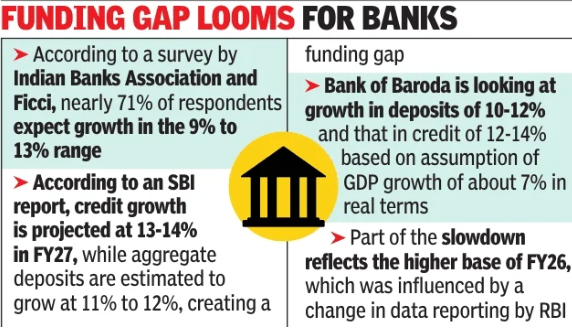
MUMBAI : Multiple reports show that bankers are bracing for slower credit offtake in FY27 after a high base in FY26, with deposit mobilisation emerging as a constraint on margins.According to a survey by the Indian Banks Association and Ficci, lenders have entered FY27 with a constructive but more calibrated outlook, with nearly 71% of respondents expecting growth in the 9% to 13% range.Credit demand is expected to be led by retail, services and SME segments, while industrial lending is seen recovering gradually alongside an infrastructure and capexled cycle.Bank deposits rose to Rs 262.3 lakh crore in FY26, up about Rs 31.2 lakh crore with growth accelerating to 13.5% from 10.1% a year ago.
–
Bank credit increased to Rs 213.6 lakh crore, rising by Rs 29.6 lakh crore with growth at 16.1% compared with 11% in FY25, pushing the credit-deposit ratio to 81.4% from 79.6%.According to an SBI report on the outlook for FY27, credit growth is projected at 13-14% in FY27, while aggregate deposits are estimated to grow at 11% to 12%, creating a funding gap. This gap is expected to be partly bridged by relaxed liquidity coverage ratio norms that could free up Rs 2.7-3 lakh crore of lendable resources. “Declining Current Account and Savings Account (CASA) ratios are a major concern for banks, as they signal a shift from low-cost, stable deposits to more expensive funding sources, compressing net interest margins (NIMs),” the SBI report said.“For FY27 we are looking at growth in deposits of 1012% and that in credit of 1214% based on assumption of GDP growth of 7% in real terms. The high base growth rate in FY26 will have bearing on that for FY27,” said Madan Sabnavis, chief economist, Bank of Baroda, in a report.Part of the slowdown reflects the higher base of FY26, which was influenced by a change in data reporting by Reserve Bank of India from the last Friday of the reporting fortnight to March 31.“There will be a reversal (in bank deposits) in the first fortnight of April just as was witnessed in Jan after there was a sharp increase of about Rs 7.3 lakh crore in deposits in the last fortnight of Dec. This was followed by a decline of Rs 3.6 lakh crore in the first fortnight of Jan,” Sabnavis added.
‘Love Insurance Kompany’ has picked up fresh momentum from international markets. The Pradeep Ranganathan-led sci-fi romantic comedy added notable earnings overseas on day 12.
Strong overseas performance for ‘LIK’
As reported by Sacnilk, the film has now collected Rs 11 crore in gross earnings from overseas territories. This contribution pushes the worldwide gross to Rs 55.04 crore.Back in India, the movie has gathered Rs 38.14 crore in net collections so far. Its India gross figure stands at Rs 44.04 crore.
Day-wise trends fpr Krithi Shetty starrer
On day 10, which marked the second Sunday, ‘Love Insurance Kompany’ earned Rs 1.70 crore from 1,455 shows at 25.0 percent occupancy. Day 11, the second Monday, saw it collect Rs 58 lakhs across 1,343 shows with 17.8 percent occupancy.
Fresh take on love in a tech-driven world
The story follows a young man whose life gets tangled with a clever compatibility app in a future version of Chennai. He questions whether algorithms can truly capture real emotions when his own heart leads him in unexpected directions. Director Vignesh Shivan mixes fun gadgets, light comedy, and thoughtful moments about how technology shapes relationships.ETimes gave the film a rating of 3.5 stars out of 5 and our review reads, ” The film unfolds in a vividly imagined, tech-driven Chennai, with confident world-building that lends the story a glossy, futuristic sheen (a smart effort from DoP Ravi Varman, production designer Muthuraj and the VFX team), and a soundtrack (by Anirudh) that makes it breezy and youthful. And the director delivers a colourful, high-energy entertainer — one that balances playful spectacle with moments of genuine warmth, occasional reflections on technology’s growing hold over our lives, and, at times, a streak of crassness.“As ‘Love Insurance Kompany’ moves further into its theatrical run, the overseas boost could help sustain interest.DISCLAIMER: The box office numbers and the data in this article are compiled from public and industry sources. All figures are approximate unless explicitly mentioned, offering a fair representation of the movie’s box office performance. These totals may change as official studio data is updated or as additional international market reports are finalized. This data is provided by us for informational and entertainment purposes only.