
Monday, September 28, 2026
Home Blog Page 550

Iran has closed Strait of Hormuz completely: What does this mean for India’s crude oil, LPG, LNG supplies?

0
Iran has closed Strait of Hormuz completely: What does this mean for India’s crude oil, LPG, LNG supplies?


Iran has closed Strait of Hormuz completely: What does this mean for India’s crude oil, LPG, LNG supplies?
Iran has closed the Strait of Hormuz again. (AI image)

Open, closed, closed but open – the Strait of Hormuz has become the center of the ongoing US-Iran conflict and its blockade a key factor in pressure tactics from both sides. The Strait of Hormuz is a critical channel for nearly one-fifth of global oil trade. The result is that economies dependent on the Middle East for energy supplies stare at disruptions and uncertainties. India is among Asian economies which require ships to transit smoothly through the Strait of Hormuz for its crude, LPG, and LNG needs. Since deciding to restrict access to the vital energy corridor last month during its conflict with the US and Israel, Iran has intermittently allowed Indian vessels to pass through.The situation has, however, become more complicated now. A few days ago Iran declared that the Strait of Hormuz was open, but the US maintained its blockade of ships heading to or out of Iranian ports. This led Iran to close the Strait of Hormuz again.Also Read | Explained: On way to 4th largest, how India slipped to 6th rank & what it means for 3rd largest economy dream

Iran’s Hormuz blockade and firing on Indian flagged vessels

The Indian-flagged tanker Desh Garima, carrying crude oil, successfully passed through the Strait of Hormuz on Saturday afternoon. However, two other vessels, Sanmar Herald and Jag Arnav, came under fire from boats of Iran’s Islamic Revolutionary Guard Corps (IRGC) while navigating the conflict-hit route and were forced to turn back. No injuries were reported among the crew.India summoned Iranian ambassador Mohammad Fathali on Saturday to convey its “deep concern” over the firing incident. During the meeting, Foreign Secretary Vikram Misri underlined the importance India places on the safety of merchant vessels and seafarers, while recalling that Iran had earlier ensured secure passage for ships bound for India.He urged the envoy to communicate India’s position to authorities in Tehran and called for the swift restoration of safe transit for Indian-bound ships through the strait. The Ministry of External Affairs said the ambassador agreed to relay these concerns.

What this means for India

Data from MarineTraffic shows that several Indian and foreign ships headed for Indian ports are still awaiting clearance near the Strait of Hormuz. Official figures indicate that 13 Indian vessels are currently in the Persian Gulf (west of Hormuz), six in the Gulf of Oman (east of Hormuz), one in the Gulf of Aden, and three in the Red Sea.
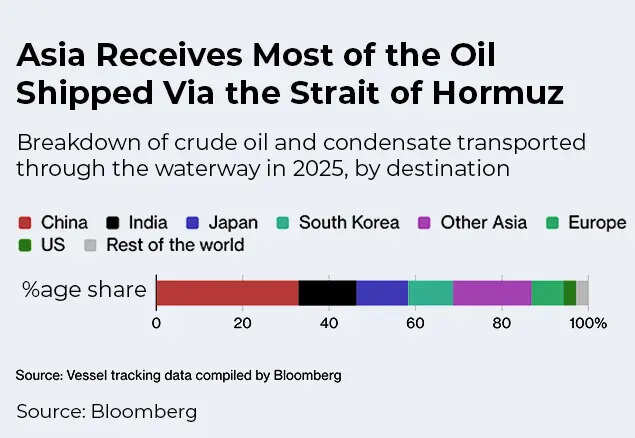
Asia received most of oil shipped via Hormuz

According to the petroleum ministry, 17 vessels have been identified for evacuation including four LPG carriers, three LNG carriers, and 10 crude oil tankers. Of these, three are Indian-flagged, while the remaining 14 are foreign vessels.Separately, the chemicals and fertilisers ministry has prepared a list of 16 additional ships for evacuation, including one Indian-flagged vessel (Jag Arnav) which was targeted by the IRGC on Saturday.Since the start of the US-Iran war, India which depends largely on imports for its energy needs has seen supply disruptions that have in particular impacted LPG availability. The government was forced to direct supplies for domestic consumption, and restrict commercial availability.According to the latest update from the government, domestic LPG supplies continue to face some disruption due to the prevailing geopolitical situation, though distribution to households has been prioritised.Also Read | Oil price shock loading: How India’s strong economic fundamentals will cushion the blow – explained in chartsOn the commercial side, allocations have been raised to around 70% of pre-crisis levels, including reform-linked supplies.On the crude front, India has aggressively stepped up procurement of Russian crude oil since the start of the conflict. In fact, India’s imports of Russian oil are now near their June 2023 highs and the flows are unlikely to abate in the near term. This has been aided by the Donald Trump administration to waive sanctions on Russian oil for a month, and then later extending it by another month.
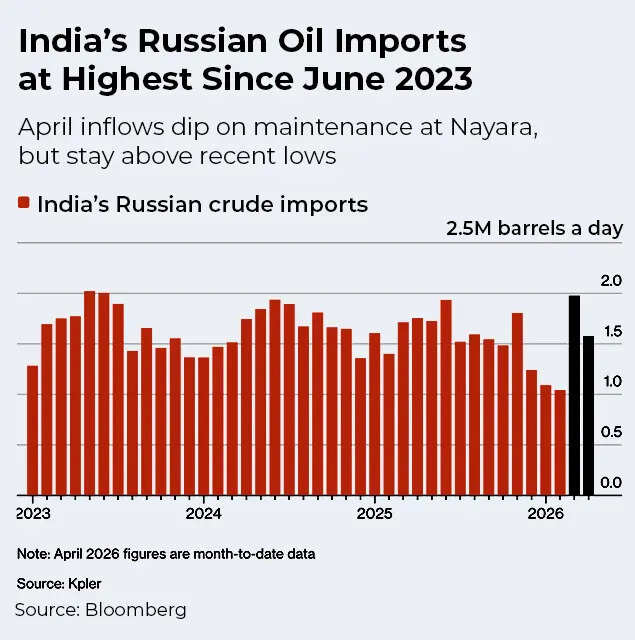
India's Russian oil imports highest since June 2023

Experts are of the view that while India’s crude oil basket is diversified, and Russian crude availability makes the situation less worrisome, LPG and LNG may continue to be an area of constraint.Sumit Ritolia, Manager Modelling and Refining at Kpler told TOI, “India’s crude oil supply currently appears stable to cover domestic demand, supported by continued imports from Venezuela, West Africa, and other key suppliers, alongside the extension of the US sanctions waiver, which allows access to Russian crude already at sea to meet near-term requirements. April Russian barrel import has picked up to around 1.6 mbd for now and with a possibility of further increase.”However, LPG and LNG supplies remain relatively constrained, he noted. “According to Kpler data, at least two LPG tankers are presently stranded near the Strait of Hormuz. Should the blockade persist particularly if restrictions extend to Indian-flagged vessels there could be emerging supply challenges in the coming days,” he added.


T Keditsu: “In rural India, the idea of ​​’children’s books’ becomes redundant”

0
T Keditsu: “In rural India, the idea of ​​’children’s books’ becomes redundant”


your book wrestling day Recently released. What was it like to create a book with Naga characters and set in Kohima, which is rare for an Indian children’s publication in English?

Author Theisinuo Keditsu who writes creatively as Tee Keditsu. (courtesy of topic)

It was a dream come true. I ventured into writing books for children because I could not find any picture books for children that featured Naga characters or places for my own children to read. There are only so many times one can ask or try to persuade other writers to fill that gap. So, I wrote my first picture book titled UkepenuopfüA retelling of the Angami origin myth, with my own ‘masala’. Locally, it was a huge success as it allowed many parents and children to see themselves and their life worlds in a book for the first time. When Sayoni Basu asked if I could write a book set in Nagaland, I jumped at the opportunity to give not only Naga children, but children in India and elsewhere, a glimpse of my beautiful home town and its culture through Wrestling Day.

You have a very gentle approach to a subject that is often considered hyper-masculine and aggressive. Anyingu, a boy about to debut as a wrestler, is upset because he has forgotten to take his mother’s shawl with him. “It is believed that if you wear your mother’s shawl while wrestling, it brings strength and protection,” says his cousin Ashiu. What excited you to write this story?

Very glad to hear your evaluation. Thank you! Traditionally, Naga wrestling was certainly an exclusively men’s sport, but that did not mean that women did not or did not participate in other ways – be it as mothers, sisters and wives supporting the wrestlers, or the many ways women contributed to the organization of matches. Wrestling is truly a community event – ​​one that thrives on the synergy of men and women working together. Through my story, I wanted to inspire two little girls to ‘save’ their cousin, whom they clearly idolize. I was very impressed that one of the all-time greats of Naga wrestling, Kejhalili Keretsu, raised this topic when he read my book Wrestling Day. At the Kohima launch, he gave a moving speech about the role of women in his life, which made him a great wrestler.

The book uses a lot of non-English words, relying on readers to get the meaning from context rather than giving them a glossary. This is quite rare in children’s books. What was the thought process behind this?

This was a colonial thought process. If we imagine stories in their original form and intention – as oral – then language is the most profound way for a listener to get a feel for a people or a culture. In childhood, we were taught to address elders in the local language. I teach this to my children too. This is the most intimate way to connect with someone. As a poet, I’m always thinking about how my words sound, what kind of impact they create. When I write my stories, I also imagine them being spoken – if this story were being read, how unnatural it would feel for a little girl in a Kohima village to call her uncle ‘Uncle’, these words Affujaao, Apfujaao etc., depict kinship with such complexity that English cannot match it. and like things Mesu – a water vessel made from dried gourd peels – does not exist anywhere else, so it felt right to introduce a new word for the verbal melee that is the English language.

You use social media to promote indigenous textiles. How was the experience of working with illustrator Rishita Loitongbam on the clothes worn by your characters?

Sayoni Basu, my editor at Duckbill Books, proposed a unique way to put together a wrestling day. She corresponded with a painter, but we would communicate through her, not directly. I have a passion for textiles and a lot of my research focused on illustration for my previous book Ukepenuopfü Too. I paid equal attention to the images and information shared with Rishita. I liked the fact that Rishita understood the cultural and political importance of accurately representing the characters’ costumes. Furthermore, his depictions of Kohima and its surrounding places were thoughtfully created and I commend him for that. Most of the feedback I get from local readers involves praise for his illustrations, especially about how they inspired the view of our city life in his book.

tell us about it the only childYour book proposal received the Neve Literature Festival (NLF) Fellowship for Children’s Book Creators.

This book is proving devastating to me but it is also my chrysalis. The saying ‘those who can’t, teach’ keeps rubbing salt on my creative wounds. I am grateful that I was awarded the fellowship. It has allowed me to think more deeply about what a children’s book is, and to appreciate the difficulty as an academic of translating my ideas into a story that people will read.

The book is about KV, a boy of mixed tribal descent. His father is Angami and mother is Yimkhiung. He has been an only child for about 10 years when his parents became pregnant again. The father, who is an administrative officer, gets a posting in Shamtor district from where his mother hails. So, after living in Kohima, he has to move to an interior and remote place with his family and new sister. This book is about his first year there, his adventures and discoveries.

I really hope that this book will open up a new part of Nagaland to Naga readers and readers from elsewhere. As part of this fellowship, I went on a field trip to Shamtor district where the book is set and found a place rich with stories. I want to try to get some of that into the book.

At a writers’ retreat a day before the Neev Literature Festival in Bengaluru, you said, “Reading is about preparing children for life. Why are we sanitizing children’s books? The structure of childhood we hold on to is colonial. Indigenous traditions of storytelling do not infantilize children in this way.” Who do you hold responsible for this sanitization, colonization and infantilization?

Perhaps not so much the ‘who’ but the what – events and forces such as colonialism, neo-colonialism and capitalism have given rise to ways of thinking about childhood that have shifted from one class or culture to another. Even if imposed, the sense in which Pierre Bourdieu interpreted and associated ‘taste’ has simply been made aspirational.

At the same time, the ways in which these structures of childhood are organized into silos to better facilitate transactions perpetuates a certain network of profit and exploitation. When we consider that for many children literacy is the result of coming to school for a meal, the discussion of whether they are reading ‘age appropriate’ books and how we categorize books as such is almost ridiculous, bordering on immoral.

A young man I know, who grew up in the interior of Nagaland, read the Bible from cover to cover several times as a child – it was the only book he had to read. A similar experience is so poignantly captured by Betty Smith, in one of my all-time favorite books that I read as a child (I was 10), A tree grows in BrooklynWhere the only mother is francie nolan complete works of shakespeare and this holy bible To read to his children.

I loved to read, but ‘children’s books’ were hard to come by, so apart from my cousin’s wonderfully illustrated Beatrix Potter books or the picture books that my aunt would bring for me on her twice-yearly trips to Darjeeling to drop off her children, or the books that my parents would bring for me from their travels, I had to make do with the books at home.

I am also fortunate to have grown up in a bookish home. Both my parents love reading. But after I read my quota of ‘children’s books’, I read my parents’ copy of the book gone With the Wind When I was eight years old, I was scolded without asking permission, not congratulated. Retrospectively, I consider myself lucky to have outlived Enid Blyton. I didn’t know that Harold Robbins was not ‘age-appropriate’ until I reached those pages, and by then, it was too late to stop – it didn’t go well, the books were rearranged on the shelf, I think one was even burnt. Since my father is a gynecologist, there was a graphic labor manual, and yes, Sidney Sheldon’s encouraging motions. I often wonder whether I would have become such an avid reader if my parents had taken as much care and control over my reading as I do with my own children.

It is clear that, especially in rural or small town India, and from neck level down in our social hierarchy, the idea of ​​’children’s books’ becomes redundant. I like to think that the connection with books ‘down here’, if there is one at all, is more chaotic and visceral. I imagine that children, starved for words in addition to other essentials, snatch up whatever they can read and, in the process, mount a strong resistance to the world literary market and its disciplinary forces.

Chintan Girish Modi is a journalist, teacher, poet, fiction writer, literary critic and peace builder. His work has appeared in various anthologies, including Borderlines: Volume 1 (2015), Clear Hold Build (2019), Fearless Love (2019), and Bent Book (2020).


Adarsh Gourav reprises role in Alien Earth season 2, Peter Dinklage joins cast

0
Adarsh Gourav reprises role in Alien Earth season 2, Peter Dinklage joins cast


Adarsh Gourav reprises role in Alien Earth season 2, Peter Dinklage joins cast

Adarsh Gourav confirms that he has joined Ridley Scott’s Alien: Earth Season 2 and will reprise his role from the previous season.

Following a widely acclaimed turn in Season 1, Adarsh returns to reprise his role as “Slightly” — a character noted for its emotional depth and complexity, earning him praise from audiences and critics internationally.


Top air coolers under ₹10,000 to tackle the heat smartly technology news

0
Top air coolers under ₹10,000 to tackle the heat smartly technology news


I’ve spent enough summers in North India to know that summer isn’t just about the temperature, it’s about how the air moves inside the room. A good air cooler doesn’t try to behave like an AC. It works best when it maintains air circulation, draws fresh flow, and runs without sending your electricity bill out of control. For many homes, this balance matters more than chasing extreme coolness.

Finding a budget air cooler that actually works well can make Indian summers a lot easier to handle.

Ijaz Khan is a tech journalist and senior content creator at HT Tech, where he translates the fast-paced world of consumer tech, gaming and AI into stories that drive curiosity and engagement. Always looking for the next big trend, he believes technology should be as relevant as your everyday interactions. When he’s not decoding gadgets and innovations, you’ll likely find him roaming cities, pursuing new adventures and sampling dishes that tell their own story.

read moreread less

Air coolers remain a practical option, especially in cities where dry heat dominates. They use water-based cooling, consume less power, and work well in locations where windows or cross-ventilation are available. under ₹₹10,000, the market offers a mix of personal, tower and desert coolers that can handle everything from a study corner to a shared bedroom.

Before choosing one, it helps to match the cooler with the size of your room. Smaller rooms do better with compact or tower models, while larger areas require desert coolers with higher tank capacity and stronger air throw. Portability, inverter compatibility and ease of filling water also play a role in daily use.

Here are some top options to consider this summer that meet a variety of needs without breaking the bank.

For tight spaces, the Symphony DIET 12T focuses on basic cooling without taking up much space. Its 12-litre tank and slim tower design allow it to sit in corners or next to a desk. It is suitable for rooms up to approximately 100-130 square feet. The cooler offers three speed settings and auto louver movement, which helps in direct airflow instead of keeping it fixed at one place. An air throw of about 30 feet is sufficient for small bedrooms or study areas. A side water refill system eliminates the need to open or lift the tank, making daily use easier. It works best for single users who want a simple setup for sleeping or working.

What are buyers saying on Amazon?

Buyers love how it cools small bedrooms and study spaces without using too much power. Many appreciate the compact size and easy-to-move wheels, although some say the cooling range is modest compared to larger desert coolers.

Why choose this product?

Choose this if you want a simple, low-cost, low-power cooler for a small room or personal space, and you don’t want the big or running costs of an AC.

The Bajaj PX 97 Torque has increased capacity and is designed for slightly larger rooms. With a 36-litre tank and three-sided honeycomb pads, it aims to cool spaces up to about 150 square feet.

The turbo fan design pushes air throughout the room, while the four-way swing helps distribute it more evenly. Users can switch between three speeds depending on the time of day. It also supports inverter operation, which is useful during power cuts. This cooler fits into shared bedrooms or small living rooms where a basic cooler might fall short.

What are buyers saying on Amazon?

Owners call it a “workhorse” for bedrooms and shared living areas, praising the strong airflow and honeycomb cooling. Some people feel that it is a little noisy at high speeds, but overall they believe that it performs well for its size and price.

Why choose this product?

If you share a bedroom or small-to-medium-sized living area and want a powerful, no-AC-bill cooler that can run for hours without frequent refills, choose this one.

For larger locations, Crompton ozone shifts to the desert cold zone. Its 75-litre tank supports long cooling cycles without frequent refilling, making it useful for halls or large bedrooms.

It uses honeycomb pads and a high-capacity airflow system to deliver air to wide areas. Motorized louvers and four-way air deflection help avoid uneven cooling. Crompton has also designed this unit to handle varying water conditions, which can matter in many parts of India. This cooler works well when placed near a window or balcony so that it can draw fresh air.

What are buyers saying on Amazon?

Users love its cooling power, especially in dry conditions. The build and airflow is also good. Some say setup and refilling is more involved than compact models.

Why choose this product?

Choose this if you live in a hot, open-plan home or have a large bedroom or hall where standard coolers perform poorly and you want a durable, desert-style unit instead of an AC.

Orient DuraChill brings a blend of portability and storage-friendly design. With a 40-litre tank and collapsible side panels, its size can be folded down when not in use. It uses honeycomb cooling pads and supports inverter operation, making it suitable for daily use during long summer hours. Air flow can be adjusted through multiple speed settings, which helps adapt to different room conditions. This cooler is suitable for users who want a medium-sized cooler that does not take up space all year round.

What are buyers saying on Amazon?

Reviewers like its “fold-away” design and performance-storage balance, with some wishing for stronger high-end airflow.

Why choose this product?

If you want a room-scale cooler that doesn’t waste floor space once the season ends, and you use inverter-based backup power regularly during the summer, choose this one.

Kenstar Robusta Neo is designed for stationary use in large rooms. Its 45-litre tank and honeycomb pad support extended operations without frequent refilling. A water-level indicator helps track usage, which is useful during overnight runs. Air flow remains consistent due to the motor designed for long cycles. The overall design follows a standard desert cooler format, focusing more on function than extra features. It is a practical option for homes that need a reliable cooler for daily use in shared spaces.

What are buyers saying on Amazon?

Owners say it keeps large bedrooms and drawing rooms cool, especially in the dry summer. Many people like the clear water level window and the fact that it “just runs” all day, although some do mention noise at the highest speed.

Why choose this product?

If you regularly deal with intense, open field heat and want a straightforward, high-capacity desert cooler that can handle a full-sized room without huge AC power bills, then choose this one.

Livpure Coolbliss Neo offers high tank capacity while keeping the design manageable for home use. With a 70-litre tank, it supports cooling for long periods of time without any interruption.

It uses honeycomb pads and an inverter-compatible motor, which allows it to run during power cuts. Air flow is stable enough for bedrooms and medium-sized living areas. The controls are simple, making it easy to operate without much setup. This cooler is suitable for users who want long runtimes with minimum manual effort.

What are buyers saying on Amazon?

Buyers love how it cools a bedroom or small living area without looking bulky, and many appreciate the inverter-friendly operation. Some say it is best for auxiliary cooling rather than extremely hot, sealed rooms.

Why choose this product?

If you want a compact, modern-looking cooler for a bedroom or compact living space, and you value backup-power compatibility as well as easy-to-use controls, choose this one.

Havells Cult focuses on compact cooling for small rooms. Its 24-litre tank and slim structure make it suitable for study areas, single bedrooms or work from home setups.

It uses honeycomb pads and keeps the controls simple, reducing maintenance effort. Power consumption remains low, making it suitable for long-term use. This air cooler is best for users who want a straightforward cooler without having to deal with larger units.

What are buyers saying on Amazon?

Users praise its clean look and how it fits into tight spaces like under a window or in the corner of a study bench. Many say it’s ideal for “one-person cooling” and that it’s easy to refill, though some wish it had a larger tank or a remote control.

Why choose this product?

Choose this if you need a hassle-free, ultra-compact cooler for a single-person bedroom, study, or small workplace, and you want to avoid the noise and bulk of a full-sized unit.

Factors to Consider Before Buying an Air Cooler

1. Room size and coverage

Match the cooler capacity (small, medium, large room) with your actual space; Oversized units are wasteful and undersized units will not cool properly.

2. Type of layout (room vs open balcony)

Desert-style coolers with honeycomb pads work best in open-air, well-ventilated rooms, while compact tower units are fine for closed bedrooms or small living areas.

3. Power and Backup Requirements

Check if the cooler is inverter-compatible or backup-ready, especially if you rely on inverter-based power during the peak of summer.

4. Ease of filling and maintenance

Check out the clear water level indicator, easy-fill tank and easy-to-clean honeycomb pad to reduce daily hassles.

5. Noise and portability

Consider how fast the cooler moves at high speed and whether castor wheels or a compact design make sense for your space.

Top Specifications of Best Air Cooler for Home

Disclaimer: At Hindustan Times, we help you stay updated with the latest trends and products. Hindustan Times has an affiliate partnership, so we may get a share of the revenue when you make a purchase. We will not be liable for any claims under applicable laws including but not limited to the Consumer Protection Act, 2019 in relation to the Products. The products listed in this article are in no particular order of priority.


King: Ed Sheeran to be part of Shah Rukh Khan film`s album?

0
King: Ed Sheeran to be part of Shah Rukh Khan film`s album?


King: Ed Sheeran to be part of Shah Rukh Khan film`s album?

Shah Rukh Khan’s next film, King, is one of the most anticipated films of the year. Directed by Siddharth Anand of Pathaan fame, the film also marks the theatrical debut of Khan’s daughter, Suhana Khan. Apart from the father-daughter duo, the film boasts a rich cast including Deepika Padukone, Abhishek Bachchan, Raghav Juyal, and Saurabh Shukla, among others.

Ed Sheeran to sing for King?

In 2025, singer Ed Sheeran revealed that he had recorded a Hindi song for an upcoming Bollywood film starring Shah Rukh Khan. While he did not name the film, many assumed it to be King, as the actor had not announced any other project at the time. Now, music composer Anirudh Ravichander has reacted to speculation about Ed Sheeran being part of the film’s album.


‘Nobody is offering me roles’: Archana Puran Singh says The Kapil Sharma Show cost her films

0
‘Nobody is offering me roles’: Archana Puran Singh says The Kapil Sharma Show cost her films


For an actor with over four decades in Indian cinema, Archana Puran Singh’s relationship with success has been anything but straightforward. In a recent interview with News18, the veteran star revealed how her wildly popular television run inadvertently became a roadblock to the very career she had built her name on. (Also read: Archana Puran Singh slams ‘kanjoosi’ mindset on film sets, flags 13-14 hour shifts and lack of meal breaks for crew )

Archana Puran Singh reflects on the challenges of balancing TV success and film career. (Instagram)

Archana Puran Singh on losing film roles

Archana joined the show in 2019, stepping in for Navjot Singh Sidhu, and quickly became a fan favourite. However, the demanding shooting schedule left her with little room to take up film projects. She shared that she had to turn down multiple offers over the years, including an international shoot that required her to be away for nearly a month, as she couldn’t commit due to her television schedule. Over time, these repeated refusals led to fewer film offers coming her way.

Reflecting on how she is perceived in the industry, Archana expressed disappointment over being typecast. “No matter how much I try, I’m not being able to convince filmmakers. Nobody is offering me roles. They aren’t very convinced that I’m an actor. They still think that I’m somebody who sits on a chair and laughs,” she said.

Archana Puran Singh’s role in Toaster

Archana Puran Singh recently took on a quirky yet important role in Toaster, marking her second collaboration with Rajkummar Rao, who has also turned producer with the project. She shared that the film came her way after he noticed her work in Vicky Vidya Ka Woh Wala Video, which was their first professional association.

Archana explained that their earlier collaboration played a key role in her being cast in Toaster, adding that she hopes this project opens doors to more opportunities in the future and leads to further films.

(Also read: Archana Puran Singh recalls feeling alone, weak during pregnancy; Parmeet Sethi admits he was an ‘absent, bad father’ )

About Archana Puran Singh’s career

Despite a long and varied career, she feels her image as a comic personality has overshadowed her acting range. Archana made a strong impression early on with a lead role opposite Naseeruddin Shah in Jalwa, before transitioning into supporting roles. Over the years, she appeared in popular films like Kuch Kuch Hota Hai, De Dana Dan and Bol Bachchan, often in comic parts that further reinforced her on-screen persona.


Rumen Radev's party wins Bulgarian election

0
Rumen Radev's party wins Bulgarian election


With 87% of the vote now counted, Progressive Bulgaria has secured a majority in parliament.


Deepika Padukone, Ranveer Singh’s old clips on having ‘lots of kids’ melt hearts; fans hope its twins this time

0
Deepika Padukone, Ranveer Singh’s old clips on having ‘lots of kids’ melt hearts; fans hope its twins this time


Bollywood couple Deepika Padukone and Ranveer Singh are all set to embrace parenthood again. The couple announced Deepika’s second pregnancy on April 19, leaving fans excited. As soon as they made the announcement, fans dug out old videos of them talking about their dream life, which included having lots of children.

Ranveer Singh and Deepika Padukone with their daughter Dua Padukone Singh.

When Ranveer Singh and Deepika Padukone talked about lots of kids and a peaceful family

One of the videos shows Ranveer and Deepika talking about having children and a peaceful life. When Ranveer made his TV debut with The Big Picture in 2021, at the launch event of the show, the actor revealed his “big picture” and said, “Ek chota sa pyaara sa ghar ho, jismein meri wife aur mere bacche, puri family khel rahi khood rahi hai aur sab khush hain, swasth hain (A small, lovely home where my wife and children are together, the whole family laughing and playing, and everyone is happy and healthy).”

Another video that has surfaced on the internet shows Deepika talking about having lots of children and grandchildren, and hoping for a peaceful life. In 2017, even before marrying Ranveer, Deepika spoke to France 24 at the Cannes Film Festival about the kind of life she imagined for herself at 70. She said, “Hopefully have a little home with a sea view, lots of children and grandchildren. Just a good, happy and peaceful life.” In another video shared by a fan club, the actor revealed the one thing she wished to do before she died, saying, “One thing I have got to do before I die is definitely have lots of babies. That’s what I want to do.”

Fans couldn’t stop gushing over the videos. One commented, “They literally manifested it.” Another wrote, “Manifesting a relationship like this.” A fan said, “Lots of children and grandchildren, oh I love them,” while another added, “No nazar please.” Another wrote, “Hope it’s Twins this time’

About Deepika Padukone and Ranveer Singh’s marriage

The couple got married in an intimate yet grand wedding ceremony in Italy. Their wedding included both Sindhi and traditional Konkani rituals. Ranveer and Deepika hosted multiple receptions, including ones in Mumbai and Bengaluru for their industry friends.

Deepika and Ranveer embraced parenthood for the first time in 2024 when they welcomed their daughter, Dua. The couple revealed that they named her Dua because she is the answer to their prayers. Deepika later shared pictures of Dua on her first birthday, leaving fans in awe.

On April 19, the couple took to Instagram and shared a picture of their daughter Dua, who is now set to become an elder sister, holding a pregnancy test with two pink lines, confirming the second pregnancy. Several stars, including Priyanka Chopra, Kareena Kapoor, Katrina Kaif, Anushka Sharma, Samantha Ruth Prabhu and Kiara Advani, congratulated the couple and showered them with love.


India’s truckers brace for first diesel price hike in four years| Business News

0
India’s truckers brace for first diesel price hike in four years| Business News


Operators of truck fleets across India are bracing for fuel rationing and the first significant increase in diesel prices in years, a move that would end a period of relative stability that has continued even into a war in the Persian Gulf.

Diesel is the lifeblood of the Indian economy as trucks account for nearly 70% of the freight movement in the country. (HT)

The world’s third-largest oil importer is among the countries most exposed to the trade upheaval in West Asia as the conflict extends into an eighth week—but it has not faced the widespread price hikes at the pump seen elsewhere, as the government shields consumers and state-run refiners absorb losses.

That may be about to change, once key regional elections wrap up next week, as pressure increases and the war drags on. A hike by those government-owned refiners would add to inflationary pressures weighing on the economy. Truck drivers already report widespread informal rationing that forces them to stop more frequently to fill their tanks, delaying deliveries.

“We are going to see an increase in diesel prices after the elections,” said Shailendra Gupta, an executive member at All India Motor Transport Congress, a truckers’ lobby group. “Already nearly 10% of the fleet is idle, if the fuel prices are increased that number could go up to 30%.”

Pumps have withdrawn discounts they used to give earlier on monthly purchases above a certain threshold, he said.

Much of India’s cargo moves around by road—trucks account for nearly 70% of the freight movement—so diesel is the lifeblood of the economy. Private players Nayara Energy Ltd. have already raised pump prices and Reliance Industries Ltd. and its partner BP Plc have rationed supplies. Still, any widespread increase in retail fuel prices, coupled with a weak exchange rate, would feed through to the wider economy.

Ajay Bansal, president of All India Petroleum Dealers Association, said there was currently no rationing at state outlets—though they were feeling the knock—on effect from other restrictions.

“With the private refiners curtailing sales, there has been abnormal spike in demand at pumps of state retail outlets which may have led to dry-outs at some outlets and forcing them to curtail sales,” Bansal said.

The government has urged citizens to avoid panic buying fuel and said on Sunday that retail outlets were operating normally. There was no increase in regular retail prices for petrol or diesel, it added. India has already reduced local taxes on petrol and diesel and raised export levies in order to protect consumers.

Standard Chartered Plc economists led by Anubhuti Sahay said in a report last Friday that if crude averages $95 a barrel in this fiscal year, the government would be forced to raise pump prices by ₹8-15 per litre for petrol and diesel, along with higher cooking gas prices. Even if crude averages $85-$90 a barrel, retail fuel prices may still need to rise by ₹3-7 per litre, they said.

Brent crude was trading around $96 a barrel on Monday. India’s last widespread pump price increase was in 2022.


Samay Raina reveals fearing bankruptcy like Amitabh Bachchan

0
Samay Raina reveals fearing bankruptcy like Amitabh Bachchan


Samay Raina reveals fearing bankruptcy like Amitabh Bachchan post 'India’s Got Latent' row: 'Lost sponsors, broke FDs'
Samay Raina revealed in Still Alive how India’s Got Latent controversy cost him sponsors, episodes, and FDs, fearing debt like Amitabh Bachchan’s ₹90 crore ABCL crisis. Triggered by Ranveer Allahbadia’s joke, it led to FIRs and show removal. Despite mental toll, Season 2 teased.

Following the release of his latest special, Still Alive, stand-up comedian Samay Raina has finally broken his silence on the severe financial and personal fallout of the 2025 ‘India’s Got Latent’ controversy. In a candid reflection, Raina revealed that the legal battles and loss of corporate backing pushed him to a breaking point, drawing a stark comparison to Amitabh Bachchan‘s high-profile financial collapse in the late 90s.

Samay Raina discloses losing everything

During a recent Dostcast chat, Samay disclosed that the controversy left him having “lost everything.” He explained, “I lost all the upcoming episodes because everyone was scared and didn’t want their episode to be uploaded. I also lost the sponsors for those episodes. I had already received their payments and invested them in fixed deposits. I had to break those FDs and return the money. I was in a mess.”

Samay Raina shares fears of projects collapsing

The comedian went on to share his ongoing fears during that period. “I had several projects lined up and had even shot for ads, but they asked for their money back. I had also signed a deal with BookMyShow, where they had given me an advance for the entire tour, and all that money was already invested. I was extremely scared. At that time, I didn’t know what I would do. I knew no brand would come on board. My biggest fear was that I would go broke and fall into debt, like what happened with Amitabh Bachchan,” he said.

Amitabh Bachchan’s 90s financial crisis

In the late 1990s, Amitabh Bachchan endured a major financial setback when his Amitabh Bachchan Corporation Limited (ABCL) went under. The debacle saddled him with roughly Rs 90 crore in debts. He dealt with numerous legal battles and creditor demands at the time, with reports indicating he nearly lost his house.

‘India’s Got Latent’ controversy erupts in February 2025

Back in February 2025, Ranveer Allahbadia, along with Ashish Chanchlani and Apoorva Mukhija, joined as panellists on Samay Raina’s India’s Got Latent. A comment from Ranveer on parents and sex during the episode triggered huge online outrage. FIRs were lodged against Samay, Ranveer, Apoorva, and Ashish. Samay had to pull the show from YouTube, Ranveer apologized publicly, and in March, the Supreme Court cleared Ranveer to restart his podcast.

Samay Raina reveals the truth behind a controversial joke

In his latest comedy special, Samay revealed that Ranveer repeated the offending joke eight times in the episode, though just one clip made the final cut and ignited the backlash. He confessed the ordeal took a toll on his mental health, making him feel powerless. Even so, Samay has teased a potential second season of ‘India’s Got Latent,’ thrilling fans.