Monday, September 28, 2026
Home Blog Page 565

Dhurandhar 2 beats Pushpa 2 to become third-highest-grossing Indian film ever; can it beat Dangal to reach #1 | Analysis

0
Dhurandhar 2 beats Pushpa 2 to become third-highest-grossing Indian film ever; can it beat Dangal to reach #1 | Analysis


On Saturday, Aditya Dhar’s Dhurandhar: The Revenge crossed an important milestone, reaching ₹1750 crore in gross worldwide. This is significant because it helped the film surpass Sukumar’s Pushpa 2: The Rule on India’s all-time highest-grossing films list. Dhurandhar 2 now stands in third place on the elite list, behind only Baahubali: The Conclusion and Dangal.

Dhurandhar 2 worldwide box office collection now stands at  ₹1750 crore.
Dhurandhar 2 worldwide box office collection now stands at ₹1750 crore.

Dhurandhar 2 beats Pushpa 2

By Sunday, April 19, Dhurandhar 2 had earned ₹1750 crore worldwide gross. This includes ₹1111 crore net in India, the second-highest collection by an Indian film in the domestic market. The film has also collected $46 million overseas, taking it just outside the top 10 of highest-grossing Indian films overseas. The ₹1750-crore gross is enough for the Ranveer Singh-starrer to overtake Allu Arjun’s Pushpa 2, which earned ₹1742 crore gross upon its release in 2024. Unlike Dhurandhar 2, Pushpa 2 did the bulk of its earnings at home, earning a record ₹1234 crore net in India. Its international collections were $32 million.

Can Dhurandhar 2 beat Baahubali 2 and Dangal

Dhurandhar 2 has now set its sights on SS Rajamouli’s Baahubali 2, which is in the second spot with worldwide earnings of ₹1788 crore gross (not adjusted for inflation). Dhurandhar 2 earned ₹6.70 crore globally on Saturday, and is expected to add around ₹7 crore more on Sunday. This will take its global gross to ₹1755 crore, just ₹33 crore shy of Baahubali 2’s lifetime earnings. The film is expected to see a massive drop on Monday, but it should have enough in the tank to catch up to Baahubali 2 in a couple of weeks. The release of Bhooth Bangla has affected Dhurandhar 2’s earnings, but the absence of another tentpole film for the next few weeks should enable it to sustain its momentum. The film is also not expected to release on streaming anytime soon, which will keep it alive in theatres.

It will, however, definitely fall short of Dangal’s all-time mark of ₹2070 crore. In fact, Dhurandhar 2 may not even reach the ₹1800 crore mark, let alone ₹2000 crore. Part of the reason is that Dhurandhar 2 did not get a release in the Gulf, which hurt the film’s collections by at least $12-15 million ( ₹110-140 crore). That additional push could have put the film closer to ₹2000 crore. It should be noted that the lion’s share of Dangal’s earnings came from China, where it remains one of the highest-grossing international features. The Aamir Khan-starrer was the highest-grossing Indian film at the time of its release, even without its China haul, though. However, its worldwide gross before its China release was a more modest ₹716 crore.

Another record that Dhurandhar 2 may not break is Pushpa 2’s domestic collections record of ₹1234 crore. The Aditya Dhar film is over ₹120 crore behind right now, and does not have enough momentum to bridge that gap.


Rajasthan Royals reach 95 runs for the loss of one wicket in 10 overs against Kolkata Knight Riders

0
Rajasthan Royals reach 95 runs for the loss of one wicket in 10 overs against Kolkata Knight Riders


Rajasthan Royals reach 95 runs for the loss of one wicket in 10 overs against Kolkata Knight Riders

In the IPL 2026 match against Kolkata Knight Riders (KKR), Rajasthan Royals (RR) have reached the score of 95 runs for the loss of one wicket in 10 overs at the Eden Gardens in Kolkata.

Having opted to bat first, opening batsman Yashasvi Jaiswal scored 38 runs in 27 balls, including four boundaries and two maximums. Fellow opening batsman Vaibhav Sooryavanshi departed after scoring 46 runs off 28 deliveries, laced with six boundaries and two maximums.


Kim Kardashian and Lewis Hamilton: From friendship to romance

0
Kim Kardashian and Lewis Hamilton: From friendship to romance


Kim Kardashian and Lewis Hamilton: A decade-long journey from friendship to romance
In a delightful twist of fate, Kim Kardashian appears to have confirmed her blossoming romance with F1 racing sensation Lewis Hamilton. The spark between the two ignited back in 2014, with numerous public outings and playful exchanges on social media. Just recently, they’ve been spotted jet-setting to Paris together and attending high-profile events, solidifying the growing buzz around their relationship.

Kim Kardashian is seemingly confirming her romantic relationship with Formula One racer Lewis Hamilton. While sharing the inside glimpses of her Coachella outing on social media, the Kardashian shared a photo of herself cozying up to Hamilton.Kim and Lewis first sparked dating rumors in February after getting snapped catching a private flight to Paris together. And since then, they haven’t been secretive about their budding romance, with Lewis commenting flirty emojis on Kim’s Instagram pictures.Even though their romance sparked now, the two have known each other for quite a long time. Here’s what we know: 2014As far as a public outing is confirmed, Kim and Lewis were first photographed in 2014, with their then-partners. Kim was still with her ex-husband, Kanye West, while Lewis was dating Nicole Scherzinger at the time. Both couples were photographed as a group at the GQ Men of the Year Awards in September of that year.2015According to ELLE, in March 2015, they were both seated front row at the same fashion show in Paris. They also attended a post-show dinner hosted by Balmain that same month.Meanwhile, Kanye West and Lewis Hamilton were friends at the time, and even spent time with the Kardashians and Jenners at their family homes. In 2015, West told the School of the Art Institute of Chicago that Hamilton spent Easter with them.“Lewis Hamilton’s over at my house, and we’re playing some music in my studio,” he shared. “We’re having an Easter brunch and all of the family’s there, my wife’s family, my friends, everything. And everybody’s like, ‘What is this music?’ And I’m like, ‘It’s Lewis Hamilton’s music.’ They’re like, ‘Oh my God. It’s really good!’”2018Hamilton also shares a friendship with Kardashian’s mother, Kris Jenner, and has made a number of appearances with her in public. She visited him in 2018 at the Monaco Formula One Grand Prix. 2021In 2021, after Kardashian’s relationship with West ended, she and Hamilton posed for a group photo at WSJ. Magazine’s 2021 Innovator Awards, where they were both honored. At that time, Kardashian had just started seeing comedian Pete Davidson. Hamilton shared a photo on Instagram with Kardashian at the time, saying it was an “honor” to be in the same group as the Skims founder.2026Now in 2026, on New Year’s Eve, both Kardashian and Hamilton were seen at Kate Hudson’s New Year’s Eve party in Aspen, Colorado.On February 2, after footage came out of Kardashian and Hamilton entering a Paris hotel together, a source confirmed to People that “it was a romantic meetup.”Kardashian and Hamilton attended the 2026 Super Bowl, where they were filmed chatting in the stands. It marked their first public appearance together since dating rumors began.


Pope Leo tells Angola during huge Mass to ‘build hope’ | Religion News

0
Pope Leo tells Angola during huge Mass to ‘build hope’ | Religion News


On the third leg of his Africa tour, Leo urges Angola to move beyond “divisions” created by its war-scarred past.

Pope Leo XIV has addressed tens of thousands of faithful near Angola’s capital, urging the country to overcome “divisions” and “corruption” during a landmark tour of Africa.

Speaking at an open-air Mass on Sunday in the town of Kilamba on the outskirts of Luanda, Leo addressed the country’s civil war-scarred past that he said has brought “enmity and division, squandered resources and poverty”.

Recommended Stories

list of 3 itemsend of list

“Today, there is a need to look to the future with hope and to build that hope. Do not be afraid to do so,” Leo said.

The pontiff arrived in the Portuguese-speaking nation on Saturday for the third leg of a four-nation tour of the continent, which began in Algeria and Cameroon and will also include a stop in Equatorial Guinea.

At a meeting with Angolan officials, including President Joao Lourenco, Leo spoke out against the “suffering” and social and environmental “disasters” caused by the rampant exploitation of natural resources.

The remarks in Angola, which endured a decades-long civil war that ended in 2002, continued a theme of Leo’s 11-day tour, during which he has delivered pointed warnings against corruption and the plunder of the continent’s resources.

The first United States-born pope has also delivered remarks seen as critical of the US-Israeli war in Iran and US policy, including calling US President Donald Trump’s threat to end Iran’s civilisation “unacceptable”.

The pontiff’s rhetoric has put him at odds with Trump, who last week called the Catholic leader “weak” and “terrible for foreign policy”.

Leo said he is not afraid of the Trump administration and will continue to speak out against war. But travelling from Cameroon to Angola on Saturday, Leo also said he has no interest in starting “a new debate” with the US president.

‘Waiting for pope’s blessing’

Many people who attended the Mass at Kilamba arrived early in the morning in anticipation.

“The pope coming here is a joy,” said ‌Sister Christina Matende, who arrived about 6am (05:00 GMT). “We are living in a moment of a lot of difficulties, and we are waiting for the blessing of the pope.”

Faithful wait on the day Pope Leo XIV is to lead a Holy Mass, during his apostolic journey in Africa, in Kilamba, Luanda province, Angola, April 19, 2026. REUTERS/Guglielmo Mangiapane
People attend a Mass led by Pope Leo XIV in Kilamba, Angola [Guglielmo Mangiapane/Reuters]

From Kilamba, Leo is to travel 110km (70 miles) by helicopter to the town of Muxima, Angola’s most venerated pilgrimage site, where a 300-year-old church overlooks a river that was once a major slave-trading route.

The church, with a statue of the Virgin Mary known affectionately as “Mama Muxima”, draws roughly two million pilgrims a year and large crowds are expected to meet the pope there.

The pope is then due to travel more than 800km (497 miles) from the capital to visit a retirement home in Saurimo, where he will celebrate another Mass before departing for Equatorial Guinea.

Catholic lawyer Domingos das Neves said the pope’s focus on social justice was welcome in Angola, which is struggling with “stark social asymmetries and inequalities”.

“Angola is in great need of a guiding light to illuminate our collective efforts both within ecclesiastical institutions and the state, so that we do not forget the poor and the destitute,” das Neves told the AFP news agency.


Vinay Bhardwaj on how he conceived the inspirational talk show Pehchaan

0
Vinay Bhardwaj on how he conceived the inspirational talk show Pehchaan


When people across the world felt lost during the COVID-19-induced lockdown, producer Vinay Bhardwaj found inspiration in a book that, years later, led him to conceive Pehchaan — an unscripted inspirational talk show hosted by Mahesh Bhatt. The SonyLIV series, which dropped this April, features conversations with 13 voices from the Sikh community who have dedicated their lives to seva (service).

(L-R) Author Dr Prabhleen Singh, Mahesh Bhatt, and producer Vinay Bhardwaj. Pics/By Special Arrangement, Ashish Raje


Delimitation decoded: What the Centre tried to do, why opposition shot it down & what happens next | India News

0
Delimitation decoded: What the Centre tried to do, why opposition shot it down & what happens next | India News


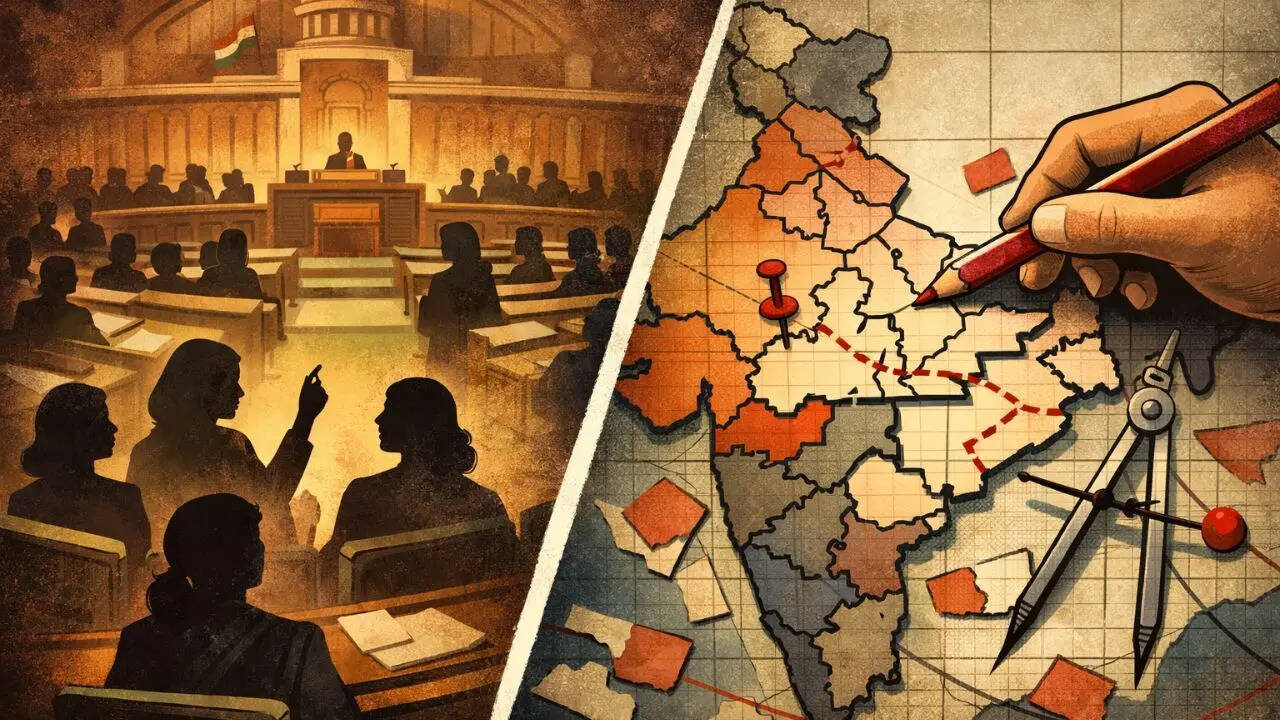
NEW DELHI: Parliament has voted down the government’s proposal to expand the Lok Sabha from 543 to 850 seats, implement 33% reservation for women, and redraw constituencies accordingly, but the defeat has not closed the issue. If anything, it has exposed how a once-technical constitutional mechanism has become one of the most consequential unresolved questions in electoral politics.It is important to note that the Women’s Reservation Act 2023, which provides for a 33% reservation for women in the Lok Sabha and state legislative assemblies, came into force on April 16, 2026 amid the ongoing debate on proposed bills.The opposition was unambiguous about these bills. “This defeat is not of women’s quota but of delimitation by the backdoor,” said Revolutionary Socialist PartyMP N K Premachandran. Samajwadi Party chief Akhilesh Yadav called it a “defeat of BJP’s malice.” Trinamool Congress, whose 21 MPs had been urgently mobilised by the INDIA bloc, proved critical to the margin. After the vote, Congress’s Rahul Gandhi spoke personally with TMC’s Abhishek Banerjee to thank him for the support.Congress’s Priyanka Gandhi Vadra was direct: “PM Modi maliciously linked women’s quota to delimitation based on the 2011 census. His hollow attempt to pose as the messiah of women has failed today.”CPI MP Sandosh Kumar put the charge differently- that women should “see through BJP’s approach of delaying women’s quota by linking it to the census and delimitation.”On the government side, home minister Amit Shah, as the bill’s fate became clear, offered to adjourn the House and return with an amended bill. “I have the amendment prepared,” he said, pressing the government’s commitment to the 50% seat expansion. Prime Minister Narendra Modi made a final appeal before voting, asking MPs to “reflect on your conscience” and act on behalf of women across the country.The bill failed. Two related pieces of legislation, including the one to set up a delimitation commission, were not tabled in the Rajya Sabha. Parliament was adjourned.

What government proposed

The government’s plan was architecturally different from any previous delimitation exercise. Its central proposal was to increase total Lok Sabha seats by 50%, from 543 to 850, while keeping each state’s proportional share of seats unchanged. Uttar Pradesh, which currently holds 80 seats, would have received 120; Tamil Nadu, with 39, would have received 58 or thereabouts.The mechanism for women’s reservation flowed from this expansion. If every state’s seats increased by 50%, one-third of the new total — 33% — could be reserved for women, equalling precisely the one-third of the expanded total. The arithmetic was designed to be self-contained: no state would lose share, and the reservation obligation would be met without redistributing existing seats.The proposed delimitation commission, as described in the bill circulated to lawmakers, would be headed by a former Supreme Court judge, with the chief election commissioner or a nominee as a member, consistent with past practice.The exercise for the Lok Sabha, government sources made clear, was to be delinked from the 2011 census. Constituency boundaries would be redrawn; the proportional shares of states in the Lok Sabha would not change. In that structural sense, it was closer to the 2008 delimitation exercise than to the full reallocation exercises of 1952, 1963, or 1973.

.

Why opposition read it as threat

The bill’s legal architecture contained a provision that drew sustained fire. As Vidhi Centre for Legal Policy’s Swapnil Tripathi, lead at Charkha (Centre for Constitutional Law), explained: “Currently, Article 82 requires that delimitation of constituencies and readjustment of seats among states be undertaken after completion of every census, using population data of that census. The present bill removes this obligation and instead leaves it to parliament to determine both timing of delimitation and census to be used for the exercise. Importantly, this transforms what was a constitutional obligation into a matter of legislative discretion.”That shift from constitutional mandate to parliamentary choice was the provision that most alarmed critics. It would have allowed parliament to decide, at will, which census data to use and when to act, stripping Article 82 of its periodic, automatic character.Congress lead speakers Gaurav Gogoi and K C Venugopal accused the government of using women’s quota as “cover” for a larger electoral reengineering. Gogoi invoked the American term explicitly- BJP was using delimitation “like gerrymandering in the US, where seats are redrawn for political exploitation.” He pointed to what he called precedents in Jammu & Kashmir, where a delimitation commission used census 2011, and in Assam, where the election commission used census 2001, bypassing norms of geographical contiguity and uniformity. “What was done in Assam and J&K, government wants to do it in the entire country,” he said.DMK chief M K Stalin, who had led protests in Tamil Nadu, said his party’s concern was squarely about delimitation–”which requires careful thought to ensure it is fair, especially for southern states.” He said the government should have delinked women’s reservation from delimitation entirely.Congress challenged the government to implement women’s reservation immediately in the existing 543-seat House without linking it to census or delimitation. The government declined.

.

Stakes for southern states

The underlying anxiety that animated the southern bloc is rooted in demography and mathematics that are not in dispute.India’s seat allocation in the Lok Sabha has not been updated since 1977. It rests on the 1971 census. In the five decades since, population growth has been sharply uneven. Northern states Uttar Pradesh, Bihar, Madhya Pradesh, Rajasthan grew faster. Southern states Tamil Nadu, Kerala, Karnataka, Andhra Pradesh invested earlier in public health and fertility reduction, and their populations stabilised sooner.Based on 2011 census data, Tamil Nadu has a population of approximately 7 crore and sends 39 MPs to the Lok Sabha. Uttar Pradesh has a population of roughly 20 crore, nearly three times as large, and sends 80. A Tamil Nadu MP represents approximately 18 lakh voters; and a UP MP represents approximately 25 lakh.Vidhi Centre for Legal Policy’s research quantifies what a strict population-based delimitation could produce: going by projected 2026 population, Tamil Nadu could fall to 31 Lok Sabha seats while Uttar Pradesh could rise to 90. More populous northern states have reason to argue their representation has been frozen unjustly. But southern states–which implemented family planning successfully, raised literacy, and reduced fertility–fear they are being penalised for effective governance.The government’s expansion plans–keeping proportional shares frozen while growing the overall House–was presented precisely as the resolution to this conflict. Each state keeps its share; all states gain seats; women get their quota. Critics, however, argued that the real issue was not the immediate arithmetic of the current bill, but the constitutional discretion it would have created for all future delimitation exercises.

.

What delimitation actually means

The word is used loosely in political debate to describe three distinct processes. The first is the allocation of seats among states — how many of the Lok Sabha’s total seats each state receives. This is the most consequential dimension and the one frozen since 1977. The second is the redrawing of constituency boundaries within states — carving a state’s allotted seats into geographic units of roughly equal population. The third is the reservation of specific constituencies for Scheduled Castes and Scheduled Tribes, placed in areas where those communities form the largest share of the local population.These three processes have different constitutional triggers and very different political stakes. The 2008 delimitation exercise, for instance, redrew boundaries within states using 2001 Census data — but left the inter-state seat distribution entirely untouched. The current debate is almost entirely about the first category, which has not moved in over five decades.

The Constitutional framework

The architecture begins with Article 81 — seats in the Lok Sabha shall be allocated broadly in proportion to state populations. Article 82 mandates that upon completion of each census, allocation and constituency division shall be readjusted by such authority as Parliament may by law determine. Article 170 mirrors this for state assemblies.Article 327 empowers Parliament to make laws on all matters relating to elections, including delimitation. Article 329(a) removes courts from the picture: the validity of any law relating to the delimitation of constituencies or the allotment of seats “shall not be called in question in any court.”The original design was automatic: every census triggered a readjustment, keeping representation tethered to population. It was a commitment to equal citizenship — one person, one vote, one value.

The Freeze: Why it happened

In 1976, the 42nd constitutional amendment suspended inter-state seat revision until after the 2001 census, freezing Lok Sabha seats at 543. The stated rationale was protective — states that had successfully implemented family planning should not be penalised in representation relative to faster-growing states.In 2001, the 84th constitutional amendment extended the freeze to the first census after 2026. The delimitation commission’s own guidelines, issued in 2002 under Secretary Shangara Ram, recorded the consequence plainly: “the total number of existing seats as allocated to various states in the House of the people on the basis of 1971 census shall remain unaltered till the first census to be taken after the year 2026.“The 87th constitutional amendment (2003) permitted a partial exercise using 2001 data — constituency boundaries within states could be redrawn, and SC/ST reserved seat calculations updated — without altering state-wise seat totals. The 2008 delimitation order resulted from this partial exercise. It redrew boundaries. It did not reallocate seats. India has now operated under 1971 population figures for over five decades.

.

How a delimitation exercise proceeds

When the next exercise is triggered, it will follow a structured, multi-stage procedure documented in the delimitation commission’s official guidelines.Parliament first enacts a new delimitation act — each exercise requires fresh legislation, and the old act is repealed. The Union government then constitutes a delimitation commission, chaired by a retired Supreme Court judge, with the chief election commissioner and relevant state election commissioners as ex-officio members. For each state, the commission associates five MPs and five MLAs as nominated members. These associate members can attend hearings, consult on working papers, and submit dissenting notes. They cannot vote. They cannot block final orders.The commission then prepares working papers covering district-wise population data, seat entitlements, SC/ST population distributions, and proposed constituency boundaries. Guidelines specify that constituencies must be “geographically compact areas” with regard to “physical features, existing boundaries of administrative units, facilities of communication and public convenience.” A deviation of 10 percent plus or minus from the state or district average population is permissible where geography demands it.Draft proposals are published in the Gazette of India and in state gazettes, in at least two vernacular newspapers per state, with a deadline for public objections. Public sittings follow in each state. A final order, signed by the full commission, is then published. Copies are laid before the Lok Sabha and state assemblies, but — as the guidelines confirm — “no modification shall be permissible therein by them.” Parliament receives the orders. It cannot change them.The last such exercise, covering 28 states, took over six years from commission to final order.

The courts cannot intervene — and why

The insulation of delimitation from judicial review was definitively established in Meghraj Kothari vs Delimitation Commission (1967). The petitioner challenged a notification that converted his constituency, Ujjain, from a general to an SC-reserved seat, removing his right to contest it. The Madhya Pradesh High Court dismissed the petition on the short ground that Article 329(a) barred any such challenge. The Supreme Court upheld the dismissal.The court held that delimitation commission orders, once published in the Gazette, carry the same force as law made by Parliament itself under Article 327. The practical reasoning was explicit: if such orders could be challenged in courts, “any voter, if he so wished, could hold up an election indefinitely by questioning the delimitation of the constituencies from court to court.” Section 10(2) of the Delimitation Commission Act reinforced this — every such order “shall have the force of law and shall not be called in question in any court.“This does not mean all constitutional questions are foreclosed. Whether Parliament had authority to enact a particular enabling statute, or whether a commission exceeded its mandate, remains theoretically arguable in narrow circumstances. But courts have historically exercised great deference in this space, and the constitutional design strongly discourages litigation that would delay elections.

What happens next

The defeated bill has not resolved the underlying questions–it has deferred them. The census itself is overdue. Scheduled for 2021, it was delayed by the pandemic and houselisting of census has been started this year. The ‘caste census’–which was accepted by the government after opposition parties demanded it–will be done in the second phase. Without published census figures, the constitutional trigger under Article 82 cannot fire. Whether it will be completed in time to enable delimitation before the 2029 general election is uncertain.If delimitation proceeds, Parliament will determine what form it takes. An expansion of the House, constitutionally permissible, could soften proportional losses for southern states while meeting the women’s reservation mandate. A full population-based reallocation within the existing 543-seat cap would produce the gains and losses that drove this week’s confrontation. A further extension of the freeze remains a third option.The bill defeated in Parliament had proposed to strip Article 82 of its mandatory character, giving Parliament discretion over both timing and census data. That change is now off the table. But the underlying tension — between the democratic principle that each citizen’s vote should count equally, and the federal principle that states should not be penalised for effective governance — has not been resolved. It has been sent back to Parliament, and to the constitutional negotiation that will have to happen before 2029.Delimitation has never been purely about constituency boundaries. It is India’s recurring constitutional effort to reconcile two things that periodically fall out of alignment: the democratic imperative that every citizen’s vote count equally, and the federal imperative that the compact between states remain intact.The freeze of 1976 resolved that tension by choosing federation over arithmetic. The 84th amendment of 2001 extended that choice for another quarter-century. What happens after 2026 will define which principle governs India’s political geography for decades to come



India-US trade deal: Three-day talks to begin from April 20; what to expect

0
India-US trade deal: Three-day talks to begin from April 20; what to expect


India-US trade deal: Three-day talks to begin from April 20; what to expect

India and the United States are set to resume trade negotiations this week, with a delegation of about a dozen officials travelling from New Delhi to Washington for discussions on the first phase of the proposed bilateral trade agreement (BTA). The talks, scheduled from April 20 to 22, will be led by India’s chief negotiator Darpan Jain, additional secretary in the department of commerce, and will include officials from the customs department and the ministry of external affairs.“The meeting will happen from April 20-22 in Washington DC. India’s chief negotiator Darpan Jain (additional secretary in the department of commerce) is leading the team. Officers from customs and external affairs ministry are also part of the Indian team,” an official told PTI. This round of talks comes after major changes in the US tariff system, which have led both sides to reconsider the structure of the trade agreement finalised earlier this year and released on February 7.A key shift came after the US Supreme Court struck down reciprocal tariffs imposed under the 1977 International Emergency Economic Powers Act, prompting the US administration to introduce a temporary flat 10% tariff on all countries for 150 days from February 24. These developments resulted in postponing of a planned February meeting between the chief negotiators, with the rescheduled talks in Washington now set to take place under this updated tariff framework.With Washington now applying a uniform 10% tariff on all trading partners, the relative advantage India had under the earlier arrangement has diminished, leading to calls for revisiting the agreement. “So the agreement will have to be recalibrated, redrafted,” a government source has said, adding, “that amount of change will take place from their side”.“In our case, since the agreement has not been signed, we have got the option where we can right now change whatever needs to be changed,” the source has said.In addition to tariff issues, the discussions are expected to address two investigations initiated by the US Trade Representative under Section 301 of its trade law. India has contested the allegations in these probes and has asked for them to be withdrawn, arguing that the initiation notices do not provide adequate justification. The talks are taking place at a time when countries are reassessing their positions under the revised tariff system amid changes in global trade with the US.At the same time, trade patterns for India have also seen changes. China has become India’s largest trading partner in 2025-26, replacing the US, which had held that position for four consecutive years until 2024-25.Latest figures show India’s exports to the US rose slightly by 0.92% to $87.3 billion in the last financial year, while imports grew by 15.95% to $52.9 billion. This resulted in a narrowing of the trade surplus to $34.4 billion in 2025-26, compared with $40.89 billion in the previous year.


Premier League: Tottenham Hotspur call for police action over racism against Kevin Danso

0
Premier League: Tottenham Hotspur call for police action over racism against Kevin Danso


Tottenham Hotspur has strongly condemned the racist abuse directed at defender Kevin Danso on social media following their 2-2 draw against Brighton & Hove Albion on Sunday. The club described the messages as “vile” and “dehumanising.”

PREMIER LEAGUE: FULL COVERAGE

The backlash came after Danso made a costly error in the closing stages of the match. The 27-year-old centre-back was dispossessed under pressure, allowing Georginio Rutter to score a late equaliser for Brighton, denying Spurs all three points.

“Kevin Danso has been, and continues to be, subject to significant and abhorrent racist abuse on social media,” Spurs said in a statement.

“We have heard and seen vile, dehumanising racism. Behaviour that is without doubt a criminal offence. It will not be tolerated.”

In response to the online abuse, Tottenham confirmed it had reported the offensive posts to the Metropolitan Police, as well as to relevant authorities and social media companies.

“We will push for the strongest possible action against each and every person we identify,” Spurs added.

“Kevin has our complete and unconditional support as a player and as a person. No one at this club will ever stand alone in the face of this.

“Nothing about form or league position can ever excuse or explain racist abuse.”

Police in the UK have increased efforts to combat racist abuse in football, implementing stricter punishments, including arrests and stadium bans, though such incidents persist.

Danso also acknowledged the hateful messages he received, which occurred during the same weekend the Premier League was actively promoting its “No Room For Racism” campaign.

“The racist abuse has no place in this game or anywhere. But it doesn’t define me and it won’t distract me from what is important. I know who I am, what I stand for, and why I play,” he said on Instagram.

“Now it’s about staying focused, working harder, and coming back stronger for the next games.”

This result added to Tottenham’s ongoing struggles, with the North London club still seeking their first Premier League win of 2026. With only five matches remaining in the campaign, Spurs are positioned at 18th place and are battling to avoid relegation.

– Ends

Published On:

Apr 19, 2026 17:30 IST


How Mumbai's TV industry is tackling the city's heatwave

0
How Mumbai's TV industry is tackling the city's heatwave


Maharashtra has been dealing with an intense heatwave. And Mumbai city has been on yellow alert on Friday as hot and humid weather continues across the city, according to the India Meteorological Department (IMD). With the temperature soaring to 33°C on Sunday, Mumbai’s TV industry has been taking precautions to ensure not just the cast but the crew too remain safe.

Poonam Dhillon, Actor-poltician

Poonam Dhillon, JD Majethia

Dhillon is currently serving as the President of the Cine and TV Artistes Association (CINTAA), and says she is writing to all producers associations to be prepared for the heatwave. “I have asked them to make working conditions comfortable for the artistes and crew accordingly. Providing enough drinking water, shade, fans are non-negotiable and production houses should be aware and considerate of that.”

JD Majethia, Actor-filmmaker

Majethia, who is also the chairman of the Indian Film and Television Producers Council, says he has been spreading the word among his fraternity. ”We have sent guidelines to producers to install more waterbooths, ORS (Oral Rehydration Solution), along with canteen guidelines to instruct caterers to avoid food that produce heat and store more fruits, butter milk, nimboo pani and so on,” he shares, adding, “We had also sent instructions to install temporary shades for areas on the sets that aren’t covered, along with installing portable air-conditioners. Other important instructions included having emergency medical kits and proper shifts, so the crew does not work in the heat for long hours.“

Rajan Shahi, producer

Producer of shows like Anupamaa, Rajan Shahi, says he recently shifted an outdoor sequence to the sets to keep his cast and crew safe: “Recently one of my shows had an intense dance sequence that was to be shoot outdoors but keeping in mind the heatwave, we shifted the entire sequence to a set.” He adds that his team has also installed water bowls for birds and stray dogs on set.

Prateek Sharma, Producer

Sharma, who is working on his upcoming show, says, “We recently shot the music video for Oh Humnava, with Shabir Ahluwalia and Sriti Jha and the heatwave couldn’t deter the spirit. All standard facilities are taken care of, be it shelter in vanity vans or whatever is needed to beat the heat, including constant supply of liquids to keep hydrated.”